
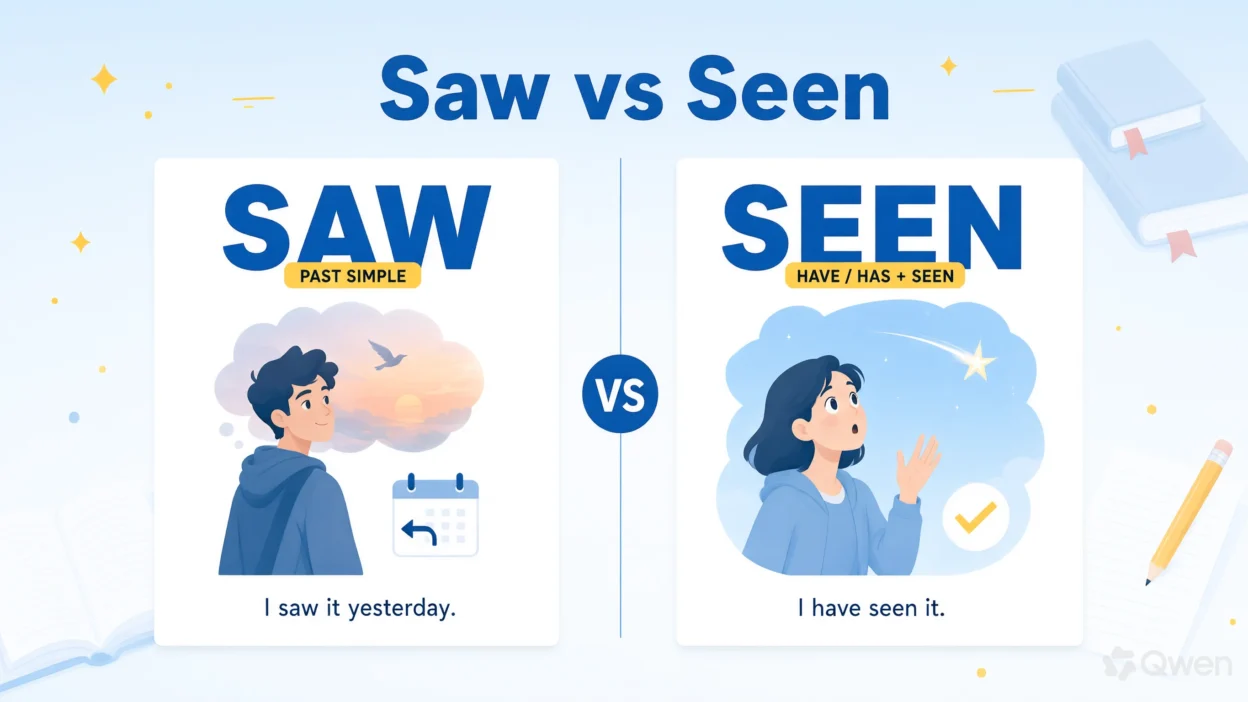
The words saw vs seen are often confused because both are forms of the verb see. They describe the same basic action of noticing something with your eyes, but they are not interchangeable. The main difference is how they work in a sentence. Saw is the simple past tense of see, while seen is the past participle and usually needs a helping verb such as have, has, or had.
Understanding when to use saw and seen can help you speak and write English more confidently. If you are a student, an ESL learner, or someone improving everyday communication, learning this simple grammar rule will help you avoid common mistakes. In this guide, you will discover the meanings, differences, sentence structures, and practical examples of both words so you can choose the correct one naturally.
Quick Answer: Saw vs Seen
Saw is the simple past tense of the verb see. Use it when describing something that happened in the past. Seen is the past participle of see. It usually follows a helping verb such as have, has, or had. For example, say “I saw him yesterday” but “I have seen him before.”
Why Do People Confuse Saw and Seen?
People often confuse saw and seen because both words describe an action that happened in the past. They also come from the same verb, see.
However, English has different verb forms that serve different grammatical purposes.
The confusion usually happens for three reasons:
- Similar meanings: Both words refer to seeing or noticing something.
- Past-time connection: Both are commonly used when discussing past experiences.
- Different sentence patterns: Learners sometimes use seen without a helping verb or replace saw with seen incorrectly.
The easiest way to understand the difference is to learn their verb forms:
| Verb form | Word | Example |
| Base form | See | I see a bird. |
| Simple past | Saw | I saw a bird. |
| Past participle | Seen | I have seen a bird. |
Remember that saw can stand alone as the main verb in a simple past sentence, while seen normally needs an auxiliary verb.
What Does Saw Mean?
Saw is the simple past tense of the verb see. It means that someone noticed, observed, or looked at something at a particular time in the past.
Use saw when talking about a completed action without using the present perfect or past perfect structure.
Simple definition: Saw means noticed or viewed something in the past.
When Should You Use Saw?
Use saw when:
- Describing something you noticed in the past.
- Talking about a completed viewing experience.
- Mentioning a specific past time.
- Explaining what someone observed or witnessed.
Examples of Saw in Sentences
- I saw my teacher at the shopping mall yesterday.
- She saw a beautiful rainbow after the rain.
- We saw an interesting movie last night.
- He saw his best friend at the airport.
- They saw several birds flying over the lake.
In each sentence, saw describes an action that happened in the past.
What Does Seen Mean?
Seen is the past participle of the verb see. It is used with helping verbs such as have, has, and had to form perfect tenses.
It describes something that someone has experienced, noticed, or observed.
Simple definition: Seen means noticed or viewed something as part of a perfect verb construction.
When Should You Use Seen?
Use seen when:
- Talking about life experiences.
- Describing something that has happened before.
- Explaining an action completed before another past event.
- Forming present perfect or past perfect sentences.
- Using passive voice constructions involving the verb see.
Examples of Seen in Sentences
- I have seen that movie three times.
- She has seen the new school building.
- We had seen the warning before the accident.
- Have you seen my notebook?
- They have seen many beautiful places.
In these examples, seen works with a helping verb to complete the sentence.
Saw vs Seen: Key Differences
The main difference between saw and seen is their grammatical function. Saw is a simple past verb, whereas seen is a past participle.
| Feature | Saw | Seen |
| Verb form | Simple past | Past participle |
| Base verb | See | See |
| Main use | Completed past action | Perfect tenses and passive voice |
| Helping verb | Not usually needed | Usually required |
| Common structure | Subject + saw + object | Subject + have/has/had + seen |
| Example | I saw her yesterday. | I have seen her before. |
| Specific past time | Commonly used | Not normally used with present perfect |
Easy rule: Use saw for a simple past action and seen with a helping verb.
When Should You Use Saw vs Seen?
Choosing between saw and seen becomes easier when you understand the sentence structure.
1. Use Saw for Simple Past Actions
Use saw when an action happened and finished in the past.
Examples:
- I saw him at the restaurant.
- She saw a shooting star last night.
- We saw the results yesterday.
2. Use Seen With Have
Use seen with have when talking about experiences or actions connected to the present.
Examples:
- I have seen this place before.
- They have seen the new announcement.
- We have seen better results recently.
3. Use Seen With Has
Use has seen with singular third-person subjects such as he, she, and it.
Examples:
- He has seen the doctor.
- She has seen that television show.
- My brother has seen the photograph.
4. Use Seen With Had
Use had seen when describing an action completed before another past event.
Examples:
- I had seen the movie before you recommended it.
- She had seen the message before replying.
- They had seen the building before it was renovated.
5. Use Seen in Passive Voice
Seen can also appear in passive constructions.
Examples:
- The accident was seen by several people.
- The movie has been seen by millions of viewers.
- The suspect was last seen near the station.
Saw vs Seen: 15+ Examples in Everyday English
Here are practical examples to help you understand how both words work in everyday conversations.
Examples Using Saw
- I saw your brother at the market.
- She saw a strange animal in the garden.
- We saw the ocean during our vacation.
- He saw an old friend at the wedding.
- They saw the teacher entering the classroom.
- I saw your message this morning.
- My parents saw the house before buying it.
- Sarah saw a beautiful painting in the museum.
Examples Using Seen
- I have seen this movie before.
- She has seen my new phone.
- We have seen many changes this year.
- He had seen the doctor before the meeting.
- Have you seen my keys?
- They have seen the latest photographs.
- I have never seen such a beautiful sunset.
- The missing dog was last seen near the park.
Examples Using Both Words Together
These sentences show how saw and seen can appear naturally in the same context.
- I saw a movie that I had already seen twice.
- She saw the painting after she had seen it online.
- We saw the place where our parents had first seen each other.
These examples demonstrate that the two words have different grammatical jobs even when they describe related experiences.
Common Mistakes When Using Saw and Seen
Even fluent English speakers sometimes make mistakes with irregular verb forms. Here are some common errors and their correct versions.
| Incorrect sentence | Correct sentence |
| I seen him yesterday. | I saw him yesterday. |
| I have saw that movie. | I have seen that movie. |
| She seen the accident. | She saw the accident. |
| He has saw my phone. | He has seen my phone. |
| We had saw the building. | We had seen the building. |
| Have you saw my bag? | Have you seen my bag? |
| I had seen him yesterday. | I saw him yesterday. |
Why Is “I Seen Him” Incorrect?
“I seen him” is grammatically incorrect in standard English because seen is a past participle and normally requires a helping verb.
The correct sentence is:
- Incorrect: I seen him yesterday.
- Correct: I saw him yesterday.
Why Is “I Have Saw” Incorrect?
“I have saw” is incorrect because the present perfect tense requires the past participle, not the simple past form.
The correct sentence is:
- Incorrect: I have saw that movie.
- Correct: I have seen that movie.
Easy Memory Trick to Remember Saw vs Seen
A simple memory trick can help you remember the difference without memorizing complicated grammar rules.
Saw = Simple past.
Seen = Needs a helping verb.
Think of these two examples:
- Yesterday, I saw a bird.
- I have seen that bird before.
You can also remember the three main forms of the verb:
See → Saw → Seen
- See: Present
- Saw: Simple past
- Seen: Past participle
If you remember this sequence, choosing the correct word becomes much easier.
Saw vs Seen in American and British English
The grammatical rules for saw and seen are the same in both American and British English.
Both varieties use:
- Saw for the simple past tense.
- Seen with have, has, and had in perfect tenses.
- Seen in passive voice constructions.
There is no standard American or British grammar rule that changes the basic distinction between these words.
One difference you may notice is how speakers use the present perfect and simple past in everyday conversation.
For example:
- American English: I already saw that movie.
- British English: I’ve already seen that film.
Both sentences are grammatically correct. However, British English often favors the present perfect in situations where American English commonly uses the simple past.
This is a general tendency, not an absolute rule.
Similar Words Related to Saw and Seen
Understanding related verb forms can help you improve your English grammar and avoid confusion.
| Base verb | Simple past | Past participle |
| See | Saw | Seen |
| Eat | Ate | Eaten |
| Write | Wrote | Written |
| Speak | Spoke | Spoken |
| Break | Broke | Broken |
| Take | Took | Taken |
| Give | Gave | Given |
| Drive | Drove | Driven |
| Choose | Chose | Chosen |
| Forget | Forgot | Forgotten |
These verbs follow similar irregular patterns.
For example:
- I ate breakfast yesterday.
- I have eaten breakfast already.
Just as you use eaten instead of ate after have, you use seen instead of saw.
FAQs:
1. Is It Saw or Seen?
Both are correct words, but they have different grammatical uses. Saw is the simple past tense of see, while seen is the past participle. Use saw for a completed past action and seen with helping verbs such as have, has, or had.
2. Is “I Saw Him” or “I Seen Him” Correct?
“I saw him” is correct in standard English. Saw is the simple past form and does not need a helping verb. “I seen him” is nonstandard in formal English because seen normally requires an auxiliary verb.
3. Should I Say “Have Saw” or “Have Seen”?
You should say “have seen.” The present perfect tense requires the past participle of the verb. For example, “I have seen that movie” is correct, while “I have saw that movie” is incorrect.
4. Can You Use Seen Without a Helping Verb?
In standard English, seen generally needs a helping verb when used as a verb. However, it can appear in other grammatical structures, such as participial phrases. For example, “Seen from a distance, the building looks beautiful.”
5. Is “Had Saw” or “Had Seen” Correct?
Had seen” is correct because the past perfect tense uses had followed by the past participle. For example, “I had seen the movie before you arrived.”
6. What Is the Past Tense of See?
The simple past tense of see is saw. For example, “I saw a beautiful bird yesterday.” Its past participle is seen, as in “I have seen that bird before.”
7. Is “Have You Saw It” Correct?
No. The correct expression is “Have you seen it?” The word have must be followed by the past participle seen, not the simple past form saw.
Remember This: Saw vs Seen
Here is the easiest way to remember the difference:
- Saw: Use it for a simple past action. Example: I saw him yesterday.
- Seen: Use it with a helping verb. Example: I have seen him before.
- See: Use it for the base form and present-tense situations. Example: I see him every day.
Always remember the verb sequence: See → Saw → Seen.
Conclusion
Understanding saw vs seen is simple once you learn the difference between the simple past tense and the past participle. Saw describes an action that happened in the past, while seen is used with helping verbs to form perfect tenses and certain passive constructions. Both words come from the same verb, but they cannot be freely exchanged.
The next time you write or speak English, remember to use saw for simple past sentences and seen with have, has, or had. Practice with everyday examples, pay attention to verb forms, and you will soon use both words correctly and confidently.

I am Olivia Brooks, a language enthusiast and writer at SynonymsHive. I enjoy creating clear, engaging content about synonyms, vocabulary, and word meanings, helping readers improve their writing and communicate with confidence every day.