English has many word pairs that look or sound almost identical but have completely different meanings. Flair vs flare is one such pair. Both words are pronounced the same way, but they are not interchangeable. Understanding their meanings can help you avoid spelling mistakes and choose the correct word in everyday writing.
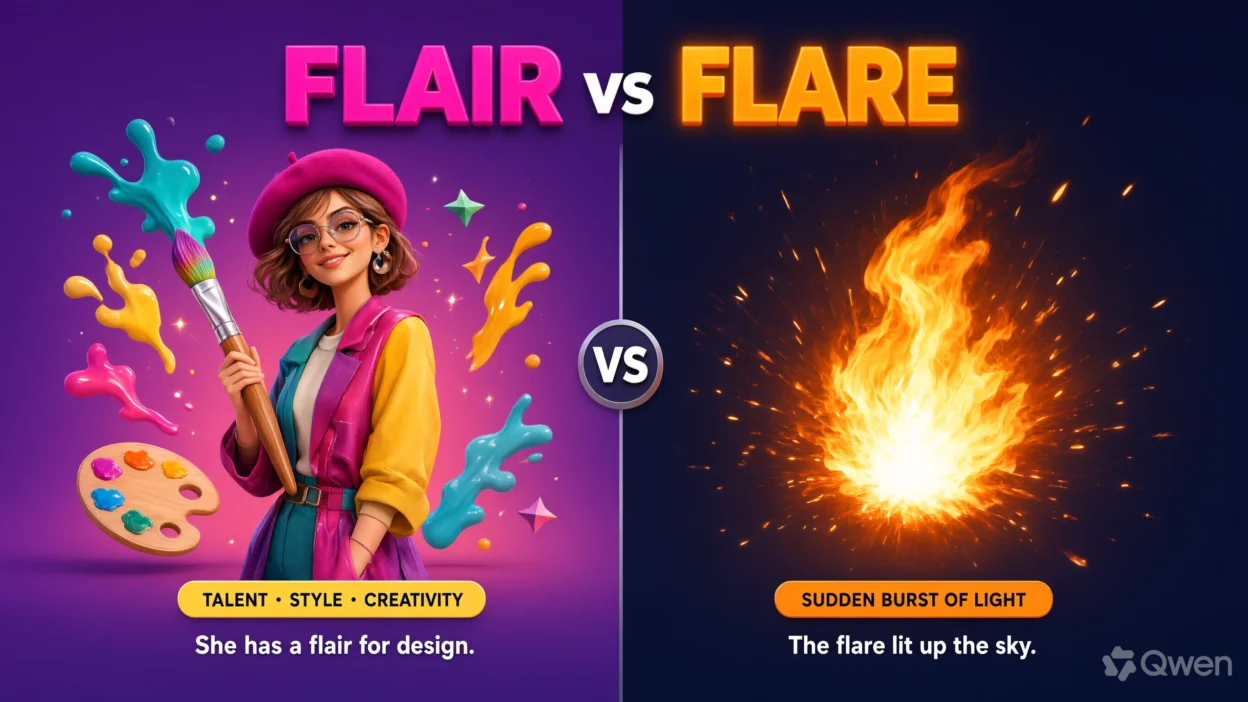
The main difference is that flair means a natural talent, special ability, or stylish way of doing something, while flare refers to a sudden burst of light, fire, brightness, or an increase in something. For example, someone might have a flair for writing, while a fire might flare up unexpectedly.
Although these words sound alike, their spelling and meanings are different. Learning when to use each one will make your writing clearer and more accurate.
Quick Answer: What Is the Difference Between Flair and Flare?
Flair means a natural talent, ability, or distinctive style. Flare means a sudden burst of light, fire, emotion, or activity. Both words are pronounced identically, but their meanings differ. Use flair when talking about someone’s skills or creativity and flare when describing something that bursts, expands, or suddenly becomes stronger.
Why Do People Confuse Flair and Flare?
People often confuse flair and flare because they are homophones. Homophones are words that have the same pronunciation but different spellings and meanings.
Both words sound like “flair,” which makes it difficult to identify the correct spelling when listening to someone speak.
There are three main reasons for this confusion:
- Similar pronunciation: Both words are pronounced exactly alike in standard English.
- Similar spelling: They differ by only one letter, making typing mistakes easy.
- Different contexts: Their meanings are unrelated, but both can appear in everyday conversations, writing, and professional communication.
The easiest way to avoid confusion is to remember that flair relates to talent and style, whereas flare relates to a sudden burst or expansion.
What Does Flair Mean?
Flair is a noun that describes a natural talent, special ability, or distinctive style that makes someone particularly good at something.
It is commonly used when talking about creativity, personality, communication, fashion, art, and professional skills.
Someone with flair often does something in an impressive, original, or attractive way.
Simple Meaning of Flair
Flair means:
- Natural talent or ability.
- A special gift for doing something.
- A creative or stylish approach.
- A distinctive and attractive quality.
Examples of Flair in Sentences
- She has a natural flair for painting.
- He writes stories with great flair.
- The designer has a flair for modern fashion.
- My sister has a flair for decorating rooms.
- His presentation showed a lot of creative flair.
Common Phrases Using Flair
Here are some expressions where the word flair is commonly used:
- Flair for writing: A natural ability to write well.
- Flair for languages: An ability to learn and use languages easily.
- Creative flair: A special talent for creative activities.
- Natural flair: An ability someone seems to have naturally.
- With flair: Doing something in a stylish or impressive way.
What Does Flare Mean?
Flare can be used as both a noun and a verb. It generally describes a sudden burst of light, fire, brightness, emotion, or activity. It can also refer to something that spreads outward or becomes wider.
As a noun, flare can describe a bright flame, a signal light, or a sudden increase in intensity.
As a verb, it means to burn brightly, expand outward, or suddenly become more intense.
Simple Meaning of Flare
Flare means:
- A sudden burst of bright light.
- A brief or sudden fire.
- A sudden increase in anger or emotion.
- A condition or situation becoming more intense.
- Something spreading outward or becoming wider.
Examples of Flare in Sentences
- The candle began to flare in the wind.
- A bright flare appeared in the night sky.
- His anger started to flare during the argument.
- The fire flared up after someone added more wood.
- The trousers flare slightly at the bottom.
Common Phrases Using Flare
These expressions help explain how flare is used in everyday English:
- Flare up: To suddenly become stronger or more intense.
- Solar flare: A sudden burst of energy from the Sun.
- Emergency flare: A bright light used to attract attention during an emergency.
- Flare of anger: A sudden burst of anger.
- Flared trousers: Trousers that become wider toward the bottom.
Flair vs Flare: Comparison Table
The following table highlights the main differences between these two words.
| Feature | Flair | Flare |
| Part of speech | Noun | Noun and verb |
| Meaning | Natural talent or style | Sudden burst or expansion |
| Main use | Skills and creativity | Light, fire, emotion, and shape |
| Pronunciation | /fler/ | /fler/ |
| Example | She has a flair for music. | The fire began to flare. |
| Related phrase | Creative flair | Solar flare |
| Common context | Art, writing, fashion | Fire, light, emotions |
Key difference: Flair describes someone’s talent or distinctive style, while flare describes something that bursts, intensifies, or spreads outward.
When Should You Use Flair or Flare?
Choosing the correct word becomes easier when you understand the situation in which each word belongs.
When to Use Flair
Use flair when describing someone’s natural ability, creativity, or distinctive style.
Choose flair when discussing:
- Artistic or creative talent.
- Natural abilities and skills.
- Fashion and personal style.
- An impressive way of doing something.
- Someone’s unique approach to a task.
Examples:
- She has a flair for graphic design.
- He completed the project with remarkable flair.
- The chef prepares traditional dishes with creative flair.
When to Use Flare
Use flare when describing something that suddenly becomes brighter, stronger, wider, or more intense.
Choose flare when discussing:
- Fire or flames.
- Bright lights and signals.
- Sudden emotional reactions.
- Solar activity.
- Clothing that widens toward the bottom.
Examples:
- The flames began to flare.
- A red flare lit up the sky.
- His temper can flare without warning.
- Her trousers flare at the ankles.
15 Examples of Flair vs Flare in Sentences
Understanding both words through practical examples is one of the best ways to remember their meanings.
Here are 15 sentences showing how flair and flare work in different situations.
Examples of Flair
- She has a flair for storytelling. Her natural ability makes her stories interesting.
- He decorated the room with flair. He used an attractive and creative style.
- My brother has a flair for mathematics. He is naturally good at mathematics.
- The artist displayed remarkable flair. The artist showed impressive creative talent.
- She has a flair for choosing beautiful clothes. She has a natural sense of fashion.
- The teacher explained the lesson with flair. The teacher made the explanation engaging.
- His writing combines creativity and flair. His writing has a distinctive style.
Examples of Flare
- The fire began to flare up. The flames suddenly became stronger.
- A flare appeared above the mountains. A bright light became visible.
- His anger started to flare. He suddenly became angry.
- The emergency team used a flare for help. They used a bright signal to attract attention.
- The solar flare affected radio communications. A burst of solar energy caused interference.
- Her trousers flare at the bottom. The trousers become wider toward the ankles.
- The flames flared brightly in the darkness. The fire suddenly became brighter.
- Old disagreements can flare up again. Previous conflicts can suddenly become intense.
Common Mistakes When Using Flair and Flare
Even confident English speakers sometimes mix up these words because they sound identical.
Here are some common mistakes and their corrections.
| Incorrect Sentence | Correct Sentence |
| She has a flare for music. | She has a flair for music. |
| He showed creative flare. | He showed creative flair. |
| The fire began to flair up. | The fire began to flare up. |
| His temper started to flair. | His temper started to flare. |
| She has a natural flare for art. | She has a natural flair for art. |
| The flames began to flair. | The flames began to flare. |
How to Avoid These Mistakes
Remember these simple guidelines:
- Use flair when discussing talent, creativity, or style.
- Use flare when discussing fire, light, emotions, or expansion.
- Check the context before choosing a spelling.
- Remember that both words sound alike but have different meanings.
What Is an Easy Memory Trick for Flair vs Flare?
A simple memory trick can help you remember the difference without repeatedly checking a dictionary.
Think of these two associations:
Flair = Talent and Style
Remember the word art when thinking about flair. Someone with artistic flair has a natural ability to create beautiful or interesting things.
Flare = Fire and Light
Remember the word fire when thinking about flare. A flame can flare up, and an emergency flare produces bright light.
You can also remember this simple sentence:
“Flair is a talent; flare is a flash.”
This short phrase captures the basic difference between the two words.
Is There a Difference Between Flair and Flare in American and British English?
No significant difference exists between the meanings or spellings of flair and flare in American and British English.
Both varieties use the same spelling and definitions.
| Word | American English | British English |
| Flair | Natural talent or style | Natural talent or style |
| Flare | Sudden burst or expansion | Sudden burst or expansion |
Both words are pronounced the same way in standard American and British English, although individual accents may affect pronunciation slightly.
For example:
- American English: She has a flair for design.
- British English: She has a flair for design.
- American English: The flames began to flare.
- British English: The flames began to flare.
The spelling and meaning remain the same in both varieties.
What Are Some Similar Words to Flair and Flare?
Although flair and flare have different meanings, several other English words have related definitions.
Knowing these words can help expand your vocabulary.
Synonyms of Flair
When flair means natural talent or ability, you can use:
- Talent
- Gift
- Skill
- Ability
- Aptitude
- Creativity
- Style
- Genius
- Expertise
- Knack
Example: She has a natural flair for writing.
You could also say:
She has a natural talent for writing.
Synonyms of Flare
When flare refers to a sudden burst or increase in intensity, related words include:
- Flash
- Blaze
- Burst
- Flame
- Spark
- Outburst
- Explosion
- Surge
- Intensification
- Expansion
Example: The fire began to flare.
You could also say:
The fire began to blaze.
Remember that synonyms are not always interchangeable in every sentence. Choose a word that fits the exact meaning and context.
Final Verdict: Flair vs Flare
The difference between flair and flare is simple once you understand their meanings.
- Flair is a noun meaning natural talent, special ability, or distinctive style.
- Flare is a noun or verb describing a sudden burst of light, fire, emotion, or expansion.
Both words have identical pronunciation, but their meanings and uses are different.
Use flair when talking about someone’s creativity or abilities. Use flare when describing something that suddenly burns, shines, becomes stronger, or spreads outward.
FAQs:
1. What is the main difference between flair and flare?
Flair means natural talent, creativity, or distinctive style. Flare means a sudden burst of light, fire, emotion, or activity. Both words sound the same but have different spellings and meanings.
2. Are flair and flare pronounced the same?
Yes. Flair and flare are homophones, meaning they have the same pronunciation but different meanings and spellings.
3. Is it a flair or a flare for something?
The correct expression is a flair for something. It describes a natural talent or ability.
Example: She has a flair for creative writing.
4. What does flare up mean?
Flare up means to suddenly become stronger, brighter, or more intense. It can describe fire, anger, arguments, or other situations.
Example: The argument began to flare up again.
5. Can flare be used as a noun and a verb?
Yes. Flare is both a noun and a verb.
As a noun: The pilot saw a bright flare.
As a verb: The flames began to flare.
6. What is the plural of flair and flare?
The plural of flair is flairs, although the word is commonly used as an uncountable noun when describing general talent or style.
The plural of flare is flares.
Example: The emergency workers used several flares.
7. What is another word for flair?
Common alternatives for flair include talent, skill, ability, aptitude, creativity, knack, and style. The best alternative depends on the sentence and intended meaning.
Remember This
F
FLAIR = Talent and Style
She has a flair for painting.
Think of creativity, skills, and natural abilities.
F
FLARE = Fire and Flash
The flames began to flare.
Think of light, fire, sudden intensity, and expansion.
Conclusion
Understanding the difference between flair and flare is important for clear and accurate English writing. Although these words sound identical, they serve different purposes. Flair describes someone’s natural talent, creativity, or distinctive style, while flare refers to a sudden burst of light, fire, emotion, or expansion.
The easiest way to remember them is flair means talent, and flare means a flash. Keep this simple distinction in mind, practice using both words in sentences, and you will find it much easier to choose the correct spelling in everyday conversations, schoolwork, and professional writing.

I’m James Parker, Administrator at SynonymsHive. I oversee content quality, improve user experience, and ensure reliable synonym resources. My passion is making language learning simple, accurate, and accessible for everyone.