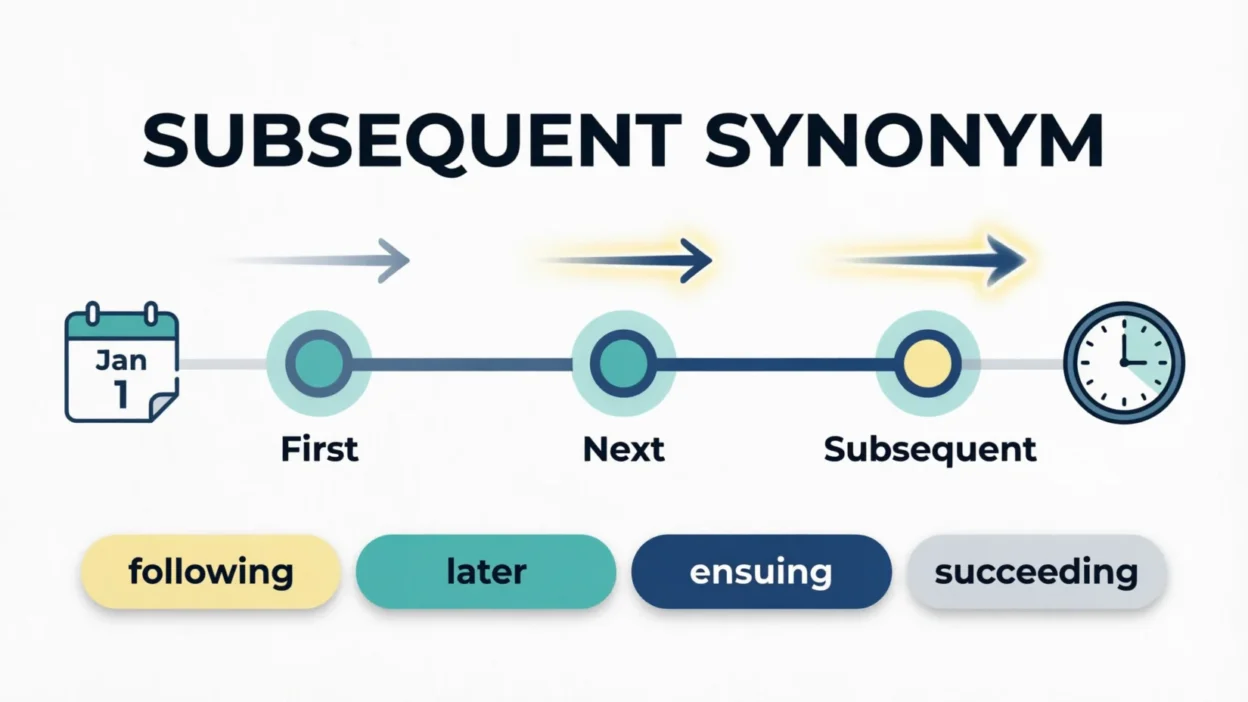
The word subsequent means happening or coming after something else in time, order, or sequence. Common subsequent synonyms include following, next, succeeding, later, ensuing, and consecutive. These words help you explain events, describe a sequence, and make your writing clearer. However, each synonym has a slightly different meaning, so choosing the right one depends on the context.
If you are writing an essay, preparing an academic assignment, creating content, or improving your English vocabulary, understanding subsequent synonyms can help you express time and order more naturally.
Quick Answer: What Is a Synonym for Subsequent?
The most common synonyms for subsequent are following, next, succeeding, later, ensuing, consecutive, forthcoming, and later-occurring.
- Following: Coming immediately or sometime after something.
- Next: Coming directly after something in a sequence.
- Succeeding: Coming after something else, often in a series.
- Later: Happening at a time after the present or another event.
- Ensuing: Happening as a result of or following an event.
- Consecutive: Following one after another without interruption.
For everyday English, following and next are usually the easiest alternatives. In formal writing, ensuing, succeeding, and thereafter may be more suitable.
What Does Subsequent Mean?
Subsequent is an adjective that describes something happening or existing after a particular event, action, or point in time.
It is commonly used in academic writing, professional communication, news reports, historical accounts, and everyday descriptions of events.
Examples of Subsequent in a Sentence
- The subsequent meeting addressed the team’s concerns.
- Several subsequent studies confirmed the original findings.
- The company introduced new policies in subsequent years.
- Her subsequent success came after months of hard work.
In each sentence, subsequent indicates that something happened after an earlier event.
When Should You Use Subsequent?
Use subsequent when you want to establish a clear relationship between two events or stages.
For example, “The initial test revealed a problem, and subsequent tests confirmed it.”
Here, subsequent tests means the tests that happened after the initial test.
The word is especially useful when you want a formal, precise alternative to later or afterward.
30 Synonyms for Subsequent With Meanings and Examples
The following list includes common, formal, academic, and context-specific alternatives to subsequent. Some are close synonyms, while others work only in particular situations.
1. Following
Simple meaning: Coming after something else.
Example: The following chapter explains the main findings.
Best usage/context: Everyday writing, instructions, reports, and descriptions of events.
2. Next
Simple meaning: Coming immediately after something in a sequence.
Example: The next stage of the project begins on Monday.
Best usage/context: Conversations, instructions, schedules, and step-by-step explanations.
3. Later
Simple meaning: Happening after a particular time or event.
Example: She later explained why she had changed her decision.
Best usage/context: Everyday conversation, storytelling, and informal writing.
4. Succeeding
Simple meaning: Coming after something else.
Example: The succeeding chapters explore the topic in greater detail.
Best usage/context: Formal writing, historical accounts, and ordered series.
5. Ensuing
Simple meaning: Happening after an event, often as a result of it.
Example: The disagreement and the ensuing discussion helped clarify the issue.
Best usage/context: Formal writing, news reports, and descriptions of consequences.
6. Consecutive
Simple meaning: Following one after another without a break.
Example: The team won three consecutive matches.
Best usage/context: Sports, schedules, statistics, and uninterrupted sequences.
7. Successive
Simple meaning: Following one another in order.
Example: Successive experiments produced similar results.
Best usage/context: Academic writing, research, and repeated events.
8. Later-occurring
Simple meaning: Happening at a later time.
Example: The researchers examined later-occurring changes in behavior.
Best usage/context: Technical or descriptive writing when the timing needs emphasis.
9. Subsequent-in-time
Simple meaning: Taking place after a specified point in time.
Example: The report considers subsequent-in-time developments in the industry.
Best usage/context: Explanatory wording where chronological order matters. This is a descriptive phrase rather than a common standalone synonym.
10. Thereafter
Simple meaning: After that point or event.
Example: The agreement was signed, and payments were made thereafter.
Best usage/context: Formal writing, legal documents, reports, and chronological accounts.
11. Afterwards
Simple meaning: After an event or activity.
Example: We discussed the results and went for lunch afterwards.
Best usage/context: Everyday English, narratives, and informal communication.
12. Subsequently
Simple meaning: Afterward or at a later time.
Example: The proposal was reviewed and subsequently approved.
Best usage/context: Formal sentences describing events that happened in sequence. It is the adverb form of subsequent, not an adjective substitute.
13. Following-on
Simple meaning: Continuing or developing from something earlier.
Example: The following-on discussion focused on practical solutions.
Best usage/context: Only in suitable specialized or informal constructions. More natural alternatives often include follow-up or subsequent.
14. Oncoming
Simple meaning: Approaching or coming toward someone or something.
Example: The driver slowed down to avoid the oncoming vehicle.
Best usage/context: Approaching traffic, events, or periods. It is not a general synonym for subsequent.
15. Forthcoming
Simple meaning: Expected to happen or appear soon.
Example: The forthcoming conference will examine new research.
Best usage/context: Announcements, schedules, planned events, and future publications.
16. Future
Simple meaning: Happening or existing at a later time.
Example: Future decisions will depend on the final report.
Best usage/context: Plans, predictions, goals, and general references to time ahead.
17. Later-stage
Simple meaning: Belonging to a stage that comes after an earlier one.
Example: The team addressed these concerns during the later-stage review.
Best usage/context: Projects, processes, product development, and staged activities.
18. Next-in-line
Simple meaning: Coming next in an established order.
Example: The next-in-line candidate will be interviewed tomorrow.
Best usage/context: Queues, rankings, succession, and ordered selection.
19. Following-up
Simple meaning: Taking further action after an earlier event.
Example: The doctor scheduled a follow-up appointment.
Best usage/context: Healthcare, customer service, business communication, and continued action. As a noun, follow-up is often more natural.
20. Resulting
Simple meaning: Happening as an outcome of something.
Example: The resulting changes improved the team’s performance.
Best usage/context: Explaining outcomes or consequences. It emphasizes a result rather than merely a later time.
21. Consequent
Simple meaning: Occurring as a result of something else.
Example: The policy change and its consequent effects were discussed in the report.
Best usage/context: Formal and academic writing that emphasizes cause and effect.
22. Eventual
Simple meaning: Happening at the end of a process or after some time.
Example: Their eventual agreement ended the long discussion.
Best usage/context: Describing final outcomes after delays, effort, or development.
23. Terminal
Simple meaning: Final or situated at the end of a process.
Example: The terminal stage of the experiment required additional testing.
Best usage/context: Technical, medical, or process-related contexts. It usually means final rather than simply subsequent.
24. Interim
Simple meaning: Occurring during the time between two events or stages.
Example: The interim report summarized the progress made so far.
Best usage/context: Temporary arrangements, progress reports, and periods between milestones. It is not a direct substitute for every use of subsequent.
25. Sequential
Simple meaning: Arranged or occurring in a particular order.
Example: The software processes the information through sequential steps.
Best usage/context: Technical instructions, procedures, research, and ordered processes.
26. Chronological
Simple meaning: Arranged according to the order in which events happened.
Example: The historian presented a chronological account of the events.
Best usage/context: Timelines, historical writing, biographies, and reports.
27. Posterior
Simple meaning: Coming later in time or situated behind something, depending on context.
Example: The posterior stage of the analysis focused on long-term effects.
Best usage/context: Specialized academic or technical language. In ordinary English, later or subsequent is usually clearer.
28. Succeeding-in-time
Simple meaning: Occurring after an earlier event.
Example: The succeeding-in-time observations showed a change in the pattern.
Best usage/context: Descriptive or technical explanations. This is an explanatory phrase, not a common fixed synonym.
29. Onward
Simple meaning: Continuing forward from a particular point.
Example: From that date onward, the organization followed a new procedure.
Best usage/context: Describing continuation from a specified time. It does not always mean the same thing as subsequent.
30. Afterward-following
Simple meaning: Coming after an earlier event.
Example: The afterward-following review considered the project’s overall results.
Best usage/context: This is an uncommon constructed phrase, not a natural standard-English substitute. Prefer subsequent, following, or later instead.
Comparison Table: Which Subsequent Synonym Should You Use?
| Synonym | Main meaning | Tone | Best context |
| Following | Coming after | Neutral | General writing |
| Next | Immediately after | Simple | Instructions and sequences |
| Later | At a later time | Informal or neutral | Everyday English |
| Succeeding | Coming after | Formal | Chapters and stages |
| Ensuing | Following an event | Formal | Events and consequences |
| Consecutive | Without interruption | Neutral | Matches, days, and periods |
| Successive | Following in a series | Formal | Research and repeated events |
| Thereafter | After that | Formal | Reports and legal writing |
| Afterwards | After an event | Neutral | Conversation and storytelling |
| Forthcoming | Expected soon | Neutral or formal | Planned events |
| Future | At a later time | Neutral | Plans and predictions |
| Resulting | Produced as an outcome | Neutral or formal | Cause and effect |
| Eventual | Happening in the end | Neutral | Final outcomes |
| Sequential | In a particular order | Technical | Procedures and systems |
| Chronological | Ordered by time | Formal | Timelines and history |
Quick tip: Choose following for general use, next for the immediate item, ensuing for events that follow an incident, and consecutive when there are no interruptions.
How to Choose the Right Synonym for Subsequent
The best synonym depends on what you want your sentence to communicate. Consider the timing, relationship between events, and level of formality.
1. For Everyday Conversation
Choose simple and familiar words.
- Later: I’ll call you later.
- Next: The next bus arrives in ten minutes.
- Afterwards: We had dinner and watched a movie afterwards.
- Following: Please read the following instructions.
These words are easy to understand and sound natural in everyday English.
2. For Academic and Professional Writing
Choose precise words that make the sequence clear.
- Subsequent: Subsequent research supported the hypothesis.
- Succeeding: The succeeding sections explain the methodology.
- Successive: Successive trials produced comparable results.
- Thereafter: The application was reviewed and thereafter approved.
Use these alternatives when writing essays, research papers, business reports, or formal documents.
3. When You Want to Show Cause and Effect
Some words suggest that a later event happened because of an earlier one.
- Ensuing: The ensuing debate attracted public attention.
- Resulting: The resulting changes reduced operating costs.
- Consequent: The consequent delays affected the schedule.
Remember that subsequent only establishes that something happened later. It does not automatically mean that one event caused another.
4. When Describing an Uninterrupted Sequence
Choose words that communicate order and continuity.
- Consecutive: She worked five consecutive days.
- Successive: Successive generations adopted new technologies.
- Sequential: The program follows a sequential process.
- Chronological: The events are arranged in chronological order.
These terms are especially useful for schedules, procedures, statistics, and historical accounts.
5. When Referring to Future Events
Use words that match whether an event is merely later or specifically expected.
- Future: Future meetings will address these concerns.
- Forthcoming: The forthcoming report will include the findings.
- Later: We can discuss the matter later.
Forthcoming usually suggests that something is expected soon, while future can refer to any time ahead.
Common Mistakes When Using Subsequent Synonyms
Mistake 1: Treating Every Synonym as Interchangeable
Incorrect: The team won three later matches.
Better: The team won three consecutive matches.
Why? Consecutive communicates that the matches followed one another without interruption. Later only indicates a later time.
Mistake 2: Confusing Subsequent With Consequent
- Subsequent: Happening after something.
- Consequent: Happening as a result of something.
Example: “The subsequent investigation revealed the problem” describes what happened later. “The consequent changes improved safety” emphasizes the effects of an earlier event.
Mistake 3: Using Forthcoming for Every Later Event
Forthcoming usually describes something expected or scheduled to happen.
Instead of “the forthcoming meeting yesterday,” write “the subsequent meeting” or “the meeting that followed.”
Mistake 4: Using Consecutive When There Is a Break
“Three consecutive days” means three days in a row without a gap in the sequence being described.
If the events happened on Monday, Wednesday, and Friday, three separate days is more accurate.
Mistake 5: Choosing Unnecessarily Complicated Words
Although words such as thereafter and ensuing are useful, they may make simple writing sound stiff.
Instead of “The subsequent action was implemented thereafter,” write “The next step was completed afterward.”
Clear language is often more effective than unnecessarily formal vocabulary.
FAQs:
1. What is the closest synonym for subsequent?
Following is one of the closest and most versatile synonyms for subsequent. It describes something that comes after another event, stage, or item. Depending on the sentence, later, next, and succeeding may also work.
2. What is a simple word for subsequent?
The simplest alternatives are later, next, and following. Use next when something comes immediately after another item, and use later when there is a time gap.
3. Is subsequent the same as later?
They have similar meanings, but their grammar differs. Subsequent is an adjective, as in “subsequent events.” Later can function as an adjective or adverb, as in “a later meeting” or “we met later.”
4. What is the difference between subsequent and consecutive?
Subsequent means happening after something else. Consecutive means following continuously without interruption. For example, a meeting can be subsequent to another meeting without occurring immediately afterward, but consecutive days must follow one another without a gap.
5. What is a formal synonym for subsequent?
Formal alternatives include ensuing, succeeding, successive, and thereafter, depending on the sentence. Use ensuing when describing what followed an event, and thereafter when referring to the period after a particular point.
6. Can subsequent describe people?
Yes. It can describe people or things in a sequence, although it is more commonly used for events, actions, periods, and stages. For example, “Subsequent applicants were asked to provide additional documents.”
7. What is the difference between subsequent and consequent?
Subsequent refers to time or order, whereas consequent emphasizes a result or effect. A subsequent event happens afterward; a consequent effect occurs because of something else.
8. How do you use subsequent in a sentence?
Use subsequent before a noun to describe something that happens after an earlier event. For example, “The initial experiment failed, but subsequent trials produced better results.”
Conclusion
Learning subsequent synonyms helps you describe events, stages, and changes with greater clarity. Words such as following, next, later, succeeding, ensuing, consecutive, and successive are useful alternatives, but they do not all communicate exactly the same idea.
For everyday communication, choose simple words such as later and next. For academic or professional writing, subsequent, ensuing, and thereafter can provide a more formal tone. When describing uninterrupted events, use consecutive or successive where appropriate.
The most important rule is to consider both meaning and context before replacing a word. The right synonym should make your sentence more accurate, natural, and easy to understand.

I’m Nathan Collins, a language enthusiast passionate about exploring synonyms and improving everyday writing. I create clear, accurate, and helpful content that helps readers expand vocabulary and communicate with confidence.