
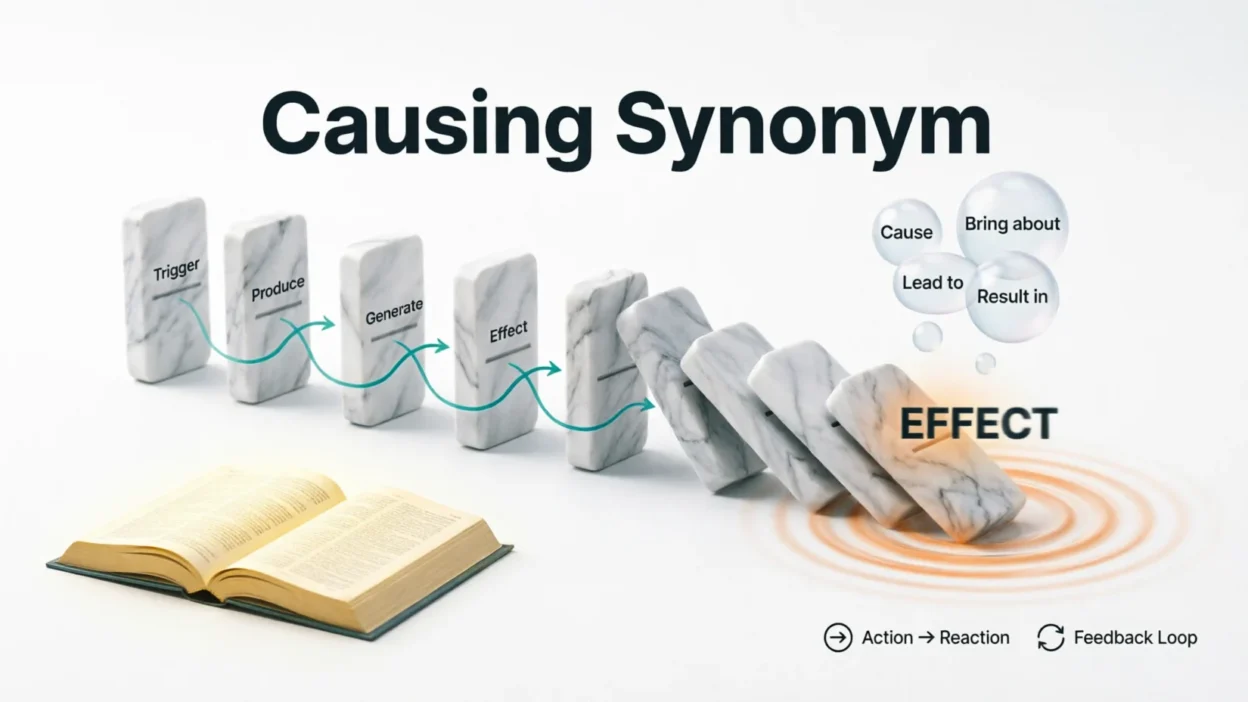
The best synonyms for causing include creating, producing, bringing about, triggering, leading to, resulting in, and giving rise to. These words describe making something happen, producing an effect, or being responsible for a particular result. The right synonym depends on the situation, whether you are describing a problem, an emotion, a positive change, or a chain of events.
In this guide, you will discover 30 useful synonyms for causing, their simple meanings, example sentences, and the contexts in which they work best.
Quick Answer: What Are the Best Synonyms for Causing?
The most useful synonyms for causing are:
- Creating
- Producing
- Triggering
- Generating
- Bringing about
- Leading to
- Resulting in
- Giving rise to
- Prompting
- Inducing
- Provoking
- Making
- Sparking
- Contributing to
- Setting off
For everyday English, making and creating are simple choices. For formal writing, generating, inducing, and bringing about may be more appropriate. When describing a negative event, triggering, provoking, or leading to can express the relationship more precisely.
What Does Causing Mean?
Causing means making something happen or being responsible for an event, condition, action, or result.
It is the -ing form of the verb cause. It can describe a direct action, an indirect influence, or something that creates a particular effect.
For example:
- The heavy rain is causing flooding in the area.
- His kind words are causing people to feel more confident.
- The new policy is causing significant changes in the workplace.
In each sentence, something produces an effect or contributes to a particular outcome.
When Is the Word Causing Used?
The word causing is common in everyday conversations, academic writing, news reports, business communication, and scientific explanations.
It can describe different kinds of effects:
- Negative effects: The storm is causing serious damage.
- Positive effects: The new program is causing improvements in student performance.
- Emotional effects: The movie is causing viewers to feel emotional.
- Physical effects: The medication is causing mild discomfort.
- Social effects: The announcement is causing widespread discussion.
Although causing is useful in many situations, choosing a more specific word can make your writing clearer and more natural.
30 Synonyms for Causing With Meanings and Examples
The following words and phrases can replace causing in suitable contexts. Remember that synonyms often have slightly different meanings, so check the example and recommended usage before choosing one.
1. Creating
Simple meaning: Making something new happen or exist.
Example sentence: The new teaching method is creating better learning opportunities for students.
Best usage/context: Use creating when an action produces a situation, opportunity, problem, or something new.
2. Producing
Simple meaning: Making or generating a particular result.
Example sentence: The changes in temperature are producing unusual weather patterns.
Best usage/context: Suitable for formal writing, scientific explanations, manufacturing, and discussions about results.
3. Triggering
Simple meaning: Making something start suddenly.
Example sentence: The sudden announcement is triggering strong reactions among employees.
Best usage/context: Use this word when one event starts another event, reaction, feeling, or process.
4. Generating
Simple meaning: Producing or creating something, often an effect or result.
Example sentence: The campaign is generating interest in environmental protection.
Best usage/context: Common in business, technology, education, research, and discussions about ideas or outcomes.
5. Bringing About
Simple meaning: Making a change or event happen.
Example sentence: The new law is bringing about important improvements in public safety.
Best usage/context: Best for describing meaningful changes, developments, or outcomes, especially in formal writing.
6. Leading To
Simple meaning: Causing a particular result or outcome.
Example sentence: Poor communication is leading to misunderstandings between team members.
Best usage/context: Use this phrase when explaining how one situation develops into another.
7. Resulting In
Simple meaning: Producing a particular outcome.
Example sentence: The equipment failure is resulting in delays across the production line.
Best usage/context: Useful for reports, academic writing, and explanations of consequences.
Usage note: Resulting in focuses on the outcome, while causing can emphasize the source of the effect.
8. Giving Rise To
Simple meaning: Making something develop or happen.
Example sentence: The new technology is giving rise to fresh opportunities for small businesses.
Best usage/context: Suitable for formal writing about new ideas, situations, opportunities, or problems.
9. Prompting
Simple meaning: Encouraging or making someone take action.
Example sentence: The unexpected results are prompting researchers to conduct further tests.
Best usage/context: Use it when an event encourages a response, decision, investigation, or action.
10. Inducing
Simple meaning: Making something happen or bringing about a particular condition.
Example sentence: The treatment is inducing changes in the patient’s sleep pattern.
Best usage/context: Often used in medical, scientific, psychological, and formal contexts.
11. Provoking
Simple meaning: Causing a strong reaction, often anger or disagreement.
Example sentence: The controversial statement is provoking heated debate online.
Best usage/context: Best when an action causes an emotional response, argument, protest, or strong reaction.
12. Making
Simple meaning: Causing something to happen or putting something into a particular state.
Example sentence: The constant noise is making it difficult for students to concentrate.
Best usage/context: Ideal for simple, everyday English and beginner-friendly writing.
13. Sparking
Simple meaning: Starting something suddenly, especially interest, discussion, or excitement.
Example sentence: The documentary is sparking conversations about climate change.
Best usage/context: Use it for sudden interest, public discussion, creativity, debate, or enthusiasm.
14. Contributing To
Simple meaning: Helping to produce a result without necessarily being its only cause.
Example sentence: Lack of sleep is contributing to the students’ difficulty concentrating.
Best usage/context: Particularly useful when several factors combine to create an outcome.
15. Setting Off
Simple meaning: Making something begin suddenly.
Example sentence: The loud noise is setting off car alarms throughout the street.
Best usage/context: Suitable for everyday conversations about alarms, reactions, events, or sudden changes.
16. Bringing On
Simple meaning: Causing a condition or experience to begin.
Example sentence: The intense heat is bringing on headaches for some workers.
Best usage/context: Common in everyday English, especially when discussing symptoms, discomfort, or unwanted conditions.
17. Eliciting
Simple meaning: Bringing out a response, reaction, or piece of information.
Example sentence: The teacher’s question is eliciting thoughtful answers from the class.
Best usage/context: Useful in education, interviews, psychology, research, and discussions of emotional responses.
18. Prompting a Response
Simple meaning: Causing someone to react or reply.
Example sentence: The manager’s message is prompting a response from every department.
Best usage/context: Appropriate for workplace communication, interviews, customer service, and discussions of reactions.
19. Fostering
Simple meaning: Encouraging the development of something.
Example sentence: The mentoring program is fostering confidence among young professionals.
Best usage/context: Use it for positive developments such as trust, cooperation, creativity, and personal growth.
Important distinction: Fostering usually means supporting development rather than directly causing an immediate result.
20. Cultivating
Simple meaning: Helping something develop over time.
Example sentence: The school is cultivating a stronger sense of responsibility among its students.
Best usage/context: Best for gradual development of habits, skills, relationships, attitudes, or values.
21. Indicating
Simple meaning: Showing that something may be true or that a situation exists.
Example sentence: The unusual readings are indicating a possible problem with the system.
Best usage/context: Use it when evidence points toward a conclusion.
Important distinction: Indicating does not necessarily mean causing. Evidence can show that something exists without producing it.
22. Provoking a Reaction
Simple meaning: Causing someone to respond strongly to an event or statement.
Example sentence: The advertisement is provoking a reaction from viewers across the country.
Best usage/context: Useful when emphasizing the response rather than the original event.
23. Initiating
Simple meaning: Starting a process, action, or series of events.
Example sentence: The new safety rules are initiating changes in workplace procedures.
Best usage/context: Suitable for business, research, government, and formal discussions about starting a process.
24. Activating
Simple meaning: Making something active or causing it to begin functioning.
Example sentence: The sensor is activating the alarm when smoke enters the room.
Best usage/context: Best for machines, systems, biological processes, and mechanisms that switch into action.
25. Inducing a Response
Simple meaning: Causing someone or something to react.
Example sentence: The experiment is inducing a response in the test group.
Best usage/context: Useful in scientific research, medicine, psychology, and technical explanations.
26. Engendering
Simple meaning: Causing a feeling, situation, or condition to develop.
Example sentence: The lack of transparency is engendering distrust among employees.
Best usage/context: Appropriate for formal writing about emotions, attitudes, relationships, and social conditions.
27. Occasioning
Simple meaning: Causing an event or situation to happen.
Example sentence: The unexpected delay is occasioning changes to the travel schedule.
Best usage/context: A formal or literary alternative to causing, especially in written explanations.
28. Catalyzing
Simple meaning: Helping an important change or process happen more quickly.
Example sentence: The community project is catalyzing improvements in local education.
Best usage/context: Useful for describing actions or events that accelerate change, innovation, or progress.
29. Spurring
Simple meaning: Encouraging or pushing someone or something toward action.
Example sentence: The growing demand is spurring companies to develop better products.
Best usage/context: Best for motivation, growth, innovation, competition, and action.
30. Precipitating
Simple meaning: Causing an event or situation to happen suddenly, often an unpleasant one.
Example sentence: The sudden resignation is precipitating a leadership crisis.
Best usage/context: Suitable for formal writing about crises, conflicts, sudden changes, and serious consequences.
Comparison Table: Which Synonym for Causing Should You Use?
The most suitable word depends on the kind of effect you want to describe and the tone of your sentence.
| Synonym | Main meaning | Best context | Tone |
| Creating | Making something exist | Opportunities and situations | Neutral |
| Producing | Generating a result | Reports and research | Formal |
| Triggering | Starting suddenly | Reactions and events | Neutral |
| Generating | Producing an effect | Business and technology | Formal |
| Bringing about | Making a change happen | Social or political change | Formal |
| Leading to | Resulting in an outcome | Cause-and-effect explanations | Neutral |
| Prompting | Encouraging a response | Decisions and actions | Neutral |
| Inducing | Bringing about a condition | Medical and scientific writing | Technical |
| Provoking | Causing a strong reaction | Arguments and emotions | Strong |
| Sparking | Starting interest or discussion | Public debate and creativity | Conversational |
| Contributing to | Helping cause a result | Multiple contributing factors | Neutral |
| Fostering | Encouraging development | Trust and cooperation | Positive |
| Engendering | Causing a feeling or condition | Formal analysis | Formal |
| Catalyzing | Accelerating change | Innovation and progress | Formal |
| Precipitating | Bringing on a sudden event | Crises and conflicts | Formal |
How to Choose the Right Synonym for Causing
Choosing the right synonym involves more than replacing one word with another. Consider your intended meaning, the result being described, and the tone of your writing.
1. Choose According to Tone
For simple, everyday English
Use making, creating, or leading to.
Example: The loud music is making it difficult to study.
These expressions are clear and easy to understand.
For formal or academic writing
Use producing, generating, bringing about, or engendering.
Example: The research is producing valuable evidence about student performance.
These words often fit reports, essays, and professional explanations.
For technical or scientific writing
Use inducing, activating, or catalyzing when the specific meaning matches the situation.
Example: The chemical is inducing a measurable reaction.
Always choose a technical term because it accurately describes the process, not merely because it sounds formal.
2. Choose According to Meaning
Different synonyms emphasize different relationships between an action and its outcome.
- Direct creation: Use creating or producing when something generates a result.
- Sudden beginning: Use triggering or setting off when an event starts quickly.
- A chain of events: Use leading to or resulting in when explaining consequences.
- Partial influence: Use contributing to when several factors help produce an outcome.
- Emotional reaction: Use provoking or eliciting when describing a response.
- Gradual development: Use fostering or cultivating when something develops over time.
- Sudden serious change: Use precipitating when an event brings about a crisis or major development.
3. Choose According to Intent
Your purpose also affects which synonym works best.
To explain a problem: Use causing, leading to, or resulting in.
Example: Poor planning is leading to unnecessary expenses.
To describe a positive change: Use fostering, catalyzing, or bringing about.
Example: The training program is fostering greater confidence among employees.
To describe a strong reaction: Use triggering, provoking, or sparking.
Example: The announcement is sparking widespread discussion.
To explain a scientific process: Use inducing, activating, or producing, depending on the process.
Example: The treatment is inducing a measurable biological response.
To explain several contributing factors: Use contributing to.
Example: Traffic congestion is contributing to longer commuting times.
Common Mistakes When Using Synonyms for Causing
Even words with similar meanings cannot always replace one another. Avoid these common mistakes to make your writing more accurate.
1. Treating Every Synonym as an Exact Match
Incorrect: The evidence is causing that the theory is correct.
Correct: The evidence is indicating that the theory is correct.
Indicating is more appropriate because the evidence supports a conclusion rather than necessarily producing it.
2. Confusing Causing With Contributing To
Incorrect: Poor sleep is the only factor causing fatigue when other factors are involved.
Better: Poor sleep is contributing to fatigue.
Use contributing to when something is one of several possible causes.
3. Using Overly Formal Words in Casual Writing
Unnatural: The rain is precipitating a delay in our picnic.
More natural: The rain is causing a delay in our picnic.
Formal vocabulary is useful when it improves precision, but simpler wording is often better in conversation.
4. Ignoring the Strength of the Meaning
Triggering often suggests that something starts a reaction. Fostering suggests encouraging development. Precipitating often suggests bringing about a sudden or serious event.
Choose a word that reflects the strength and nature of the relationship.
5. Using the Wrong Grammatical Structure
Some synonyms require different sentence patterns.
- Causing a problem
- Leading to a problem
- Resulting in a problem
- Contributing to a problem
- Prompting someone to act
For example, write “The delay is leading to confusion,” not “The delay is leading confusion.”
Learning the correct pattern is just as important as learning the synonym itself.
FAQs:
1. What is the best synonym for causing?
Creating, producing, triggering, and leading to are among the most useful synonyms. The best choice depends on context. Use creating for making something happen, triggering for starting a reaction, and leading to for explaining consequences.
2. What is another word for causing a problem?
Useful alternatives include creating, triggering, provoking, bringing about, and leading to. For example, “Poor communication is creating problems within the team.”
3. What is a formal synonym for causing?
Formal alternatives include generating, inducing, engendering, occasioning, and bringing about. Choose the word that accurately describes the effect and fits the subject.
4. What is a positive synonym for causing?
Fostering, cultivating, catalyzing, generating, and bringing about can describe positive outcomes. For example, “The program is fostering cooperation among students.”
5. What is a synonym for causing a reaction?
Triggering, provoking, eliciting, and sparking can describe causing a reaction. Use eliciting for bringing out a response, provoking for a strong reaction, and sparking for starting interest or discussion.
6. Is causing the same as resulting in?
Not exactly. Causing often emphasizes the action or factor responsible for an effect, while resulting in emphasizes the outcome. For example, “The storm is causing damage” highlights the storm, while “The storm is resulting in widespread damage” emphasizes the consequence.
7. What is the difference between causing and contributing to?
Causing can describe a direct cause or a factor responsible for an outcome. Contributing to means helping produce an outcome, often alongside other factors. For example, poor lighting may contribute to accidents without being the only cause.
8. Can I use causing in academic writing?
Yes. Causing is appropriate in academic writing when it accurately describes a cause-and-effect relationship. However, words such as producing, inducing, contributing to, and resulting in may be more precise in particular contexts. Avoid claiming that one factor causes another when the evidence only shows an association.
Conclusion
Learning synonyms for causing helps you express cause-and-effect relationships more clearly and naturally. Words such as creating, producing, triggering, leading to, and bringing about are useful in everyday English, while inducing, engendering, catalyzing, and precipitating suit more specific or formal contexts.
The key is to understand the difference between making something happen, encouraging a development, starting a reaction, and contributing to an outcome. Choose the word that matches your meaning, sentence structure, and intended tone.
With regular practice, you can expand your vocabulary, avoid repetitive wording, and communicate your ideas with greater confidence.

I’m James Parker, Administrator at SynonymsHive. I oversee content quality, improve user experience, and ensure reliable synonym resources. My passion is making language learning simple, accurate, and accessible for everyone.