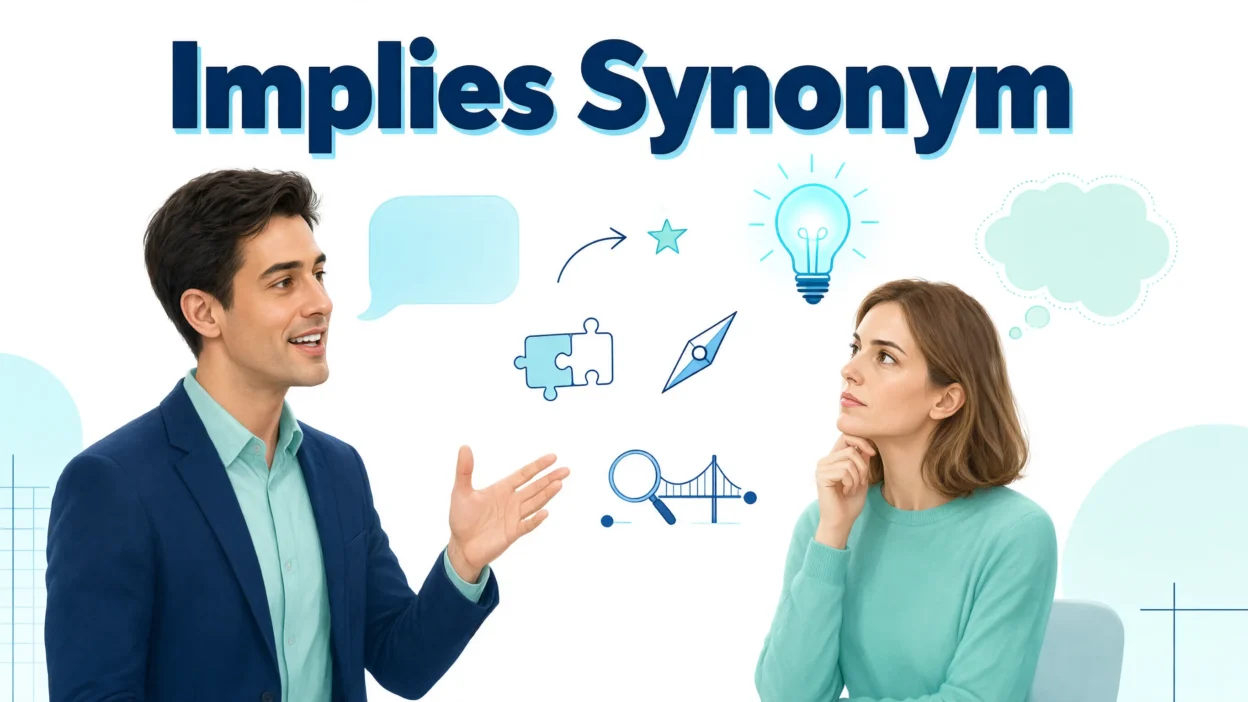
The best synonyms for implies include suggests, indicates, signifies, hints at, entails, conveys, and points to. These words describe situations where something communicates an idea, meaning, or possibility directly or indirectly. The right synonym depends on whether you want to express a hidden meaning, show evidence, suggest a conclusion, or indicate a necessary result.
Understanding these alternatives can help students, ESL learners, writers, and content creators communicate more clearly and choose words that fit different situations.
Quick Answer: What Are Synonyms for Implies?
Synonyms for implies are words or phrases that express an indirect meaning, suggestion, indication, or logical consequence.
The most useful alternatives include:
- Suggests — expresses an idea indirectly.
- Indicates — points toward a fact or conclusion.
- Signifies — represents or means something.
- Hints at — gives a small or indirect clue.
- Entails — involves something as a necessary result.
- Conveys — communicates a message or feeling.
- Suggests that — introduces an idea or possible conclusion.
- Points to — provides evidence for something.
- Insinuates — suggests something indirectly, often negatively.
- Means — expresses a direct or intended meaning.
What Does Implies Mean?
The word implies is the third-person singular form of the verb imply. It means to communicate or suggest something without stating it directly. It can also describe a situation in which one fact logically involves or leads to another.
For example:
- Indirect meaning: Her smile implies that she is happy.
- Evidence: The dark clouds imply that rain may be coming.
- Logical consequence: Accepting the offer implies agreeing to its conditions.
In each example, the word implies connects one thing to another meaning, possibility, or consequence.
When Should You Use Implies?
Use implies when a statement, action, expression, or situation suggests something beyond its direct meaning.
For example, if someone says, “You arrived earlier than usual,” they might imply that they noticed your changed routine. However, the exact meaning depends on the situation and the speaker’s intention.
In formal writing, implies is useful when discussing arguments, evidence, literature, research, and logical relationships.
30 Synonyms for Implies With Meanings and Examples
The following alternatives have slightly different meanings. Choose the one that best expresses your intended message.
1. Suggests
Simple meaning: Gives an idea or possibility without stating it directly.
Example: Her tone suggests that she disagrees with the decision.
Best usage/context: Everyday conversations, essays, discussions, and situations involving indirect meaning.
2. Indicates
Simple meaning: Shows or points toward something.
Example: The latest report indicates that sales are increasing.
Best usage/context: Academic writing, professional reports, research, and evidence-based statements.
3. Signifies
Simple meaning: Represents or means something.
Example: A red light signifies that drivers must stop.
Best usage/context: Formal writing, symbols, signs, and explanations of meaning.
4. Hints at
Simple meaning: Gives a small clue about something.
Example: His answer hints at a deeper problem.
Best usage/context: Casual conversations, storytelling, mysteries, and subtle suggestions.
5. Entails
Simple meaning: Involves something as a necessary part or result.
Example: The new position entails additional responsibilities.
Best usage/context: Formal discussions, contracts, work duties, and logical relationships.
6. Conveys
Simple meaning: Communicates an idea, message, or feeling.
Example: Her expression conveys a sense of relief.
Best usage/context: Communication, literature, writing, and descriptions of emotions.
7. Denotes
Simple meaning: Means or directly refers to something.
Example: In mathematics, the symbol denotes a specific value.
Best usage/context: Technical writing, definitions, academic discussions, and precise explanations.
8. Implies That
Simple meaning: Introduces an idea that is suggested indirectly.
Example: His silence implies that he may not agree.
Best usage/context: Formal and informal sentences where you want to explain the suggested meaning clearly.
9. Points to
Simple meaning: Provides a clue or evidence about something.
Example: The available evidence points to a different explanation.
Best usage/context: Investigations, research, discussions, and evidence-based reasoning.
10. Indicates That
Simple meaning: Shows that something is likely true or happening.
Example: Her improved results indicate that the new method is working.
Best usage/context: Reports, academic writing, and explanations supported by observations.
11. Insinuates
Simple meaning: Suggests something indirectly, often in an unpleasant or critical way.
Example: He insinuates that his colleague was dishonest.
Best usage/context: Discussions involving accusations, criticism, suspicion, or hidden negative meanings.
12. Suggests the Possibility of
Simple meaning: Shows that something might happen or be true.
Example: The early results suggest the possibility of further improvement.
Best usage/context: Scientific writing, predictions, cautious conclusions, and uncertain situations.
13. Means
Simple meaning: Expresses the meaning of something.
Example: A yellow traffic light means drivers should prepare to stop.
Best usage/context: Everyday explanations, simple definitions, and direct communication.
14. Expresses
Simple meaning: Communicates a thought, feeling, or idea.
Example: Her statement expresses concern about the new policy.
Best usage/context: Writing, speaking, emotional descriptions, and personal opinions.
15. Communicates
Simple meaning: Shares or delivers information or meaning.
Example: His body language communicates confidence.
Best usage/context: Interpersonal communication, presentations, workplace discussions, and nonverbal expressions.
16. Reveals
Simple meaning: Makes something previously hidden or unknown clear.
Example: The investigation reveals a serious weakness in the system.
Best usage/context: Discoveries, reports, storytelling, and situations where information becomes known.
17. Reflects
Simple meaning: Shows or represents a quality, condition, or situation.
Example: Her careful preparation reflects her commitment to the project.
Best usage/context: Personal qualities, behavior, research findings, and analytical writing.
18. Demonstrates
Simple meaning: Shows something clearly through evidence or an example.
Example: The experiment demonstrates the importance of regular testing.
Best usage/context: Academic writing, presentations, experiments, and evidence-supported arguments.
19. Suggests the Idea That
Simple meaning: Introduces an idea that is communicated indirectly.
Example: His response suggests the idea that further discussion is needed.
Best usage/context: Explanatory writing, although suggests that is usually shorter and more natural.
20. Alludes To
Simple meaning: Refers to something indirectly.
Example: The author alludes to a historical event in the final chapter.
Best usage/context: Literature, speeches, cultural references, and indirect mentions.
21. Connotes
Simple meaning: Suggests an additional feeling or association beyond a basic meaning.
Example: The word “home” often connotes comfort and belonging.
Best usage/context: Literary analysis, language studies, advertising, and discussions of emotional associations.
22. Denotes the Meaning of
Simple meaning: Identifies what a word, symbol, or expression represents.
Example: In this diagram, the blue line denotes the river’s path.
Best usage/context: Technical descriptions and explanatory writing. In most sentences, simply use denotes.
23. Carries the Meaning of
Simple meaning: Communicates or contains a particular meaning.
Example: The phrase carries the meaning of hope and renewal.
Best usage/context: Literary discussions, language learning, and interpretations of expressions.
24. Is Indicative Of
Simple meaning: Serves as a sign of something.
Example: Frequent delays are indicative of a scheduling problem.
Best usage/context: Formal reports, professional writing, and analytical explanations.
25. Implies the Existence of
Simple meaning: Suggests that something exists or is present.
Example: The unusual pattern implies the existence of an underlying connection.
Best usage/context: Academic, scientific, and philosophical discussions.
26. Presupposes
Simple meaning: Assumes that something is already true or exists.
Example: The argument presupposes that everyone has equal access to education.
Best usage/context: Logic, philosophy, academic arguments, and critical analysis.
27. Entails the Idea of
Simple meaning: Includes or requires a particular idea or consequence.
Example: Responsible leadership entails the idea of accountability.
Best usage/context: Formal arguments and conceptual explanations. Use entails alone when possible.
28. Suggests a Connection Between
Simple meaning: Indicates a possible relationship between two things.
Example: The study suggests a connection between sleep quality and concentration.
Best usage/context: Research summaries, analytical writing, and discussions of relationships between factors.
29. Bears Witness To
Simple meaning: Provides evidence of something or helps demonstrate that it happened.
Example: The ancient buildings bear witness to the city’s rich history.
Best usage/context: Historical writing, descriptive prose, and formal or expressive language.
30. Is Evidence Of
Simple meaning: Serves as proof or an indication of something.
Example: Consistent improvement is evidence of effective practice.
Best usage/context: Arguments, research, investigations, and evidence-based explanations.
Comparison Table: Which Synonym for Implies Is Best?
| Synonym | Main meaning | Best context |
| Suggests | Communicates indirectly | Everyday writing |
| Indicates | Points toward a fact | Reports and research |
| Signifies | Represents a meaning | Symbols and formal writing |
| Hints at | Gives a subtle clue | Conversations and stories |
| Entails | Involves a necessary result | Logic and responsibilities |
| Conveys | Communicates a message | Feelings and communication |
| Denotes | Refers to a specific meaning | Definitions and technical writing |
| Insinuates | Suggests something negatively | Criticism or suspicion |
| Alludes to | Refers indirectly | Literature and cultural references |
| Presupposes | Assumes something beforehand | Logic and philosophy |
| Reveals | Makes something known | Discoveries and investigations |
| Demonstrates | Shows clearly | Academic arguments |
| Connotes | Suggests an association | Literary analysis |
| Reflects | Represents a quality or state | Behavior and analysis |
| Points to | Provides a clue or evidence | Investigations and research |
How to Choose the Right Synonym for Implies
Not every synonym fits every sentence. Consider your intended meaning, tone, and purpose before replacing implies.
Choose by Tone
For everyday conversations: Use suggests, hints at, means, or points to.
Example: “Her expression suggests that she is tired.”
For formal or academic writing: Use indicates, signifies, entails, or is indicative of.
Example: “The findings indicate that additional research is necessary.”
For literary or expressive writing: Use conveys, connotes, alludes to, or reflects.
Example: “The poem conveys a sense of loneliness.”
For critical or negative meanings: Use insinuates when someone hints at an accusation or unpleasant idea.
Example: “The manager insinuates that the employee ignored the rules.”
Choose by Meaning
- For an indirect message: Suggests, hints at, or alludes to.
- For evidence or signs: Indicates, points to, or is evidence of.
- For a direct definition: Means, denotes, or signifies.
- For a necessary consequence: Entails.
- For an emotional association: Connotes or conveys.
- For an assumption: Presupposes.
- For making something clear: Reveals or demonstrates.
Choose by Intent
Your purpose also matters when selecting an alternative.
If you want to express uncertainty, use suggests rather than a stronger word such as proves. If you want to explain a logical requirement, entails may be more accurate than hints at. If you are analyzing a poem, connotes may communicate an emotional association more precisely than means.
The goal is not simply to replace a word. It is to preserve the exact meaning of your sentence.
Common Mistakes When Using Synonyms for Implies
1. Treating Every Synonym as Identical
Words such as suggests, entails, and denotes have different meanings. Suggests expresses a possible or indirect meaning, while entails describes something involved as a necessary consequence.
Incorrect: “Getting a promotion suggests more responsibility is guaranteed.”
Better: “Getting a promotion often entails more responsibility.”
2. Confusing Implies With Infers
These words describe different sides of communication.
- Implies: The speaker or situation suggests something.
- Infers: The listener or reader draws a conclusion.
Example: “Her words imply that she is unhappy, and I infer that she needs support.”
3. Using Insinuates in Neutral Situations
Insinuates often carries a negative or suspicious tone.
Less suitable: “The sign insinuates that the road is closed.”
Better: “The sign indicates that the road is closed.”
4. Using Entails When You Mean Suggests
Entails usually expresses a necessary relationship rather than a possibility.
Less precise: “The clouds entail that it may rain.”
Better: “The clouds suggest that it may rain.”
5. Using Denotes for Every Type of Meaning
Denotes is especially useful for direct reference or established meaning. For an indirect emotional message, suggests or connotes may be better.
Example: “The dove symbolizes peace” is generally more natural than “The dove denotes peace” when discussing cultural associations.
6. Assuming That Evidence Always Proves a Conclusion
Indicates and points to can express evidence without claiming certainty. Use proves only when the evidence genuinely establishes the conclusion.
Example: “The results indicate a possible connection” is more cautious than “The results prove a connection.”
FAQs:
1. What is the closest synonym for implies?
Suggests is often the closest synonym because both words describe communicating an idea indirectly. However, indicates may be better when referring to evidence, and entails is more suitable for necessary consequences.
2. What is another word for implies in academic writing?
Common academic alternatives include indicates, suggests, signifies, entails, and is indicative of. Choose based on whether you are describing evidence, meaning, or a logical relationship.
3. What is a simple word for implies?
Suggests is a simple and widely useful alternative. Depending on the sentence, you can also use means, shows, or hints at.
4. What is the difference between implies and suggests?
Both words communicate indirect meaning. However, implies can emphasize what a statement or situation indirectly communicates, while suggests often presents an idea or possibility more cautiously.
Example: “His comment implies dissatisfaction” and “His comment suggests dissatisfaction” are both natural, but the second may sound less definite.
5. What is the difference between implies and entails?
Implies often means that something is indirectly suggested or logically indicated. Entails means that something necessarily involves or requires another thing.
Example: “The evidence implies a connection” expresses a possible conclusion. “The job entails travel” states that travel is part of the job.
6. Is indicates a synonym for implies?
Yes. Indicates is a useful synonym when something serves as a sign, clue, or evidence of another thing. However, it is not always interchangeable with implies, particularly when discussing hidden intentions or indirect communication.
7. Can implies have a negative meaning?
Yes. The meaning depends on the context. For example, “His remark implies that she is careless” communicates a negative suggestion. The word itself is generally neutral, although the idea being implied may be positive, negative, or neutral.
8. What is the difference between implies and infers?
Implies describes what a speaker, writer, or situation communicates indirectly. Infers describes the conclusion someone draws from available information.
Example: “The author implies that the decision was unfair, and the reader infers that the characters are dissatisfied.”
Conclusion
The best synonyms for implies include suggests, indicates, signifies, hints at, entails, conveys, and points to. Each alternative communicates a slightly different relationship between a statement, an idea, and its meaning.
Use suggests for indirect ideas, indicates for signs or evidence, entails for necessary consequences, and conveys for messages or feelings. For literary analysis, connotes and alludes to can offer more precise descriptions.
By understanding these differences, you can select words that make your writing clearer, more natural, and more accurate. Always consider the context and the level of certainty you want to express before choosing a replacement for implies.

I’m James Parker, Administrator at SynonymsHive. I oversee content quality, improve user experience, and ensure reliable synonym resources. My passion is making language learning simple, accurate, and accessible for everyone.