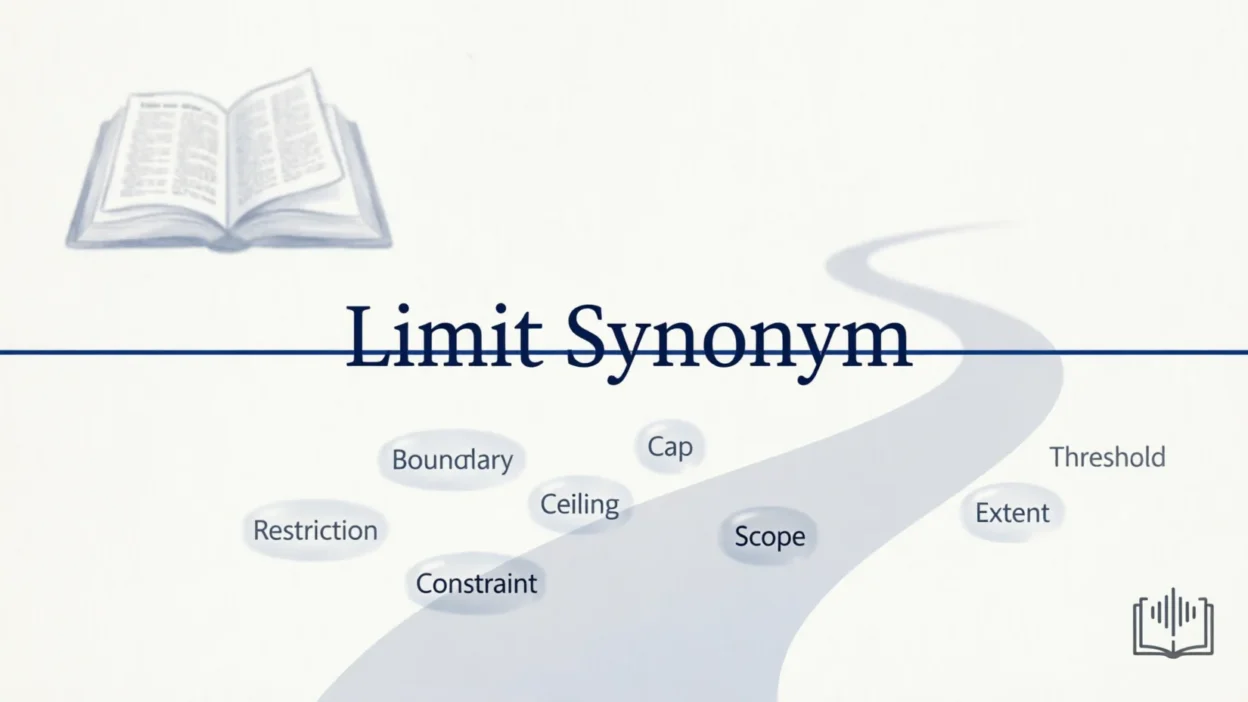
The best limit synonym depends on what you mean by “limit.” Common alternatives include restrict, cap, constrain, curb, control, reduce, confine, boundary, maximum, and threshold. Each word has a slightly different meaning and works better in certain situations.
Whether you are writing an essay, improving your vocabulary, or looking for a more precise word, choosing the right synonym can make your sentence clearer and more natural.
Quick Answer: What Is a Synonym for Limit?
Some of the most useful synonyms for limit are:
- Restrict – to prevent something from becoming too great or extensive
- Constrain – to keep something within certain boundaries
- Cap – to set a maximum amount
- Curb – to control or reduce something
- Confine – to keep something within a particular area or range
- Boundary – a line or point that marks an edge
- Maximum – the greatest amount allowed
- Threshold – a particular point at which something begins, changes, or becomes possible
- Constraint – something that restricts freedom or possibilities
- Control – the power to regulate something
The best choice depends on whether limit is being used as a verb, noun, physical boundary, maximum amount, or restriction.
What Does “Limit” Mean?
The word limit can function as both a noun and a verb.
As a noun, limit means a point or amount beyond which something cannot or should not go.
Example:
“There is a limit to how much luggage each passenger can bring.”
As a verb, limit means to control, reduce, restrict, or keep something within a particular range.
Example:
“The company wants to limit unnecessary spending.”
The word can describe physical boundaries, rules, quantities, abilities, time, money, behavior, or possibilities.
30 Synonyms for Limit
1. Restrict
Simple meaning: To prevent something from becoming too large, extensive, or freely available.
Example:
“The school restricts access to certain areas.”
Best usage/context: Use restrict when rules or circumstances prevent someone from doing something freely.
2. Constrain
Simple meaning: To keep something within certain boundaries or conditions.
Example:
“A limited budget constrained the team’s choices.”
Best usage/context: Common in formal, academic, business, and professional writing.
3. Cap
Simple meaning: To set a highest possible amount or number.
Example:
“The company capped annual spending at $10,000.”
Best usage/context: Best when discussing numbers, prices, salaries, quantities, or growth.
4. Curb
Simple meaning: To control or reduce something unwanted.
Example:
“The new policy aims to curb excessive spending.”
Best usage/context: Often used with negative or excessive behavior such as spending, pollution, inflation, or violence.
5. Confine
Simple meaning: To keep someone or something within a particular place or range.
Example:
“Please confine your comments to the topic being discussed.”
Best usage/context: Useful for physical spaces, topics, activities, and restricted situations.
6. Control
Simple meaning: To manage or regulate something.
Example:
“The government introduced measures to control rising costs.”
Best usage/context: A broad synonym suitable for everyday, professional, and formal contexts.
7. Restrain
Simple meaning: To prevent something from increasing, developing, or happening freely.
Example:
“She tried to restrain her anger.”
Best usage/context: Often used for emotions, behavior, spending, or physical movement.
8. Contain
Simple meaning: To keep something within a particular area or prevent it from spreading.
Example:
“Officials acted quickly to contain the fire.”
Best usage/context: Particularly useful for physical substances, problems, diseases, fires, costs, or situations.
9. Bound
Simple meaning: To restrict something within certain boundaries.
Example:
“The project is bound by strict regulations.”
Best usage/context: More formal and often used with rules, conditions, obligations, or boundaries.
10. Confine to
Simple meaning: To restrict something to a particular person, place, subject, or range.
Example:
“The discussion was confined to the main issue.”
Best usage/context: Excellent when specifying the exact area or subject that something must stay within.
11. Check
Simple meaning: To stop or slow something from developing too much.
Example:
“The central bank raised rates to check inflation.”
Best usage/context: Often used in formal writing for controlling growth, expansion, or undesirable developments.
12. Curbing
Simple meaning: The act of controlling or reducing something.
Example:
“Curbing unnecessary expenses can improve financial stability.”
Best usage/context: Useful when discussing the process of reducing an excessive activity.
13. Restraint
Simple meaning: Control that prevents something from going too far.
Example:
“The policy places restraints on excessive borrowing.”
Best usage/context: Use this noun when referring to a restriction or controlled behavior.
14. Constraint
Simple meaning: Something that restricts what can be done.
Example:
“Time was the biggest constraint on the project.”
Best usage/context: Common in academic, technical, business, and professional writing.
15. Restriction
Simple meaning: A rule or condition that prevents something or makes it more difficult.
Example:
“There are restrictions on parking in this area.”
Best usage/context: Ideal when talking about official rules, regulations, access, or permissions.
16. Boundary
Simple meaning: A line, point, or edge that marks where something ends.
Example:
“The river forms a natural boundary between the two regions.”
Best usage/context: Best for physical, social, personal, conceptual, or geographical limits.
17. Border
Simple meaning: The dividing line between two areas.
Example:
“The mountain range forms a border between the countries.”
Best usage/context: Primarily used for geographical areas, although it can sometimes be used figuratively.
18. Threshold
Simple meaning: A particular point at which something begins, changes, or becomes significant.
Example:
“The temperature has reached the danger threshold.”
Best usage/context: Useful for levels, measurements, conditions, technology, science, and decision-making.
19. Maximum
Simple meaning: The greatest amount or highest level possible or allowed.
Example:
“The maximum speed on this road is 80 kilometers per hour.”
Best usage/context: Use when you mean the highest permitted or possible amount.
20. Ceiling
Simple meaning: A maximum level that cannot normally be exceeded.
Example:
“The government introduced a price ceiling.”
Best usage/context: Common in economics, finance, salaries, prices, and organizational policies.
21. Restricting
Simple meaning: Preventing something from becoming too broad, large, or available.
Example:
“Restricting access can improve security.”
Best usage/context: Useful when describing an ongoing action or policy.
22. Moderation
Simple meaning: Keeping something within reasonable or controlled levels.
Example:
“Moderation is important when managing personal spending.”
Best usage/context: Best for behavior, consumption, opinions, emotions, and activities that should not become excessive.
23. Regulation
Simple meaning: An official rule used to control something.
Example:
“Environmental regulations limit industrial pollution.”
Best usage/context: Use when a government, organization, or authority establishes rules.
24. Provision
Simple meaning: A condition or rule included in an agreement or law.
Example:
“The contract contains a provision limiting liability.”
Best usage/context: Especially appropriate for legal, contractual, and formal documents.
25. Qualification
Simple meaning: A condition that limits or modifies a statement.
Example:
“There is one important qualification to this argument.”
Best usage/context: Useful in academic and formal writing when a statement has an exception or condition.
26. Constraint on
Simple meaning: A factor that prevents something from developing or operating freely.
Example:
“Limited resources are a major constraint on growth.”
Best usage/context: Particularly useful in academic, business, economic, and analytical writing.
27. Impose
Simple meaning: To officially place a rule, restriction, or requirement on someone or something.
Example:
“The city imposed limits on water usage.”
Best usage/context: Use when an authority actively introduces a restriction.
28. Narrow
Simple meaning: To make something smaller, less broad, or more specific.
Example:
“The researcher narrowed the scope of the study.”
Best usage/context: Useful for topics, choices, possibilities, focus, and areas of study.
29. Reduce
Simple meaning: To make something smaller or lower.
Example:
“The company reduced its monthly expenses.”
Best usage/context: A simple and widely applicable alternative when the meaning involves making an amount smaller.
30. Fence in
Simple meaning: To keep someone or something within a particular area or set of boundaries.
Example:
“The farmer fenced in the animals.”
Best usage/context: Mostly informal and literal, though it can also be used figuratively.
Limit Synonyms Comparison Table
| Synonym | Main Meaning | Tone | Best Context |
| Restrict | Prevent or control | Neutral/Formal | Rules, access, activities |
| Constrain | Keep within boundaries | Formal | Academic, business |
| Cap | Set a maximum | Neutral | Numbers, prices, spending |
| Curb | Reduce or control | Neutral/Formal | Problems, excesses |
| Confine | Keep within a specific range | Formal | Places, topics, activities |
| Control | Manage or regulate | Neutral | General situations |
| Restrain | Hold back | Neutral/Formal | Behavior, emotions |
| Contain | Prevent spreading | Neutral | Problems, fires, costs |
| Constraint | Something that restricts | Formal | Business, research |
| Restriction | Rule that limits | Neutral/Formal | Laws, access |
| Boundary | Point where something ends | Neutral | Physical or abstract limits |
| Threshold | Point where something changes | Formal | Levels, conditions |
| Maximum | Highest amount | Neutral | Quantities, rules |
| Ceiling | Highest permitted level | Formal | Prices, salaries, economics |
| Regulation | Official controlling rule | Formal | Government, industry |
| Reduce | Make smaller | Neutral | Amounts, costs, size |
| Narrow | Make less broad | Neutral | Choices, topics, scope |
| Moderation | Keep within reasonable levels | Neutral/Formal | Behavior, consumption |
| Impose | Officially place a restriction | Formal | Laws, rules, requirements |
How to Choose the Right Synonym for Limit
Not every synonym for limit can replace the word in every sentence. The best choice depends on the meaning and tone.
For Rules and Restrictions
Use:
- Restrict
- Restriction
- Regulation
- Constrain
- Restrain
Example:
“New regulations restrict access to the protected area.”
These words work well when a rule or authority prevents something.
For Maximum Amounts
Use:
- Cap
- Maximum
- Ceiling
- Threshold
Example:
“The company placed a cap on travel expenses.”
Choose cap when you want to emphasize a maximum amount.
For Reducing Something
Use:
- Reduce
- Curb
- Control
- Check
- Moderate
Example:
“The campaign aims to curb unnecessary waste.”
These words are especially useful when something is excessive and needs to be brought down.
For Physical Boundaries
Use:
- Boundary
- Border
- Confine
- Fence in
Example:
“The wall marks the boundary of the property.”
Use boundary for the edge of an area rather than a rule that controls behavior.
For Academic and Professional Writing
Use:
- Constraint
- Constrain
- Restriction
- Threshold
- Qualification
- Regulation
Example:
“Limited funding is a significant constraint on further research.”
These words generally sound more precise in formal writing.
For Everyday English
Use:
- Limit
- Restrict
- Control
- Reduce
- Cap
These alternatives are clear and easy to understand.
Limit vs. Restrict
Limit and restrict are closely related, but they are not always interchangeable.
Limit often means reducing the amount, number, size, or extent of something.
“We need to limit our spending.”
Restrict often suggests preventing freedom or access.
“The museum restricts access to certain rooms.”
A useful rule is:
Limit = control the amount or extent.
Restrict = control what someone can do or access.
Limit vs. Constraint
A limit can be a maximum point or an action that reduces something.
A constraint is usually a condition or factor that prevents something from happening freely.
Example:
“The budget limits our options.”
“The budget is a constraint on our options.”
The two sentences are similar, but constraint emphasizes the obstacle or condition causing the restriction.
Limit vs. Cap
A cap specifically refers to a maximum amount or level.
Example:
“The company limited expenses.”
“The company capped expenses at $5,000.”
The second sentence gives the idea of a clearly defined maximum.
Limit vs. Boundary
A boundary usually describes where something ends.
Example:
“The fence marks the boundary of the property.”
A limit can describe an endpoint, but it can also describe a rule or maximum amount.
Therefore, boundary is especially useful when discussing physical or conceptual edges.
Common Mistakes When Using Limit Synonyms
Using “maximum” as a direct replacement for every use of “limit”
This does not always work.
Incorrect or awkward:
“The teacher maximums the number of students.”
Better:
“The teacher limits the number of students.”
Or:
“The maximum number of students is 30.”
Maximum is generally a noun or adjective, not a direct replacement for the verb limit.
Using “restrict” when you mean “reduce”
Consider:
“The company wants to reduce its costs.”
This means the company wants costs to become smaller.
If you say:
“The company wants to restrict its costs.”
the meaning shifts toward controlling or preventing costs from increasing.
Using “boundary” for rules
A boundary can be metaphorical, but it is not usually the best word for an official restriction.
Instead of:
“There is a boundary on the number of applications.”
Use:
“There is a limit on the number of applications.”
Confusing “cap” with “reduce”
A cap establishes a maximum.
A reduction makes something smaller.
For example:
“The company capped expenses at $20,000.”
means $20,000 is the highest permitted amount.
“The company reduced expenses by $5,000.”
means the amount became smaller.
Choosing a formal synonym in a casual sentence
Words such as constraint, qualification, and regulation can sound unnecessarily formal in everyday conversation.
Instead of:
“A financial constraint prevents me from purchasing it.”
you could simply say:
“I can’t afford it.”
The best synonym should match the context and audience.
FAQs:
What is the best synonym for limit?
Restrict is one of the closest general synonyms for limit, but the best word depends on context. Use cap for a maximum amount, curb for reducing something undesirable, constrain for formal restrictions, and boundary for an edge or endpoint.
What is a simple synonym for limit?
Simple alternatives include restrict, control, reduce, stop, cap, and confine. The easiest choice depends on the sentence.
What is a synonym for limit as a verb?
Useful verb synonyms include restrict, constrain, curb, control, confine, restrain, contain, reduce, narrow, and cap.
What is a synonym for limit as a noun?
Common noun alternatives include boundary, restriction, constraint, maximum, ceiling, threshold, and cap.
What is a formal synonym for limit?
For formal writing, consider constraint, restriction, regulation, threshold, boundary, or constrain. The correct choice depends on the intended meaning.
What is the opposite of limit?
Common opposites include allow, expand, increase, encourage, release, free, and unrestricted. The appropriate opposite depends on whether limit is being used as a noun or verb.
Is “cap” a synonym for “limit”?
Yes. Cap can be a synonym for limit when the meaning is to establish a maximum amount or level.
For example:
“The government capped the price.”
This means the government established a maximum price.
Is “restrict” stronger than “limit”?
Often, yes. Restrict commonly emphasizes reducing freedom, access, or choice, while limit can simply mean setting a maximum or reducing an amount. However, the strength depends on context.
Conclusion
The word limit has many useful alternatives, but each synonym carries a slightly different meaning. Restrict works well for rules and access, cap is ideal for maximum amounts, curb suggests reducing something excessive, and constrain is especially useful in formal writing.
For physical or conceptual edges, boundary is often the best choice. For maximum levels, consider maximum, ceiling, or threshold. When writing academically or professionally, constraint, restriction, regulation, and constrain can provide greater precision.
The key is not simply to replace limit with another word. Choose the synonym that expresses the exact relationship, degree, and tone you want your sentence to communicate.

I’m James Parker, Administrator at SynonymsHive. I oversee content quality, improve user experience, and ensure reliable synonym resources. My passion is making language learning simple, accurate, and accessible for everyone.