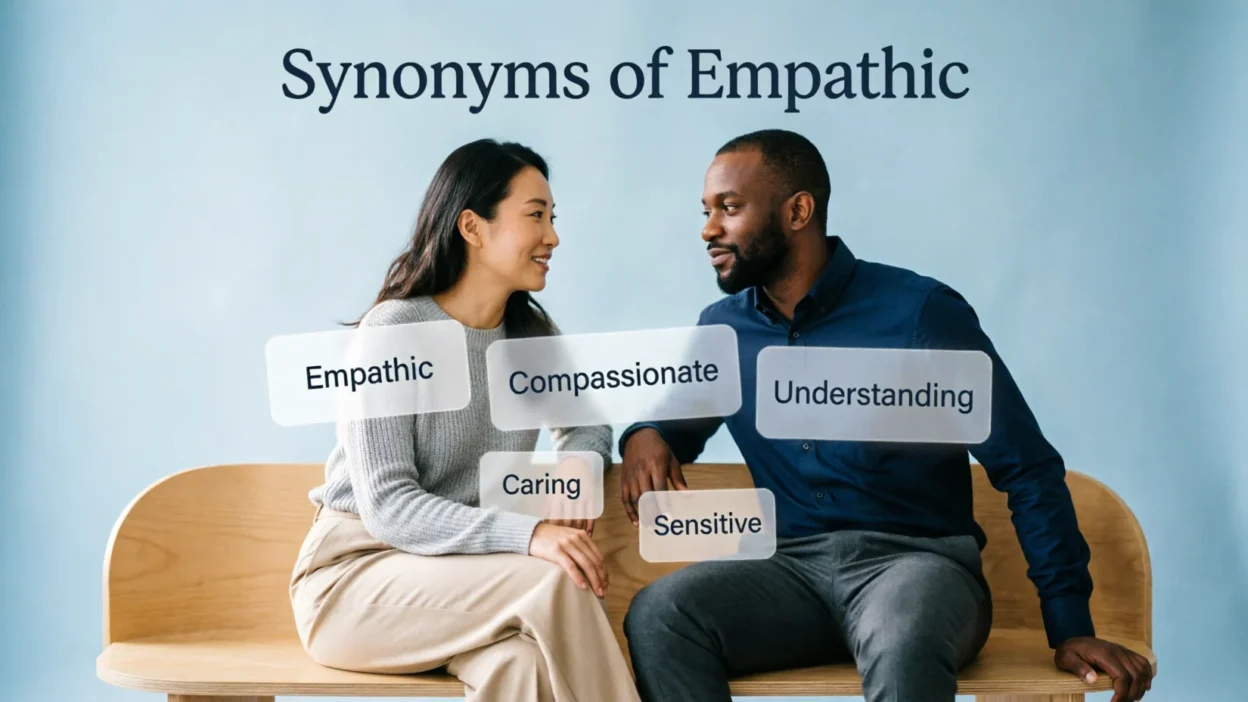
When you need synonyms of empathic, useful alternatives include empathetic, understanding, compassionate, sympathetic, sensitive, caring, considerate, perceptive, supportive, and emotionally aware. However, these words are not always interchangeable. Some describe the ability to understand another person’s feelings, while others emphasize kindness, sympathy, or emotional support.
Choosing the right synonym depends on what you want to express. For example, empathetic is very close to empathic, while compassionate focuses more on caring about someone’s suffering and wanting to help.
Quick Answer: What Are the Best Synonyms of Empathic?
The closest synonyms and related alternatives for empathic include:
- Empathetic
- Understanding
- Compassionate
- Sympathetic
- Sensitive
- Caring
- Considerate
- Perceptive
- Emotionally aware
- Attuned
- Supportive
- Receptive
- Insightful
- Kind
- Thoughtful
- Nonjudgmental
- Responsive
- Warm
- Tenderhearted
- Humane
- Benevolent
- Merciful
- Comforting
- Consoling
- Commiserative
- Solicitous
- Patient
- Charitable
- Emotionally sensitive
- Emotionally understanding
The best choice depends on whether you want to emphasize emotional understanding, kindness, sensitivity, sympathy, or support.
What Does Empathic Mean?
Empathic means having the ability to understand or recognize another person’s feelings, emotions, or experiences.
An empathic person tries to understand what someone else may be feeling rather than focusing only on their own perspective.
Example:
The counselor took an empathic approach when listening to the student’s concerns.
Here, empathic shows that the counselor tried to understand the student’s emotional experience.
Empathic vs. Empathetic
Empathic and empathetic are extremely close in meaning. Both describe the ability to understand and respond to another person’s feelings.
For example:
- She is an empathic teacher.
- She is an empathetic teacher.
Both sentences describe a teacher who understands students’ feelings.
In everyday English, empathetic is very common, while empathic is also established and is often used when discussing emotional understanding, counseling, psychology, communication, and interpersonal relationships.
30 Synonyms of Empathic
1. Empathetic
Simple meaning: Able to understand and recognize another person’s feelings.
Example:
She was empathetic when her friend explained why she was upset.
Best usage/context: This is the closest everyday alternative to empathic and works well in conversations, education, workplaces, and personal relationships.
2. Understanding
Simple meaning: Able to recognize why someone feels or behaves a certain way.
Example:
My teacher was understanding when I explained why I had missed class.
Best usage/context: Use this when emphasizing patience and acceptance rather than emotional insight alone.
3. Compassionate
Simple meaning: Caring deeply about someone’s suffering and wanting to help.
Example:
The nurse gave compassionate care to the elderly patient.
Best usage/context: Particularly useful when empathy leads to kindness, care, or helpful action.
4. Sympathetic
Simple meaning: Showing concern for someone who is experiencing difficulty.
Example:
His manager was sympathetic after hearing about his family emergency.
Best usage/context: Use it when expressing concern or support, especially during difficult situations.
5. Sensitive
Simple meaning: Aware of other people’s feelings and emotional needs.
Example:
She is sensitive to the feelings of people around her.
Best usage/context: Useful when describing awareness of emotional reactions, although sensitive can have several meanings depending on context.
6. Caring
Simple meaning: Showing concern, kindness, and affection toward others.
Example:
He is a caring friend who always checks on people when they need help.
Best usage/context: Best for informal and personal descriptions of kindness and concern.
7. Considerate
Simple meaning: Thinking carefully about other people’s feelings and needs.
Example:
It was considerate of her to ask whether everyone was comfortable.
Best usage/context: Use it when someone’s actions demonstrate respect for other people’s needs.
8. Perceptive
Simple meaning: Good at noticing things that are not immediately obvious.
Example:
The perceptive counselor noticed that the student seemed unusually quiet.
Best usage/context: Useful when emotional understanding comes from accurately noticing subtle behavior or feelings.
9. Emotionally Aware
Simple meaning: Able to recognize and understand emotions.
Example:
An emotionally aware leader notices how workplace changes affect employees.
Best usage/context: Good for professional, educational, and psychological discussions.
10. Attuned
Simple meaning: Very aware of someone’s feelings, needs, or reactions.
Example:
The doctor was attuned to the patient’s concerns.
Best usage/context: Particularly effective in professional writing and discussions about relationships, communication, counseling, and care.
11. Supportive
Simple meaning: Providing encouragement, help, or emotional assistance.
Example:
Her supportive colleague listened without criticizing her.
Best usage/context: Use it when empathy is expressed through encouragement or practical and emotional help.
12. Receptive
Simple meaning: Open and willing to listen to another person’s ideas or feelings.
Example:
The counselor was receptive to the student’s concerns.
Best usage/context: Appropriate when emphasizing openness and willingness to listen.
13. Insightful
Simple meaning: Showing a deep understanding of a person, situation, or feeling.
Example:
He gave an insightful explanation of why the team was frustrated.
Best usage/context: Best when someone understands the deeper reasons behind emotions or behavior.
14. Kind
Simple meaning: Friendly, caring, and considerate toward others.
Example:
She was kind to the new student who felt nervous.
Best usage/context: A simple and widely understood alternative when the focus is general goodness rather than emotional understanding.
15. Thoughtful
Simple meaning: Carefully considering another person’s feelings or needs.
Example:
It was thoughtful of him to call and ask how she was feeling.
Best usage/context: Useful when empathy is demonstrated through a considerate action.
16. Nonjudgmental
Simple meaning: Not quickly criticizing or condemning other people’s feelings or actions.
Example:
The counselor created a nonjudgmental environment where everyone could speak freely.
Best usage/context: Especially useful for counseling, healthcare, education, friendships, and sensitive conversations.
17. Responsive
Simple meaning: Reacting appropriately to another person’s needs or feelings.
Example:
The teacher was responsive to the students’ concerns about the assignment.
Best usage/context: Good for professional and formal contexts where emotional awareness is followed by appropriate action.
18. Warm
Simple meaning: Friendly, caring, and emotionally welcoming.
Example:
The receptionist gave the nervous visitor a warm welcome.
Best usage/context: Best for describing a friendly emotional atmosphere or personality.
19. Tenderhearted
Simple meaning: Easily moved by the feelings or suffering of others.
Example:
Her tenderhearted nature made her especially caring toward animals.
Best usage/context: More expressive and literary than empathic; suitable for personal descriptions and creative writing.
20. Humane
Simple meaning: Showing kindness, care, and respect for people or animals.
Example:
The organization promotes humane treatment of vulnerable people.
Best usage/context: Often used in formal or ethical discussions involving dignity and compassion.
21. Benevolent
Simple meaning: Kind and willing to do good for others.
Example:
The benevolent donor supported several community programs.
Best usage/context: More formal than empathic and usually focuses on goodwill or generosity.
22. Merciful
Simple meaning: Showing forgiveness or kindness instead of causing unnecessary suffering.
Example:
The judge’s merciful decision gave the offender another opportunity to change.
Best usage/context: Use when kindness involves forgiveness, leniency, or reducing suffering.
23. Comforting
Simple meaning: Making someone feel calmer, safer, or less distressed.
Example:
Her comforting words helped him through a difficult evening.
Best usage/context: Best when the person’s empathy is expressed through emotional reassurance.
24. Consoling
Simple meaning: Giving comfort to someone who is sad or suffering.
Example:
She offered a consoling message after her friend’s loss.
Best usage/context: Especially appropriate for grief, disappointment, loss, and other painful experiences.
25. Commiserative
Simple meaning: Showing that you share or understand someone’s feelings of sadness or difficulty.
Example:
His commiserative response showed that he understood how disappointing the experience had been.
Best usage/context: A more formal and less common word, useful when emphasizing shared distress or sympathy.
26. Solicitous
Simple meaning: Showing great concern for another person’s well-being.
Example:
The solicitous nurse repeatedly asked whether the patient needed anything.
Best usage/context: A formal word that works well when describing attentive concern and care.
27. Patient
Simple meaning: Able to listen or respond calmly without becoming irritated.
Example:
The patient teacher listened carefully as the child explained the problem.
Best usage/context: Useful when empathic behavior involves giving someone time and space to express themselves.
28. Charitable
Simple meaning: Generous, forgiving, or inclined to interpret others kindly.
Example:
She took a charitable view of his mistake and considered the difficult circumstances he was facing.
Best usage/context: Useful in formal writing when describing a generous or forgiving interpretation of someone’s behavior.
29. Emotionally Sensitive
Simple meaning: Highly aware of emotions and how situations affect people.
Example:
A good mediator needs to be emotionally sensitive during difficult discussions.
Best usage/context: Useful when discussing communication, conflict resolution, relationships, and interpersonal skills.
30. Emotionally Understanding
Simple meaning: Able to recognize and appreciate another person’s emotional experience.
Example:
The emotionally understanding mentor gave the student time to discuss her concerns.
Best usage/context: Helpful when you want to describe emotional comprehension in clear, straightforward language.
Comparison Table: Synonyms of Empathic
| Synonym | Main idea | Tone | Best context |
| Empathetic | Understanding another person’s feelings | Neutral | General use |
| Understanding | Accepting someone’s situation | Neutral | Everyday communication |
| Compassionate | Caring about suffering | Warm | Healthcare, relationships |
| Sympathetic | Showing concern | Neutral | Difficult situations |
| Sensitive | Aware of feelings | Neutral | Relationships, communication |
| Caring | Showing concern and affection | Warm | Personal relationships |
| Considerate | Thinking about others’ needs | Positive | Everyday actions |
| Perceptive | Noticing subtle emotions | Formal/neutral | Counseling, analysis |
| Attuned | Highly aware of feelings | Formal | Professional contexts |
| Supportive | Offering help and encouragement | Positive | Work, education, relationships |
| Insightful | Understanding deeper causes | Formal | Analysis, counseling |
| Nonjudgmental | Avoiding criticism | Neutral | Counseling, healthcare |
| Thoughtful | Showing careful consideration | Positive | Personal interactions |
| Comforting | Reducing emotional distress | Warm | Difficult moments |
| Consoling | Providing comfort after loss | Warm/formal | Grief and sadness |
Empathic vs. Similar Words
Although many words can replace empathic in certain sentences, they do not all mean exactly the same thing.
Empathic vs. Compassionate
Empathic focuses on understanding another person’s emotional experience.
Compassionate goes a step further by emphasizing concern and a desire to help.
The therapist was empathic toward the patient’s fears.
The therapist was compassionate and helped the patient find practical support.
Empathic vs. Sympathetic
Empathic suggests understanding someone’s feelings from their perspective.
Sympathetic generally means showing concern for someone’s difficulty.
She was empathic because she understood why he felt anxious.
She was sympathetic because she expressed concern about his situation.
Empathic vs. Sensitive
Sensitive means being aware of feelings or easily affected by emotional situations.
Empathic specifically emphasizes understanding another person’s emotional experience.
Empathic vs. Understanding
Understanding is broader. It can mean recognizing someone’s feelings, situation, reasons, or circumstances.
Empathic is more specifically connected with emotional understanding.
How to Choose the Right Synonym for Empathic
The best synonym depends on the meaning and tone you want.
For Emotional Understanding
Choose:
- Empathetic
- Emotionally aware
- Emotionally understanding
- Attuned
- Perceptive
- Insightful
These words work when you want to emphasize someone’s ability to recognize or understand emotions.
For Kindness and Care
Choose:
- Caring
- Compassionate
- Kind
- Warm
- Humane
- Benevolent
These alternatives focus more strongly on kindness and concern.
For Support
Choose:
- Supportive
- Responsive
- Comforting
- Consoling
- Considerate
These are useful when emotional understanding results in helpful behavior.
For Professional Writing
Choose:
- Empathetic
- Compassionate
- Attuned
- Perceptive
- Nonjudgmental
- Responsive
- Emotionally aware
These words work particularly well in writing about education, healthcare, counseling, leadership, communication, and workplace relationships.
For Personal and Everyday English
Choose:
- Understanding
- Caring
- Kind
- Thoughtful
- Sensitive
- Supportive
These are natural and easy to understand in ordinary conversation.
For Formal or Literary Writing
Choose:
- Benevolent
- Humane
- Solicitous
- Tenderhearted
- Commiserative
- Charitable
- Merciful
These words have more specific or formal shades of meaning, so they should be chosen according to context.
Common Usage Mistakes
1. Treating Every Synonym as Identical
Not every alternative has exactly the same meaning.
For example, kind describes general goodness, while empathic specifically relates to understanding another person’s feelings.
2. Confusing Empathy With Sympathy
These concepts overlap, but they are not identical.
Empathy is associated with understanding another person’s emotional experience.
Sympathy generally involves feeling concern for someone who is experiencing difficulty.
3. Using Compassionate When You Only Mean Understanding
Compassionate often suggests caring about someone’s suffering and wanting to help.
If you only mean emotional understanding, empathetic, empathic, or understanding may be more precise.
4. Assuming Sensitive Always Means Empathic
Sensitive can describe emotional awareness, but it can also mean easily affected, responsive to physical changes, or requiring careful treatment.
Context matters.
5. Using Formal Words in Casual Conversations
Words such as solicitous, commiserative, and benevolent may sound formal in everyday conversation.
For ordinary situations, understanding, caring, kind, or empathetic usually sounds more natural.
6. Confusing Empathic With Emotional
Being emotional and being empathic are different.
Someone can experience strong emotions without accurately understanding another person’s feelings. Similarly, an empathic person may calmly understand someone’s emotions without becoming emotionally overwhelmed.
FAQs:
What is the closest synonym for empathic?
Empathetic is generally the closest and most direct synonym for empathic. Both describe the ability to understand or recognize another person’s feelings and emotional experience.
Is empathetic the same as empathic?
Yes, they are very close in meaning and are often interchangeable. Both refer to understanding or identifying with another person’s feelings. Usage can vary by context and personal preference.
What is a simple word for empathic?
Understanding or caring can be simple alternatives, depending on the intended meaning. If you specifically mean emotional understanding, empathetic is usually the clearest choice.
What is the difference between empathic and sympathetic?
Empathic emphasizes understanding another person’s feelings, while sympathetic generally emphasizes concern for someone experiencing difficulty. The two can overlap, but they highlight different aspects of an emotional response.
What is a synonym for an empathic person?
Depending on the intended meaning, you could describe an empathic person as empathetic, understanding, compassionate, sensitive, caring, perceptive, emotionally aware, attuned, or supportive.
Is compassionate a synonym for empathic?
It can be a useful related synonym in some contexts, but the meanings are not identical. Empathic emphasizes emotional understanding, while compassionate emphasizes concern for suffering and often a desire to help.
What is the opposite of empathic?
Possible opposites include insensitive, uncaring, indifferent, unsympathetic, dismissive, and unconcerned, depending on the specific context.
Conclusion
The best synonyms of empathic depend on the exact idea you want to communicate. Empathetic is the closest general alternative, while understanding emphasizes acceptance, compassionate emphasizes care for suffering, sympathetic emphasizes concern, and perceptive emphasizes recognizing subtle emotional signals.
For everyday writing, words such as understanding, caring, kind, supportive, and thoughtful are easy and natural. For professional contexts, empathetic, emotionally aware, attuned, perceptive, and nonjudgmental can provide greater precision.
Choosing the right synonym is not simply about finding a word with a similar dictionary definition. The strongest word is the one that matches your intended meaning, tone, audience, and situation.

I’m James Parker, Administrator at SynonymsHive. I oversee content quality, improve user experience, and ensure reliable synonym resources. My passion is making language learning simple, accurate, and accessible for everyone.