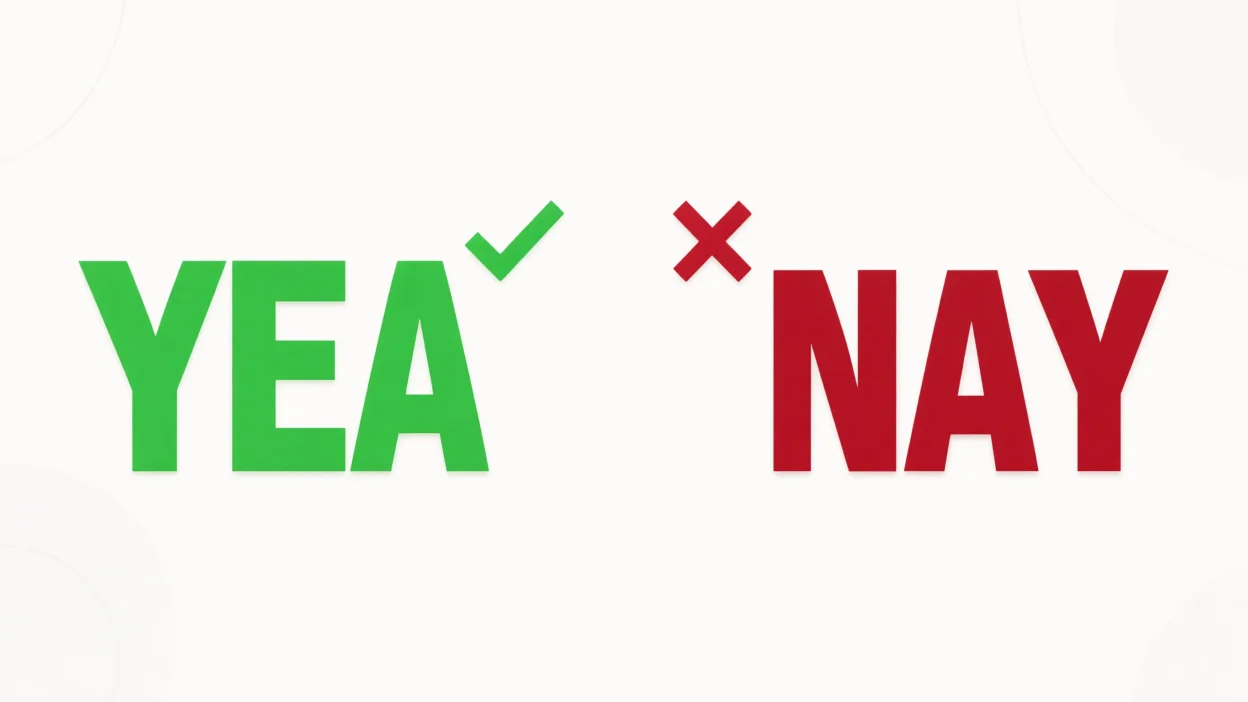
The difference between yea and nay is simple: yea means yes or expresses an affirmative vote, while nay means no or expresses a negative vote. Both words are commonly associated with formal voting, parliamentary debates, and traditional ways of expressing agreement or disagreement. Although they may sound old-fashioned in everyday conversation, they remain useful in specific situations.
Understanding yea vs nay can help you read meeting minutes, follow political discussions, understand historical texts, and communicate more confidently. For example, if someone asks, “Who votes yea?” they are asking who supports a proposal.
If they ask, “Who votes nay?” they want to know who opposes it. These words are especially important when decisions are made through formal votes, where a clear expression of support or opposition matters.
Quick Answer
Yea means yes, agreement, or an affirmative vote. Nay means no, disagreement, or a negative vote. Both words are often used in formal voting and legislative settings. Use yea to show support for a proposal and nay to show opposition. In everyday conversation, yes and no are usually more natural.
Why Do People Confuse Yea and Nay?
People often confuse yea and nay because both are short words used to express a position, especially when answering a question or voting on a proposal.
Their meanings are opposites, but they appear in similar contexts. Both are common in formal proceedings, historical documents, and traditional voting expressions.
Another reason for confusion is pronunciation. Yea sounds like “yay,” while nay rhymes with “day.” The word yea can also be confused with yeah, which is a common informal way to say yes.
Remember that these words have distinct meanings:
- Yea: Yes, agreement, or support.
- Nay: No, disagreement, or opposition.
- Yeah: An informal form of yes.
- Yay: An expression of happiness, excitement, or approval.
What Does Yea Mean?
Yea is an affirmative word meaning yes. It is especially common in formal voting, legislative proceedings, and situations where people must officially express support for a decision.
When someone votes yea, they support the motion, proposal, or decision being considered.
Simple Meaning of Yea
The simplest meaning of yea is yes or in favor.
For example:
- “The members voted yea on the proposal.”
- “All those in favor should say yea.”
- “The final count showed 45 yeas and 20 nays.”
In these sentences, yea communicates agreement or support.
When Is Yea Used?
Yea is most appropriate in:
- Formal voting: Expressing support for a motion or proposal.
- Political discussions: Describing affirmative votes in legislative bodies.
- Official records: Recording how members voted.
- Traditional expressions: Using an established or old-fashioned way of saying yes.
Although yea is correct English, it may sound unusual in casual conversations. Most people would say yes or yeah when talking with friends.
What Does Nay Mean?
Nay is a word meaning no. It is commonly used in formal voting to express opposition to a proposal, motion, or decision.
When someone votes nay, they indicate that they do not support the matter being considered.
Simple Meaning of Nay
The simplest meaning of nay is no or against.
For example:
- “The members voted nay on the proposal.”
- “Those opposed should say nay.”
- “The vote recorded 12 yeas and 8 nays.”
In each example, nay communicates a negative response or opposition.
When Is Nay Used?
Nay is commonly used in:
- Formal voting: Rejecting or opposing a proposal.
- Legislative proceedings: Recording votes against a bill or motion.
- Official meeting records: Showing how members voted.
- Traditional English expressions: Providing a formal or old-fashioned alternative to no.
In everyday conversations, no is generally more natural than nay. However, nay may be appropriate when discussing a formal vote or using a deliberately traditional tone.
Yea vs Nay: Comparison Table
| Feature | Yea | Nay |
| Basic meaning | Yes | No |
| Main purpose | Expresses support | Expresses opposition |
| Type of response | Affirmative | Negative |
| Voting meaning | In favor | Against |
| Common setting | Formal votes and proceedings | Formal votes and proceedings |
| Everyday alternative | Yes or yeah | No |
| Example | “I vote yea.” | “I vote nay.” |
| Opposite word | Nay | Yea |
The key difference is that yea indicates support, while nay indicates opposition. Both words can be used to record votes clearly and briefly.
When Should You Use Yea or Nay?
Choosing between yea and nay depends on your intended meaning and the situation.
Use Yea When You Agree
Use yea when you want to express approval, agreement, or support in a formal voting context.
Examples:
- “I vote yea on the proposed changes.”
- “The committee recorded 18 yeas.”
- “Those supporting the motion should vote yea.”
For ordinary conversations, you can usually replace yea with yes.
Use Nay When You Disagree
Use nay when you want to express opposition or cast a negative vote.
Examples:
- “I vote nay on the proposal.”
- “The motion received 10 yeas and 15 nays.”
- “Members who oppose the change should vote nay.”
For everyday communication, no is generally the better choice.
Use Yes and No in Casual Conversations
Although yea and nay are valid words, they can sound overly formal or old-fashioned in ordinary speech.
For example:
- Natural: “Yes, I agree with you.”
- Formal or traditional: “Yea, I support the motion.”
- Natural: “No, I don’t want to go.”
- Formal or traditional: “Nay, I oppose the proposal.”
12 Examples of Yea vs Nay in Sentences
These examples show how to use both words correctly in different situations.
- Yea: “I vote yea because the proposal will benefit everyone.”
- Nay: “I vote nay because the proposal is too expensive.”
- Yea: “The chairperson asked everyone in favor to say yea.”
- Nay: “Several members shouted nay during the meeting.”
- Yea: “The official record showed 30 yeas and 12 nays.”
- Nay: “The bill failed after receiving more nays than yeas.”
- Yea: “She cast a yea vote in support of the new policy.”
- Nay: “He cast a nay vote against the proposed rule.”
- Yea: “The committee’s yea votes demonstrated broad support.”
- Nay: “The proposal received a strong nay response from the members.”
- Yea: “When asked whether he supported the motion, he answered yea.”
- Nay: “When asked whether she approved the change, she responded nay.”
Notice that yea and nay are most natural in formal voting situations. In ordinary conversation, yes and no usually communicate the same ideas more naturally.
Common Mistakes When Using Yea and Nay
Even though these words are easy to understand, a few common mistakes can cause confusion.
1. Confusing Yea With Yeah
Yea is traditionally used to express an affirmative response, particularly in voting. Yeah is an informal word for yes.
- Correct formal vote: “I vote yea.”
- Natural casual response: “Yeah, that sounds good.”
2. Confusing Yea With Yay
Yay expresses happiness, excitement, or celebration. It is not the standard word for an affirmative legislative vote.
- Correct: “Yay! We won the competition!”
- Correct: “The motion received 25 yea votes.”
3. Using Nay When You Mean Yea
These words have opposite meanings, so using one instead of the other can completely change your message.
- “I vote yea” means you support the proposal.
- “I vote nay” means you oppose the proposal.
4. Using Yea and Nay in Every Conversation
Although both words are correct, they can sound unnatural in casual situations.
Instead of saying, “Nay, I will not attend the party,” you would normally say, “No, I won’t attend the party.”
5. Assuming Nay Always Means Rejection of a Person
In formal voting, nay usually indicates opposition to a specific motion, proposal, or question. It does not necessarily mean that the voter dislikes the person who introduced it.
What Is an Easy Memory Trick for Yea vs Nay?
Use this simple memory trick:
- Yea = Yes: Both express agreement or support.
- Nay = No: Both express disagreement or opposition.
You can also remember the familiar voting expression “yeas and nays.” The first refers to votes in favor, and the second refers to votes against.
Think of a question such as, “Should we approve the plan?”
- If your answer is yes, vote yea.
- If your answer is no, vote nay.
This simple connection makes it easier to remember which word to use.
Yea vs Nay in American and British English
Both yea and nay are recognized in American and British English. Their basic meanings remain the same in both varieties.
American English
In the United States, yea and nay are familiar in legislative voting, formal meetings, and discussions about government decisions. For example, members of the U.S. Congress may be recorded as voting yea or nay.
In everyday American English, however, people generally use yes and no.
British English
In British English, yea and nay also appear in formal or traditional voting contexts. They may be encountered in parliamentary discussions, historical documents, and older forms of English.
Modern British speakers generally prefer yes and no in casual conversations.
The main point: There is no major difference in the basic meanings of yea and nay between American and British English. The choice depends more on formality and context than on regional spelling or meaning.
Similar Words Related to Yea and Nay
Several English words are related to yea and nay, but they are not always interchangeable.
| Word | Meaning | Example |
| Yes | An affirmative response | “Yes, I agree.” |
| No | A negative response | “No, I disagree.” |
| Yeah | Informal yes | “Yeah, let’s go.” |
| Nope | Informal no | “Nope, not today.” |
| Affirmative | Expressing agreement or confirmation | “The response was affirmative.” |
| Negative | Expressing denial or disagreement | “The answer was negative.” |
| Approve | To support or accept something | “I approve of the plan.” |
| Oppose | To disagree with or resist something | “I oppose the proposal.” |
| Aye | Yes, especially in certain formal or traditional voting contexts | “The members voted aye.” |
| Vote against | To cast a vote opposing something | “She voted against the motion.” |
One important distinction is that aye and yea can both express an affirmative vote, but their use varies by institution and tradition. Always follow the voting procedure established for the meeting or organization.
Final Verdict: Which Word Is Correct, Yea or Nay?
Both words are correct, but they express opposite positions.
Choose yea when you mean yes, support, or an affirmative vote. Choose nay when you mean no, opposition, or a negative vote.
If you are writing a formal report, describing a legislative decision, or participating in a traditional voting procedure, these words may be appropriate. If you are chatting with friends, answering a simple question, or writing an everyday message, yes and no are usually clearer choices.
The best word is the one that communicates your intended meaning accurately and suits the situation.
FAQs:
1. Does yea mean yes or no?
Yea means yes. It expresses agreement, support, or an affirmative vote. For example, “I vote yea” means “I vote in favor.”
2. Does nay mean no?
Yes. Nay means no or expresses opposition. In formal voting, a nay vote indicates that someone does not support the motion or proposal being considered.
3. Which is correct, yea or yay?
Both words are correct, but they have different uses. Yea is associated with affirmative responses and formal voting, while yay expresses excitement or happiness, as in “Yay, we won!”
4. What is the difference between yea, yeah, and yay?
Yea means yes, particularly in formal voting. Yeah is an informal way to say yes in everyday conversation. Yay is an expression of excitement, happiness, or celebration.
5. Is nay still used in modern English?
Yes. Nay is still used in formal voting, legislative proceedings, and traditional expressions. However, it is much less common than no in everyday conversations.
6. Is yea the opposite of nay?
Yes. Yea expresses agreement or an affirmative vote, while nay expresses disagreement or a negative vote. They are opposites when used to record positions on the same proposal.
7. What does “yeas and nays” mean?
“Yeas and nays” refers to affirmative and negative votes. The expression is often used when recording or counting votes on a motion, bill, or proposal.
Remember This
- Yea = Yes: You support the proposal.
- Nay = No: You oppose the proposal.
- Yeah = Informal yes: Common in everyday speech.
- Yay = Excitement: Used to express happiness or celebration.
When deciding between yea and nay, focus on whether you are supporting or opposing something. For ordinary conversation, choose yes or no unless a formal or traditional expression is appropriate.
Conclusion
Understanding yea vs nay is easy once you remember their opposite meanings. Yea expresses agreement or support, while nay expresses disagreement or opposition. Both words are especially useful in formal voting, official records, and traditional expressions, where clear responses matter.
Although these words remain part of modern English, they are less common in everyday conversation than yes and no. Learning the differences between yea, nay, yeah, and yay will help you avoid common mistakes and choose the right expression for the situation.

I’m James Parker, Administrator at SynonymsHive. I oversee content quality, improve user experience, and ensure reliable synonym resources. My passion is making language learning simple, accurate, and accessible for everyone.