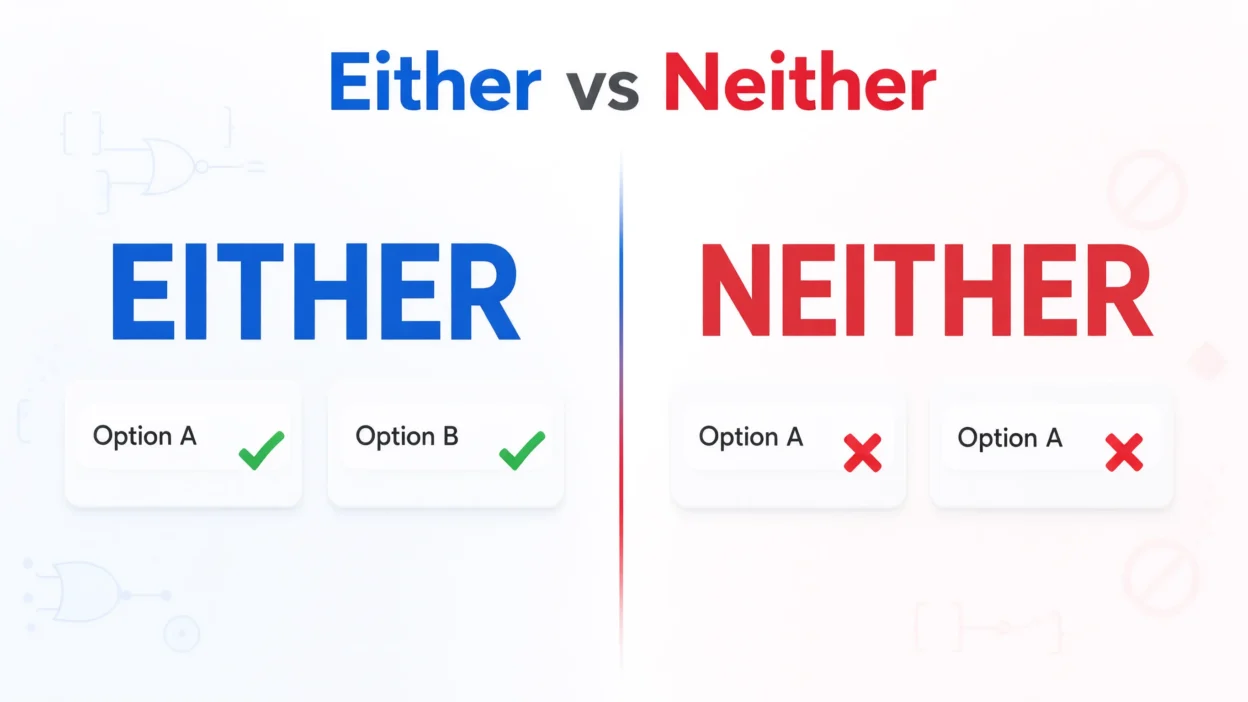
The words either and neither look similar, but they have different meanings. Both are used when talking about two people, things, choices, or possibilities. However, either usually refers to one of two options or shows that both options are possible, while neither means not one and not the other. Understanding the difference helps you write clearer sentences and speak more naturally in everyday English.
For example, you can say, “You can choose either book” when both books are available as choices. On the other hand, “Neither book is interesting” means that both books are uninteresting. Although these words are common in conversations, emails, school assignments, and professional writing, learners sometimes confuse their meanings, verb agreement, and sentence patterns.
The good news is that the difference is easy to learn once you understand how each word works. In this guide, you will discover the meanings of either and neither, learn their grammatical rules, compare them in a simple table, and explore practical examples that will help you use both words correctly.
Quick Answer: Either vs Neither
Either means one or the other of two choices, or it can indicate that both choices are acceptable. Neither means not one and not the other. Use either when presenting alternatives or expressing a positive choice, and use neither when rejecting both options. Both words commonly take a singular verb when used as subjects on their own.
Why Do People Confuse Either and Neither?
People often confuse either and neither because both words refer to two alternatives. They also appear in similar grammatical structures, such as either…or and neither…nor.
The main difference is their meaning:
- Either: One option or the other; both may be acceptable.
- Neither: Not the first option and not the second.
- Either…or: Presents two alternatives.
- Neither…nor: Excludes both alternatives.
Consider these sentences:
- You can have either tea or coffee. Both are available as choices.
- I want neither tea nor coffee. I do not want either drink.
The first sentence offers a choice, while the second rejects both options.
First Word: What Does Either Mean?
Either is used to refer to one of two choices, possibilities, or people. Depending on the sentence, it can also mean that both options are acceptable or that something applies to each of two things.
Simple Meaning of Either
In simple English, either means one or the other of two options.
For example:
- You can take either road to reach the station.
- Either answer is acceptable.
- You can sit on either side of the table.
In these examples, either presents available options without rejecting them.
How to Use Either in a Sentence
Either can function as a determiner, pronoun, adverb, or part of a conjunction.
1. Either as a determiner
It comes before a singular countable noun when referring to one of two things.
- Either option is fine.
- You can choose either dress.
2. Either as a pronoun
It replaces a noun when the choices are already understood.
- Which pen do you want? Either is fine.
- There are two routes. You can take either.
3. Either in negative sentences
Either can appear at the end of a negative sentence to mean “also not.”
- I don’t like spicy food either.
- She isn’t coming, and I am not coming either.
4. Either…or
This structure connects two alternatives.
- You can either walk or take a taxi.
- Either Ali or Ahmed will lead the team.
Does Either Take a Singular or Plural Verb?
When either is used alone as the subject, it generally takes a singular verb.
- Either answer is correct.
- Either of the two students has the book.
With either…or, verb agreement can depend on the subjects being connected. In standard formal usage, when one subject is singular and the other is plural, the verb often agrees with the nearer subject.
- Either the teacher or the students are responsible.
- Either the students or the teacher is responsible.
For polished writing, you can often rewrite such sentences to avoid awkward agreement.
Second Word: What Does Neither Mean?
Neither means not one and not the other of two people or things. It is used when both options are rejected, absent, unsuitable, or untrue.
Simple Meaning of Neither
In simple English, neither means “not either one.”
For example:
- Neither answer is correct.
- Neither student attended the meeting.
- Neither road leads to the village.
Each sentence excludes both options.
How to Use Neither in a Sentence
Neither can function as a determiner, pronoun, or part of a conjunction.
1. Neither as a determiner
It comes before a singular countable noun.
- Neither candidate is available.
- Neither book belongs to me.
2. Neither as a pronoun
It replaces a noun when the two options are already known.
- Which shirt do you prefer? Neither.
- I offered them two solutions, but neither worked.
3. Neither…nor
This structure connects two negative alternatives.
- Neither Sara nor Emma attended the event.
- He likes neither football nor cricket.
4. Neither in agreement with a negative statement
Neither can be used to agree with someone who has made a negative statement.
- “I don’t enjoy horror movies.” “Neither do I.”
- “She hasn’t finished.” “Neither have I.”
The helping verb changes according to the original sentence.
Does Neither Take a Singular or Plural Verb?
When neither is the subject by itself, it normally takes a singular verb in formal standard English.
- Neither answer is correct.
- Neither of the boys has arrived.
In informal speech, plural agreement sometimes occurs with neither of + plural noun, especially when the emphasis is on the individuals. However, singular agreement is the safer choice in formal writing.
Either vs Neither: Comparison Table
| Feature | Either | Neither |
| Main meaning | One or the other | Not one or the other |
| Purpose | Offers or identifies alternatives | Rejects or excludes both alternatives |
| Positive choices | Either option is acceptable. | Neither option is acceptable. |
| Common pair | Either…or | Neither…nor |
| Example | Either answer is correct. | Neither answer is correct. |
| Subject agreement | Usually singular when used alone | Usually singular when used alone |
| Negative agreement | I don’t like it either. | Neither do I. |
The easiest distinction is that either leaves at least one option available, while neither rules out both.
When Should You Use Either or Neither?
Choose the word that matches what you want to communicate.
Use Either When Offering Two Choices
Use either when someone can choose one of two options.
Examples:
- You can order either pizza or pasta.
- Either day works for me.
- Either of these phones would make a good gift.
Use Either When Both Options Are Acceptable
Sometimes you do not have a preference between two alternatives.
Examples:
- Either answer is fine.
- You may use either method.
- Either seat is comfortable.
Here, either does not mean that both options must be selected. It means that either one is acceptable.
Use Either at the End of a Negative Sentence
In this pattern, either means “also not.”
Examples:
- I don’t understand the question either.
- He doesn’t play tennis either.
- We haven’t received the message either.
Use Neither When Both Options Are Rejected
Use neither when you mean that both alternatives are unsuitable, unwanted, or untrue.
Examples:
- Neither restaurant is open.
- Neither answer is correct.
- Neither candidate received enough votes.
Use Neither…Nor to Connect Two Negative Options
Examples:
- Neither my brother nor my sister drives.
- She speaks neither French nor German.
- Neither the manager nor the assistant was available.
Remember that neither already carries a negative meaning. In standard English, avoid adding another negative word to the same construction.
12 Examples of Either vs Neither in Everyday English
These examples show how the two words work in common situations.
1. Choosing a Drink
- Either: You can have either tea or coffee.
- Neither: I want neither tea nor coffee.
The first offers two choices; the second rejects both.
2. Selecting a Book
- Either: Either book would be useful.
- Neither: Neither book contains the information I need.
3. Making Plans
- Either: Either Monday or Tuesday works for me.
- Neither: Neither Monday nor Tuesday is convenient.
4. Talking About Friends
- Either: Either of my friends can help you.
- Neither: Neither of my friends is available today.
5. Discussing Schoolwork
- Either: Either answer could receive full marks.
- Neither: Neither answer explains the problem correctly.
6. Choosing Transportation
- Either: We can travel by either bus or train.
- Neither: Neither the bus nor the train arrives before 8 a.m.
7. Talking About Food
- Either: You can choose either rice or potatoes.
- Neither: Neither dish contains meat.
8. Discussing Skills
- Either: Either employee can operate the machine.
- Neither: Neither employee knows how to repair it.
9. Agreeing With a Negative Statement
- Either: I don’t watch television much either.
- Neither: “I don’t watch television much.” “Neither do I.”
Both responses express a similar idea, but they use different sentence structures.
10. Talking About Weather
- Either: We can go hiking on either Saturday or Sunday.
- Neither: Neither Saturday nor Sunday looks suitable for hiking.
11. Discussing Availability
- Either: Either room is available for the meeting.
- Neither: Neither room is available for the meeting.
12. Talking About Preferences
- Either: I would be happy with either color.
- Neither: I like neither color.
These pairs demonstrate how changing one word can reverse the meaning of a sentence.
Common Mistakes When Using Either and Neither
Even experienced English learners sometimes make mistakes with these words. Here are the most common ones and how to correct them.
Mistake 1: Confusing Their Meanings
Incorrect meaning: “Neither option is fine” when you want to say both options are acceptable.
Better: “Either option is fine.”
Use neither only when both options are being rejected.
Mistake 2: Using Neither With Or
Incorrect: Neither Ali or Ahmed attended.
Correct: Neither Ali nor Ahmed attended.
The standard pairing is neither…nor, not neither…or.
Mistake 3: Using Either With Nor
Incorrect: Either stay here nor come with me.
Correct: Either stay here or come with me.
The standard pairing is either…or.
Mistake 4: Using Double Negatives
Incorrect: I don’t like neither option.
Correct: I like neither option.
You can also say, “I don’t like either option.”
Both correct versions express the same basic meaning.
Mistake 5: Using the Wrong Verb
Less suitable in formal writing: Neither of the answers are correct.
Preferred in formal standard English: Neither of the answers is correct.
When neither is the subject, singular agreement is generally the safest choice.
Mistake 6: Assuming Either Always Means One Only
The sentence “Either answer is correct” means that each of the two answers is acceptable. You may choose either one; the sentence does not mean that one answer is correct and the other is wrong.
A Simple Memory Trick for Either vs Neither
Use this easy memory trick:
- Either = an available alternative.
- Neither = not this one and not that one.
Imagine two doors.
If someone says, “You can enter through either door,” both doors are available.
If someone says, “Neither door is open,” both doors are unavailable.
You can also remember the common word pairs:
- Either or = a choice.
- Neither nor = two rejected options.
When you are unsure, ask yourself: “Am I offering a choice or rejecting both choices?” That question will usually help you select the correct word.
Either vs Neither in American and British English
The meanings of either and neither are essentially the same in American and British English. The main differences you may notice are pronunciation and some preferences in informal speech.
Pronunciation Differences
Both words have two common pronunciations:
- Either: “EE-thər” or “EYE-thər.”
- Neither: “NEE-thər” or “NYE-thər.”
Both pronunciations are widely recognized in American and British English. Neither pronunciation changes the word’s meaning.
Grammar Differences
Both varieties generally use singular verbs when either or neither is the subject.
For example:
- American English: Neither option is available.
- British English: Neither option is available.
You may hear plural verbs after neither of or either of in casual conversation, particularly when the following noun refers to people. However, singular agreement remains a reliable choice in formal writing in both varieties.
Similar Words and Expressions
Several English words and expressions are related to either and neither, but they are not interchangeable in every sentence.
| Word or expression | Meaning | Example |
| Both | The two together | Both answers are correct. |
| Any | One or more from a group, depending on context | You can choose any of these books. |
| None | Not any; often used for three or more, but also possible for two | None of the options worked. |
| Each | Every individual in a group | Each student received a certificate. |
| One or the other | One of two alternatives | We must choose one or the other. |
| Not either | Neither of the two | I do not want either option. |
Either vs Both
Either usually identifies one of two alternatives, while both refers to the two together.
- You can choose either dessert. (Choose one.)
- Both desserts are delicious. (The two desserts are delicious.)
Neither vs None
Neither is specifically associated with two alternatives. None is more flexible and is often used when talking about a group of any size.
- Neither of the two answers is correct.
- None of the five answers is correct.
Either vs Any
Either commonly refers to two options, whereas any can refer to one or more possibilities within a larger group.
- You can take either road. (Two roads.)
- You can take any road on this list. (A group of roads.)
Final Verdict: Which Word Should You Choose?
The difference between either and neither comes down to whether you are presenting alternatives or rejecting both.
Choose either when one of two options is possible, acceptable, or available. Use neither when both options are excluded or unacceptable.
For example, “Either answer is correct” tells someone that both alternatives are acceptable. “Neither answer is correct” tells someone that both alternatives are wrong.
Also remember the correct pairings: either…or presents alternatives, while neither…nor excludes them. With these basic rules in mind, you can use both words confidently in conversations, essays, emails, and professional writing.
FAQs:
1. What is the main difference between either and neither?
Either refers to one of two alternatives or indicates that both options are acceptable. Neither means not one and not the other. For example, “Either route is fine” accepts both choices, while “Neither route is safe” rejects both.
2. Is either positive and neither negative?
Generally, yes. Either often presents available choices or acceptable alternatives, while neither expresses a negative meaning by excluding both options. However, either can also appear in negative sentences, as in “I don’t like it either.”
3. Should I use is or are after either and neither?
When either or neither is the subject on its own, use a singular verb in standard formal English. For example, “Either option is suitable” and “Neither option is suitable.” With either…or and neither…nor, agreement depends on the connected subjects and sentence structure.
4. Is it correct to say “I don’t like neither”?
In standard English, “I don’t like neither” is generally considered incorrect because it combines two negatives. Instead, say “I like neither” or “I don’t like either.” Both express that neither option appeals to you.
5. Can I use either and neither for more than two things?
Traditionally, either and neither refer to two alternatives. In everyday English, speakers sometimes use them for larger groups, but any and none are often clearer when discussing three or more options.
For example, “You can choose any of these five books” is more natural than “You can choose either of these five books.”
6. What is the difference between either…or and neither…nor?
Either…or presents two alternatives, while neither…nor excludes both. For example, “Either Sara or Maya will attend” means one of them is expected to attend. “Neither Sara nor Maya will attend” means both are expected to be absent.
7. Can I say “Me neither” or “Me either”?
Both expressions occur in informal English, especially in conversation, and both can communicate agreement with a negative statement. “Me neither” is widely used in both American and British English. “Me either” is particularly common in American informal speech.
In formal writing, prefer a complete construction such as “Neither do I” or “I don’t either.”
Remember This
- Either = one or the other; both may be acceptable.
- Neither = not one and not the other.
- Either…or = presents alternatives.
- Neither…nor = excludes both alternatives.
- I don’t like it either = I also don’t like it.
- Neither do I = I share your negative opinion.
- Use singular verbs after either or neither when either word is the subject on its own in formal standard English.
Conclusion
Understanding either vs neither is easier when you focus on the meaning of each word. Either is useful for offering choices, identifying alternatives, and agreeing with a negative statement at the end of a sentence. Neither communicates that both options are rejected or that neither of two things applies. Learning these differences will help you make your English clearer and more natural.
Practice using both words in everyday sentences, such as “Either restaurant is fine” and “Neither restaurant is open.” Pay attention to the patterns either…or and neither…nor, and remember to avoid unnecessary double negatives. With regular practice, you will be able to choose the right word confidently in speaking, writing, and academic work.

I am Andrew Foster, a passionate language writer who enjoys helping readers discover the right synonyms and improve their vocabulary. I create clear, accurate, and engaging content that makes learning English simple, practical, and enjoyable.