The words farther and further often confuse English learners because they have similar meanings and are sometimes used interchangeably. Both words can describe distance, but they are not always appropriate in the same situations.
Understanding the difference can help you write more clearly, speak naturally, and choose the right word for your sentence. The good news is that learning this distinction is easier than it might seem.
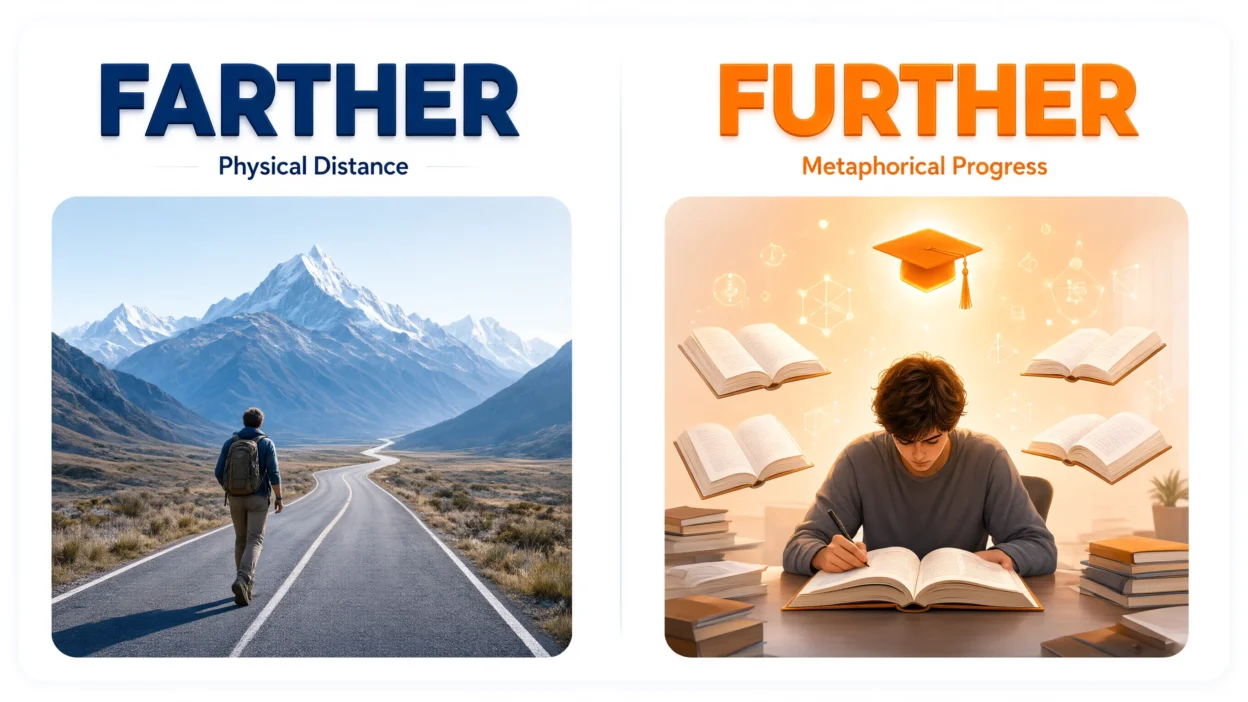
The main difference is that farther usually refers to physical distance, while further often refers to additional progress, a greater degree, or something extra. For example, you might say, “The school is farther from my house than the library,” because you are talking about physical distance.
However, you would say, “We need further information before making a decision,” because you mean additional information. In everyday English, both words can describe distance, and many speakers use them interchangeably in that context. By learning their main uses and seeing them in practical examples, you can confidently decide when to use farther and when to use further.
Quick Answer: Farther vs. Further
Farther usually describes measurable physical distance, such as how far a place is from another location. Further usually means additional, more advanced, or to a greater extent. For example, “We walked farther down the road” describes distance, while “We need further discussion” means we need more discussion. Both words can refer to physical distance.
Why Do People Confuse Farther and Further?
People confuse these words because they have overlapping meanings. Both can describe going beyond a point, moving ahead, or extending something.
The difference becomes clearer when you look at the context:
- Physical distance: Farther is traditionally preferred when describing measurable distance.
- Additional information or activities: Further is the usual choice.
- Progress or development: Further often describes moving forward or advancing.
- Everyday conversation: Either word can sometimes describe physical distance.
For example:
- “The next village is farther away.” This refers to physical distance.
- “Let’s discuss this matter further.” This means continuing the discussion.
- “The hikers traveled further into the forest.” This describes movement and can also suggest progress beyond a point.
The key is to understand the intended meaning instead of memorizing a rigid rule that applies to every sentence.
What Does Farther Mean?
Farther is a comparative form of far that usually refers to a greater physical distance between places, objects, or people.
It answers the question “How much farther?” and is especially useful when talking about journeys, locations, walking distances, and travel.
Simple Meaning of Farther
Farther means at a greater physical distance or a longer distance away.
Examples:
- My school is farther from home than yours.
- We walked farther than we planned.
- The airport is farther away than the train station.
- Can you move a little farther from the door?
In each sentence, farther describes physical space or distance.
When Should You Use Farther?
Use farther when you want to emphasize physical distance, particularly when that distance can be measured or compared.
For example:
- “The hotel is five miles farther down the road.”
- “She ran farther than everyone else.”
- “We need to drive farther to reach the beach.”
You can also use farther in questions about distance.
For example: “How much farther do we have to walk?”
What Does Further Mean?
Further means additional, more, to a greater degree, or beyond the current point. It can also describe physical distance.
It is especially common in academic writing, business communication, explanations, discussions, and situations involving progress or development.
Simple Meaning of Further
Further means more, additional, or to a greater extent.
Examples:
- We need further information.
- The teacher explained the topic further.
- She wants to further her education.
- The company plans to investigate the issue further.
In these examples, further does not simply describe how many miles someone travels. It describes additional information, continued action, or progress.
When Should You Use Further?
Use further when you mean more information, additional action, deeper discussion, or continued development.
For example:
- “Please contact us for further details.”
- “The proposal requires further review.”
- “He wants to further his career.”
- “We should explore this idea further.”
Further is also commonly used in formal expressions such as furthermore, further investigation, and until further notice.
Farther vs. Further: Comparison Table
| Feature | Farther | Further |
| Main meaning | Greater physical distance | Additional, more, or greater progress |
| Physical distance | Commonly preferred | Also correct in many contexts |
| Extra information | Usually not preferred | Common and natural |
| Academic writing | Used for distance comparisons | Used for additional study or discussion |
| Business writing | Used for physical locations | Used for additional details or action |
| Example | We walked farther. | We need further research. |
| Memory clue | Think of distance | Think of more |
Remember that this table describes the usual distinction, not an absolute rule. Further can also describe physical distance, so context matters.
When to Use Farther vs. Further
Choosing between these words becomes easier when you identify what your sentence is trying to express.
Use Farther for Physical Distance
Choose farther when comparing distances between places or describing how far someone or something moves.
Examples:
- The grocery store is farther from my office.
- We traveled farther than we expected.
- Move the chair farther away from the window.
Use Further for Additional Information
Choose further when referring to extra facts, explanations, details, or evidence.
Examples:
- I need further clarification.
- Please provide further details about the project.
- The report contains further information about the results.
Use Further for Progress or Development
Further is appropriate when talking about advancing a goal, developing an idea, or improving a situation.
Examples:
- She wants to further her career.
- The organization aims to further its mission.
- We need to further develop this plan.
Use Further in Common Expressions
Some expressions naturally use further.
Examples:
- Further information
- Further education
- Further discussion
- Further investigation
- Until further notice
- Further action
- Further research
These expressions are useful to learn because they appear frequently in professional, academic, and everyday English.
12 Examples of Farther vs. Further in Sentences
The following examples show how each word works in context.
Examples Using Farther
1. The library is farther from my house than the school.
Farther compares the physical distance between two places.
2. We walked farther than we had planned.
It describes the additional distance covered on foot.
3. How much farther is the nearest hospital?
The question asks about physical distance.
4. Move a little farther away from the fire.
It describes increasing the distance between two things.
5. The runners who trained regularly could run farther.
It refers to the physical distance they could cover.
6. Our destination is farther down this road.
It describes the location of a destination.
Examples Using Further
7. We need further information before we decide.
Further means additional information.
8. The teacher explained the difficult concept further.
It means the teacher provided a more detailed explanation.
9. She hopes to further her education next year.
It means she wants to continue or advance her education.
10. The manager requested further investigation into the problem.
It means additional investigation is needed.
11. Let’s discuss the matter further tomorrow.
It means continuing the discussion in greater detail.
12. The new policy will take effect until further notice.
The expression until further notice means the policy remains in effect until another announcement is made.
Common Mistakes When Using Farther and Further
Even experienced English speakers sometimes use these words interchangeably. However, a few common mistakes are worth avoiding.
Mistake 1: Using Farther for Additional Information
Incorrect or less natural: “Please send me farther details.”
Correct: “Please send me further details.”
Why? Details refers to additional information, not physical distance.
Mistake 2: Using Further When Farther Is More Precise
Less precise: “The village is further away than the town.”
More precise in traditional usage: “The village is farther away than the town.”
Why? Farther makes the physical-distance meaning especially clear. However, the first sentence is also accepted in modern English.
Mistake 3: Assuming Further Never Refers to Distance
Incorrect rule: “Further can only mean additional.”
Correct understanding: Further can also refer to physical distance.
For example: “We traveled further along the coast.”
This is a natural sentence, even though farther would also work.
Mistake 4: Confusing Farther and Further With Farthermost and Furthest
Farthest and furthest are superlative forms commonly used to describe the greatest distance or degree.
Examples:
- “That is the farthest point we can reach today.”
- “This is the furthest we have progressed so far.”
The same general distinction applies: farthest emphasizes physical distance, while furthest can refer to distance or degree.
An Easy Memory Trick for Farther vs. Further
Use this simple memory trick to remember the difference:
- Farther = physical distance. Think about how far you travel.
- Further = additional or more. Think about getting more information or making more progress.
For example:
- “I ran farther today.” You covered more physical distance.
- “I researched the topic further.” You did more research.
When you are unsure, ask yourself: Am I talking about distance or something additional?
If you mean physical distance, farther is usually the clearest choice. If you mean additional information, action, or progress, choose further.
Farther vs. Further in American and British English
Both words are used in American and British English, and their meanings overlap in both varieties.
American English
American English often follows the traditional distinction:
- Farther for physical distance.
- Further for additional information, progress, or degree.
For example:
- “The airport is farther away.”
- “We need further evidence.”
However, American speakers also commonly use further for physical distance.
British English
British English also uses farther and further, but further is widely used for both physical distance and additional meaning.
Examples:
- “The next town is further down the road.”
- “For further information, contact the office.”
Which Form Should You Choose?
For formal writing, a useful approach is to use farther for physical distance and further for additional meaning. This distinction is clear, familiar, and easy for readers to follow.
In everyday speech, either word may be acceptable when discussing physical distance. The intended meaning matters more than enforcing a strict rule that actual usage does not always follow.
Similar Words Related to Farther and Further
Several other English words express distance, continuation, or additional meaning. Understanding them can help you choose more precise vocabulary.
| Word or phrase | Simple meaning | Example |
| Farther away | At a greater physical distance | The station is farther away. |
| More distant | Located at a greater distance | We visited a more distant village. |
| Beyond | Past a particular point | The road continues beyond the bridge. |
| Additional | Extra or more | We need additional documents. |
| Further along | At a later point or a greater distance | The shop is further along the street. |
| Moreover | In addition to what was said | Moreover, the plan is affordable. |
| Continue | Keep going or proceed | Please continue your explanation. |
| Advance | Move forward or make progress | The team hopes to advance its research. |
| Extend | Make something longer or broader | They extended the deadline. |
| Deeper | More detailed or thorough | We need a deeper understanding. |
These words are related but not always interchangeable. For instance, moreover introduces an additional point, while farther away specifically describes physical distance.
Final Verdict: Farther vs. Further
The difference between farther and further is mainly about how you use them in a sentence.
Use farther for physical distance when you want to make the meaning clear. Use further for additional information, more discussion, continued progress, or a greater degree.
Here is the easiest way to remember the distinction:
- “We drove farther.” This describes distance.
- “We need further information.” This describes something additional.
If you are discussing physical distance, either word may be acceptable depending on the context and writing style. When precision matters, the traditional distinction is a reliable guide.
FAQs:
1. What is the main difference between farther and further?
Farther usually refers to physical distance, while further usually means additional, more, or to a greater extent. For example, “We walked farther” describes distance, while “We need further discussion” means we need more discussion.
2. Are farther and further interchangeable?
They are often interchangeable when describing physical distance. For example, both “We walked farther” and “We walked further” are acceptable. However, further is the usual choice for additional information, as in “further details.”
3. Is it farther away or further away?
Both expressions are correct. Farther away follows the traditional preference for physical distance, while further away is also widely accepted in modern English.
4. Should I use farther or further in formal writing?
A clear approach is to use farther for physical distance and further for additional information, discussion, or progress. This distinction works well in academic writing, business documents, and formal communication.
5. Is further a synonym for more?
Yes. Further can mean more or additional in many contexts. For example, “We need further evidence” means “We need more evidence.” However, further has other meanings, including physical distance and progress.
6. What is the difference between farthest and furthest?
Farthest usually refers to the greatest physical distance. Furthest can refer to the greatest distance or the greatest degree of progress. For example, “the farthest town” emphasizes distance, while “the furthest point in the discussion” may refer to progress or extent.
7. Which is correct: further education or farther education?
Further education is correct when you mean additional learning or continued education. Farther education is not the standard expression because the intended meaning is additional study, not physical distance.
8. Is “until further notice” correct?
Yes. “Until further notice” is a standard expression meaning that something will continue until another announcement or instruction is given. For example, “The office will remain closed until further notice.”
Remember This
- Farther: Usually refers to physical distance.
- Further: Usually means additional, more, or continued progress.
- Both: Can describe physical distance.
- Formal writing: The traditional distinction is a useful guide.
- Common expression: Say further information, not farther information.
The most important thing is to choose the word that communicates your intended meaning clearly.
Conclusion
Understanding farther vs. further does not require memorizing complicated grammar rules. Remember that farther is traditionally associated with physical distance, while further is commonly used for additional information, deeper discussion, and progress. Once you recognize these patterns, choosing the right word becomes much easier.
Keep practicing with everyday examples, such as traveling farther to reach a destination or asking for further details about a task. Although both words can describe distance, using the traditional distinction helps make your writing precise and natural. With a little practice, you will be able to use farther and further confidently in conversations, essays, emails, and professional documents.

I am Olivia Brooks, a language enthusiast and writer at SynonymsHive. I enjoy creating clear, engaging content about synonyms, vocabulary, and word meanings, helping readers improve their writing and communicate with confidence every day.