English has many words and phrases that look similar but follow different spelling rules. One common example is “at least” vs. “atleast.” If you have ever wondered whether these two forms are correct, you are not alone. Students, English learners, writers, and even confident speakers sometimes confuse them when writing messages, emails, assignments, or professional documents. Understanding the difference is simple once you learn the correct spelling.
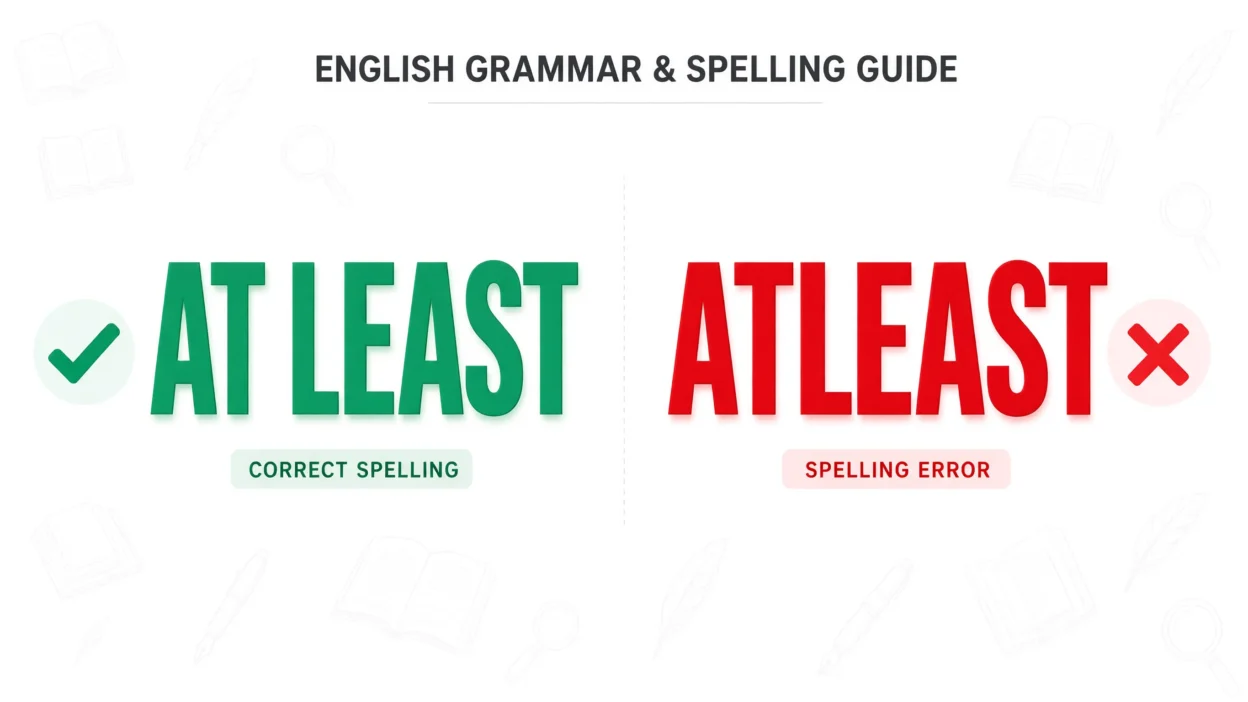
The correct form is “at least,” written as two separate words. It means “a minimum of,” “not less than,” or “at the very least.” For example, if someone says, “Please wait at least ten minutes,” they mean you should wait for ten minutes or longer. The word “atleast,” written as one word, is a common spelling mistake in standard English.
Although people may use it in informal messages or online conversations, it is not the standard spelling. In this guide, you will learn the meaning of both forms, understand why people confuse them, explore practical examples, and discover easy ways to remember the correct spelling.
Quick Answer
“At least” is correct, while “atleast” is incorrect in standard English. Always write “at least” as two separate words. The phrase means “a minimum of,” “not less than,” or “at the very least.” For example: “You need at least five minutes to finish the task.”
Why Do People Confuse “At Least” and “Atleast”?
People often confuse these forms because “at least” is a frequently used phrase. When speaking quickly, the two words sound connected, so writers may mistakenly combine them into one word.
Another reason is that English contains many compound words that are correctly written as one word, such as “already,” “another,” and “although.” However, not every frequently used phrase follows this pattern.
The important rule is straightforward: “At least” always remains two words in standard English.
First Word: At Least
“At least” is the correct spelling. It is a phrase commonly used to describe a minimum amount, number, time, or requirement. It can also introduce a positive point in an otherwise disappointing situation.
Meaning of At Least
The phrase “at least” has several related uses:
- Minimum amount: The smallest acceptable amount or number.
- Not less than: A quantity that meets or exceeds a stated figure.
- To say something positive: A way to identify one good thing in a difficult situation.
- Minimum requirement: The lowest level needed to meet a condition.
Examples of At Least
- You should drink at least six glasses of water throughout the day.
- We need at least three volunteers for the event.
- Please arrive at least fifteen minutes early.
- At least we learned something from the experience.
In each example, “at least” is correctly written as two words.
Second Word: Atleast
“Atleast” is an incorrect spelling of “at least” in standard English. It does not have a separate accepted meaning in ordinary modern English writing.
People sometimes type “atleast” because they pronounce the phrase quickly or assume that its frequent use makes it a single word. However, it should be corrected in school assignments, essays, business emails, articles, and other formal or edited writing.
Incorrect and Correct Examples
- Incorrect: You need atleast ten dollars.
- Correct: You need at least ten dollars.
- Incorrect: Give me atleast five minutes.
- Correct: Give me at least five minutes.
- Incorrect: Atleast we tried our best.
- Correct: At least we tried our best.
Remember that changing the spacing does not change the intended meaning, but it does affect spelling accuracy.
At Least vs. Atleast: Comparison Table
| Feature | At least | Atleast |
| Spelling | Correct | Incorrect |
| Number of words | Two | One |
| Standard English | Yes | No |
| Meaning | A minimum of; not less than | No separate standard meaning |
| Formal writing | Appropriate | Should be avoided |
| Example | We need at least four chairs. | We need atleast four chairs. |
The key difference is spelling. When you want to express a minimum quantity or identify a positive point, use “at least.”
When Should You Use Each?
When to Use “At Least”
Use “at least” whenever you mean a minimum quantity, a lower limit, or a positive aspect of a situation.
1. To describe a minimum number
You need at least eight students to form a team.
2. To describe a minimum amount of time
Give the paint at least two hours to dry, following the product instructions.
3. To explain a minimum requirement
Applicants must have at least one year of relevant experience.
4. To express a minimum price or quantity
The tickets cost at least twenty dollars each.
5. To identify something positive
We missed the bus, but at least we arrived safely.
When to Avoid “Atleast”
Avoid writing “atleast” as a single word in standard English. Replace it with “at least” whenever you notice it in a sentence.
For example:
- Incorrect: Read atleast ten pages every day.
- Correct: Read at least ten pages every day.
There is no need to choose between the two forms based on tone, meaning, or formality. The standard spelling is always “at least.”
12 Examples of “At Least” in Everyday English
Here are practical examples showing how to use the correct phrase in different situations.
- School: You should study for at least one hour before the test.
- Work: Please complete at least three tasks before lunch.
- Shopping: I need at least fifty dollars to buy everything.
- Travel: We should leave at least thirty minutes before departure.
- Health: Try to get at least seven hours of sleep each night.
- Cooking: Let the mixture rest for at least ten minutes.
- Sports: Our team needs at least two more points to win.
- Friendship: At least you were honest about what happened.
- Technology: Make sure you have at least five gigabytes of free space.
- Business: The company expects at least twenty applications.
- Daily life: Please give me at least a day to decide.
- Encouragement: At least you gave it your best effort.
Notice that “at least” can appear at the beginning, middle, or end of a sentence when the grammar and intended meaning allow it.
Common Mistakes to Avoid
Learning the correct spelling also means recognizing a few common writing errors.
1. Combining the Two Words
Incorrect: I need atleast two more days.
Correct: I need at least two more days.
2. Using “At Least” Without a Clear Meaning
The phrase should communicate a minimum, a lower limit, or a positive point.
Unclear: I am at least going to the store.
Clearer, if you mean a minimum effort: I will at least try to finish the shopping today.
The original sentence may be grammatical in a suitable context, but the intended meaning should be clear.
3. Confusing “At Least” With “At Last”
These phrases have different meanings.
- At least: A minimum amount or a positive point.
- At last: Finally, after waiting or experiencing a delay.
Example: “At least we arrived safely” means that arriving safely is a positive outcome.
Example: “At last, the train arrived” means the train finally arrived.
4. Assuming Informal Usage Makes a Spelling Correct
You may see “atleast” in online comments, text messages, or social media posts. Its appearance does not make it the standard spelling. Use “at least” when you want accurate English.
Memory Trick: How to Remember “At Least”
A simple way to remember the correct spelling is to think of the phrase as two separate parts:
- At is one word.
- Least is another word meaning the smallest amount or degree.
Together, they form the phrase “at least.”
Try this sentence: “At least two words make the correct phrase.”
You can also remember that “at least” works similarly to other two-word expressions, such as “at once” and “at first.” These expressions retain their spaces even when people say them quickly.
Whenever you type “atleast,” pause and separate it into “at least.”
American vs. British English
There is no spelling difference between American and British English for this phrase.
| English variety | Correct form | Example |
| American English | At least | We need at least five people. |
| British English | At least | We need at least five people. |
| Australian English | At least | We need at least five people. |
| Canadian English | At least | We need at least five people. |
The phrase is written as two words in all these varieties of standard English. Regional spelling differences affect some words, such as “color” and “colour,” but they do not change the standard spelling of “at least.”
Similar Words and Phrases
Several English expressions are related to “at least” in meaning, but each has its own usage.
| Word or phrase | Meaning | Example |
| At minimum | The lowest amount or level | You need at minimum three references. |
| At a minimum | No less than a specified amount | Allow at a minimum two hours. |
| No less than | Equal to or greater than a stated amount | She waited no less than an hour. |
| At the very least | The absolute minimum | You should at the very least apologize. |
| Minimum of | The smallest required quantity | We need a minimum of ten chairs. |
| At most | The highest permitted amount | The journey will take at most an hour. |
| At last | Finally, after a wait | At last, the results arrived. |
Be careful with “at most” and “at last.” They are not interchangeable with “at least.” “At most” expresses an upper limit, while “at last” refers to something happening finally.
Final Verdict: At Least or Atleast?
The correct spelling is “at least,” not “atleast.” Write it as two separate words in essays, schoolwork, professional documents, emails, and everyday messages.
Use “at least” to express a minimum quantity, a lower limit, or a positive aspect of a situation. Do not use “atleast” as a single word in standard English.
If you remember only one rule from this guide, remember this: Always leave a space between “at” and “least.”
FAQs:
1. Is “atleast” one word or two words?
“At least” is two words. “Atleast” is a nonstandard spelling and should be corrected in standard English writing.
2. Which is correct: “at least” or “atleast”?
“At least” is correct. For example, write “I need at least five minutes,” not “I need atleast five minutes.”
3. What does “at least” mean?
“At least” usually means “a minimum of” or “not less than.” It can also emphasize a positive point. For example, “At least we tried” highlights something positive about the experience.
4. Is “atleast” acceptable in informal texting?
People sometimes use “atleast” in informal messages, but it remains a nonstandard spelling. Using “at least” is the better choice, even in casual writing.
5. Is “at least” grammatically correct at the beginning of a sentence?
Yes. For example, “At least we arrived before the meeting started.” It can also appear elsewhere in a sentence, depending on the intended meaning.
6. What is the difference between “at least” and “at last”?
“At least” expresses a minimum or a positive point, while “at last” means finally. For example, “We need at least two days” expresses a minimum, whereas “At last, the package arrived” describes something happening after a wait.
7. Does American English use “atleast”?
No. Standard American English uses “at least” as two words, just like standard British, Australian, and Canadian English.
Remember This
- Correct: At least
- Incorrect: Atleast
- Meaning: A minimum of, not less than, or at the very least
- Example: You need at least three hours to complete the project.
- Rule: Always write “at least” as two separate words.
Conclusion
The difference between “at least” and “atleast” is simple once you understand the spelling rule. “At least” is the correct two-word phrase used to express a minimum quantity, a lower limit, or something positive in a situation. “Atleast” is a common spelling mistake that should be avoided in standard English.
To improve your writing, pay attention to small details like spaces between words. Using the correct form makes your sentences clearer and helps you communicate more accurately in school assignments, professional documents, emails, and everyday conversations.

I’m Nathan Collins, a language enthusiast passionate about exploring synonyms and improving everyday writing. I create clear, accurate, and helpful content that helps readers expand vocabulary and communicate with confidence.