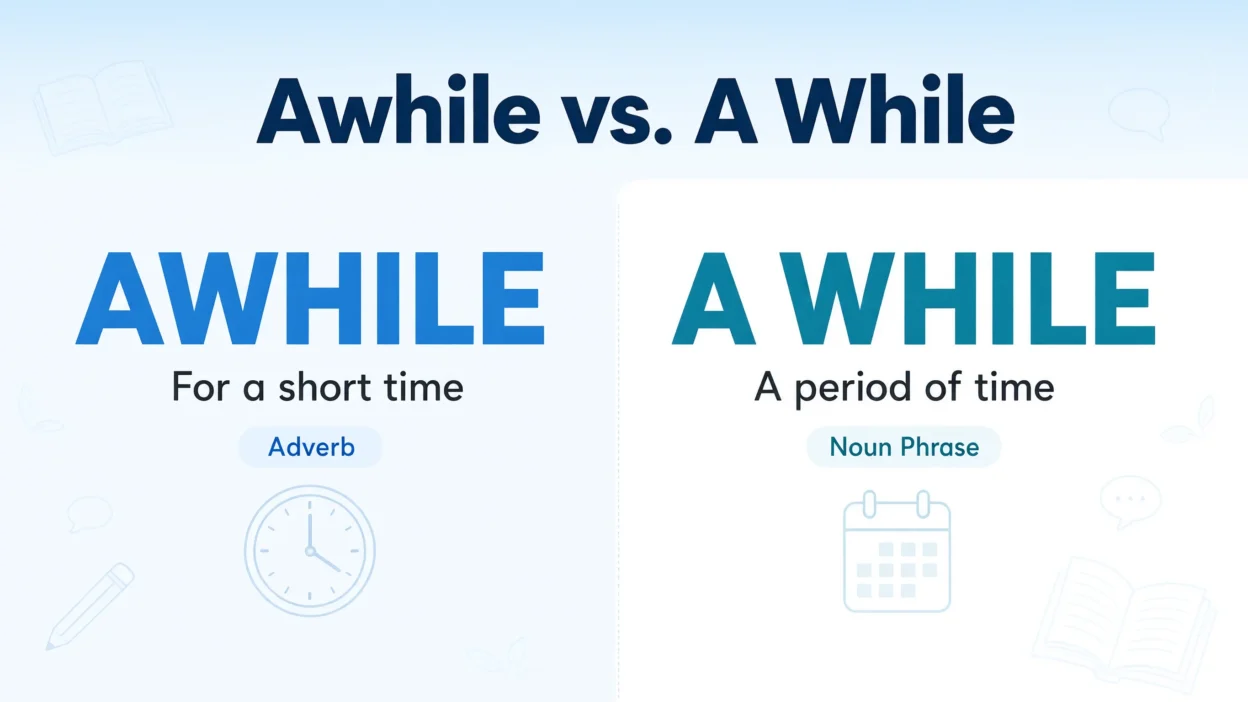
The difference between awhile vs. a while is simple once you understand how each expression works. Both refer to a period of time, but they are used differently in sentences. Awhile is an adverb meaning “for a short time,” while a while is a noun phrase meaning “a period of time.” Although they sound almost identical, knowing when to use each form can help you write more clearly and avoid common grammar mistakes.
For example, you can say, “Please wait awhile” or “Please wait for a while.” Both sentences are correct because awhile already expresses duration, whereas a while usually follows the preposition for when describing how long something lasts.
The key is to understand the role each expression plays in a sentence. If you are writing an email, completing an English assignment, or improving your everyday communication, learning the difference between awhile and a while will make your writing more accurate and natural.
Quick Answer: Awhile vs. A While
Awhile is an adverb that means “for a short time.” Use it when you want to describe an action lasting for some time, as in “Stay awhile.” A while is a noun phrase meaning “a period of time.” It commonly follows a preposition, as in “Stay for a while.” Both forms are correct when used appropriately.
Why Do People Confuse Awhile and A While?
People often confuse awhile and a while because they sound the same and have similar meanings. Both expressions describe duration, so it can be difficult to know whether to write them as one word or two.
The main difference is grammatical:
- Awhile: An adverb that describes how long an action continues.
- A while: A noun phrase referring to a period of time.
Consider these examples:
- I rested awhile after lunch.
- I rested for a while after lunch.
Both sentences are correct. However, the first uses an adverb, while the second uses a noun phrase introduced by the preposition for.
Understanding this grammatical difference makes it easier to choose the correct form.
What Does Awhile Mean?
Awhile means “for a short time” or “for some time.” It is an adverb that tells readers how long an action lasts.
Use awhile when an action continues for a period of time and you do not need the preposition for before the expression.
Examples of Awhile in Sentences
- Please sit awhile before leaving.
- We talked awhile after the meeting.
- She stayed awhile to help her friend.
- The children played awhile in the garden.
- He rested awhile before returning to work.
In each example, awhile modifies an action by indicating its duration.
When Should You Use Awhile?
Use awhile when you want to express the idea of doing something for a period of time without adding for immediately before it.
For example:
- Correct: Let’s wait awhile.
- Incorrect in standard usage: Let’s wait for awhile.
The second sentence should be written as “Let’s wait for a while” because for needs the noun phrase a while, rather than the adverb awhile.
What Does A While Mean?
A while is a noun phrase that means “a period of time.” The word a is an article, and while is a noun referring to a stretch of time.
Use a while when you are talking about a period of time as a thing or duration.
Examples of A While in Sentences
- I haven’t seen her for a while.
- It took a while to finish the assignment.
- We stayed at the library for a while.
- After a while, the rain stopped.
- She needs a while to think about the decision.
Notice that a while often appears after words and phrases such as for, after, in, and quite.
When Should You Use A While?
Use a while when the sentence needs a noun phrase referring to a period of time.
Examples include:
- Correct: We waited for a while.
- Correct: After a while, he smiled.
- Correct: It has been a while since we last spoke.
In these sentences, a while functions as a noun phrase rather than an adverb.
Awhile vs. A While: Comparison Table
| Feature | Awhile | A while |
| Meaning | For a period of time | A period of time |
| Grammar | Adverb | Noun phrase |
| Number of words | One | Two |
| Common pattern | Wait awhile | Wait for a while |
| With for immediately before it | Generally incorrect in standard usage | Correct |
| Example | Stay awhile. | Stay for a while. |
The easiest way to remember the distinction is that awhile describes duration, while a while names a period of time.
When to Use Awhile vs. A While
Choosing between these expressions becomes easier when you look at the words surrounding them.
Use Awhile Without For
When awhile follows a verb directly, it often fits naturally.
Examples:
- Rest awhile.
- Stay awhile.
- Think awhile before answering.
- Sit awhile and enjoy the view.
These sentences use awhile to describe how long the action continues.
Use A While After For
When you use the preposition for to describe duration, choose a while.
Examples:
- I waited for a while.
- She worked for a while before taking a break.
- They talked for a while after dinner.
- He lived abroad for a while.
Here, a while is the noun phrase that completes the prepositional phrase for a while.
Use A While After After
When you want to describe something that happens following a period of time, use a while.
Examples:
- After a while, everyone relaxed.
- After a while, the baby fell asleep.
- The noise stopped after a while.
The phrase refers to a period that passes before something happens.
Use A While With In
When describing something that will happen after a period of time, use a while in expressions such as in a while.
Examples:
- I’ll call you in a while.
- We will discuss the results in a while.
- The guests should arrive in a while.
12 Examples of Awhile vs. A While
The following examples show how these expressions work in everyday English.
| Awhile | A while |
| 1. Please stay awhile. | Please stay for a while. |
| 2. He rested awhile. | He rested for a while. |
| 3. We talked awhile. | We talked for a while. |
| 4. She waited awhile. | She waited for a while. |
| 5. Sit awhile and relax. | Sit for a while and relax. |
| 6. They played awhile outside. | They played outside for a while. |
| 7. Think awhile before deciding. | Take a while to make your decision. |
| 8. I watched awhile before leaving. | I watched for a while before leaving. |
| 9. He lingered awhile. | He lingered for a while. |
| 10. The dog rested awhile. | The dog rested for a while. |
| 11. We chatted awhile. | We chatted for a while. |
| 12. She remained awhile. | She remained for a while. |
Both columns contain grammatically acceptable examples. The choice depends on the sentence structure and the meaning you want to express.
Common Mistakes With Awhile and A While
Even experienced English writers sometimes mix up these expressions. Here are a few mistakes to avoid.
Mistake 1: Writing For Awhile
Incorrect: Please wait for awhile.
Correct: Please wait for a while.
You can also write “Please wait awhile.” The important point is that for should be followed by the noun phrase a while in standard usage.
Mistake 2: Confusing In Awhile With In A While
Incorrect in standard usage: I’ll see you in awhile.
Correct: I’ll see you in a while.
The expression in a while refers to a period of time before something happens.
Mistake 3: Assuming Both Forms Are Interchangeable Everywhere
Although both expressions describe duration, they do not fit every sentence in the same way.
- Correct: It took a while to understand the lesson.
- Correct: I stayed awhile to understand the lesson.
The first sentence treats a while as a noun phrase. The second uses awhile as an adverb.
Mistake 4: Forgetting the Article A
When you use the noun phrase, remember to include the article.
Correct: We waited for a while.
Incorrect: We waited for while.
The phrase for while is not the standard expression when referring to an unspecified period of time.
A Simple Memory Trick for Awhile vs. A While
Use this easy trick to remember the difference:
If you can put “for” before the expression, use “a while” after it.
For example:
- Stay awhile.
- Stay for a while.
You can also remember that a while contains two words because it names a period of time.
Try asking yourself: “Am I describing an action, or am I referring to a period of time?”
- Describing an action’s duration without for: awhile.
- Referring to a period of time: a while.
This simple check will help you make the right choice in most everyday sentences.
Awhile vs. A While in American and British English
The distinction between awhile and a while is generally the same in American and British English.
Both varieties recognize awhile as an adverb and a while as a noun phrase. The basic grammatical rules do not change based on whether you are writing for an American or British audience.
Examples in American English:
- Please wait awhile.
- I’ll be back in a while.
Examples in British English:
- Stay awhile and have a cup of tea.
- We haven’t spoken for a while.
There can be differences in writing preferences and style, but the core distinction remains consistent. For formal writing, use the form that fits the grammar of your sentence.
Similar Words and Expressions
Understanding related expressions can help you talk about time more naturally.
For a While
This expression means for a period of time.
Example: We sat outside for a while.
In a While
This means after some time has passed, often referring to the future.
Example: I’ll meet you in a while.
After a While
This means after a period of time has passed.
Example: After a while, the children became quiet.
For Some Time
This phrase means for a period of time, often suggesting a duration that may be longer or more noticeable.
Example: She worked there for some time.
Briefly
This adverb means for a short time or in a few words, depending on context.
Example: He briefly explained the problem.
Temporarily
This means for a limited period rather than permanently.
Example: The office is temporarily closed.
These expressions are related to awhile and a while, but their meanings and grammatical uses are not always identical.
Final Verdict: Awhile or A While?
Both awhile and a while are correct English expressions, but they serve different grammatical purposes.
Use awhile when you mean “for a period of time” and do not need the preposition for before it. Use a while when referring to a period of time as a noun phrase, especially after prepositions such as for, in, and after.
Compare these examples:
- “Let’s rest awhile.”
- “Let’s rest for a while.”
Both sentences are correct and communicate almost the same idea.
When in doubt, check the sentence structure rather than relying only on the meaning. That is the most reliable way to choose between the two forms.
FAQs:
1. Is awhile one word or two?
Awhile is one word. It is an adverb meaning “for a period of time.” The alternative, a while, consists of two words and is a noun phrase referring to a period of time.
2. Is it correct to say for awhile?
In standard English, write for a while, not for awhile. The word for normally takes the noun phrase a while in this expression.
Correct: I waited for a while.
You can also write: I waited awhile.
3. Should I write see you in awhile or see you in a while?
The standard form is “See you in a while.” Here, a while is a noun phrase used in the expression in a while, meaning after some time has passed.
4. Are awhile and a while pronounced the same?
Yes. In ordinary speech, awhile and a while are generally pronounced the same way. Their difference appears in spelling and grammar rather than pronunciation.
5. Is awhile grammatically correct?
Yes. Awhile is a standard English adverb. For example, “Please stay awhile” is grammatically correct because the adverb describes how long someone should stay.
6. Can I use awhile at the beginning of a sentence?
Yes, although it is often more natural after a verb. For example, “Awhile passed before the meeting began” is not standard in this meaning. A better sentence is “A while passed before the meeting began.” Alternatively, you can write, “Wait awhile before beginning.”
7. Is a while always written as two words?
When a while means a period of time, it is written as two words. However, while can also function as a conjunction, as in “While I was waiting, it started raining.” That use is different from both awhile and the noun phrase a while.
Remember This
- Awhile = for a period of time.
- A while = a period of time.
- Write wait awhile, not wait for awhile.
- Write wait for a while, not wait for awhile.
- Write in a while and after a while.
- Both forms are correct when used in the right grammatical structure.
Conclusion
The difference between awhile and a while comes down to grammar. Awhile is an adverb that describes how long an action continues, while a while is a noun phrase referring to a period of time. Although both expressions sound alike and often communicate a similar idea, they cannot be used interchangeably in every sentence.
To choose correctly, pay attention to the words around the expression. Use awhile in sentences such as “Stay awhile,” and use a while in phrases such as “for a while,” “in a while,” and “after a while.” With these simple rules and examples, you can use both forms confidently in everyday conversations, school assignments, and professional writing.

I’m James Parker, Administrator at SynonymsHive. I oversee content quality, improve user experience, and ensure reliable synonym resources. My passion is making language learning simple, accurate, and accessible for everyone.