The words die and dye sound exactly the same, but they have completely different meanings. If you have ever wondered if to write “plants die without water” or “plants dye without water,” understanding the difference will help you avoid common spelling mistakes. Both words are pronounced /daɪ/, like the word eye, but their meanings and uses are not interchangeable.
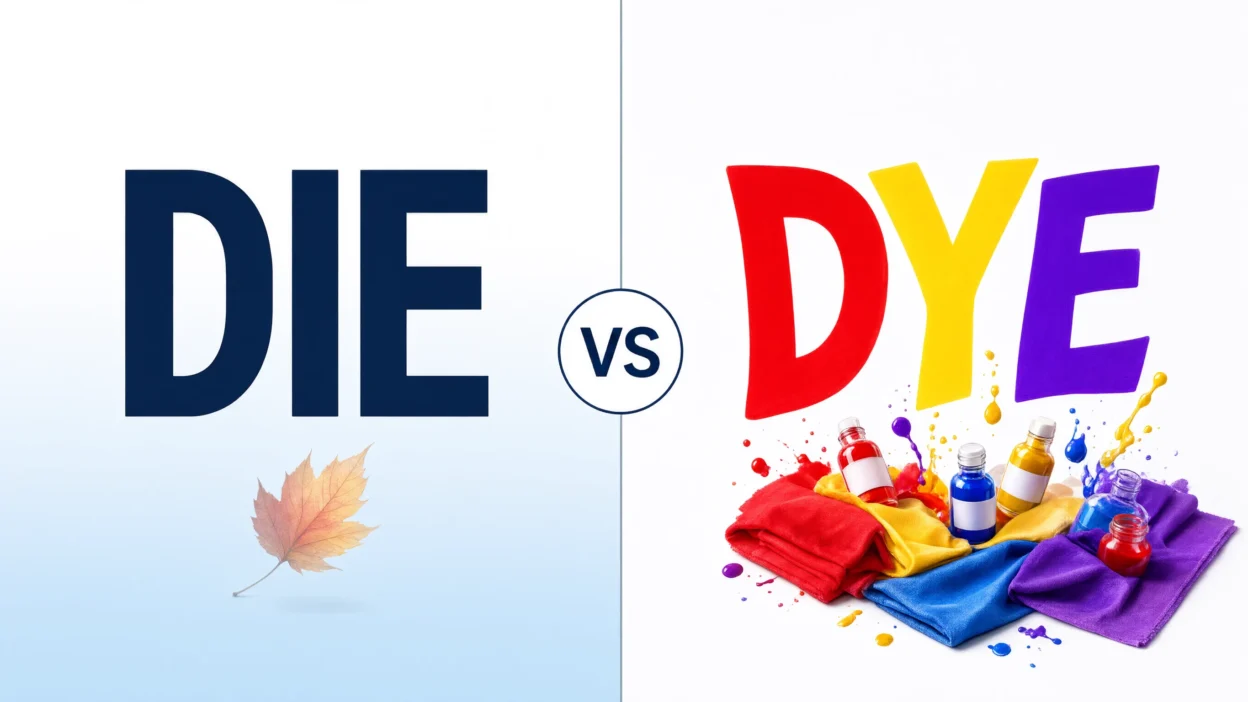
The easiest way to remember the difference is that die usually refers to the end of life, the failure of something to function, or the fading of a feeling. In contrast, dye means to add color to something, such as fabric, hair, or other materials.
For example, “The flowers die without sunlight” describes what happens to living things, while “I dye my hair brown” describes changing its color. Learning when to use each word will make your writing clearer and help you recognize these commonly confused words in everyday English.
Quick Answer: What Is the Difference Between Die and Dye?
Die means to stop living or to cease functioning. Dye means to change the color of something by applying a coloring substance. Both words sound identical but have different spellings and meanings. For example, “The plant may die” refers to life, while “She will dye her hair” refers to changing its color.
Why Do People Confuse Die and Dye?
People often confuse die and dye because they are homophones. Homophones are words that have the same pronunciation but different spellings and meanings.
Both words rhyme with my, try, and sky. When speaking, listeners usually understand which word someone means from the context. However, when writing, choosing the wrong spelling can change the meaning of a sentence or make it confusing.
Here are the main reasons for the confusion:
- Same pronunciation: Both words sound like /daɪ/.
- Different spellings: Die has three letters, while dye has an extra letter, “y.”
- Different meanings: One commonly relates to life or existence, while the other relates to color.
- Similar sentence patterns: Both can appear as verbs, making spelling mistakes easier to overlook.
The key is to understand what you want to communicate before choosing the spelling.
First Word: What Does Die Mean?
Die is a verb that usually means to stop living. It can describe people, animals, plants, and other living organisms. It can also mean that something stops working, disappears, or loses strength.
Simple Meaning of Die
To die means to stop being alive or to come to an end.
Examples:
- Many plants die without enough water.
- The old man died peacefully in his sleep.
- Some fish die when the water becomes polluted.
- My phone might die if I do not charge it.
In the last example, die is used informally to describe a battery losing all its power.
Other Meanings of Die
The word die can have several meanings depending on the context.
1. To stop living
- The bird died after becoming seriously ill.
- All living things eventually die.
2. To stop working
- My laptop may die during the meeting.
- The car engine died at the traffic light.
3. To disappear or fade away
- Her excitement began to die after the disappointing news.
- The sound of music slowly died away.
4. To feel a strong desire for something
The expression die for can mean wanting something very much.
- I am dying for a cup of coffee.
- She would die for the chance to travel the world.
These expressions are figurative and do not usually refer to literal death.
Word Forms of Die
| Word form | Example |
| Die | Some plants die in winter. |
| Dies | The character dies at the end. |
| Died | The battery died overnight. |
| Dying | The flowers are dying. |
| Death | The story explores death and loss. |
Remember that death is the noun form, while die is the verb.
Second Word: What Does Dye Mean?
Dye is a verb that means to change the color of something by using a substance that adds color. It is commonly used for hair, clothing, fabrics, yarn, and other materials.
The word dye can also be a noun referring to the coloring substance itself.
Simple Meaning of Dye
To dye means to give something a different color by using a dye.
Examples:
- She wants to dye her hair blonde.
- They dye cotton fabric before making clothes.
- I learned how to dye white shirts blue.
- The artist used a natural dye made from plants.
In each sentence, dye describes adding color rather than ending life.
Other Uses of Dye
1. Dye as a verb
- My sister will dye her hair red.
- The company dyes wool in several colors.
- We dyed the old curtains green.
2. Dye as a noun
- This fabric requires a special dye.
- The blue dye stained my hands.
- Natural dye can come from certain plants.
3. Common expressions involving dye
The phrase dyed-in-the-wool describes someone who strongly holds a particular belief or identity.
– He is a dyed-in-the-wool football fan.
This expression is figurative; it does not mean that someone has literally been colored with dye.
Word Forms of Dye
| Word form | Example |
| Dye | I use dye to color fabric. |
| Dyes | This product dyes hair effectively. |
| Dyed | She dyed her dress purple. |
| Dyeing | He is dyeing a cotton shirt. |
Notice the spelling dyeing, not dieing, when referring to the act of adding color.
Die vs Dye: Comparison Table
The following table highlights the main differences between the two words.
| Feature | Die | Dye |
| Main meaning | To stop living or functioning | To add or change color |
| Part of speech | Usually a verb | A verb or noun |
| Pronunciation | /daɪ/ | /daɪ/ |
| Common subjects | People, animals, plants, batteries | Hair, clothes, fabric, materials |
| Past tense | Died | Dyed |
| Present participle | Dying | Dyeing |
| Example | The flowers may die. | I will dye the flowers blue. |
The final example shows how the words can appear in similar sentences while expressing different ideas. Flowers may die naturally, but they can also be dyed to change their appearance.
When Should You Use Die or Dye?
Choose the word according to the meaning you want to express.
Use Die When Talking About Life or Endings
Use die when describing the end of life, the failure of a device, or the disappearance of something.
Examples:
- Plants die when they lack essential nutrients.
- My phone will die if I forget my charger.
- The noise gradually died down.
- Their hopes began to die after repeated failures.
Quick rule: If you mean that something stops living, functioning, or continuing, use die.
Use Dye When Talking About Color
Use dye when describing the process of adding color to hair, fabric, clothing, or another material.
Examples:
- She wants to dye her hair black.
- We used blue dye on the cotton fabric.
- The manufacturer dyes the material before sewing it.
- He dyed his old jeans a darker shade.
Quick rule: If you mean changing the color of something, use dye.
12 Examples of Die vs Dye in Sentences
These examples show how the two words work in everyday English.
- Die: Some animals die when their natural habitats disappear.
- Dye: She decided to dye her hair purple.
- Die: My phone may die before I reach home.
- Dye: The designer used red dye for the fabric.
- Die: The flowers began to die after several hot days.
- Dye: We will dye the curtains a lighter color.
- Die: The engine suddenly died in the middle of the road.
- Dye: He learned to dye wool using natural ingredients.
- Die: The excitement slowly died after the announcement.
- Dye: My mother wants to dye her white scarf blue.
- Die: The fictional hero refuses to let hope die.
- Dye: The workers dyed the cotton before producing the shirts.
Examples Using Both Words Together
Sometimes both words can correctly appear in the same sentence.
- The flowers may die, but you can dye artificial flowers to match your decorations.
- If the fabric fades, you can dye it again before it becomes unusable.
- The plant could die if you use the wrong chemicals to dye its leaves.
The third example is grammatically correct, but coloring living leaves with unsuitable chemicals could damage the plant.
Common Mistakes When Using Die and Dye
Even experienced English writers sometimes confuse homophones. These are some common mistakes to avoid.
Mistake 1: Using Dye When You Mean Die
Incorrect: The fish may dye without oxygen.
Correct: The fish may die without oxygen.
Why? The sentence refers to the loss of life, not a change in color.
Mistake 2: Using Die When You Mean Dye
Incorrect: I want to die my hair brown.
Correct: I want to dye my hair brown.
Why? The sentence describes changing hair color.
Mistake 3: Writing Dieing Instead of Dying
Incorrect: The flowers are dieing.
Correct: The flowers are dying.
Why? The present participle of die is dying. The final “e” is removed before adding “-ing.”
Mistake 4: Writing Dieing Instead of Dyeing
Incorrect: She is dieing the fabric red.
Correct: She is dyeing the fabric red.
Why? The present participle of dye is dyeing. The “e” in dye is retained to distinguish it from dying.
Mistake 5: Confusing the Past Tense
Incorrect: She died her hair blonde.
Correct: She dyed her hair blonde.
Why? The past tense of dye is dyed, while the past tense of die is died.
Easy Memory Trick: How to Remember Die vs Dye
A simple memory trick can help you choose the correct word without hesitation.
DIE
Think: Life ends.
Use die for living things that stop living or for things that stop working.
Example: The plant may die.
DYE
Think: Color changes.
Use dye for adding color to hair, fabric, or other materials.
Example: I will dye my shirt.
Another helpful trick is to associate the “y” in dye with the idea of a new color. This is only a memory aid, but it can make the spelling easier to recall.
Die vs Dye in American and British English
The meanings and spellings of die and dye are the same in American and British English. Both varieties pronounce the words identically, and neither uses a different spelling for the main meanings discussed here.
| Meaning | American English | British English |
| Stop living | The plant may die. | The plant may die. |
| Change color | She will dye her hair. | She will dye her hair. |
| Past tense of die | Died | Died |
| Past tense of dye | Dyed | Dyed |
| Present participle of die | Dying | Dying |
| Present participle of dye | Dyeing | Dyeing |
For example, an American writer and a British writer would both write, “She is dyeing her hair.” There is no regional spelling difference between these two words.
Similar Words: Homophones Like Die and Dye
English contains many words that sound alike but have different spellings and meanings. Learning these words can improve spelling and writing accuracy.
| Words | Meaning difference | Example |
| See / Sea | Look at / Large body of salt water | I can see the sea. |
| Right / Write | Correct or opposite of left / Put words on paper | Please write the right answer. |
| Flour / Flower | Baking ingredient / Bloom of a plant | The flower is beside the flour bag. |
| Pair / Pear | Two things / A type of fruit | I bought a pair of pears. |
| Brake / Break | Slow a vehicle / Separate or damage | Apply the brake before you break the rules. |
| Night / Knight | Time after sunset / Armored historical warrior | The knight traveled at night. |
| Weather / Whether | Atmospheric conditions / Expressing alternatives or uncertainty | I wonder whether the weather will improve. |
| Plain / Plane | Simple or flat / Aircraft | The plane flew over the plain. |
Like die and dye, these pairs rely on context to communicate the intended meaning.
Final Verdict: Die vs Dye
The difference between die and dye is simple once you focus on their meanings. Die means to stop living, stop functioning, or come to an end. Dye means to add color to something and can also refer to the coloring substance itself.
Although they sound the same, their spellings cannot be used interchangeably. Write “The battery died” when it lost power, and write “I dyed the shirt” when you changed its color.
FAQs:
1. What is the main difference between die and dye?
Die means to stop living or functioning, while dye means to change the color of something. For example, a plant can die without water, but a shirt can be dyed blue.
2. Are die and dye pronounced the same?
Yes. Die and dye are homophones, meaning they have the same pronunciation but different spellings and meanings. Both are pronounced /daɪ/, rhyming with my and sky.
3. Is it die my hair or dye my hair?
The correct expression is dye my hair. The verb dye means to change the color of hair using a coloring product. For example, “I want to dye my hair brown.”
4. Is it dying or dyeing?
Both spellings are correct, but they have different meanings. Dying is the present participle of die, while dyeing is the present participle of dye.
- The plant is dying.
- She is dyeing her dress.
5. What is the past tense of die and dye?
The past tense of die is died, while the past tense of dye is dyed.
- The bird died yesterday.
- She dyed her scarf yesterday.
6. Is dye a noun or a verb?
Dye can be both a noun and a verb. As a noun, it means a substance used to add color. As a verb, it means to apply that coloring substance to something.
- Noun: The blue dye stained the fabric.
- Verb: They dye the fabric blue.
7. Can die and dye be used in the same sentence?
Yes. For example, “The flowers may die, but you can dye a fabric flower to match their color.” In this sentence, die refers to the end of life, while dye refers to changing color.
8. What is an easy way to remember die vs dye?
Remember die = life ends and dye = color changes. If the sentence is about something stopping living or functioning, use die. If it is about adding color, use dye.
Remember This
- Die: To stop living, stop functioning, or come to an end.
- Dye: To add or change color.
- Died: Past tense of die.
- Dyed: Past tense of dye.
- Dying: The process of dying.
- Dyeing: The process of adding color.
The words sound the same, but their meanings determine which spelling is correct.
Conclusion
Understanding die vs dye is easier when you remember the difference between life and color. Use die when talking about a living thing that stops living, a device that stops working, or something that gradually disappears. Use dye when describing the process of changing the color of hair, clothing, fabric, or another material. Both words are pronounced the same way, but they serve different purposes in a sentence.
To avoid mistakes, pay attention to the meaning of the sentence before choosing the spelling. Remember that a plant can die, a battery can die, and a piece of clothing can be dyed. With these simple rules and examples, you can use die and dye correctly in everyday conversations, school assignments, professional writing, and other forms of communication.

I’m James Parker, Administrator at SynonymsHive. I oversee content quality, improve user experience, and ensure reliable synonym resources. My passion is making language learning simple, accurate, and accessible for everyone.