The difference between “on to” and “onto” can be confusing because these expressions look almost identical and sometimes sound the same. However, they serve different grammatical purposes.
Understanding when to write “on to” as two words and when to use “onto” as one word will help you write clearer, more natural English. If you are a student, an ESL learner, or someone who wants to improve everyday writing, learning this simple distinction can prevent common grammar mistakes.
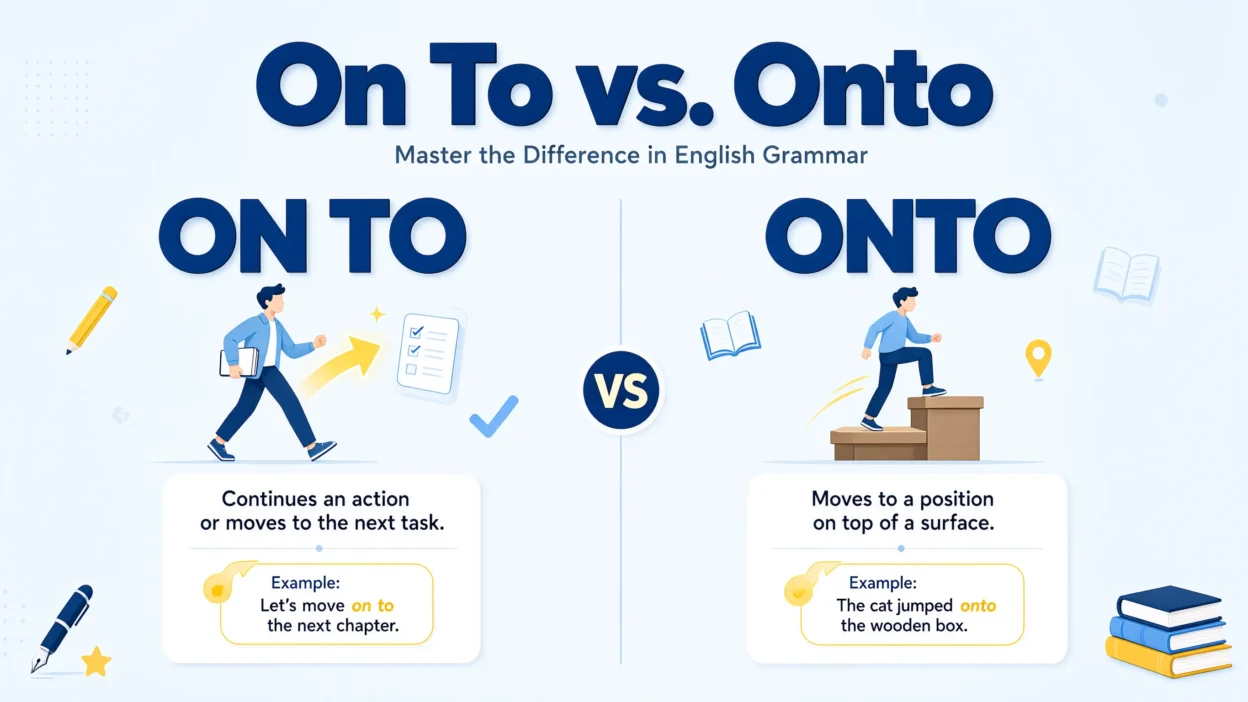
The main difference is that “onto” usually describes movement to a surface or position, while “on to” is used when “on” belongs to a verb or expression and “to” begins the next part of the sentence. For example, “The cat jumped onto the table” describes movement toward a surface.
In contrast, “She moved on to the next question” means she continued and started dealing with something new. Although the expressions can occasionally overlap in meaning, their grammatical roles help you choose the correct form. Once you understand how each expression works, you can use both confidently in conversations, school assignments, emails, and professional writing.
Quick Answer: On To vs Onto
Onto is usually a preposition that describes movement to or placement on a surface, as in “He climbed onto the roof.” On to consists of two separate words, often used when “on” belongs to a verb or means continuing, and “to” introduces what follows, as in “She went on to explain the answer.” Choose the spelling that matches the sentence’s meaning and structure.
Why Do People Confuse On To and Onto?
People often confuse “on to” and “onto” because both contain the word “on” followed by “to.” In everyday speech, they may sound identical, making it difficult to recognize the difference when writing.
Another reason for the confusion is that both expressions can describe actions involving movement, progress, or a change of position. However, their grammatical functions are different.
Consider these examples:
- Onto: The boy jumped onto the bed.
- On to: The boy went on to win the competition.
In the first sentence, “onto” describes movement toward a surface. In the second, “went on to win” means the boy continued and eventually achieved something.
The easiest way to distinguish them is to examine the role of each word in the sentence rather than relying only on how the phrase sounds.
What Does Onto Mean?
Onto is a preposition that commonly describes movement to a surface or a position on something. It can also describe moving into a new situation, position, or state.
When something moves from one place to a position on another object, “onto” is often the correct choice.
Examples of Onto in Sentences
- The cat jumped onto the sofa.
- She placed her books onto the desk.
- The children climbed onto the bus.
- Water spilled onto the floor.
- He stepped onto the stage.
In each example, “onto” connects an action with a destination or position.
When Is Onto Used?
Use “onto” when describing:
- Movement to a surface: The bird flew onto the fence.
- Placing something somewhere: He put the keys onto the counter.
- Climbing or stepping onto something: She climbed onto the horse.
- Moving into a position: The company moved onto a larger platform.
- Becoming aware of something: The detective was onto a new clue.
The last example uses the expression “be onto something,” which means discovering, suspecting, or recognizing something important.
What Does On To Mean?
On to is a two-word expression used when “on” and “to” perform separate grammatical functions. It commonly appears when a verb phrase ends with “on” and “to” introduces an action, destination, person, or thing.
For example, in “She went on to become a doctor,” the expression “went on” means continued, while “to become” introduces the next action or outcome.
Examples of On To in Sentences
- We moved on to the next chapter.
- He went on to explain the problem.
- She passed the message on to her manager.
- Let’s get on to the main topic.
- The student went on to become a successful writer.
These sentences show that “on” is connected to an existing expression, while “to” introduces what follows.
When Is On To Used?
Use “on to” in situations such as:
- Continuing to another subject: Let’s move on to the next lesson.
- Proceeding to a new activity: We went on to discuss the results.
- Passing something to another person: She handed the responsibility on to her colleague.
- Moving forward in a sequence: He went on to complete the project.
- Using a phrasal verb: The team held on to its lead.
Remember that the correct spelling depends on the sentence’s grammatical structure, not simply on whether the sentence describes movement or progress.
On To vs Onto: Comparison Table
| Feature | On To | Onto |
| Number of words | Two | One |
| Main function | Keeps “on” and “to” grammatically separate | Usually acts as a preposition |
| Common meaning | Continuing, proceeding, or passing something along | Movement to a surface or position |
| Example | She went on to teach English. | She stepped onto the platform. |
| Common pattern | Go on to do something | Jump onto something |
| Memory clue | “On” belongs to an expression or verb | Movement or position on a surface |
Both forms are correct English. The important thing is choosing the one that fits the intended meaning.
When Should You Use On To or Onto?
Choosing between these expressions becomes easier when you identify what the sentence is trying to communicate.
Use Onto for Movement Toward a Surface
When an action involves moving to or placing something on a surface, “onto” is usually appropriate.
Examples:
- The dog jumped onto the sofa.
- She climbed onto the roof.
- He threw the ball onto the field.
The word identifies the destination or position reached by the action.
Use On To When Continuing an Action
When “on” belongs to a verb phrase and “to” introduces a new action, use two words.
Examples:
- She went on to study medicine.
- They moved on to another question.
- He went on to explain the decision.
Here, the expression describes continuation or progression rather than movement onto a physical surface.
Use On To With Phrasal Verbs
Some phrasal verbs naturally end in “on,” and the following “to” begins a separate phrase.
Examples:
- Hold on to your ticket.
- Pass the information on to your teacher.
- Carry on to the next stage.
In these examples, keeping the words separate preserves the intended grammatical structure.
Can Onto and On To Ever Overlap?
Yes. In some contexts, especially when describing movement, either spelling may be possible depending on the sentence’s structure and the writer’s intended meaning.
For instance:
- She climbed onto the platform.
- She climbed on to the platform.
The first is the more straightforward and widely preferred choice for describing movement to a surface. The second may be understood as “climbed on” followed by “to the platform,” depending on the intended construction.
When the meaning is simple movement to a surface, choose “onto” for clarity.
12 Examples of On To vs Onto
The following examples show how these expressions work in everyday English.
| No. | Sentence | Correct Form | Why? |
| 1 | The cat jumped ___ the table. | Onto | It moved to a surface. |
| 2 | We moved ___ the next lesson. | On to | It indicates progression. |
| 3 | She placed the bag ___ the chair. | Onto | The bag was placed on a surface. |
| 4 | He went ___ become a teacher. | On to | It introduces a later achievement. |
| 5 | The child climbed ___ the bed. | Onto | It describes movement to a surface. |
| 6 | Let’s get ___ the main issue. | On to | It means proceeding to a topic. |
| 7 | The ball rolled ___ the grass. | Onto | It describes movement to a surface. |
| 8 | She passed the details ___ her colleague. | On to | It means passing information along. |
| 9 | The athlete stepped ___ the track. | Onto | It describes movement to a surface. |
| 10 | He held ___ his old notebook. | On to | “Hold on to” means keep something. |
| 11 | The actor walked ___ the stage. | Onto | It describes movement to a surface. |
| 12 | The researcher went ___ publish several books. | On to | It describes subsequent achievements. |
More Examples in Everyday Contexts
At school: The teacher moved on to the next topic after explaining the lesson.
At home: The puppy climbed onto the couch and fell asleep.
At work: After completing the report, Maria went on to prepare the presentation.
During travel: The passengers stepped onto the train.
In a conversation: Let’s move on to the question everyone wants answered.
These examples demonstrate that the correct expression depends on whether you mean reaching a position or continuing to something else.
Common Mistakes With On To and Onto
Even confident English speakers sometimes mix up these expressions. Here are several mistakes to watch for.
Mistake 1: Using Onto for Every Situation
Incorrect: She went onto explain the answer.
Correct: She went on to explain the answer.
Why? “Went on” expresses continuation, while “to explain” introduces the next action.
Mistake 2: Separating Onto When Movement Is Clear
Less suitable for the intended meaning: The cat jumped on to the table.
Preferred: The cat jumped onto the table.
The two-word version can sometimes be interpreted differently, but “onto” clearly expresses movement to the table’s surface.
Mistake 3: Confusing On To With Into
Incorrect for movement to the outside surface: The child climbed into the roof.
Correct: The child climbed onto the roof.
“Into” generally describes movement from outside to inside, whereas “onto” describes movement to a surface.
Mistake 4: Ignoring the Verb Phrase
Incorrect: Please pass the documents onto the manager.
Clearer for the intended meaning: Please pass the documents on to the manager.
The expression “pass on” means transfer or forward something, while “to the manager” identifies the recipient. In some contexts, “pass onto” may be used differently, so consider the intended meaning.
Mistake 5: Assuming Both Forms Always Mean the Same Thing
“Onto” often describes a destination or position, while “on to” commonly signals continuation or forms part of a phrasal verb followed by another phrase.
Always check the meaning before deciding which spelling to use.
What Is an Easy Memory Trick for On To vs Onto?
Use this simple memory trick:
Onto = movement to a surface.
Think of a cat jumping onto a table. The word describes where the cat lands.
On to = continuing or passing something along.
Think of a student moving on to the next lesson or someone passing a message on to a friend.
You can also use a quick test: if you can clearly describe the action as movement to a surface, “onto” is likely correct. If “on” belongs to a phrase such as “go on,” “move on,” or “pass on,” check whether “to” introduces the next part of the sentence.
This trick works in many everyday situations, although the full grammatical context should always guide your final choice.
On To vs Onto in American and British English
The distinction between “on to” and “onto” is broadly similar in American and British English. Both varieties use “onto” for movement to a surface and “on to” in expressions such as “go on to explain” or “pass on to someone.”
There may be differences in individual style guides and editorial preferences, but neither variety follows a completely different rule for these expressions.
Examples accepted in both varieties include:
- American English: The dog jumped onto the bed.
- British English: The dog jumped onto the bed.
- American English: She went on to study law.
- British English: She went on to study law.
For formal writing, consistency and grammatical meaning are more important than choosing a spelling based on nationality.
Similar Words and Expressions
Understanding related prepositions can make the difference between “on to” and “onto” easier to remember.
| Word or Expression | Meaning | Example |
| On | A position on a surface or continued activity | The book is on the desk. |
| Into | Movement from outside to inside | She walked into the room. |
| In to | Separate uses of “in” and “to” | He turned his homework in to the teacher. |
| Onward | Continuing forward | The travelers moved onward. |
| Toward | In the direction of something | She walked toward the door. |
| Up to | Reaching a point or limit, or being someone’s responsibility | The choice is up to you. |
| Over to | Moving to another place or person | He handed the microphone over to her. |
On To vs In To
“On to” and “in to” both contain two words, but they are used in different grammatical contexts.
- On to: She went on to explain the results.
- In to: He turned his assignment in to the teacher.
In the second example, “in” belongs to the phrasal verb “turn in,” while “to” identifies the recipient.
Onto vs Into
These two prepositions describe different kinds of movement.
- Onto: The child climbed onto the chair.
- Into: The child climbed into the box.
The first sentence describes movement to the chair’s surface. The second describes movement inside the box.
Final Verdict: On To or Onto?
The correct choice depends on what you want to say.
Use “onto” when describing movement to a surface or a position, such as “The bird flew onto the roof.”
Use “on to” when “on” belongs to a verb phrase or expresses continuation, such as “She went on to win the award.”
If you are unsure, examine the verb and the meaning of the entire sentence. This simple habit will help you avoid most mistakes and choose the correct form in everyday and formal writing.
FAQs:
1. Is Onto One Word or Two?
“Onto” is one word. It is commonly used as a preposition to describe movement to a surface or position. For example, “The boy jumped onto the bed.”
2. Is On To Ever Correct?
Yes. “On to” is correct when “on” and “to” perform separate grammatical functions. For example, “She went on to become a doctor.” Here, “went on” expresses continuation, and “to become” introduces the next action.
3. What Is the Difference Between On To and Onto?
“Onto” usually describes movement to a surface or position, while “on to” commonly appears when a verb phrase ending in “on” is followed by a separate phrase beginning with “to.” The sentence’s grammatical structure determines the correct choice.
4. Should I Write Jumped On To or Jumped Onto?
For the usual meaning of moving onto a surface, write “jumped onto.” For example, “The dog jumped onto the sofa.” This is the clearest choice when describing the destination of a jump.
5. Is It Move On To or Move Onto?
Both can be correct, depending on the meaning. Use “move on to” when progressing to a new topic or activity, as in “Let’s move on to the next question.” Use “move onto” when describing movement to a surface or position, as in “The workers moved onto the platform.”
6. Is Onto Correct in British English?
Yes. “Onto” is standard in British English, just as it is in American English. The distinction between “on to” and “onto” is generally the same in both varieties.
7. How Can I Remember When to Use On To or Onto?
Remember that “onto” often describes movement to a surface, while “on to” commonly expresses continuation or follows a phrasal verb. For example, “jump onto the table” and “go on to explain” illustrate the difference.
Remember This
- Onto: Movement to a surface or position.
- On to: Separate words used for continuation or other grammatical purposes.
- Jump onto the bed: Describes movement to a surface.
- Go on to explain: Describes continuing with another action.
- Pass on to a colleague: Describes transferring something to another person.
The key is to understand the sentence’s meaning instead of relying on how the words sound.
Conclusion
Understanding “on to” versus “onto” is a small but useful step toward better English writing. Although the expressions look similar, they serve different purposes. “Onto” usually describes movement to a surface or position, while “on to” often appears when an expression ending in “on” is followed by a separate phrase beginning with “to.” Learning these patterns will help you recognize the correct form more quickly.
When writing, pay attention to the verb, the destination, and the meaning you want to communicate. Use “the cat jumped onto the table” to describe movement to a surface, and “she went on to explain the answer” to describe continuation. With regular practice and attention to context, you will become more confident using both expressions in conversations, academic assignments, and professional communication.

I am Andrew Foster, a passionate language writer who enjoys helping readers discover the right synonyms and improve their vocabulary. I create clear, accurate, and engaging content that makes learning English simple, practical, and enjoyable.