English has many words that look or sound almost identical but have completely different meanings. Discrete vs. discreet is a common example. Both words are pronounced the same way, but they are not interchangeable. Choosing the wrong one can change the meaning of your sentence and create confusion for your readers.
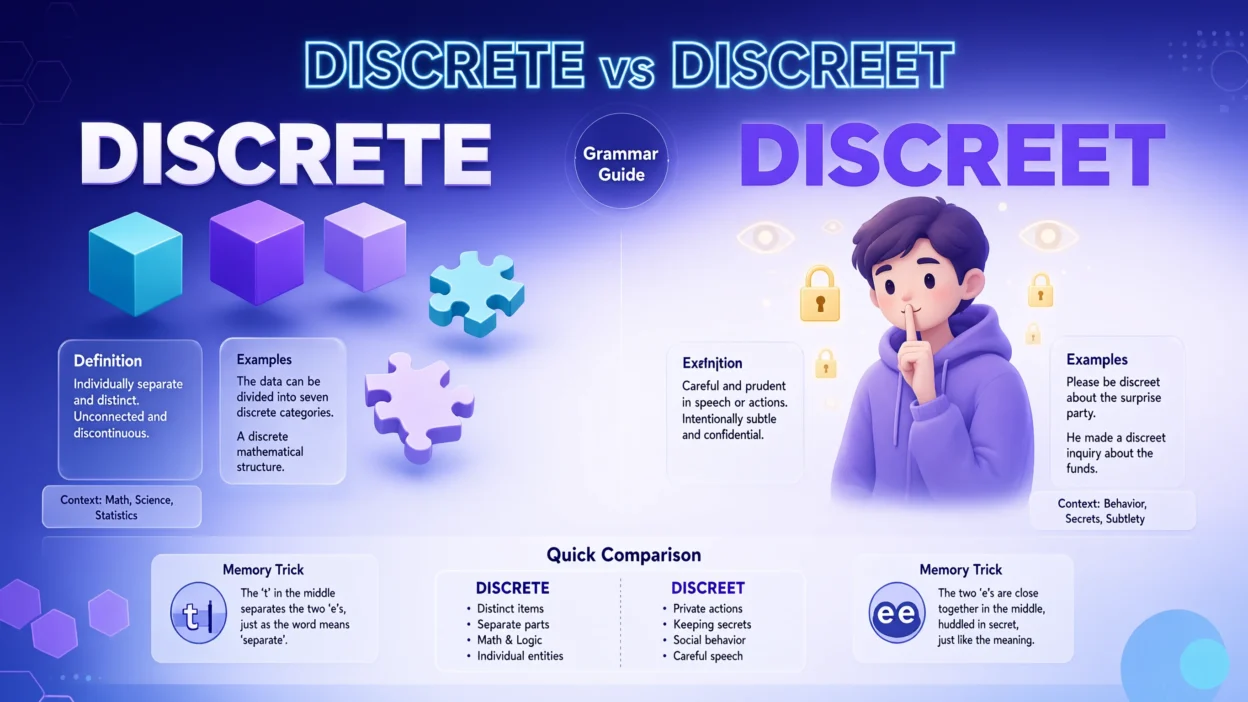
The main difference is simple: discrete means separate, distinct, or individually different, while discreet means careful, tactful, and respectful of privacy. You use discrete when talking about separate items, categories, or parts. You use discreet when describing someone who knows how to keep information private or behave without attracting unwanted attention.
Understanding this distinction can help you write more clearly in academic assignments, professional emails, everyday conversations, and formal documents. In this guide, you will learn the definitions, differences, spelling rules, and practical examples of both words.
Quick Answer: Discrete vs. Discreet
Discrete means separate, distinct, or individually identifiable. Discreet means careful, tactful, and respectful of privacy. Although both words are pronounced identically, their meanings are different. Use discrete for separate things or categories and discreet for private, thoughtful, or cautious behavior.
Why Do People Confuse Discrete and Discreet?
People often confuse these words because they:
- Have exactly the same pronunciation.
- Have almost identical spellings.
- Differ by only one letter arrangement.
- Are frequently used in formal and professional writing.
Both words are pronounced /dɪˈskriːt/, which sounds like “dih-SKREET.”
However, their meanings are quite different.
One describes something that is separate from other things, while the other describes someone who behaves carefully and avoids sharing private information.
The easiest way to avoid confusion is to remember that discrete relates to separation, whereas discreet relates to privacy and good judgment.
1. What Does Discrete Mean?
Discrete is an adjective that means separate, distinct, or individually distinguishable from other things.
It describes objects, ideas, categories, units, or elements that are considered separately rather than as one continuous whole.
Simple Meaning of Discrete
In simple English, discrete means:
- Separate
- Distinct
- Individual
- Independent
- Clearly divided
- Not connected as one continuous unit
Examples of Discrete in Sentences
- The course is divided into five discrete sections.
- Each department operates as a discrete unit.
- The researcher studied three discrete groups.
- The report contains several discrete categories.
- These are two discrete problems that need different solutions.
Where Is Discrete Commonly Used?
You will often find discrete in these contexts:
- Education: Discrete subjects or learning units.
- Mathematics: Discrete numbers, values, and structures.
- Science: Separate elements or measurable units.
- Technology: Individual data points or components.
- Business: Separate departments, tasks, or operations.
For example, in mathematics, discrete mathematics studies structures involving distinct, separate values rather than continuous quantities.
2. What Does Discreet Mean?
Discreet is an adjective that means careful, tactful, and sensible when dealing with sensitive information or situations.
It describes someone who understands the importance of privacy and knows when to speak, what to say, and how to avoid unnecessary attention.
Simple Meaning of Discreet
In simple English, discreet means:
- Careful
- Tactful
- Private
- Cautious
- Respectful
- Sensible
- Not attracting unnecessary attention
Examples of Discreet in Sentences
- She was discreet about her friend’s personal problems.
- Please be discreet when discussing confidential information.
- He made a discreet request during the meeting.
- The receptionist handled the situation discreetly.
- They chose a discreet location for their conversation.
Where Is Discreet Commonly Used?
The word discreet is commonly used when discussing:
- Privacy: Keeping personal information confidential.
- Relationships: Avoiding unnecessary gossip.
- Workplaces: Handling sensitive conversations carefully.
- Social situations: Behaving tactfully and respectfully.
- Professional communication: Sharing information only when appropriate.
For example, a discreet employee does not discuss confidential company information with people who are not authorized to know it.
Discrete vs. Discreet: Comparison Table
| Feature | Discrete | Discreet |
| Part of speech | Adjective | Adjective |
| Meaning | Separate or distinct | Careful or tactful |
| Main idea | Separation | Privacy |
| Describes | Things, units, categories | People, actions, behavior |
| Common usage | Mathematics, science, business | Relationships, workplaces, communication |
| Synonyms | Separate, distinct, individual | Tactful, cautious, diplomatic |
| Opposite | Continuous, connected | Indiscreet, careless |
Remember: Discrete is about things being separate. Discreet is about behaving carefully and protecting privacy.
When Should You Use Discrete or Discreet?
Choosing the correct word becomes easier when you understand what you want to describe.
When to Use Discrete
Use discrete when you are talking about separate or distinguishable things.
Examples:
- The project has four discrete stages.
- The company manages two discrete operations.
- The experiment involved several discrete variables.
- Each student completed a discrete assignment.
Ask yourself: Are the things separate or individually identifiable?
If the answer is yes, discrete is probably the correct choice.
When to Use Discreet
Use discreet when describing careful behavior, privacy, or tact.
Examples:
- Please remain discreet about the announcement.
- She gave him a discreet warning.
- He was discreet when discussing the issue.
- The manager handled the complaint discreetly.
Ask yourself: Am I describing someone being careful, private, or tactful?
If the answer is yes, use discreet.
10+ Examples of Discrete vs. Discreet in Sentences
The following examples show how both words work in everyday and professional English.
| Discrete Example | Discreet Example |
| The book has six discrete chapters. | She was discreet about her plans. |
| We identified three discrete problems. | Please be discreet with this information. |
| The system contains discrete components. | He made a discreet phone call. |
| Each group completed a discrete task. | The doctor was discreet with patient details. |
| The data consists of discrete values. | She gave me a discreet signal. |
| The company has discrete departments. | They had a discreet conversation. |
| These are discrete scientific concepts. | He remained discreet throughout the discussion. |
| The experiment used discrete samples. | The staff handled the matter discreetly. |
| Each lesson covers a discrete topic. | She discreetly avoided the personal question. |
| The design has several discrete elements. | They discreetly left the room. |
| The research examined discrete categories. | He was discreet when sharing the news. |
| The program contains discrete modules. | We need a discreet way to discuss this. |
More Examples in Everyday Contexts
Discrete:
- The teacher divided the subject into discrete lessons.
- Each box contains a discrete collection of items.
- The application processes discrete pieces of information.
Discreet:
- My friend was discreet about my surprise party.
- She discreetly changed the subject.
- Please make a discreet inquiry before sharing the details.
These examples demonstrate that the two words cannot replace each other without changing the meaning.
Common Mistakes When Using Discrete and Discreet
Even experienced English speakers sometimes mix up these words because their pronunciation is identical.
Here are some common mistakes and their corrections.
Mistake 1: Using Discreet Instead of Discrete
Incorrect
The experiment involved three discreet groups.
Correct
The experiment involved three discrete groups.
Why? The sentence describes separate groups, not people behaving privately.
Mistake 2: Using Discrete Instead of Discreet
Incorrect
Please be discrete about the confidential information.
Correct
Please be discreet about the confidential information.
Why? The sentence asks someone to protect private information.
Mistake 3: Assuming Both Words Have the Same Meaning
Although they sound alike, they have different definitions and uses. Never choose between them based only on pronunciation.
Mistake 4: Confusing Discreet With Discrete in Professional Writing
Using the wrong word in a business email, academic paper, or formal report can make your message unclear.
Always consider whether you are describing separate elements or careful behavior.
Easy Memory Trick: How to Remember Discrete vs. Discreet
A simple memory trick can help you remember the difference permanently.
DISCRETE
Separate things
T = Two
Think of the letter T in discrete as representing two or more separate things.
Example: Two discrete groups are separate groups.
DISCREET
Privacy and tact
EE = Keep
Think of the double E in discreet as a reminder to keep information private.
Example: A discreet person knows when to keep a secret.
Another helpful trick:
- Discrete = Different and separate.
- Discreet = Discerning and careful.
These associations make it easier to choose the correct spelling.
Discrete vs. Discreet in American and British English
There is no spelling difference between these words in American and British English.
Both varieties use:
- Discrete to mean separate or distinct.
- Discreet to mean careful, tactful, or private.
Their pronunciation and meanings are also essentially the same in both varieties.
Examples:
American English:
- The company has several discrete departments.
- Please be discreet when discussing the matter.
British English:
- The company has several discrete departments.
- Please be discreet when discussing the matter.
You can use both words confidently in American and British writing without changing their spelling.
Similar Words Related to Discrete and Discreet
Understanding related vocabulary can help you expand your English skills and choose more accurate words.
Synonyms of Discrete
These words describe things that are separate or distinct.
- Separate: Not joined or connected.
- Distinct: Clearly different from something else.
- Individual: Belonging to one person or thing.
- Independent: Not depending on another thing.
- Detached: Not physically or emotionally connected.
- Different: Not the same as something else.
- Isolated: Separate from other things.
Synonyms of Discreet
These words describe careful, private, or tactful behavior.
- Tactful: Careful not to upset or offend others.
- Diplomatic: Skilled at handling sensitive situations.
- Cautious: Careful to avoid problems.
- Prudent: Showing good judgment.
- Reserved: Not revealing too much information or emotion.
- Confidential: Intended to be kept private.
- Circumspect: Careful to consider possible consequences.
Discrete vs. Distinct
Both words can describe things that are different or distinguishable.
However, discrete emphasizes separation into individual units, while distinct emphasizes being clearly different or recognizable.
Discreet vs. Secretive
Both words can relate to privacy, but they are not identical.
- Discreet: Careful and tactful about private matters.
- Secretive: Unwilling to share information or reveal details.
A discreet person respects privacy, while a secretive person may deliberately hide information.
Final Verdict: Discrete or Discreet?
The difference between discrete and discreet comes down to their meanings.
- Use discrete when describing separate, distinct, or individual things.
- Use discreet when describing someone who behaves carefully, protects privacy, or handles sensitive situations tactfully.
Both words sound exactly alike, but their spelling and meanings are different.
If you are writing about separate categories, choose discrete. If you are writing about privacy, confidentiality, or careful behavior, choose discreet.
FAQs:
1. What is the main difference between discrete and discreet?
Discrete means separate or distinct, while discreet means careful, tactful, and respectful of privacy. Both words sound the same but have different meanings and spellings.
2. Are discrete and discreet pronounced the same?
Yes. Both words are pronounced /dɪˈskriːt/, which sounds like “dih-SKREET.” They are homophones because they have identical pronunciations but different meanings and spellings.
3. Is discreet a synonym for discrete?
No. Discreet is not a synonym for discrete. Discreet means tactful or careful about private matters, whereas discrete means separate or individually distinguishable.
4. What is an example of discrete in a sentence?
An example is: “The teacher divided the course into five discrete units.” Here, discrete means that each unit is separate and individually identifiable.
5. What is an example of discreet in a sentence?
An example is: “She was discreet about her friend’s personal information.” Here, discreet means that she respected her friend’s privacy and did not share sensitive details.
6. What is the opposite of discreet?
The opposite of discreet is indiscreet, which describes someone who is careless about privacy or shares information without considering the consequences.
Other related opposites include tactless, imprudent, and careless, depending on the context.
7. What is the opposite of discrete?
The opposite of discrete is often continuous, especially when discussing mathematics, science, or separate versus connected quantities.
Other possible opposites include connected, combined, and continuous, depending on the sentence.
8. What is the easiest way to remember discrete and discreet?
Remember that discrete has a T for two or more separate things, while discreet has double E as a reminder to keep information private. This simple spelling trick helps you remember their different meanings.
Remember This
DISCRETE = SEPARATE
Used for individual things, categories, groups, and units.
DISCREET = PRIVATE
Used for careful behavior, tact, and protecting confidential information.
Same pronunciation, different meanings!
Conclusion
Understanding the difference between discrete and discreet is important for clear and accurate English writing. Although these words sound identical, they serve different purposes. Discrete describes separate or distinct things, while discreet describes someone who behaves carefully and respects privacy. Learning their meanings and examples will help you avoid common spelling mistakes.
The next time you use either word, think about the message you want to communicate. If you mean separate objects, groups, or categories, choose discrete. If you mean privacy, confidentiality, or tactful behavior, choose discreet. With a little practice, you can use both words confidently in everyday conversations, academic assignments, and professional writing.

I am Olivia Brooks, a language enthusiast and writer at SynonymsHive. I enjoy creating clear, engaging content about synonyms, vocabulary, and word meanings, helping readers improve their writing and communicate with confidence every day.