English has many words and phrases that look similar but have different meanings. Everyone and every one are a common example. Although they sound exactly the same, they are not interchangeable in every sentence. Knowing the difference can help you write more clearly and avoid common grammar mistakes.
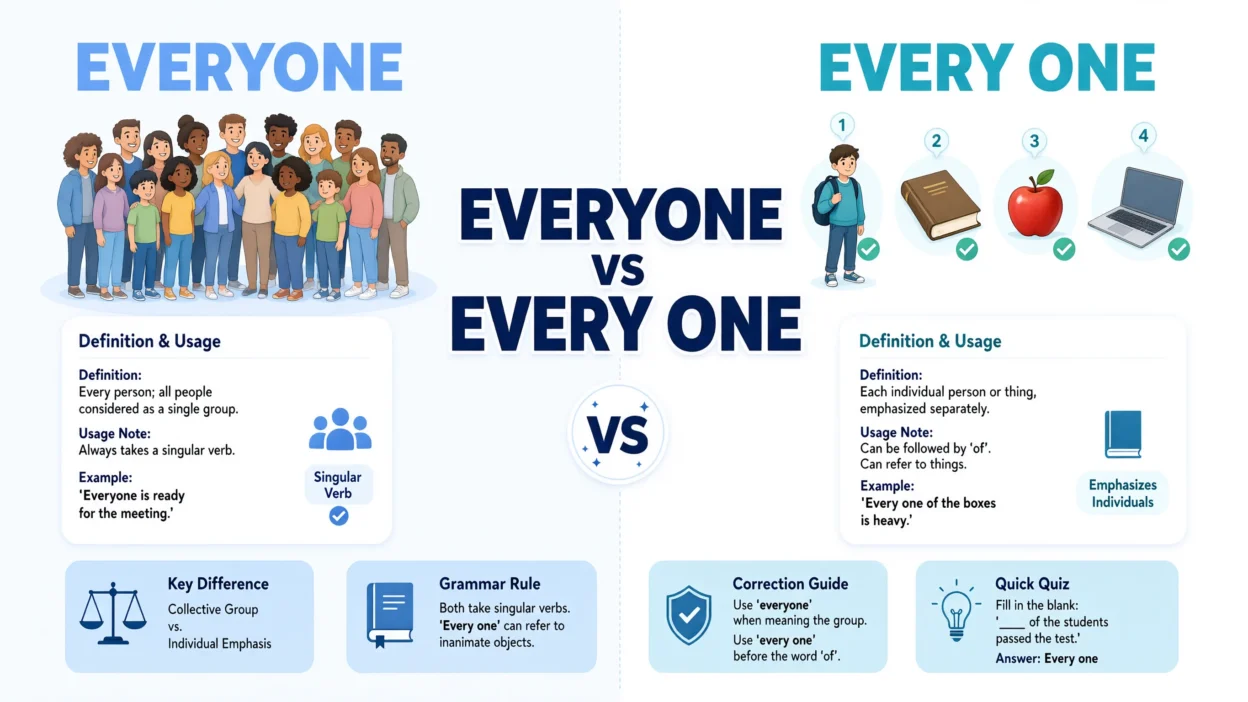
The main difference between everyone and every one is that everyone refers to all people in a group, while every one refers to each individual person or thing separately.
Everyone is an indefinite pronoun, whereas every one is a two-word phrase consisting of the determiner “every” and the pronoun “one.” For example, “Everyone enjoyed the party” refers to all the people at the party. On the other hand, “Every one of the students passed” emphasizes each student individually.
Both forms are correct, but they serve different purposes. Understanding when to use each one makes everyday writing, academic assignments, emails, and conversations more accurate.
Quick Answer: Everyone vs Every One
Everyone means all people in a group and is written as one word. Every one means each individual person or thing and is written as two words. Use everyone when referring to people collectively, and use every one when emphasizing individuals or specific items. For example, “Everyone is welcome” and “Every one of these books is useful.”
Why Do People Confuse Everyone and Every One?
People often confuse everyone and every one because they:
- Sound exactly the same when spoken.
- Have similar meanings related to all members of a group.
- Appear in similar sentence structures.
- Can sometimes refer to the same group of people.
- Differ mainly in grammatical structure and emphasis.
The biggest challenge is understanding whether you are talking about a group of people as a whole or emphasizing each individual member.
For example:
- Everyone agreed with the decision. (All people agreed.)
- Every one of the employees agreed with the decision. (Each employee agreed individually.)
Both sentences are grammatically correct, but the second places more emphasis on individual employees.
1. Everyone: Meaning, Definition, and Usage
Everyone is an indefinite pronoun that means all people or every person in a particular group. It is written as one word and is commonly used in everyday conversations, academic writing, professional communication, and informal messages.
It refers exclusively to people, not objects or things.
Definition of Everyone
According to standard English grammar, everyone means every person or all the people in a particular group.
It is a singular pronoun, even though it refers to multiple people. Therefore, it takes a singular verb.
Examples of Everyone in Sentences
- Everyone is invited to the birthday party.
- Everyone enjoyed the school trip.
- Everyone needs a little encouragement.
- Everyone was happy with the results.
- Everyone knows that honesty matters.
- Everyone should follow the instructions.
- Everyone has a different opinion.
- Everyone arrived before the meeting started.
When Should You Use Everyone?
Use everyone when:
- Referring to all people in a group.
- Making general statements about people.
- Talking about a group without naming each individual.
- Writing simple and natural sentences.
- Emphasizing the whole group rather than individual members.
Example: Everyone deserves respect and kindness.
Here, everyone refers to all people without identifying them separately.
2. Every One: Meaning, Definition, and Usage
Every one is a two-word expression used to refer to each individual person or thing in a group. It emphasizes individual members or items rather than treating them collectively.
Unlike everyone, every one can refer to both people and things.
Definition of Every One
Every one means each individual member or item in a particular group, without leaving anything out.
It is often followed by the preposition “of” and a plural noun or pronoun.
For example:
- Every one of the students received a certificate.
- Every one of these flowers looks beautiful.
- Every one of my friends attended the event.
In these sentences, every one emphasizes each individual person or object.
Examples of Every One in Sentences
- Every one of the students completed the assignment.
- I read every one of these books.
- Every one of my friends supported me.
- She checked every one of the answers.
- Every one of the children received a gift.
- He carefully examined every one of the documents.
- Every one of these apples is fresh.
- We enjoyed every one of the performances.
When Should You Use Every One?
Use every one when:
- Referring to each individual person.
- Talking about individual objects or items.
- Emphasizing that nothing or nobody is excluded.
- Using the phrase “every one of” before a plural noun or pronoun.
- Highlighting individual members of a group.
Example: Every one of the players received a medal.
This sentence emphasizes that each individual player received a medal.
Everyone vs Every One: Comparison Table
The following table highlights the main differences between these two expressions.
| Feature | Everyone | Every One |
| Meaning | All people | Each individual person or thing |
| Spelling | One word | Two words |
| Grammar | Indefinite pronoun | Two-word expression |
| Refers to | People only | People and things |
| Verb agreement | Singular | Usually singular |
| Common structure | Everyone is… | Every one of… |
| Emphasis | Whole group | Individual members |
| Example | Everyone is ready. | Every one of the books is useful. |
Important: Both everyone and every one generally take singular verbs when they function as the subject.
When to Use Everyone vs Every One
Choosing the correct expression becomes easier when you understand the purpose of your sentence.
Use Everyone When Referring to All People
If you want to talk about all the people in a group, use everyone.
Examples:
- Everyone enjoyed the concert.
- Everyone is welcome at the event.
- Everyone should respect other people’s opinions.
In each example, the sentence refers to people as a group.
Use Every One When Referring to Individual People
When you want to emphasize each person separately, use every one.
Examples:
- Every one of the teachers attended the meeting.
- Every one of my classmates passed the exam.
- Every one of the guests received an invitation.
The expression highlights each individual person.
Use Every One When Referring to Things
This is one of the most important differences between the two expressions.
Examples:
- Every one of these bags is expensive.
- I checked every one of the answers.
- Every one of the pictures looks beautiful.
You cannot replace every one with everyone in these sentences because everyone refers only to people.
15 Examples of Everyone vs Every One in Sentences
Here are practical examples to help you understand how both expressions work in everyday English.
| Everyone | Every One |
| Everyone is happy today. | Every one of the children is happy today. |
| Everyone enjoyed the movie. | Every one of the actors performed well. |
| Everyone knows the answer. | Every one of the answers is correct. |
| Everyone attended the meeting. | Every one of the employees attended the meeting. |
| Everyone loves good food. | Every one of these dishes tastes delicious. |
| Everyone was excited. | Every one of the players was excited. |
| Everyone received a message. | Every one of the messages was important. |
| Everyone deserves respect. | Every one of the guests deserves respect. |
| Everyone is ready for the trip. | Every one of the bags is ready. |
| Everyone enjoyed the performance. | Every one of the performances was entertaining. |
More Examples in Everyday Situations
In school:
- Everyone should complete their homework.
- Every one of the students should bring a notebook.
At work:
- Everyone is expected to attend the training session.
- Every one of the reports needs to be reviewed.
At home:
- Everyone loves spending time together.
- Every one of these rooms needs cleaning.
In social situations:
- Everyone enjoyed the celebration.
- Every one of the guests received a thank-you card.
In academic writing:
- Everyone should have equal opportunities.
- Every one of the research questions requires careful attention.
Common Mistakes When Using Everyone and Every One
Even experienced English speakers sometimes make mistakes with these expressions. Understanding the following examples will help you avoid them.
Mistake 1: Using Everyone for Things
Incorrect: Everyone of the books is interesting.
Correct: Every one of the books is interesting.
Why? Everyone refers to people, while every one can refer to individual objects.
Mistake 2: Writing Everyone as Two Words
Incorrect: Every one deserves kindness.
Correct: Everyone deserves kindness.
Why? When referring to all people generally, everyone should be written as one word.
Mistake 3: Using a Plural Verb with Everyone
Incorrect: Everyone are ready.
Correct: Everyone is ready.
Why? Everyone is grammatically singular and requires a singular verb.
Mistake 4: Using a Plural Verb with Every One
Incorrect: Every one of the students are present.
Correct: Every one of the students is present.
Why? Every one is treated as singular when it is the subject of the sentence.
Mistake 5: Confusing Meaning and Emphasis
Incorrect: Every one enjoyed the party.
Correct: Everyone enjoyed the party.
Why? If you mean all the people enjoyed the party, everyone is the natural choice. Every one would normally need additional context, such as “every one of them.
Easy Memory Trick: How to Remember the Difference
A simple memory trick can help you choose the correct expression every time.
- Everyone = Everybody. Both are written as one word and refer to all people.
- Every one = Each one. Both emphasize individual people or things.
Think about these examples:
- Everyone is invited. (Everybody is invited.)
- Every one of these books is interesting. (Each one of these books is interesting.)
Another helpful trick is to look for the word “of.”
If your sentence contains a structure such as “every one of the students” or “every one of the books,” you need the two-word expression.
Remember: Everyone is for people collectively, while every one is for individuals or items separately.
American vs British English: Is There Any Difference?
There is no meaningful difference between American and British English in the spelling or basic grammatical usage of everyone and every one.
Both varieties follow the same standard distinction:
- Everyone: One word meaning all people.
- Every one: Two words meaning each individual person or thing.
For example, both American and British writers would use:
- Everyone is welcome.
- Every one of the students is prepared.
- Every one of these documents needs checking.
The pronunciation is also essentially the same in both varieties.
Therefore, you do not need to change your spelling or usage depending on whether you are writing for an American or British audience.
Similar Words and Expressions to Everyone and Every One
Several English words and phrases have meanings similar to everyone and every one. However, their grammatical functions and usage can differ.
| Word or Phrase | Meaning | Example |
| Everybody | All people | Everybody enjoyed the event. |
| Each one | Every individual member | Each one received a prize. |
| Every person | All individual people | Every person needs support. |
| All people | Everyone in a group | All people deserve respect. |
| Each individual | Every separate person | Each individual has a choice. |
| All of them | The entire group | All of them arrived early. |
| Every single one | Each member without exception | Every single one was selected. |
| Everything | All things | Everything is ready. |
| Anyone | Any person | Anyone can participate. |
| Somebody | An unspecified person | Somebody left a message. |
Everyone vs Everybody
Everyone and everybody have almost identical meanings. Both refer to all people in a group and are grammatically singular.
Example:
- Everyone is excited.
- Everybody is excited.
Both sentences are correct.
Every One vs Each One
Every one and each one emphasize individual members of a group.
Example:
- Every one of the students passed.
- Each one of the students passed.
Both sentences emphasize the individual students.
Everyone vs Everything
These words are not interchangeable.
- Everyone refers to people.
- Everything refers to things, objects, or situations.
Example:
- Everyone is ready.
- Everything is ready.
Final Verdict: Everyone vs Every One
The difference between everyone and every one is mainly their spelling, meaning, and grammatical use.
Use everyone as one word when referring to all people in a group. Use every one as two words when referring to each individual person or thing separately.
For example:
- Everyone enjoyed the celebration.
- Every one of the gifts was beautifully wrapped.
Both expressions are correct English. The right choice depends on whether you are referring to all people collectively or emphasizing individual members or items.
FAQs:
1. What is the difference between everyone and every one?
Everyone means all people in a group and is written as one word. Every one means each individual person or thing and is written as two words. For example, “Everyone is happy” and “Every one of these books is useful.”
2. Is everyone one word or two words?
Everyone is always written as one word when it means all people. It is an indefinite pronoun used to refer to every person in a particular group.
Example: Everyone enjoyed the party.
3. When should I use every one instead of everyone?
Use every one when emphasizing each individual person or thing in a group. It is especially common in the structure “every one of.”
Example: Every one of the students received a certificate.
4. Can every one refer to things?
Yes. Every one can refer to individual objects, items, or people. Everyone, however, refers exclusively to people.
Example: Every one of these paintings is beautiful.
5. Is everyone singular or plural?
Everyone is grammatically singular, even though it refers to multiple people. Therefore, it takes singular verbs such as is, was, and has.
Example: Everyone has a different opinion.
6. Is every one followed by a singular or plural verb?
Every one generally takes a singular verb when it functions as the subject of a sentence.
Example: Every one of the players is talented.
Although the noun after “of” is plural, the subject is every one, which is singular.
7. Are everyone and everybody interchangeable?
Yes. Everyone and everybody have almost the same meaning and can usually be used interchangeably when referring to all people.
Example:
- Everyone is invited.
- Everybody is invited.
Both sentences are grammatically correct.
Remember This
- Everyone = All people.
- Every one = Each individual person or thing.
- Everyone is written as one word.
- Every one is written as two words.
- Both expressions generally take singular verbs.
The easiest way to remember the difference is to think of everyone as everybody and every one as each one.
Conclusion
Understanding the difference between everyone and every one is an important part of improving your English grammar and writing skills. Although these expressions sound the same, they have different meanings and grammatical uses. Everyone refers to all people in a group, while every one emphasizes each individual person or thing. Remembering this simple distinction will help you avoid spelling and sentence-structure mistakes.
The next time you write a sentence, think about what you want to express. If you are talking about all people, choose everyone. If you are emphasizing individual members or objects, choose every one. With a little practice, you will be able to use both expressions naturally and confidently in everyday conversations, academic writing, and professional communication.

I am Andrew Foster, a passionate language writer who enjoys helping readers discover the right synonyms and improve their vocabulary. I create clear, accurate, and engaging content that makes learning English simple, practical, and enjoyable.