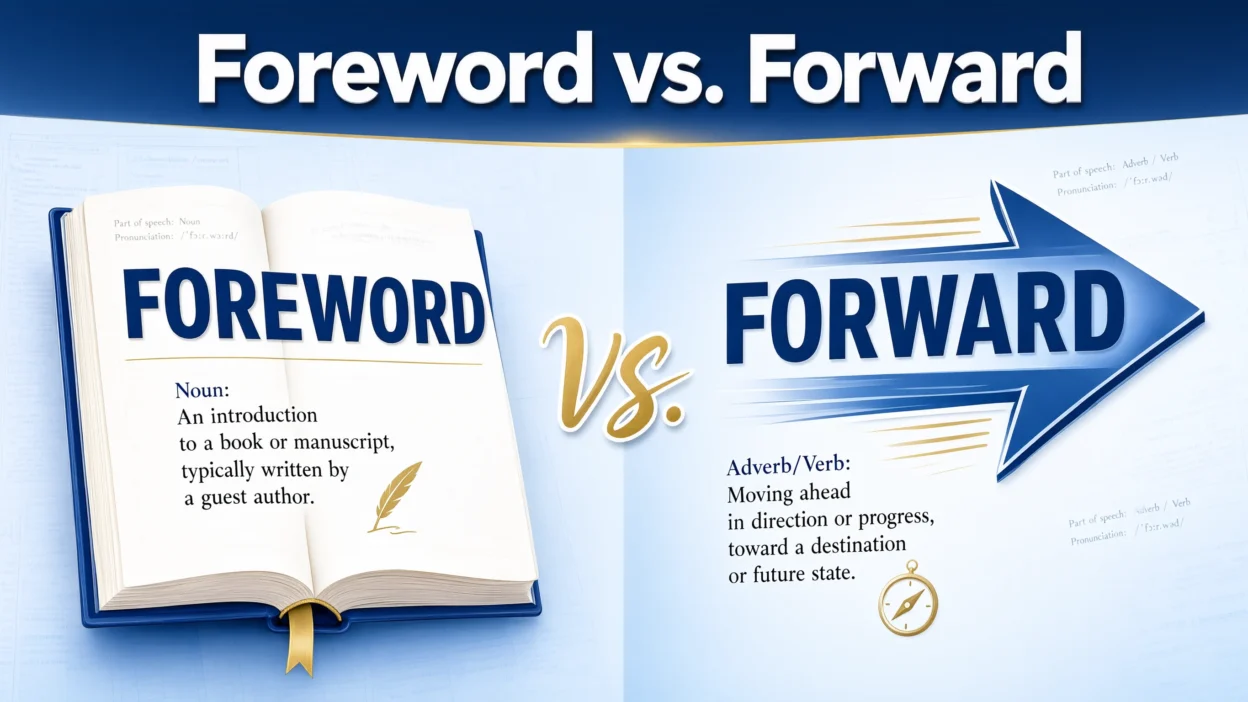
The words foreword and forward sound exactly the same, but they have different meanings, spellings, and uses. Because they are homophones, people often confuse them when writing emails, books, essays, and everyday messages. Knowing the difference can help you avoid spelling mistakes and communicate more clearly.
A foreword is a short introductory section at the beginning of a book, usually written by someone other than the author. In contrast, forward can describe movement toward something, mean ahead in position, or refer to sending something to another person.
It can also describe progress or a willingness to take action. Although these words sound alike, they cannot be used interchangeably. In this guide, you will learn what each word means, when to use it, and how to remember the difference through simple explanations and practical examples.
Quick Answer: Foreword vs Forward
Foreword is an introductory section in a book, usually written by someone who is not the author. Forward means toward the front or ahead. It can also describe progress or the action of sending a message, email, or document to someone else. Both words sound alike but have different meanings.
Why Do People Confuse Foreword and Forward?
People confuse these words because they have the same pronunciation but different spellings and meanings.
Both are pronounced like “FOR-werd” in standard English. However, their meanings depend on the context.
Here are the main reasons for the confusion:
- Similar pronunciation: Both words sound identical when spoken.
- Different spellings: One contains the extra letters “e” and “o.”
- Related to books and writing: Both words may appear in written materials.
- Different grammatical uses: Forward can function as an adjective, adverb, or verb, while foreword is a noun.
Understanding their individual meanings makes it easier to choose the correct word.
What Does Foreword Mean?
Foreword is a noun that refers to an introductory section at the beginning of a book. It usually explains the background of the book, introduces its subject, or provides information about the author’s work.
A foreword is commonly written by someone other than the book’s author, such as an expert, professor, respected writer, or another knowledgeable person.
Examples of Foreword
- The professor wrote a foreword for the new textbook.
- I enjoyed reading the foreword before starting the novel.
- The author’s mentor contributed a thoughtful foreword.
- Her book includes a foreword by a famous historian.
- The foreword explains why the book was written.
Where Is a Foreword Used?
You will commonly find a foreword in:
- Academic textbooks
- Biographies
- Historical books
- Research publications
- Professional guides
- Nonfiction books
Important: A foreword is different from a preface. A foreword is generally written by another person, while a preface is usually written by the author.
What Does Forward Mean?
Forward has several meanings depending on how it is used. It can describe movement toward the front, progress, or the act of sending something to another person.
It can function as an adjective, adverb, or verb.
Examples of Forward
- Please move forward to the next room.
- We must keep moving forward despite difficulties.
- She took one step forward.
- I will forward your email to the manager.
- The team is looking forward to the competition.
Where Is Forward Used?
The word forward appears in many everyday situations, including:
- Physical movement
- Personal development
- Business communication
- Email conversations
- Sports instructions
- Future plans and progress
Important: When forward is used as a verb, it means to send something received to another person or destination.
Foreword vs Forward: Key Differences
The following table highlights the main differences between these two commonly confused words.
| Feature | Foreword | Forward |
| Meaning | Introduction to a book | Ahead or toward the front |
| Word type | Noun | Noun, adjective, adverb, verb |
| Pronunciation | FOR-werd | FOR-werd |
| Main purpose | Introduces a book | Describes direction or progress |
| Common usage | Books and publications | Everyday speech and writing |
| Example | Read the foreword. | Move forward. |
| Related words | Introduction, opening | Ahead, onward, onward movement |
The easiest distinction is that foreword relates to books, while forward relates to direction, progress, or sending something onward.
When Should You Use Foreword or Forward?
Choosing between these words becomes simple when you understand the context.
When to Use Foreword
Use foreword when talking about an introductory section in a book or publication.
Examples:
- The author invited a famous writer to contribute a foreword.
- I read the foreword before beginning the biography.
- The foreword provides helpful background information.
Remember that foreword is a specific book-related term, not a general replacement for introduction.
When to Use Forward
Use forward when describing movement, direction, progress, or sending something to another person.
Examples:
- Please step forward.
- We are moving forward with the project.
- Can you forward this document to me?
- She always looks forward to new opportunities.
Remember that forward is much more flexible than foreword because it has several grammatical functions.
12 Examples of Foreword vs Forward in Sentences
These examples will help you understand how both words work in everyday English.
Foreword Examples
- The famous author wrote a foreword for the newly published novel.
- I found the foreword interesting and informative.
- The book’s foreword explains its historical background.
- Her professor agreed to write the foreword.
- The foreword gives readers an overview of the book’s purpose.
- Before reading the first chapter, I carefully studied the foreword.
Forward Examples
- Please move forward and take your seat.
- We should always look forward to better opportunities.
- She decided to move forward with her education.
- Could you forward the invitation to your colleagues?
- The football player passed the ball forward.
- He took a step forward to introduce himself.
Mixed Examples
Here are a few additional examples showing both words in context:
- The professor wrote the foreword, and the publisher forwarded the manuscript to the editor.
- After reading the foreword, I moved forward to the first chapter.
- Please forward the book’s foreword to the publishing team.
These sentences show why the context matters when choosing the correct spelling.
Common Mistakes When Using Foreword and Forward
Even experienced English speakers sometimes use these words incorrectly. Here are some common mistakes to avoid.
1. Using Forward Instead of Foreword
Incorrect: The author included a forward in the book.
Correct: The author included a foreword in the book.
Why? The sentence refers to a book’s introductory section, so foreword is correct.
2. Using Foreword to Describe Movement
Incorrect: Please move foreword.
Correct: Please move forward.
Why? Forward describes movement toward the front.
3. Confusing Foreword With Preface
A foreword and a preface are both introductory sections, but they are not exactly the same.
- Foreword: Usually written by someone other than the author.
- Preface: Usually written by the author to explain the book’s purpose or background.
4. Using Foreword When Talking About Emails
Incorrect: Please foreword this email to my colleague.
Correct: Please forward this email to my colleague.
Why? Forward is the correct verb for sending an email to another person.
Easy Memory Trick to Remember Foreword vs Forward
A simple memory trick can help you remember the difference permanently.
Foreword = Fore + Word
Think of the word “fore” as meaning before or at the front. A foreword appears before the main content of a book.
Forward = Moving Forward
Think of walking forward, moving ahead, or sending something onward.
Remember these two simple sentences:
- Foreword: The writer added a foreword to the book.
- Forward: Please move forward.
If you associate foreword with books and forward with movement, you will rarely confuse them again.
Foreword vs Forward in American and British English
There is no major difference between the meanings or spellings of foreword and forward in American and British English.
Both varieties use:
- Foreword for the introductory section of a book.
- Forward for movement, direction, progress, or sending something onward.
The pronunciation is also essentially the same in both varieties.
For example:
- American English: The author wrote a foreword for the book.
- British English: The author wrote a foreword for the book.
- American English: Please forward the email.
- British English: Please forward the email.
The distinction remains the same regardless of which variety of English you use.
Similar Words You Should Know
Learning related words can help you understand the difference between foreword and forward more clearly.
| Word | Meaning | Example |
| Preface | An author’s introduction to a book | Read the preface first. |
| Introduction | Opening section of a text or presentation | The introduction explains the topic. |
| Prologue | Opening section of a literary work | The novel begins with a prologue. |
| Afterword | A section placed at the end of a book | The author included an afterword. |
| Ahead | In front or further forward | She walked ahead. |
| Onward | Continuing forward | We continued onward. |
| Forwarding | Sending something to another person | Email forwarding is enabled. |
These words are related to book structure, direction, or communication, but each has its own specific meaning.
Final Verdict: Foreword vs Forward
The difference between foreword and forward is simple once you understand their meanings.
- Foreword is a noun that refers to an introductory section at the beginning of a book, usually written by someone other than the author.
- Forward describes movement toward the front, progress, or the act of sending something to another person.
Both words sound the same, but their spelling and grammatical functions are different. Always consider the meaning of your sentence before choosing one.
FAQs:
1. What is the main difference between foreword and forward?
The main difference is their meaning. Foreword refers to an introductory section in a book, while forward means ahead, toward the front, or to send something onward. They sound the same but are used in different contexts.
2. Is foreword one word or two words?
Foreword is one word. It is a noun used for an introductory section of a book, usually written by someone other than the author.
3. Does forward mean the same as ahead?
Yes, in many contexts, forward and ahead have similar meanings. Both can describe movement toward the front or progress. For example, “Move forward” and “Move ahead” can communicate the same basic instruction.
4. Can forward be used as a verb?
Yes. Forward can be used as a verb meaning to send something received to another person or destination.
Example: Please forward this email to the entire team.
5. Who usually writes a foreword in a book?
A foreword is usually written by someone other than the book’s author. It may be written by a respected expert, professor, professional, or another author who can introduce the book and its importance.
6. What is the difference between a foreword and a preface?
A foreword is generally written by someone other than the author to introduce the book. A preface is usually written by the author to explain the book’s purpose, background, or writing process.
7. Are foreword and forward homophones?
Yes. Foreword and forward are homophones because they have the same pronunciation but different spellings and meanings. Their correct usage depends on the context of a sentence.
Remember This
- Foreword = An introductory section of a book.
- Forward = Ahead, onward, progress, or sending something.
- Both words sound the same but have different meanings.
- Use foreword when discussing books and forward when discussing movement or communication.
Conclusion
Understanding the difference between foreword and forward can make your English writing clearer and more accurate. Although these words sound identical, they serve different purposes. Foreword refers to a book’s introductory section, while forward describes direction, progress, or sending something to another person.
The easiest way to remember the distinction is to connect foreword with books and forward with moving ahead. With regular practice and the examples in this guide, you can use both words confidently in everyday conversations, academic writing, and professional communication.

I’m James Parker, Administrator at SynonymsHive. I oversee content quality, improve user experience, and ensure reliable synonym resources. My passion is making language learning simple, accurate, and accessible for everyone.