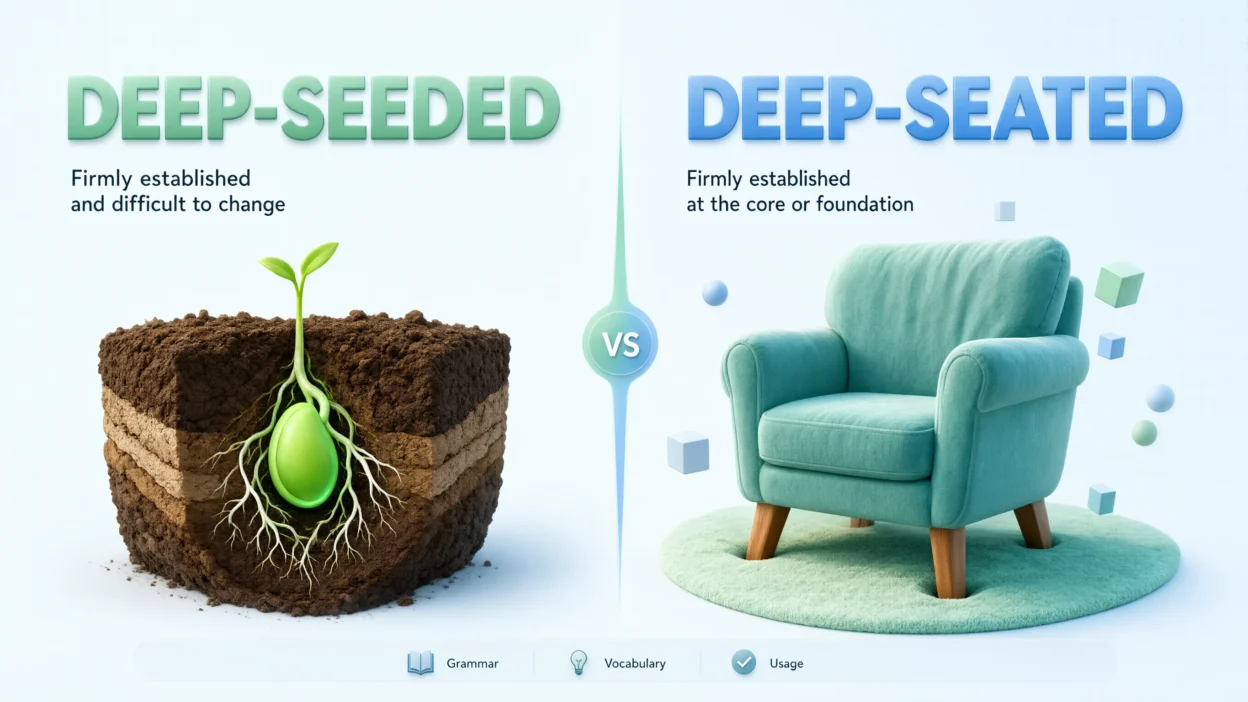
The phrases deep-seeded and deep-seated sound almost identical, so it is easy to confuse them when writing or speaking English. Both appear to describe something deeply established, strongly held, or difficult to change. However, only one is the standard expression for this meaning.
The correct phrase is deep-seated. It describes a feeling, belief, attitude, problem, or habit that has existed for a long time and is difficult to change or remove. Although many people write deep-seeded by mistake, it is generally considered a misspelling or misinterpretation of the established expression.
Understanding the difference can help you avoid common spelling mistakes and communicate more clearly. If you are writing an academic essay, a professional email, or an everyday message, knowing when to use deep-seated will make your English more accurate and natural.
Quick Answer: Deep-Seeded vs. Deep-Seated
Deep-seated is the correct expression when describing something firmly established, deeply rooted, or difficult to change. For example, a person may have deep-seated fears or deep-seated beliefs. Deep-seeded is a common spelling mistake caused by confusion with the word seed, but it is not the standard expression.
Why Do People Confuse Deep-Seeded and Deep-Seated?
People confuse these expressions mainly because they sound similar when spoken. Both contain the word deep, and the endings seeded and seated have similar sounds.
There is also a connection between their possible meanings:
- Seeded relates to planting seeds and growing something.
- Seated relates to something being firmly positioned or established.
Since seeds can grow deep roots, some people assume that deep-seeded is the correct expression for something deeply rooted.
However, the established English idiom is deep-seated, which refers to something firmly established over time.
What Does Deep-Seeded Mean?
Deep-seeded is generally considered an incorrect spelling of deep-seated when describing deeply established feelings, beliefs, attitudes, or problems.
The confusion probably comes from the idea that seeds grow roots deep in the ground. This makes the spelling seem logical, but it does not make it the standard idiomatic expression.
Examples of the incorrect usage:
- She has deep-seeded fears about failure.
- The organization faces deep-seeded problems.
- His deep-seeded beliefs influence his decisions.
- They are dealing with deep-seeded social issues.
Correct versions:
- She has deep-seated fears about failure.
- The organization faces deep-seated problems.
- His deep-seated beliefs influence his decisions.
- They are dealing with deep-seated social issues.
Remember that deep-seeded may appear in informal writing, online discussions, or edited text, but deep-seated is the accepted choice for standard English.
What Does Deep-Seated Mean?
Deep-seated is an adjective that describes something firmly established, deeply rooted, or difficult to change.
It is commonly used for emotions, beliefs, fears, attitudes, habits, traditions, and social problems.
The expression suggests that something has existed for a long time or developed so strongly that changing it requires considerable effort.
Examples of deep-seated in sentences:
- She has deep-seated fears about public speaking.
- The community has deep-seated cultural traditions.
- His deep-seated insecurity affects his relationships.
- The company must address its deep-seated problems.
- They have deep-seated disagreements about politics.
- Her deep-seated beliefs guide her decisions.
- The country is struggling with deep-seated inequality.
- He has a deep-seated fear of rejection.
In each example, deep-seated describes something that is firmly established and not easily changed.
Deep-Seeded vs. Deep-Seated: Comparison Table
The following table highlights the main differences between the two expressions.
| Feature | Deep-Seeded | Deep-Seated |
| Correctness | Generally incorrect in this idiom | Standard and correct |
| Meaning | Usually intended to mean deeply rooted | Firmly established |
| Word origin | Confusion with seeds and growth | Established idiomatic expression |
| Grammar | Adjective form | Adjective |
| Standard usage | Avoid in this context | Recommended |
| Example | Deep-seeded fear | Deep-seated fear |
The important difference: Use deep-seated when describing something deeply established, such as a fear, belief, habit, or problem.
When Should You Use Deep-Seeded or Deep-Seated?
Choosing the correct expression becomes easier when you understand the context.
When to Use Deep-Seeded
In standard English, avoid using deep-seeded to describe established emotions, beliefs, or problems.
If you are trying to express that something is deeply rooted or difficult to change, use deep-seated instead.
For example:
- Incorrect: He has deep-seeded anxiety.
- Correct: He has deep-seated anxiety.
When to Use Deep-Seated
Use deep-seated when describing something that has developed over time and become firmly established.
Common situations include:
- Emotions: Deep-seated sadness, fear, or anger.
- Beliefs: Deep-seated religious or political beliefs.
- Problems: Deep-seated social or economic problems.
- Attitudes: Deep-seated prejudice or resentment.
- Habits: Deep-seated behavioral patterns.
- Traditions: Deep-seated cultural practices.
For example, you might say, “The organization needs to address its deep-seated problems before making major changes.”
15 Examples of Deep-Seeded vs. Deep-Seated in Sentences
Here are practical examples showing how to use the correct expression naturally.
| Incorrect Usage | Correct Usage |
| She has deep-seeded fears. | She has deep-seated fears. |
| His deep-seeded beliefs affect his choices. | His deep-seated beliefs affect his choices. |
| They face deep-seeded problems. | They face deep-seated problems. |
| He has deep-seeded anger. | He has deep-seated anger. |
| The community has deep-seeded traditions. | The community has deep-seated traditions. |
| Her deep-seeded insecurity affects her confidence. | Her deep-seated insecurity affects her confidence. |
| The country struggles with deep-seeded inequality. | The country struggles with deep-seated inequality. |
| His deep-seeded resentment is difficult to overcome. | His deep-seated resentment is difficult to overcome. |
| They have deep-seeded disagreements. | They have deep-seated disagreements. |
| She developed deep-seeded trust issues. | She developed deep-seated trust issues. |
| The organization has deep-seeded cultural problems. | The organization has deep-seated cultural problems. |
| His deep-seeded habits are difficult to break. | His deep-seated habits are difficult to break. |
| The conflict comes from deep-seeded differences. | The conflict comes from deep-seated differences. |
| She struggles with deep-seeded anxiety. | She struggles with deep-seated anxiety. |
| Their deep-seeded attitudes prevent progress. | Their deep-seated attitudes prevent progress. |
Additional Correct Examples
- The disagreement is based on deep-seated mistrust.
- Years of experience helped him overcome his deep-seated fears.
- The school is trying to change deep-seated attitudes toward learning.
These examples demonstrate why deep-seated is the better choice in everyday, academic, and professional writing.
Common Mistakes When Using Deep-Seeded and Deep-Seated
Even experienced English speakers sometimes make mistakes with these expressions.
Here are some common errors to avoid.
1. Choosing the spelling based on pronunciation
Both expressions sound similar, but similar pronunciation does not mean they have the same spelling.
2. Assuming deep-seeded is correct because seeds grow roots
The comparison with seeds makes sense visually, but the established idiom is deep-seated.
3. Using both expressions interchangeably
Deep-seeded and deep-seated should not be treated as interchangeable spellings in standard writing.
4. Forgetting the hyphen
The standard expression is written as deep-seated, with a hyphen.
5. Using the expression for temporary feelings
Deep-seated generally suggests something established over time, rather than a brief or passing emotion.
For example:
- Natural: She has a deep-seated fear of failure.
- Less suitable: I have a deep-seated feeling of hunger right now.
What Is an Easy Memory Trick for Deep-Seeded vs. Deep-Seated?
A simple memory trick can help you remember the correct spelling.
Think of the word seated as something firmly placed or established.
Imagine a heavy chair that has been fixed in one position for years. It is difficult to move because it is firmly seated.
Similarly, a deep-seated belief or fear is firmly established in someone’s mind.
Remember:
- Seated = firmly established.
- Seeded = related to seeds and planting.
- Deep-seated = the correct idiom for deeply rooted feelings, beliefs, and problems.
This small trick can help you avoid the spelling mistake whenever you write the expression.
Is Deep-Seeded vs. Deep-Seated Different in American and British English?
No. There is no standard American-versus-British spelling difference for this expression.
Both American and British English use deep-seated to describe something firmly established or difficult to change.
Examples in American English:
- The company has deep-seated financial problems.
- She has deep-seated fears about the future.
Examples in British English:
- The country faces deep-seated social challenges.
- He has deep-seated concerns about education.
The spelling remains the same in both varieties of English.
Deep-seeded is not the standard alternative in either variety.
Similar Words and Expressions to Deep-Seated
If you want to express the same idea without repeating deep-seated, several alternatives may work depending on the sentence.
| Alternative | Meaning | Example |
| Deep-rooted | Firmly established | Deep-rooted beliefs |
| Entrenched | Difficult to change | Entrenched attitudes |
| Ingrained | Fixed through experience or habit | Ingrained behavior |
| Established | Existing for a long time | Established traditions |
| Long-standing | Continuing for years | Long-standing problems |
| Fundamental | Forming an essential part | Fundamental beliefs |
| Persistent | Continuing over time | Persistent fears |
| Embedded | Firmly fixed within something | Embedded attitudes |
| Chronic | Continuing for a long time | Chronic problems |
| Inherent | Naturally existing as part of something | Inherent characteristics |
These alternatives can make your writing more varied while preserving the intended meaning.
Final Verdict: Deep-Seeded or Deep-Seated?
The correct expression is deep-seated, not deep-seeded, when describing something firmly established or difficult to change.
Although deep-seeded may seem logical because seeds grow roots, it is not the standard spelling of this idiom.
Use deep-seated for:
- Deeply established fears
- Strong personal beliefs
- Long-standing problems
- Ingrained attitudes
- Persistent emotional issues
For clear and accurate English, always choose deep-seated in these contexts.
FAQs:
1. Is deep-seeded or deep-seated correct?
Deep-seated is correct when describing something firmly established or deeply rooted. Deep-seeded is generally a misspelling of the expression and should be avoided in standard English.
2. Why do people say deep-seeded instead of deep-seated?
People often confuse the expressions because they sound similar. They may also associate the word seeded with plant roots growing deep into the ground. However, the established idiom is deep-seated.
3. What does deep-seated mean in simple words?
Deep-seated means strongly established or difficult to change. It usually describes feelings, fears, beliefs, habits, or problems that have existed for a long time.
4. Is deep-seated one word or two words?
Deep-seated is written as two words joined by a hyphen. It is an adjective commonly used before nouns, such as deep-seated fear or deep-seated belief.
5. Can I use deep-seeded in formal writing?
It is best to avoid deep-seeded in formal writing when you mean something deeply established. Use deep-seated instead because it is the standard expression.
6. Is deep-seated the same as deep-rooted?
They have very similar meanings. Both describe something firmly established or difficult to change. For example, deep-seated beliefs and deep-rooted beliefs are both natural expressions.
7. Is deep-seated correct in British and American English?
Yes. Deep-seated is the standard expression in both American and British English. There is no difference in spelling between the two varieties.
Remember This
Deep-seated
Correct
✓
Use it for deeply established feelings, beliefs, fears, and problems.
Deep-seeded
Avoid
✗
Do not use it as an alternative spelling of deep-seated.
Conclusion
Understanding the difference between deep-seeded and deep-seated is simple once you remember the correct expression. Although both phrases sound similar, deep-seated is the accepted form when describing something deeply established, firmly rooted, or difficult to change. It is commonly used with words such as fear, belief, attitude, habit, and problem.
Whenever you are unsure which spelling to choose, remember that deep-seated is the correct choice in standard English. Use it in everyday conversations, academic assignments, professional documents, and online writing to make your sentences clear, natural, and grammatically accurate.

I’m James Parker, Administrator at SynonymsHive. I oversee content quality, improve user experience, and ensure reliable synonym resources. My passion is making language learning simple, accurate, and accessible for everyone.