
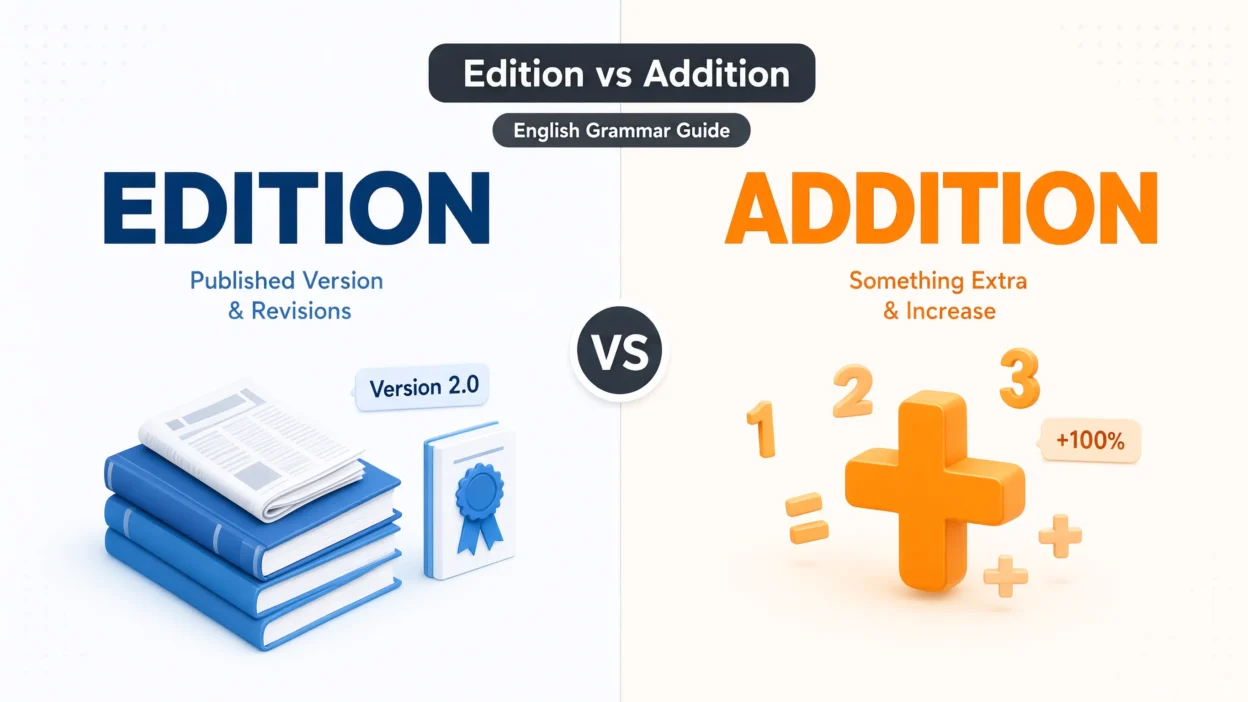
Have you ever confused edition with addition while writing an email, completing an assignment, or reading a book? These two words look and sound similar, but they have different meanings. Understanding the difference between edition and addition can help you choose the correct word and communicate more clearly.
The word edition usually refers to a particular version of a book, magazine, newspaper, or published work. For example, a student might buy the latest edition of an English textbook.
In contrast, addition refers to something added to something else or the mathematical process of combining numbers. For instance, adding a new chapter to a book is an addition, while publishing a revised version of that book creates a new edition.
Although both words are commonly used in education, publishing, and everyday conversations, they are not interchangeable. In this guide, you will learn their meanings, differences, correct usage, common mistakes, and practical examples to help you remember which word to use.
Quick Answer: Edition vs Addition
Edition means a particular version of a published work, such as the first edition of a book or a special edition of a magazine. Addition means something added to something else or the mathematical operation of adding numbers. Use edition when discussing versions and addition when discussing something extra or a sum.
Why Do People Confuse Edition and Addition?
People often confuse these words because they have similar spellings and pronunciation patterns. Both end in “-tion,” and both appear frequently in books, education, business, and everyday communication.
However, their meanings are different.
- Edition is connected with versions, publications, and releases.
- Addition is connected with adding, including extra things, and mathematics.
For example, “the new edition of the book” refers to a version of the book, while “an addition to the book” refers to something extra included in it.
Remember that a new addition does not automatically create a new edition. The correct word depends on what you want to describe.
What Does Edition Mean?
Edition refers to a particular version of a book, newspaper, magazine, or another published work. Different editions may contain updated information, corrections, new features, or changes to the original material.
The word can also describe a particular release of a product or publication, such as a limited edition collectible.
Examples of Edition in Sentences
- I bought the latest edition of the dictionary.
- The second edition contains several corrections.
- This magazine publishes a special holiday edition every year.
- My teacher recommended the revised edition of the textbook.
- The collector purchased a limited edition of the book.
Common Phrases With Edition
- First edition: The first published version of a work.
- Second edition: A later published version, often revised or updated.
- Revised edition: A version changed to correct or improve the original.
- Latest edition: The most recent version available.
- Special edition: A version released for a particular purpose or occasion.
- Limited edition: A version produced in limited quantities.
Use edition when the main idea is a particular version or release.
What Does Addition Mean?
Addition means the act of adding something or the thing that has been added. It is also a basic mathematical operation used to calculate the total of two or more numbers.
In everyday English, addition can refer to an extra feature, a new person in a group, an extension to a building, or new material included in a document.
Examples of Addition in Sentences
- The addition of new examples improved the lesson.
- Addition is one of the first mathematical operations children learn.
- The new employee is a valuable addition to our team.
- They built an addition to their house.
- The teacher made an addition to the reading list.
Common Phrases With Addition
- In addition: Used to introduce another point or piece of information.
- In addition to: Means besides or along with something.
- A new addition: Something or someone newly included.
- Addition problem: A mathematical question involving adding numbers.
- An addition to the team: A new member who joins a group.
- Home addition: An extension or extra section added to a house.
Use addition when you mean something extra, something included, or the process of adding.
Edition vs Addition: Comparison Table
| Feature | Edition | Addition |
| Main meaning | A particular version | Something added or the act of adding |
| Common use | Books and publications | Mathematics and extra items |
| Related verb | Edit (in publishing contexts) | Add |
| Example phrase | Latest edition | New addition |
| In education | An edition of a textbook | Addition in mathematics |
| In publishing | First edition of a novel | An addition to a chapter |
| Memory clue | Version | Extra or sum |
The easiest way to distinguish them is to ask yourself whether you mean a version or something added.
When Should You Use Edition or Addition?
Choose the word that matches the meaning of your sentence.
Use Edition When Talking About Versions
Use edition when referring to a particular version of a published work or a designated release.
Examples:
- This is the newest edition of the science textbook.
- I prefer the illustrated edition of the novel.
- The newspaper’s evening edition includes updated reports.
Use Addition When Talking About Something Extra
Use addition when referring to a new item, an extra feature, or the act of adding something.
Examples:
- The new chapter is a useful addition to the book.
- The addition of pictures made the presentation more interesting.
- In addition to English, she studies French.
Can a Book Have Both an Edition and an Addition?
Yes. A book can have both an edition and an addition, but the words describe different things.
For example, an author might add a new chapter to a book. That chapter is an addition. If the publisher releases an updated version of the book containing that chapter, the updated publication may be called a new edition.
12 Examples of Edition vs Addition in Sentences
These examples show how each word works in everyday English.
- Edition: I purchased the latest edition of the grammar book.
- Addition: The teacher made an addition to the homework instructions.
- Edition: The first edition of the novel became popular.
- Addition: The new student is a welcome addition to our class.
- Edition: This is a special edition released for the anniversary.
- Addition: The addition of a new room made the house more comfortable.
- Edition: The revised edition includes updated research.
- Addition: Addition helps students learn basic arithmetic.
- Edition: I read the Sunday edition of the newspaper.
- Addition: In addition to reading, he enjoys writing.
- Edition: The collector owns a rare edition of the book.
- Addition: The new illustrations are a helpful addition to the textbook.
Notice that edition identifies a version, while addition identifies something extra or the process of combining things.
Common Mistakes With Edition and Addition
Even fluent English speakers may occasionally choose the wrong word when typing quickly. Here are some common mistakes to avoid.
Mistake 1: Saying “The Latest Addition of the Book”
Incorrect: I bought the latest addition of the textbook.
Correct: I bought the latest edition of the textbook.
Why? The sentence refers to a published version, not something added to the book.
Mistake 2: Saying “A New Edition to the Team”
Incorrect: She is a great edition to our team.
Correct: She is a great addition to our team.
Why? A person joining a team is an extra member, not a version of a publication.
Mistake 3: Confusing an Addition With an Updated Edition
Incorrect: Every new paragraph automatically creates a new edition.
Correct: A new paragraph may be an addition, but a new edition usually refers to a distinct published version.
Why? Adding content does not necessarily mean a publication has been released as a new edition.
Mistake 4: Using Edition for Mathematics
Incorrect: The answer to this edition problem is 12.
Correct: The answer to this addition problem is 12.
Why? The mathematical operation is called addition.
What Is an Easy Memory Trick for Edition vs Addition?
Use this simple memory trick:
- Edition = Version. Think of the first edition or latest edition of a book.
- Addition = Add. Think of adding numbers, items, or people.
You can also remember the letter A in addition as a reminder of adding something.
For example, if you are talking about a new version of a dictionary, choose edition. If you are talking about a new chapter added to that dictionary, choose addition.
Is There a Difference Between American and British English?
There is no meaningful difference in the basic meanings of edition and addition between American and British English. Both varieties use the words in the same general ways.
| Context | American English | British English |
| A version of a textbook | The latest edition | The latest edition |
| Something extra in a group | A new addition | A new addition |
| Mathematical operation | Addition | Addition |
| A particular newspaper release | Sunday edition | Sunday edition |
Spelling and usage are essentially the same in these examples. The choice depends on meaning, not on whether you are writing American or British English.
What Words Are Similar to Edition and Addition?
Several related words can help you express your meaning more precisely.
Words Similar to Edition
- Version: A particular form of something.
- Release: A published or distributed product.
- Revision: A changed or improved version.
- Issue: A particular publication of a magazine or newspaper.
- Printing: A particular production of copies of a work.
These words overlap with edition in some contexts, but they are not always interchangeable. For example, a revision describes changes, while an edition identifies a particular version.
Words Similar to Addition
- Increase: A rise in amount or size.
- Extension: Something that lengthens or expands an existing thing.
- Supplement: Something added to complete or enhance something else.
- Expansion: An increase in size, scope, or extent.
- Extra: Something additional or beyond what is usual.
For example, a new room may be an extension to a house, while a new employee may be an addition to a team.
Final Verdict: Edition vs Addition
The difference between edition and addition is simple once you understand their meanings.
Edition refers to a particular version of a publication or released work. Addition refers to something extra or the act of adding something, including the mathematical operation.
Compare these sentences:
- “I bought the latest edition of the book.” This means you bought a particular version.
- “I made an addition to the book.” This means you added something to its content.
Choose edition when discussing versions and addition when discussing extra things or adding. This simple distinction will help you use both words correctly in writing and conversation.
FAQs:
1. What is the main difference between edition and addition?
Edition means a particular version of a publication, while addition means something extra or the act of adding. For example, a revised textbook may be a new edition, while a new chapter is an addition to its content.
2. Is it edition or addition of a book?
Use edition when referring to a version of a book. Use addition when referring to new material included in it.
Examples: “the second edition of the book” and “an addition to the book.”
3. Is “new addition” correct English?
Yes. New addition is a common expression for something or someone newly included in a group, collection, or existing structure. For example, “The new teacher is a valuable addition to our school.”
4. What does the latest edition mean?
The latest edition is the most recent version of a publication or other work. It may include corrections, updated information, revised content, or other changes.
5. What does addition mean in mathematics?
In mathematics, addition is the operation of combining two or more numbers to find their total. For example, 4+3=7, so the sum is seven.
6. Can edition and addition be used interchangeably?
No. The words have different meanings. Edition refers to a version, while addition refers to something extra or the act of adding. Replacing one with the other can change the meaning of a sentence.
7. What is the difference between an edition and a revision?
An edition is a particular version of a published work. A revision is a change or improvement made to existing content. A revised edition is a version published after changes have been made.
Remember This
- Edition = Version: The latest edition of a textbook.
- Addition = Something extra: A new chapter is an addition to the textbook.
- Addition in mathematics = Combining numbers: 5+5=10.
When choosing between these words, ask yourself one question: Am I talking about a version or something being added? Your answer will usually tell you which word to use.
Conclusion
Understanding edition vs addition is an easy way to improve your English vocabulary and avoid common writing mistakes. Although the words look and sound similar, they serve different purposes. Edition refers to a particular version of a publication, while addition refers to something extra, newly included, or the process of adding numbers together.
The next time you write about a book, a team member, a home extension, or a mathematics problem, think about the meaning you want to express. Choose edition for versions and addition for extra things or adding. With regular practice and attention to context, you can use both words naturally and confidently.

I’m James Parker, Administrator at SynonymsHive. I oversee content quality, improve user experience, and ensure reliable synonym resources. My passion is making language learning simple, accurate, and accessible for everyone.


