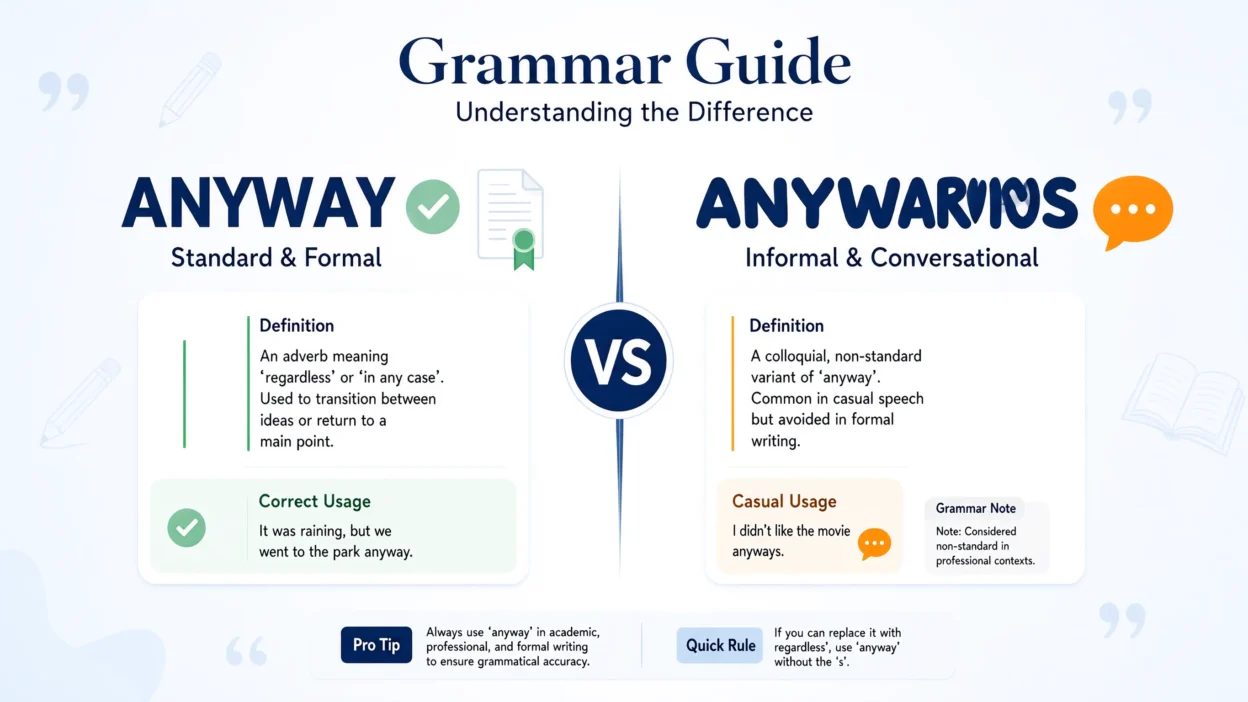
The words “anyway” and “anyways” look almost identical, and people often use them in everyday conversations to express similar ideas. Both can mean “in any case,” “regardless,” or “despite what happened.” However, there is an important difference in how they are used. “Anyway” is the standard form used in both formal and informal English, while “anyways” is generally considered informal and is more common in casual speech.
Understanding anyway vs anyways can help you write more clearly, speak naturally, and choose the right word for different situations. If you are writing an email, completing a school assignment, chatting with friends, or creating online content, knowing which word fits your sentence makes a difference. Although many native English speakers use both forms, they are not always equally appropriate in every context.
Quick Answer
Anyway is the standard and preferred form in formal and informal writing. Anyways is an informal variant that appears frequently in casual conversations and some regional varieties of English. Both can express the meaning “in any case” or “regardless,” but when you are unsure which word to choose, use anyway.
Why Do People Confuse Anyway and Anyways?
People confuse these words because they have nearly the same meaning and can often replace one another in casual conversation.
For example:
- “Anyway, let’s get started.”
- “Anyways, let’s get started.”
Both sentences communicate the same basic idea. The speaker is moving the conversation forward.
The confusion comes from three main reasons:
- Similar meanings: Both words can introduce a new topic, return to an earlier subject, or show that something remains true despite a situation.
- Everyday speech: People frequently use anyways when talking with friends or family.
- Different levels of formality: Although both forms are understood, anyway is the more widely accepted choice in standard written English.
The key difference is not usually the meaning but the level of formality and the context in which each word is used.
1. Anyway: Meaning, Definition, and Usage
Anyway is an adverb that means “in any case,” “regardless,” or “despite that.” It is a standard English word used in conversations, professional writing, academic work, and everyday communication.
It can serve several purposes depending on the sentence.
When Does Anyway Mean “Regardless”?
Use anyway when something happens despite a difficulty, obstacle, or reason not to do it.
Examples:
- It was raining, but we went outside anyway.
- She was tired, but she finished her homework anyway.
- I knew the task would be difficult, but I tried anyway.
In each example, anyway shows that the action happened despite the circumstances.
When Does Anyway Introduce a New Topic?
People also use anyway to change subjects or return to the main point of a conversation.
Examples:
- Anyway, what were you saying earlier?
- Anyway, let’s talk about tomorrow’s plans.
- Anyway, I need to get back to work.
Here, anyway helps the conversation move forward.
Is Anyway Appropriate in Formal Writing?
Yes. Anyway is appropriate in formal and informal contexts, although its conversational use may not suit every sentence in highly formal academic writing.
Examples:
- The results were inconclusive. Anyway, further research is necessary.
- The meeting was postponed; anyway, the team completed the report remotely.
In academic or professional writing, choose the word that makes the relationship between ideas clearest. Depending on the context, alternatives such as nevertheless, regardless, or in any case may be more precise.
2. Anyways: Meaning, Definition, and Usage
Anyways is an informal variant of anyway. It is widely understood in everyday English, especially in casual conversations, messages, and relaxed online communication.
Although some speakers use it naturally, anyways is generally less suitable for formal documents and academic assignments.
When Do People Use Anyways?
People often use anyways when speaking casually or communicating with friends.
Examples:
- Anyways, what are you doing tonight?
- I didn’t really like the movie, but I watched it anyways.
- Anyways, I’ll see you tomorrow.
These sentences sound conversational and relaxed.
Is Anyways Grammatically Correct?
Anyways is an established informal variant, so it is not simply a meaningless or incomprehensible word. However, many formal writing guides prefer anyway.
Its acceptability depends on the audience, region, and context. In casual dialogue, anyways can sound natural. In a research paper, business report, or formal application, anyway is usually the safer choice.
Should You Use Anyways in Emails?
It depends on the email.
- Casual email: “Anyways, I’ll send you the photos tonight.” This may be fine when writing to a friend.
- Professional email: “Anyway, I’ll send you the revised document tonight.” This is more appropriate.
- Formal business email: “In any case, I will send the revised document tonight.” This may sound more polished, depending on the context.
When writing to someone you do not know well, anyway is generally the better option.
Anyway vs Anyways: Comparison Table
| Feature | Anyway | Anyways |
| Meaning | In any case; regardless | Usually the same |
| Standard usage | Standard English | Informal variant |
| Formal writing | Preferred | Usually avoided |
| Casual conversation | Common | Common in some speech communities |
| Professional emails | Suitable | Less suitable |
| Academic assignments | Generally acceptable | Usually avoid |
| Sentence example | “Anyway, let’s begin.” | “Anyways, let’s begin.” |
| Best choice when unsure | Yes | No |
The main takeaway is simple: use anyway as your default choice. Choose anyways when a relaxed, conversational tone is appropriate.
When to Use Anyway vs Anyways
Choosing between these words becomes easier when you consider your audience and purpose.
Use Anyway in Formal and Informal Situations
Choose anyway when writing:
- School assignments and essays
- Business reports and professional emails
- Academic articles
- Applications and formal letters
- Everyday messages and conversations
Examples:
- Anyway, we should review the instructions first.
- I was busy, but I completed the assignment anyway.
- Anyway, thank you for your time.
Use Anyways in Casual Conversations
Choose anyways when you want an informal conversational tone and it fits the way you or your audience naturally speaks.
Examples:
- Anyways, let’s order some food.
- I forgot my umbrella, but I walked home anyways.
- Anyways, tell me what happened next.
Remember that using anyways does not automatically make a sentence wrong. It simply makes the language more informal.
Which Word Is Better for Exams?
For exams, essays, and other formal schoolwork, anyway is the better choice. It is standard, widely accepted, and appropriate across a broader range of contexts.
12 Examples of Anyway vs Anyways in Sentences
The following examples show how the two words work in similar situations.
| With Anyway | With Anyways |
| Anyway, let’s start the meeting. | Anyways, let’s start the meeting. |
| I was tired, but I went anyway. | I was tired, but I went anyways. |
| Anyway, what happened next? | Anyways, what happened next? |
| It was expensive, but I bought it anyway. | It was expensive, but I bought it anyways. |
| Anyway, I’ll call you later. | Anyways, I’ll call you later. |
| She was nervous, but she spoke anyway. | She was nervous, but she spoke anyways. |
| Anyway, we need to leave now. | Anyways, we need to leave now. |
| I didn’t agree, but I listened anyway. | I didn’t agree, but I listened anyways. |
| Anyway, let’s return to the topic. | Anyways, let’s return to the topic. |
| It was late, but we continued anyway. | It was late, but we continued anyways. |
| Anyway, thanks for your help. | Anyways, thanks for your help. |
| I had other plans, but I came anyway. | I had other plans, but I came anyways. |
The sentences on the right are understandable, but they sound more informal. The sentences on the left are suitable for a wider range of situations.
More Examples of Anyway in Different Contexts
Everyday conversation: “Anyway, did you finish watching that series?”
Workplace communication: “Anyway, we can discuss the remaining details tomorrow.”
Academic writing: “The initial hypothesis was not supported. Nevertheless, the findings remain useful.” In this example, nevertheless may be more precise than anyway.
Showing determination: “I knew I might fail, but I tried anyway.”
Changing the subject: “Anyway, let’s talk about something more interesting.”
Common Mistakes When Using Anyway and Anyways
Even though the difference is relatively simple, learners sometimes make a few common mistakes.
Mistake 1: Assuming Anyways Is Always Incorrect
Some people believe anyways is never acceptable English. That is too strict. It is an established informal variant, although anyway is preferred in standard formal writing.
Better understanding: Use anyways in appropriate casual contexts, but choose anyway when you need a broadly accepted form.
Mistake 2: Using Anyways in Formal Essays
Writing anyways in an academic essay may sound too conversational.
Incorrect choice for a formal essay:
“Anyways, the evidence supports the main argument.”
Better:
“Anyway, the evidence supports the main argument.”
Depending on the intended relationship between the ideas, in any case or nevertheless might be even more appropriate.
Mistake 3: Thinking the Words Always Have Different Meanings
In many sentences, anyway and anyways communicate the same idea. Their main difference is usage and tone rather than meaning.
Mistake 4: Using Either Word Without Considering Context
A casual text message and a professional report do not always require the same language.
Tip: Before choosing a word, consider who will read your message and how formal it needs to sound.
Mistake 5: Confusing Anyway With Any Way
Although they look similar, anyway and any way are different expressions.
- Anyway: In any case or regardless. “I’ll go anyway.”
- Any way: Any method or manner. “Is there any way to solve this problem?”
This distinction is important because the two-word phrase often refers to a method or possibility, while the single word usually connects ideas or expresses disregard for an obstacle.
A Simple Memory Trick for Anyway vs Anyways
Use this easy trick to remember the difference:
Anyway = Any situation, any context.
Think of anyway as your all-purpose choice. It works in everyday conversations, professional communication, and formal writing.
Anyways = An informal alternative.
Remember the extra s as a reminder to pause and check whether your sentence is casual enough for this form.
For example:
- Formal email: “Anyway, I’ll follow up tomorrow.”
- Friendly text: “Anyways, I’ll talk to you tomorrow.”
If you are ever uncertain, choose anyway. It is the simplest and most reliable option.
Anyway vs Anyways in American and British English
Both American and British English use anyway. It is the standard form in both varieties.
Anyways also appears in both, particularly in informal speech, although its frequency and social associations can vary by region and speaker.
| Variety | Anyway | Anyways |
| American English | Standard and widely used | Informal and common in casual speech |
| British English | Standard and widely used | Informal variant |
| Formal writing in either variety | Preferred | Usually avoided |
There is no strict rule that anyways belongs exclusively to American English or British English. Both forms can be heard across different English-speaking communities.
For international communication, English exams, and professional documents, anyway is the safest choice.
Similar Words and Expressions
Several words and phrases can replace anyway depending on the intended meaning. However, not every alternative works in every sentence.
| Word or phrase | Meaning | Example |
| In any case | Regardless of the situation | In any case, we should leave early. |
| Regardless | Without being affected by something | She continued regardless. |
| Nevertheless | Despite what was just stated | It was difficult; nevertheless, we succeeded. |
| Nonetheless | Despite that | The task was challenging; nonetheless, we finished. |
| Still | Despite something | It was raining, but we went still. |
| At any rate | In any case; whatever happens | At any rate, we need a decision. |
| All the same | Despite that | I disagree, but I respect your opinion all the same. |
| Anyhow | In any case or in a casual manner | Anyhow, let’s get started. |
A small note about meaning: anyhow is often similar to anyway, but it can also describe doing something carelessly or without order. Nevertheless and nonetheless more clearly express contrast, while in any case often emphasizes that a point remains relevant regardless of circumstances.
Choose the alternative that best expresses the relationship between your ideas.
Final Verdict: Anyway or Anyways?
Anyway is the better choice for most situations. It is standard English, works in formal and informal communication, and is widely accepted in both American and British English.
Anyways is an informal variant that many people use naturally in conversation and casual messages. It is generally understandable, but it is not the preferred choice for academic or professional writing.
Use this simple guide:
- Writing an essay? Use anyway.
- Sending a professional email? Use anyway.
- Chatting with friends? Either may work.
- Unsure which one is appropriate? Choose anyway.
The goal is not to avoid anyways in every situation. It is to understand when each form suits your audience and tone.
FAQs:
1. Is Anyway or Anyways Grammatically Correct?
Both forms are used in English, but anyway is the standard form preferred in formal writing. Anyways is an informal variant that is common in casual speech and conversation.
2. Is Anyways a Real Word?
Yes. Anyways is an established English variant of anyway. However, it is more informal and is generally avoided in academic writing and formal business communication.
3. Which Is Correct: Anyway or Anyways?
Anyway is the preferred choice in standard English. Anyways is also used, especially in informal conversation, but anyway is appropriate in a wider range of situations.
4. Can I Use Anyways in an Essay?
It is better to use anyway in an essay. Although readers will usually understand anyways, the standard form is more appropriate for academic writing and formal assignments.
5. Do Anyway and Anyways Mean the Same Thing?
In most everyday sentences, yes. Both can mean “in any case” or “regardless.” The main difference is that anyways generally sounds more informal.
6. Is Anyways More American or British?
Neither variety has exclusive ownership of the word. Anyways is used informally in both American and British English, although its frequency and social associations vary.
7. What Is the Difference Between Anyway and Any Way?
Anyway is usually an adverb meaning “in any case” or “regardless.” Any way is a two-word phrase that refers to a method or possibility.
Examples:
- “I’ll do it anyway.”
- “Is there any way to fix it?”
Remember This
- Anyway is the standard form and the best choice for most situations.
- Anyways is an informal variant used in casual conversation.
- Both can express the meaning “in any case” or “regardless.”
- For essays, professional emails, and formal documents, prefer anyway.
- Any way is a different expression referring to a method or possibility.
Conclusion
Understanding the difference between anyway and anyways is easy once you recognize that the main distinction is formality rather than meaning. Both forms are used in English, but anyway is the standard option and works well in everyday conversations, academic assignments, professional emails, and formal writing. Anyways is more informal and may sound natural when talking with friends or writing relaxed messages.
When choosing between the two, think about your audience and the tone you want to create. You do not need to avoid anyways completely, but you should know when it is appropriate. If you want a simple rule that works almost everywhere, remember this: use anyway when in doubt. It is clear, natural, and widely accepted across English-speaking communities.

I am Olivia Brooks, a language enthusiast and writer at SynonymsHive. I enjoy creating clear, engaging content about synonyms, vocabulary, and word meanings, helping readers improve their writing and communicate with confidence every day.