The difference between dreamed vs dreamt is simple: both words are correct past-tense forms of the verb dream. They describe something you experienced in your sleep or something you imagined, hoped for, or wished would happen.
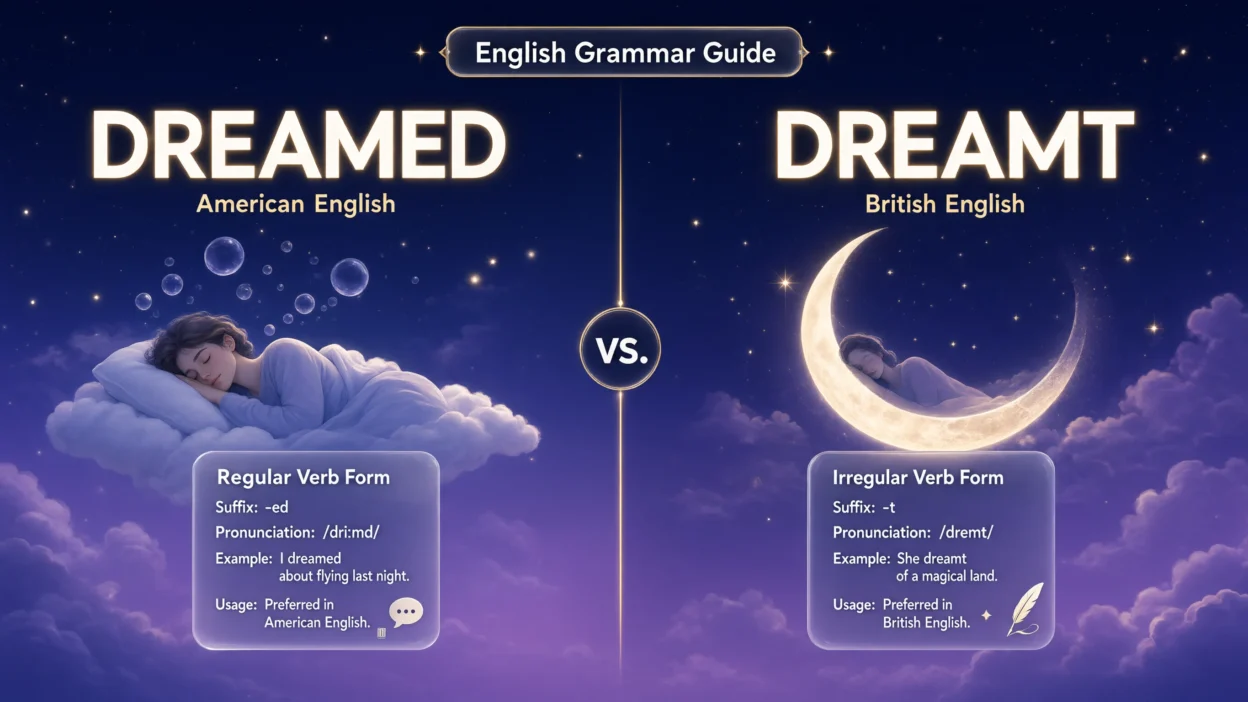
The main difference is how they are commonly used in different varieties of English. Dreamed is more common in American English, while dreamt is especially common in British English. However, both forms are understood and accepted in both varieties.
Choosing between dreamed and dreamt can be confusing because English has many verbs with different past-tense patterns. Some verbs have only one widely accepted past form, while others have two correct alternatives. Dream is one of the verbs that allows both forms.
Neither spelling is inherently more correct, and the choice usually depends on your preferred writing style, regional English, and consistency. In this guide, you will learn what each word means, how to use it in sentences, and which form is best for everyday conversations, school assignments, and professional writing.
Quick Answer: Dreamed vs Dreamt
Dreamed and dreamt are both correct past-tense and past-participle forms of dream. Dreamed is generally more common in American English, whereas dreamt is often associated with British English. Both mean to experience dreams during sleep or to imagine something you want to happen. Choose either form, but use it consistently throughout your writing.
Why Do People Confuse Dreamed and Dreamt?
People often confuse these words because they have the same meaning but different spellings. In English, verbs usually form their past tense by adding -ed, as in walked, played, and wanted. However, some verbs have irregular forms, such as slept, wrote, and bought.
The verb dream has two accepted past-tense forms:
- Dreamed: The regular past-tense form.
- Dreamt: An alternative form with an irregular spelling.
Both forms can function as the past tense and past participle. For example, you can say, “I dreamed about my childhood” or “I dreamt about my childhood.” Both sentences are grammatically correct.
What Does Dreamed Mean?
Dreamed is the regular past-tense and past-participle form of the verb dream. It can refer to experiences during sleep, hopes for the future, or things imagined in the mind.
Dreamed is particularly common in American English and is a straightforward choice for general writing.
Examples of Dreamed in Sentences
- I dreamed about flying over the mountains last night.
- She dreamed of becoming a successful writer.
- We dreamed about visiting Japan together.
- He has dreamed of owning his own business since childhood.
- They dreamed that they were walking through a beautiful garden.
In these examples, dreamed describes either a sleeping experience or an imagined possibility.
When Is Dreamed Most Appropriate?
Use dreamed when you want a familiar, widely understood form, especially in American English.
It is a good choice for:
- American English essays and assignments.
- Business and professional documents.
- Everyday conversations.
- Articles intended for an international audience.
- Writing where regular verb forms are preferred.
Dreamed is not exclusive to American English. British English speakers also use it.
What Does Dreamt Mean?
Dreamt is an alternative past-tense and past-participle form of dream. It has the same meaning as dreamed but is often more common in British English.
Dreamt can make a sentence sound slightly more traditional or literary to some readers, although it is also used in ordinary conversation.
Examples of Dreamt in Sentences
- I dreamt about an old friend last night.
- She dreamt of becoming a famous singer.
- He had dreamt of traveling around the world.
- We dreamt that we were living beside the sea.
- They dreamt of a better future for their children.
Each sentence could use dreamed instead without changing its basic meaning.
When Is Dreamt Most Appropriate?
Use dreamt when it matches your usual variety of English or the style of your writing.
It works well in:
- British English writing.
- Personal stories and diary entries.
- Creative and literary writing.
- Informal conversations.
- Writing that uses other British English conventions consistently.
Dreamt is also correct in American English, even if it is less common there.
Dreamed vs Dreamt: Comparison Table
| Feature | Dreamed | Dreamt |
| Word type | Past tense and past participle | Past tense and past participle |
| Meaning | Experienced a dream or imagined something | Experienced a dream or imagined something |
| American English | Generally more common | Less common |
| British English | Also widely accepted | Often more common |
| Grammar | Correct | Correct |
| Example | I dreamed about you. | I dreamt about you. |
| Best use | General writing, especially American English | British English or personal style |
The important point is that the difference is mainly regional and stylistic, not grammatical or semantic.
When Should You Use Dreamed or Dreamt?
The best choice depends on your audience, your preferred English variety, and the context of your sentence.
1. Use Dreamed for American English
If you are writing for an American audience, dreamed is usually the safest default.
Example: “I dreamed of opening my own restaurant.”
2. Use Dreamt for British English
If you generally follow British English conventions, dreamt is a natural choice.
Example: “I dreamt of opening my own restaurant.”
3. Use Either Word in Everyday Conversation
Both forms are understandable in everyday speech. Your choice will rarely affect how someone understands your sentence.
Example: “I dreamed about the holiday” and “I dreamt about the holiday” communicate the same idea.
4. Follow Your Style Guide
If your school, workplace, publisher, or editor prefers a particular form, follow that preference.
For example, an American publication may prefer dreamed, while a British publication may accept or favor dreamt.
5. Stay Consistent
Using both forms is not automatically grammatically wrong. However, choosing one form throughout an article or document can make your writing feel more polished.
12 Examples of Dreamed vs Dreamt in Sentences
These examples show how both forms work in different situations.
| Dreamed | Dreamt |
| I dreamed about my family last night. | I dreamt about my family last night. |
| She dreamed of becoming a doctor. | She dreamt of becoming a doctor. |
| We dreamed about our summer vacation. | We dreamt about our summer vacation. |
| He dreamed that he could fly. | He dreamt that he could fly. |
| They dreamed of living in a peaceful town. | They dreamt of living in a peaceful town. |
| I have dreamed of this moment for years. | I have dreamt of this moment for years. |
| She had dreamed about the ocean before. | She had dreamt about the ocean before. |
| We dreamed of starting a family. | We dreamt of starting a family. |
| He dreamed about his childhood home. | He dreamt about his childhood home. |
| They have dreamed of traveling abroad. | They have dreamt of traveling abroad. |
| I dreamed that I won the competition. | I dreamt that I won the competition. |
| She dreamed of a brighter future. | She dreamt of a brighter future. |
Notice that the meaning stays the same in each pair. You can use either form with expressions such as dreamed of, dreamed about, dreamt of, and dreamt about.
Common Mistakes When Using Dreamed and Dreamt
Although both words are correct, some mistakes can occur when people use them.
Mistake 1: Thinking Dreamt Is Incorrect
Incorrect assumption: “Dreamt is not a real English word.”
Correction: Dreamt is a standard, accepted form of the verb dream.
Mistake 2: Thinking Dreamed Is Only American
Incorrect assumption: “British English speakers cannot use dreamed.”
Correction: Both forms are used in British English, although dreamt is often more common.
Mistake 3: Using Dream as the Past Tense
Incorrect: “Yesterday, I dream about my old school.”
Correct: “Yesterday, I dreamed about my old school.”
Also correct: “Yesterday, I dreamt about my old school.”
Mistake 4: Forgetting the Past Participle in Perfect Tenses
Incorrect: “I have dream about that place.”
Correct: “I have dreamed about that place.”
Also correct: “I have dreamt about that place.”
Mistake 5: Assuming the Two Words Have Different Meanings
Dreamed and dreamt do not normally express different kinds of dreams. The choice is mainly about usage and regional preference.
What Is an Easy Memory Trick for Dreamed vs Dreamt?
Remember this simple rule:
- Dreamed = regular form, often preferred in American English.
- Dreamt = alternative form, often associated with British English.
You can also remember that dreamed follows the familiar -ed pattern found in regular past-tense verbs, while dreamt is shorter and has an irregular spelling.
When you are unsure, choose dreamed. It is a widely understood form and a practical default for most general writing.
Dreamed vs Dreamt in American and British English
The main regional difference is frequency, not correctness.
American English
In American English, dreamed is generally the more common form.
Examples:
- I dreamed about my vacation.
- She dreamed of becoming an artist.
Both sound natural to American readers.
British English
In British English, dreamt is often more common, though dreamed is also correct.
Examples:
- I dreamt about my holiday.
- She dreamt of becoming an artist.
British writers may naturally choose dreamt, but there is no rule requiring them to do so.
Which Form Should ESL Learners Learn?
ESL learners can learn both forms, but it is useful to start with dreamed because its spelling follows the regular -ed pattern.
Once you understand that dreamt is an accepted alternative, you can recognize and use it confidently when reading British books, articles, and stories.
Similar Words to Dreamed and Dreamt
English has several verbs with more than one accepted past-tense form. Learning these examples can help you understand why dreamed and dreamt are both correct.
| Base verb | Alternative past forms | Example |
| Learn | Learned / learnt | I learned a new skill. |
| Burn | Burned / burnt | The toast burned. |
| Spell | Spelled / spelt | She spelled the word correctly. |
| Smell | Smelled / smelt | The flowers smelled wonderful. |
| Leap | Leaped / leapt | He leaped over the puddle. |
| Dream | Dreamed / dreamt | I dreamed about my future. |
Regional preferences vary across these verbs. Some alternatives are more common in British English, while regular forms are often preferred in American English. The exact pattern depends on the verb and the context.
Final Verdict: Dreamed or Dreamt?
Both dreamed and dreamt are correct. They are alternative past-tense and past-participle forms of the verb dream, and they generally have exactly the same meaning.
Choose dreamed if you want a widely understood default, particularly for American English. Choose dreamt if you prefer British English usage or if it better matches your writing style.
Neither word is universally better. The most useful approach is to understand both forms, choose the one that suits your audience, and use it consistently.
FAQs:
1. Is dreamed or dreamt grammatically correct?
Both are grammatically correct. Dreamed is the regular past-tense and past-participle form, while dreamt is an accepted alternative. You can use either in sentences about sleeping dreams, hopes, or imagined experiences.
2. Is dreamt British or American English?
Dreamt is often associated with British English and is generally more common there. However, it is also correct in American English. American speakers tend to use dreamed more frequently.
3. Is dreamed more correct than dreamt?
No. Dreamed is not more grammatically correct than dreamt. Both are standard English forms. The difference is primarily regional preference and writing style.
4. Can I say “I have dreamt”?
Yes. Dreamt can be used as a past participle with have, has, or had.
Example: “I have dreamt about visiting Paris for years.”
You can also say, “I have dreamed about visiting Paris for years.”
5. What is the past tense of dream?
The past tense of dream can be either dreamed or dreamt.
Examples:
- I dreamed about my childhood.
- I dreamt about my childhood.
Both sentences are correct.
6. Do dreamed and dreamt have different meanings?
No. They normally have the same meaning. Both can describe an experience during sleep or something a person hopes, imagines, or wishes to achieve.
7. Which form should I use in an English exam?
Follow the spelling conventions and instructions taught by your teacher or required by the exam. If there is no specific preference, either form is generally acceptable. For American English assignments, dreamed is a sensible default.
Remember This
- Dreamed and dreamt are both correct.
- Dreamed is generally more common in American English.
- Dreamt is often more common in British English.
- Both forms can describe sleeping dreams and hopes for the future.
- Both forms work with have, has, and had.
- Consistency is more important than choosing one form as universally correct.
Conclusion
Understanding dreamed vs dreamt is easy once you know that both words are accepted forms of the verb dream. Their meanings are essentially identical, and the main difference is how frequently they appear in different varieties of English.
Dreamed is generally preferred in American English, while dreamt is often favored in British English. Neither form is wrong, and both can describe dreams during sleep or ambitions for the future.
If you are learning English, begin with dreamed as a straightforward option and become familiar with dreamt as an alternative. When writing for a particular audience, consider its regional conventions and follow any relevant style guidelines. With this simple approach, you can use both words confidently in conversations, schoolwork, professional writing, and creative stories.

I’m Nathan Collins, a language enthusiast passionate about exploring synonyms and improving everyday writing. I create clear, accurate, and helpful content that helps readers expand vocabulary and communicate with confidence.