The words either and whether are often confused because both can appear when discussing choices, alternatives, and possibilities. However, they have different meanings and grammatical roles. Knowing when to use either vs whether can help you write clearer sentences and avoid common English grammar mistakes.
The main difference is that either refers to one of two choices or options, while if introduces alternatives, uncertainty, or an indirect question. For example, in “You can choose either option,” either identifies one of two available choices. In “I don’t know if she will come,” if introduces uncertainty about what will happen.
Although these words sometimes appear in similar sentence structures, they are not interchangeable. Understanding their meanings, sentence patterns, and everyday uses will make it easier to choose the correct word in speaking and writing.
Quick Answer: Either vs Whether
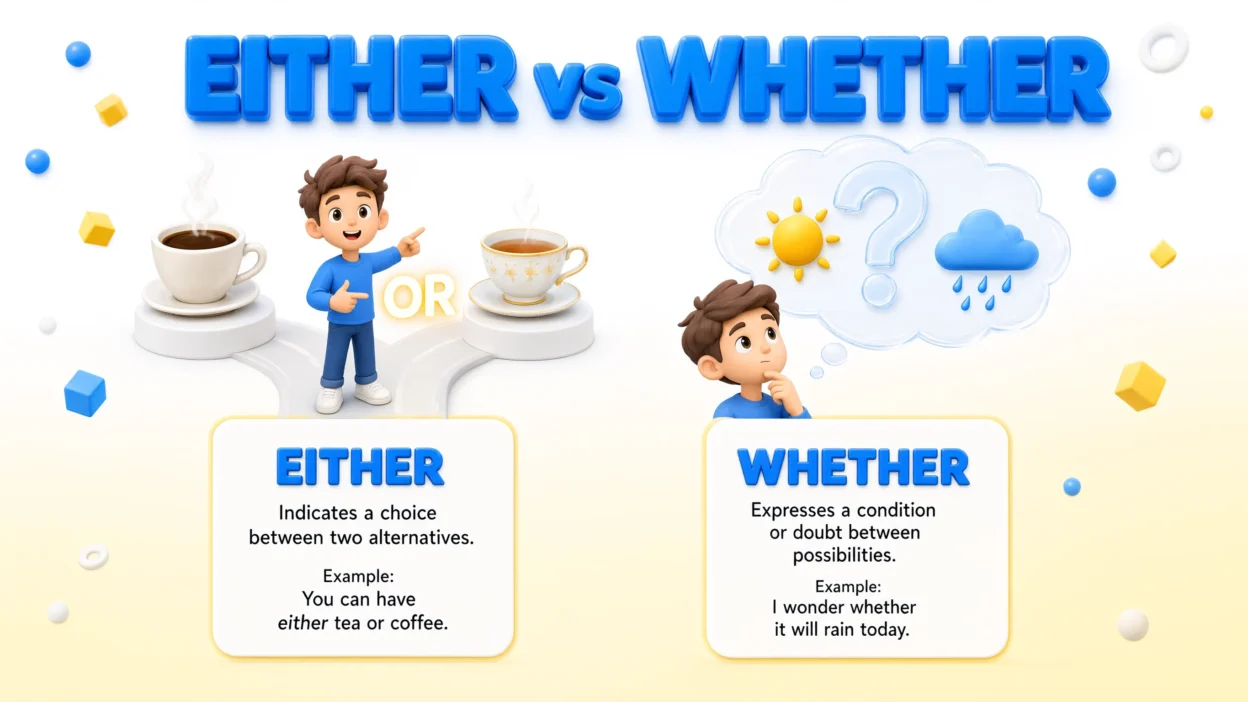
Either refers to one of two choices or options, while whether introduces a choice, possibility, or indirect yes-or-no question. Use either when selecting between alternatives, as in “Either answer is correct.” Use whether when expressing uncertainty, as in “I wonder whether he agrees.”
Why Do People Confuse Either and Whether?
People often confuse either and whether because both words are connected to choices and alternatives. They can also appear in sentences discussing two possible outcomes.
However, their grammatical functions are different.
- Either is used to identify one of two possibilities or indicate that both options are acceptable.
- Whether introduces uncertainty or presents two possible situations.
- Either…or connects two alternatives.
- Whether…or presents alternatives that are being considered.
For example:
- You can take either road. (One of two roads is acceptable.)
- I don’t know whether this road is open. (There is uncertainty.)
The easiest way to avoid confusion is to understand what the sentence is trying to express.
1. What Does Either Mean?
Either is a determiner, pronoun, or adverb used to refer to one of two people, things, or possibilities. Depending on the sentence, it can express a choice between two options or indicate that both options are acceptable.
It is commonly used when someone has two alternatives and can select one.
Different Ways to Use Either
1. Either as a determiner
Either comes before a singular countable noun when referring to one of two available options.
Examples:
- You can sit on either chair.
- Either answer is acceptable.
- There are trees on either side of the road.
2. Either as a pronoun
Either can stand alone when the noun is already understood.
Examples:
- Either of these dresses looks beautiful.
- You can choose either.
- Either of the two candidates could win.
3. Either as a conjunction
Either is used with or to connect two alternatives.
Examples:
- You can either walk or take a bus.
- Either John or Sarah will lead the meeting.
- We can either eat at home or visit a restaurant.
4. Either as an adverb
Either can also appear at the end of a negative sentence to mean also or as well.
Examples:
- I don’t like coffee either.
- She isn’t coming either.
- He doesn’t understand the question either.
When Should You Use Either?
Use either when:
- You are referring to one of two choices.
- Both options are acceptable.
- You want to connect two alternatives using either…or.
- You want to add agreement to a negative statement.
2. What Does Whether Mean?
Whether is a conjunction used to introduce alternatives, uncertainty, or an indirect question. It helps explain that something is undecided or that two or more possibilities exist.
It is commonly used when someone does not know which outcome is correct or what decision will be made.
Different Ways to Use Whether
1. Whether in indirect questions
Use whether when expressing uncertainty or asking an indirect yes-or-no question.
Examples:
- I don’t know whether he is coming.
- She asked whether I needed help.
- We are unsure whether the shop is open.
2. Whether…or
Use whether…or to introduce two alternatives or possibilities.
Examples:
- Whether you agree or disagree, you should listen.
- I don’t know whether to stay or leave.
- She must decide whether to study or work.
3. Whether or not
Use whether or not when something remains true regardless of the possible outcomes.
Examples:
- I will attend whether or not it rains.
- Whether or not you agree, the decision is final.
- She will succeed whether or not others support her.
4. Whether after certain verbs
Whether frequently follows verbs such as know, ask, decide, consider, and wonder.
Examples:
- I wonder whether she remembers me.
- They must decide whether to continue.
- He asked whether the information was correct.
When Should You Use Whether?
Use whether when:
- You are expressing uncertainty.
- You are introducing an indirect question.
- You are discussing two possible outcomes.
- You are presenting alternatives using whether…or.
- You want to express that something applies regardless of the circumstances.
3. Either vs Whether: Comparison Table
The following table explains the main differences between either and whether.
| Feature | Either | Whether |
| Main meaning | One of two choices | Expresses alternatives or uncertainty |
| Part of speech | Determiner, pronoun, adverb | Conjunction |
| Main purpose | Identifies available options | Introduces possibilities |
| Common structure | Either…or | Whether…or |
| Used in questions | Sometimes | Frequently in indirect questions |
| Indicates uncertainty | Not usually | Yes |
| Example | Either answer is correct. | I wonder whether he is right. |
| Negative sentences | I don’t like it either. | I don’t know whether he likes it. |
Key difference: Either helps identify or select an option, whereas whether introduces a question, uncertainty, or alternatives.
4. When to Use Either vs Whether
Choosing the correct word becomes easier when you understand the purpose of your sentence.
Use Either When Talking About Two Choices
Use either when one of two options is available or acceptable.
Examples:
- You can choose either color.
- Either restaurant is fine with me.
- Either student can answer the question.
Use Whether When Expressing Uncertainty
Use whether when you are unsure about something or want to introduce an indirect question.
Examples:
- I don’t know whether he is serious.
- She wonders whether they will arrive.
- We haven’t decided whether to move.
Use Either…Or for Direct Alternatives
Use either…or when presenting two choices.
Examples:
- You can either call me or send a message.
- Either study harder or accept the consequences.
- We will either travel by train or fly.
Use Whether…Or for Possibilities
Use whether…or when discussing possible situations, decisions, or outcomes.
Examples:
- I cannot decide whether to buy it or wait.
- Whether you win or lose, keep trying.
- She doesn’t know whether he is joking or serious.
5. Either vs Whether: 15 Example Sentences
Here are practical examples that show how to use both words correctly in everyday English.
Examples Using Either
- You can choose either book for your assignment.
- Either answer will receive full marks.
- We can meet on either Monday or Tuesday.
- Either of my brothers can help you.
- You may sit on either side of the table.
- I don’t like spicy food either.
- Either option is suitable for beginners.
- You can either call me or email me.
Examples Using Whether
- I don’t know whether she will attend the party.
- He asked whether I had completed my homework.
- We need to decide whether to stay or leave.
- She is wondering whether the train has arrived.
- Whether you agree or disagree, please remain respectful.
- I cannot tell whether he is happy or upset.
- They will continue whether or not the weather improves.
Examples Using Both Words
You can also use either and whether in the same sentence when their meanings are different.
- I don’t know whether either option is available.
- She asked whether I wanted either tea or coffee.
- We must decide whether either candidate is suitable.
These examples demonstrate that the two words can appear together without having the same meaning.
6. Common Mistakes When Using Either and Whether
Even experienced English learners sometimes use these words incorrectly. Here are some mistakes to avoid.
Mistake 1: Using Either Instead of Whether
Incorrect: I don’t know either he is coming.
Correct: I don’t know whether he is coming.
Why? Whether introduces an indirect question about an uncertain situation.
Mistake 2: Using Whether Instead of Either
Incorrect: You can choose whether dress.
Correct: You can choose either dress.
Why? Either identifies one of two available dresses.
Mistake 3: Confusing Either…Or and Whether…Or
Incorrect: You can whether stay or leave.
Correct: You can either stay or leave.
Why? Either…or presents a choice between two alternatives.
Mistake 4: Forgetting the Word Or
Incorrect: You can either study, sleep.
Correct: You can either study or sleep.
Why? The standard paired construction is either…or.
Mistake 5: Using Whether When Either Is Needed
Incorrect: Whether of these answers is correct.
Correct: Either of these answers is correct.
Why? Either of introduces a choice between two options.
7. Easy Memory Trick: How to Remember Either vs Whether
A simple memory trick can help you remember the difference.
- Either = Choice: Think of selecting one option from two alternatives.
- Whether = Question: Think of uncertainty or wondering about something.
Remember these two examples:
- Either road will take you home.
- I don’t know whether this road will take me home.
The first sentence identifies an available choice. The second expresses uncertainty.
Another useful trick is to remember these common word pairs:
- Either…or = Choosing between alternatives.
- Whether…or = Considering alternatives or possibilities.
- Whether or not = Regardless of the outcome.
If you remember these patterns, you can avoid most mistakes.
8. Either vs Whether in American and British English
There is no major difference between American and British English when it comes to the meanings and grammatical rules of either and whether.
Both varieties use these words in the same general ways.
| Usage | American English | British English |
| Either option is fine. | Correct | Correct |
| I don’t know whether he agrees. | Correct | Correct |
| Either…or | Common | Common |
| Whether…or | Common | Common |
| Whether or not | Common | Common |
One small pronunciation difference may occur.
- Either: Common pronunciations include EE-thər and EYE-thər.
- Whether: Commonly pronounced WETH-ər.
Both pronunciations of either are accepted in American and British English.
The important point is that spelling, meaning, and grammatical usage remain essentially the same across both varieties.
9. Similar Words Related to Either and Whether
Several English words and expressions are connected to choices, alternatives, and uncertainty. Understanding them can help expand your vocabulary.
| Word or phrase | Meaning | Example |
| Neither | Not one and not the other | Neither answer is correct. |
| Both | The two options together | Both options are useful. |
| Any | One or more without restriction | You can choose any color. |
| Or | Introduces an alternative | Tea or coffee? |
| If | Introduces a condition | If it rains, we will stay home. |
| Regardless | Without being affected by something | I will go regardless. |
| Alternatively | As another possibility | Alternatively, we can take a taxi. |
| Instead | In place of something | Take water instead. |
Either vs Neither
Either refers to one of two options, while neither means not one and not the other.
- Either answer is acceptable.
- Neither answer is acceptable.
Whether vs If
Whether and if can both introduce indirect yes-or-no questions in many situations.
Examples:
- I don’t know whether she is coming.
- I don’t know if she is coming.
Both are correct.
However, whether is generally preferred when presenting explicit alternatives or before an infinitive.
Example:
– I cannot decide whether to stay or leave.
10. Final Verdict: Either vs Whether
The difference between either and whether is simple once you understand their grammatical purposes.
Either refers to one of two choices and is commonly used with or to present alternatives. It can also mean as well in negative sentences.
Whether introduces uncertainty, indirect questions, and possible outcomes. It is frequently used in structures such as whether…or and whether or not.
Remember that either identifies a choice, while whether introduces a question or possibility. Choosing the correct word will make your English sentences more natural, clear, and grammatically accurate.
FAQs:
1. What is the main difference between either and whether?
Either refers to one of two choices, while whether introduces uncertainty, alternatives, or indirect questions. For example, “Either option is fine” identifies a choice, whereas “I don’t know whether he agrees” expresses uncertainty.
2. Can either and whether be used interchangeably?
No, either and whether cannot usually be used interchangeably because they have different grammatical functions. Either identifies an option, while whether introduces possibilities or uncertainty.
3. Is it either or or whether or?
Both expressions are correct, but they serve different purposes. Either…or presents a choice between two alternatives, while whether…or introduces possibilities or uncertainty.
Examples:
- You can either stay or leave.
- I don’t know whether he will stay or leave.
4. Can I use whether instead of if?
Yes, whether can often replace if in indirect yes-or-no questions.
For example:
- I don’t know if she is ready.
- I don’t know whether she is ready.
Both sentences are grammatically correct.
5. Is either singular or plural?
Either is generally treated as singular when it is the subject of a sentence.
Example: Either option is suitable.
When followed by either of, the verb is also generally singular in formal standard English.
Example: Either of the answers is acceptable.
6. What does whether or not mean?
Whether or not means that something will happen or remain true regardless of which possibility occurs.
Example: I will support you whether or not you succeed.
7. What is the easiest way to remember either vs whether?
Remember that either means a choice between two options, while whether introduces uncertainty or alternatives. Think of either…or for selecting and whether…or for considering possibilities.
Remember This
- Either = One of two choices.
- Whether = Uncertainty or alternatives.
- Either…or = Presents a choice.
- Whether…or = Introduces possibilities.
- Whether or not = Regardless of the outcome.
The simplest rule is: Use either when identifying a choice and whether when expressing uncertainty or introducing possibilities.
Conclusion
Understanding either vs whether does not have to be difficult. Although both words relate to choices and alternatives, they serve different purposes in English grammar. Either identifies one of two options, while if introduces uncertainty, indirect questions, or possible outcomes. Learning their common sentence patterns will help you use them correctly.
Whenever you are unsure which word to choose, look at the meaning of your sentence. If you are identifying or selecting an option, use either. If you are wondering about something or discussing possible outcomes, use whether. With regular practice and these simple examples, you can use both words confidently in everyday conversations and writing.

I am Olivia Brooks, a language enthusiast and writer at SynonymsHive. I enjoy creating clear, engaging content about synonyms, vocabulary, and word meanings, helping readers improve their writing and communicate with confidence every day.