The words vary and very look and sound similar, but they have completely different meanings. Because they differ by only one letter, English learners and even experienced writers sometimes confuse them. However, understanding their meanings and grammatical roles makes it easy to use them correctly in everyday communication.
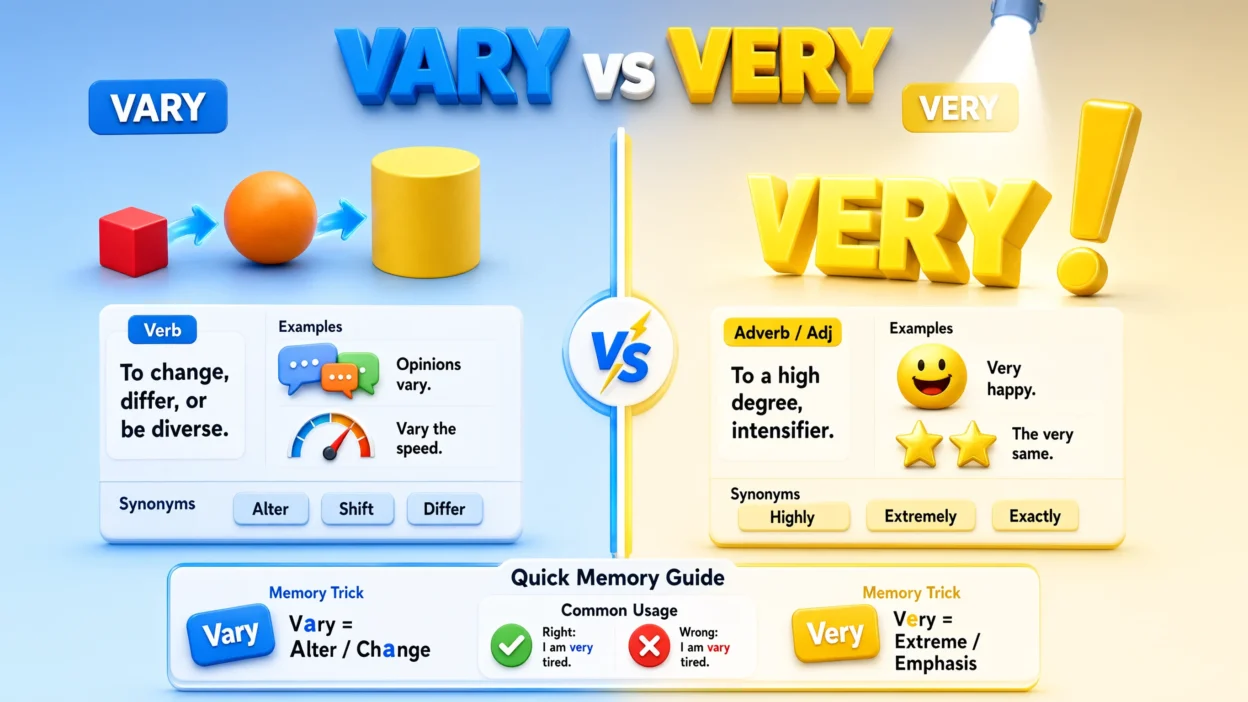
The main difference between vary and very is that vary is a verb meaning to change, differ, or be different, while very is an adverb or adjective used to emphasize something or express a high degree.
For example, “Prices vary from store to store” means prices are different, while “The food is very delicious” emphasizes how delicious the food is. Learning when to use each word will help you write clearer sentences, avoid common spelling mistakes, and communicate more confidently.
Quick Answer: Vary vs Very
Vary is a verb that means to change or differ. It describes differences in people, things, situations, or conditions. Very is an adverb or adjective that adds emphasis or indicates a high degree. For example, “Results vary” means results are different, while “The results are very good” emphasizes their quality.
Why Do People Confuse Vary and Very?
People often confuse vary and very because their spellings are almost identical. Both words contain four letters and have similar pronunciations, particularly for people learning English.
However, their meanings and grammatical functions are different.
Here are three common reasons for the confusion:
- Similar spelling: Both words contain the same letters, but the positions of A and E are different.
- Similar pronunciation: Their sounds can seem close to English learners, especially when spoken quickly.
- Frequent usage: Both words appear regularly in conversations, academic writing, emails, and everyday sentences.
The easiest way to avoid confusion is to remember that vary describes change or difference, while very adds emphasis.
What Does Vary Mean?
Vary is a verb that means to change, differ, or become different. It describes situations where something is not always the same.
You can use it when discussing differences in opinions, prices, sizes, colors, temperatures, experiences, or other conditions.
Simple Meaning of Vary
- To change from one situation to another.
- To be different from something else.
- To differ in amount, type, size, or quality.
- To make something different or introduce variety.
Examples of Vary in Sentences
- Prices vary depending on the store.
- Children’s interests vary as they grow older.
- The weather can vary throughout the year.
- My working hours vary every week.
- The results may vary from person to person.
Different Forms of Vary
Vary has several grammatical forms that are useful to understand.
| Word form | Meaning | Example |
| Vary | Base verb | Prices vary by location. |
| Varies | Present tense | The cost varies each month. |
| Varied | Past tense | The results varied last year. |
| Varying | -ing form | We experienced varying temperatures. |
| Variation | Noun | There is a variation in prices. |
| Variable | Adjective or noun | The results depend on several variables. |
Synonyms of Vary
Depending on the context, some useful synonyms include:
- Change
- Differ
- Fluctuate
- Shift
- Alter
- Modify
- Differentiate
- Diversify
- Transform
- Deviate
Remember that these alternatives are not interchangeable in every sentence. Choose one that matches the intended meaning.
What Does Very Mean?
Very is an adverb or adjective used to emphasize a word or express a high degree. It makes a description stronger and helps communicate exactly how much or how strongly something is true.
For example, saying “The movie was good” gives a general opinion. Saying “The movie was very good” expresses a stronger opinion.
Simple Meaning of Very
- To a high degree.
- Extremely or particularly.
- Used to add emphasis.
- Used to strengthen adjectives and adverbs.
Very can also function as an adjective meaning exact, same, or particular, as in “This is the very book I wanted.”
Examples of Very in Sentences
- She is very kind to everyone.
- The weather is very pleasant today.
- I am very happy with my results.
- He runs very quickly.
- This is the very place where we met.
Common Expressions with Very
Here are some everyday expressions using very:
- Very good
- Very happy
- Very important
- Very beautiful
- Very difficult
- Very interesting
- Very carefully
- Very quickly
- Very helpful
- Very expensive
These expressions make sentences more descriptive and emphasize the intended meaning.
Synonyms of Very
Depending on the sentence, you can use:
- Extremely
- Highly
- Really
- Particularly
- Especially
- Remarkably
- Exceptionally
- Incredibly
- Quite
- Truly
Not every synonym has exactly the same strength or grammatical usage. For example, “extremely” is often stronger than “quite.”
Vary vs Very: Comparison Table
The following table highlights the main differences between vary and very.
| Feature | Vary | Very |
| Part of speech | Verb | Adverb and adjective |
| Main meaning | To change or differ | To a high degree; exact or particular |
| Purpose | Describes differences or changes | Adds emphasis |
| Usage | Actions and conditions | Descriptions and emphasis |
| Example | Prices vary daily. | Prices are very high. |
| Related word | Variation | Extremely |
| Common context | Changes and differences | Feelings and descriptions |
The biggest difference is their grammatical function: vary describes what changes, while very strengthens a description or identifies something exact.
When to Use Vary vs Very
Choosing between these words becomes easier when you understand what you want to communicate.
When to Use Vary
Use vary when you want to explain that something changes or differs.
Common situations include:
- Prices: Prices vary between different shops.
- Weather: Temperatures vary throughout the seasons.
- Opinions: People’s opinions vary on this subject.
- Experiences: Experiences vary from person to person.
- Schedules: My daily routine varies depending on my work.
If your sentence describes a change, difference, or variation, vary is usually the correct choice.
When to Use Very
Use very when you want to emphasize an adjective or adverb.
Common situations include:
- Feelings: I am very excited about the trip.
- Descriptions: This is a very beautiful painting.
- Importance: Education is very important.
- Difficulty: The examination was very difficult.
- Actions: She speaks very politely.
If you want to make a description stronger or emphasize a degree, very is usually the correct choice.
15 Examples of Vary vs Very in Sentences
Examples make the difference between these words easier to understand. Notice how each word changes the meaning of a sentence.
1. Vary: Prices vary from one country to another.
Very: Prices are very expensive in that country.
2. Vary: Children’s abilities vary widely.
Very: The children are very talented.
3. Vary: Working hours vary each week.
Very: I am very busy this week.
4. Vary: Temperatures vary throughout the year.
Very: It is very hot today.
5. Vary: Opinions vary among students.
Very: This is a very interesting opinion.
6. Vary: The colors vary in different lighting conditions.
Very: The colors are very bright.
7. Vary: Results vary depending on the method.
Very: The results are very impressive.
8. Vary: The quality of products can vary.
Very: This product is very useful.
9. Vary: People’s needs vary over time.
Very: Meeting people’s needs is very important.
10. Vary: The length of the lessons may vary.
Very: Today’s lesson was very short.
11. Vary: Food preferences vary from person to person.
Very: This food is very delicious.
12. Vary: The designs vary in shape and size.
Very: The design is very attractive.
13. Vary: Travel costs vary by destination.
Very: Traveling can be very expensive.
14. Vary: Students’ learning styles vary.
Very: This learning method is very effective.
15. Vary: The delivery time may vary.
Very: The delivery was very quick.
These examples show that the two words cannot replace each other. Each has a separate purpose in English sentences.
Common Mistakes When Using Vary and Very
Even though these words are easy to understand, writers sometimes use the wrong spelling or grammatical form.
Here are some common mistakes and their corrections.
| Incorrect sentence | Correct sentence |
| I am vary happy. | I am very happy. |
| Prices are very from store to store. | Prices vary from store to store. |
| She is vary beautiful. | She is very beautiful. |
| The results very each time. | The results vary each time. |
| This is a vary important lesson. | This is a very important lesson. |
| People’s opinions very. | People’s opinions vary. |
How to Avoid These Mistakes
Follow these simple tips:
- Use vary when describing differences or changes.
- Use very when emphasizing a description.
- Check whether the sentence needs a verb or an adverb.
- Read your sentence aloud to understand its meaning.
- Practice writing sentences with both words.
Remember that using the correct spelling is important because changing one letter can completely change the meaning.
Memory Trick: How to Remember Vary vs Very
A simple memory trick can help you remember the difference without memorizing complicated grammar rules.
VARY = Variation
Both words begin with V and relate to differences and changes. When something varies, it shows variation.
VERY = Extra emphasis
Think of very as a word that makes a description stronger.
For example:
- The prices vary. (They are different.)
- The prices are very high. (They are expensive to a high degree.)
You can also remember this short rule:
Vary means change, while very means more or to a high degree.
Practice this distinction whenever you write or speak English.
Vary vs Very in American and British English
There is no meaningful difference between American and British English in the spelling or basic meaning of vary and very.
Both varieties use these words in the same grammatical ways.
| Word | American English | British English |
| Vary | To change or differ | To change or differ |
| Very | To a high degree | To a high degree |
Examples:
- American English: The prices vary by location.
- British English: The prices vary by location.
- American English: She is very happy.
- British English: She is very happy.
Pronunciation can differ slightly depending on regional accents, but the meanings and standard spellings remain the same.
Similar Words You Should Know
Vary and very are not the only English words that learners sometimes confuse. Understanding similar-looking or related words can improve your vocabulary.
1. Variation
Variation is a noun that describes a difference or change in something.
Example: There is a significant variation in the prices.
2. Various
Various is an adjective meaning several different types or kinds.
Example: The shop sells various types of shoes.
3. Variable
Variable can describe something that changes or a factor that can change.
Example: Temperature is an important variable in this experiment.
4. Variety
Variety is a noun meaning a collection of different types or forms.
Example: The restaurant offers a wide variety of meals.
5. Extremely
Extremely is an adverb used to express a very high degree.
Example: The weather is extremely cold today.
These words are connected to the ideas of difference, change, and emphasis, but each has its own grammatical role.
Final Verdict: Vary or Very?
The correct choice depends on the meaning of your sentence.
Use vary when you want to describe something that changes, differs, or is not always the same. Use very when you want to emphasize an adjective or adverb or express a high degree.
For example:
- Correct: Prices vary from shop to shop.
- Correct: These prices are very high.
Both words are correct English words, but they cannot replace each other. Understanding their meanings and grammatical roles will help you avoid spelling mistakes and communicate more clearly.
FAQs:
1. What is the main difference between vary and very?
The main difference is their meaning and grammatical function. Vary is a verb meaning to change or differ, while very is an adverb or adjective used to emphasize something or express a high degree. For example, “Prices vary” and “Prices are very high.”
2. Is vary a verb or an adjective?
Vary is a verb. It describes an action or condition involving change or difference. For example, “The prices vary depending on the location.” Its related adjective is variable.
3. Is very an adverb or an adjective?
Very is commonly used as an adverb to strengthen adjectives and adverbs, as in “very beautiful” or “very quickly.” It can also function as an adjective meaning exact or particular, as in “the very same person.”
4. Can vary and very be used interchangeably?
No, vary and very cannot be used interchangeably because they have different meanings and grammatical functions. Vary describes differences or changes, whereas very adds emphasis. Replacing one with the other can make a sentence grammatically incorrect or change its meaning.
5. What is an easy trick to remember vary and very?
Remember that vary is connected to variation, which means change or difference. Very is used to make descriptions stronger. For example, “Results vary” means results are different, while “The results are very good” emphasizes their quality.
6. What are the synonyms of vary and very?
Common synonyms of vary include change, differ, fluctuate, shift, and alter. Synonyms of very include extremely, highly, really, particularly, and exceptionally. Always choose a synonym according to the sentence and intended meaning.
7. Do vary and very have different meanings in British and American English?
No. Both words have the same basic meanings and standard spellings in British and American English. Their pronunciation may differ slightly depending on regional accents, but their grammatical functions remain the same.
Remember This
- Vary = To change, differ, or be different.
- Very = To a high degree or used for emphasis.
- Vary is a verb.
- Very is commonly an adverb and can also be an adjective.
- Use vary for differences and very for stronger descriptions.
Conclusion
Understanding the difference between vary and very is simple once you learn their meanings. Although they look and sound similar, they perform different jobs in English. Vary describes changes or differences, while very adds emphasis to descriptions and actions. Knowing these differences will help you avoid common spelling and grammar mistakes.
The best way to remember these words is through regular practice. Use vary when discussing changing conditions, different opinions, or varying results. Use very when describing strong feelings, qualities, or situations. With a little practice, you will be able to choose the correct word naturally in your everyday conversations and writing.

I’m Nathan Collins, a language enthusiast passionate about exploring synonyms and improving everyday writing. I create clear, accurate, and helpful content that helps readers expand vocabulary and communicate with confidence.