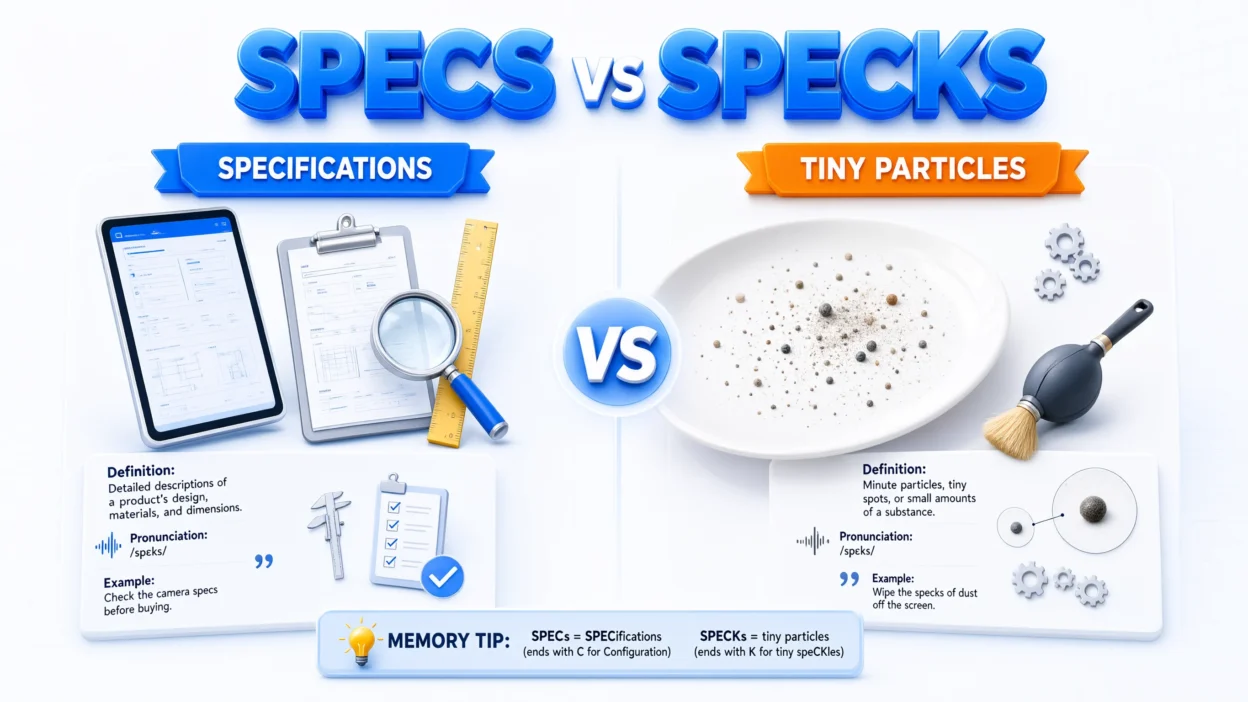
The words specs and specks sound exactly the same, but they have completely different meanings. Understanding the difference between specs vs specks can help you avoid spelling mistakes and use both words correctly in everyday writing. Although their pronunciation is identical, their meanings, spelling, and grammatical uses are different.
The word specs is an informal abbreviation of specifications, which means detailed information or requirements about something. It can also be an informal word for eyeglasses. In contrast, specks refers to tiny spots, small particles, or little marks on a surface.
For example, you might check the specs of a new smartphone before buying it, but notice tiny specks of dust on its screen. Learning when to use each word makes your writing clearer and more accurate.
Quick Answer: Specs vs Specks
Specs means specifications, technical details, or eyeglasses in informal English. Specks means tiny spots, particles, or small marks. Both words are pronounced the same way, but their meanings and spellings are different. Use specs when discussing product details or glasses and specks when describing something small.
Why Do People Confuse Specs and Specks?
People often confuse specs and specks because they are homophones. Homophones are words that sound alike but have different meanings and spellings.
Both words are pronounced /speks/, so you cannot identify the correct spelling by listening alone. You need to understand the context of the sentence.
Here are the main reasons for the confusion:
- Same pronunciation: Both words sound exactly alike in standard English.
- Different meanings: One refers to specifications or glasses, while the other describes tiny spots or particles.
- Similar spelling: Both words begin with the letters “spec.”
- Different contexts: They appear in different situations, such as technology, fashion, cleaning, and everyday conversations.
The easiest way to choose correctly is to consider what you are describing.
1. What Does Specs Mean?
Specs is an informal abbreviation of the word specifications. It refers to the details, features, measurements, or requirements of something.
It is commonly used when discussing technology, electronics, vehicles, products, and construction projects.
For example:
- I checked the specs before buying my new laptop.
- The phone has impressive camera specs.
- Can you send me the specs of this computer?
In these examples, specs refers to information that describes a product or its technical features.
Specs as an Informal Word for Eyeglasses
Specs can also mean eyeglasses or spectacles, particularly in informal English.
For example:
- My grandfather wears reading specs.
- I cannot find my specs anywhere.
- She bought a new pair of specs yesterday.
Synonyms and Related Words for Specs
Depending on the context, these words can be used instead:
- Specifications
- Details
- Features
- Requirements
- Technical information
- Characteristics
- Measurements
- Eyeglasses
- Glasses
- Spectacles
Remember: Specs is usually a plural noun, even when it refers to a single set of product specifications or one pair of glasses.
2. What Does Specks Mean?
Specks is the plural form of speck. It means very small spots, particles, marks, or pieces of something.
Specks are often used to describe tiny visible objects, such as dust, dirt, paint, or food particles.
For example:
- There are specks of dust on the table.
- I noticed tiny specks on my glasses.
- The white shirt has a few black specks.
In these sentences, specks describes small marks or particles.
Common Uses of Specks
The word specks can describe different types of tiny objects or marks.
- Dust specks: Very small particles of dust.
- Dirt specks: Tiny pieces or marks of dirt.
- Paint specks: Small spots of paint.
- Ink specks: Tiny marks made by ink.
- Light specks: Small visible points of light.
- Food specks: Tiny particles of food or ingredients.
Synonyms and Related Words for Specks
Depending on the sentence, you can use:
- Spots
- Dots
- Flecks
- Particles
- Stains
- Marks
- Grains
- Bits
- Fragments
- Tiny pieces
Remember: Specks is a plural countable noun. Its singular form is speck.
Specs vs Specks: Comparison Table
The following table highlights the main differences between these two commonly confused words.
| Feature | Specs | Specks |
| Meaning | Specifications or glasses | Tiny spots or particles |
| Singular form | Spec (short for specification) | Speck |
| Pronunciation | /speks/ | /speks/ |
| Word type | Plural noun; informal | Plural noun |
| Common context | Technology, products, eyewear | Dust, dirt, surfaces |
| Example | Check the phone specs. | Remove the dust specks. |
| Related word | Specifications | Speck |
The most important difference is their meaning. Specs describes information or eyeglasses, whereas specks describes tiny spots or particles.
When to Use Specs vs Specks
Knowing the meaning of each word makes it easier to choose the correct spelling.
When to Use Specs
Use specs when talking about:
- Technical details: The laptop specs are excellent.
- Product features: Check the camera specs before purchasing.
- Product requirements: The project specs need updating.
- Eyeglasses: He wears reading specs.
- Vehicle information: The car specs include engine size and fuel capacity.
When to Use Specks
Use specks when describing:
- Dust particles: There are specks of dust on the shelf.
- Small marks: I noticed specks on the wall.
- Dirt: His shoes were covered with specks of mud.
- Paint particles: The floor has colorful paint specks.
- Tiny spots: The fabric contains tiny blue specks.
A simple rule is to use specs for details or glasses and specks for tiny visible marks.
10+ Examples of Specs and Specks in Sentences
Examples can help you understand how both words work in everyday English.
Examples of Specs
- I always check the laptop specs before making a purchase.
- The new smartphone has better camera specs than the previous model.
- Can you share the technical specs of this machine?
- These glasses have lightweight frames and modern specs.
- The computer’s specs are suitable for gaming.
- We need to review the project specs before starting construction.
- The car’s specs include its engine capacity and fuel efficiency.
- She asked the seller about the television’s specs.
- My old specs are no longer comfortable to wear.
- The company updated the product specs last week.
Examples of Specks
- Tiny specks of dust covered the wooden table.
- I found a few specks of dirt on my white shoes.
- There are black specks on the kitchen floor.
- The artist added colorful specks to the painting.
- She noticed small specks of paint on her clothes.
- The window was covered with tiny water specks.
- A few specks of pepper fell onto the plate.
- The mirror has several tiny specks on its surface.
- His shirt contained small specks of mud.
- The camera captured tiny specks of light in the distance.
Examples Using Both Words Together
Here are a few sentences that show how both words can appear in the same context.
- I checked the phone specs while cleaning the specks of dust from its screen.
- The product specs were printed on a page with tiny ink specks.
- My new specs have a few specks of dust on their lenses.
- The camera specs are excellent, but there are small specks on the lens.
These examples demonstrate why context matters when choosing between the two spellings.
Common Mistakes When Using Specs and Specks
Even experienced English speakers sometimes mix up homophones. Here are some common mistakes to avoid.
Mistake 1: Using Specks for Product Details
Incorrect: I checked the phone specks before buying it.
Correct: I checked the phone specs before buying it.
Why? Specs refers to the phone’s specifications or technical details.
Mistake 2: Using Specs for Tiny Marks
Incorrect: There are dust specs on my desk.
Correct: There are dust specks on my desk.
Why? Specks describes tiny particles of dust.
Mistake 3: Confusing Specs With Spectacles
Incorrect: I cannot find my specks.
Correct: I cannot find my specs.
Why? Specs is an informal term for eyeglasses.
Mistake 4: Using Specks Instead of Speck
Incorrect: There is one specks on the screen.
Correct: There is one speck on the screen.
Why? Speck is singular, while specks is plural.
Mistake 5: Ignoring Sentence Context
The words sound alike, but their meanings are not interchangeable.
Incorrect: The laptop has excellent specks.
Correct: The laptop has excellent specs.
Always consider whether you are talking about technical information or tiny particles.
Memory Trick: How to Remember Specs vs Specks
A simple memory trick can help you remember the difference.
- Specs = Specifications: Both are connected to product details and technical information.
- Specks = Spots: Both describe tiny marks or particles.
Think of these two examples:
- Specs: Check the specifications of your smartphone.
- Specks: Clean the tiny spots from your smartphone screen.
Another helpful trick is to associate the letter combination “ck” in specks with tiny particles that can stick to surfaces.
Once you remember these connections, choosing the correct word becomes much easier.
American vs British English: Specs and Specks
There is no major spelling difference between American and British English when using specs and specks.
Both words are spelled the same way and have the same basic meanings in both varieties of English.
However, their everyday usage may vary slightly depending on the context.
| Word | American English | British English |
| Specs | Technical details or eyeglasses | Technical details or eyeglasses |
| Specks | Tiny spots or particles | Tiny spots or particles |
| Spectacles | Formal term for glasses | Common term for glasses |
For example:
- American English: I need to check my glasses.
- British English: I need to find my specs.
Both expressions are understandable in either variety of English.
The key point is that neither spelling changes between American and British English.
Similar Words You Should Know
Specs and specks are homophones, but several other English words can cause similar confusion.
Here are some useful examples:
| Word Pair | Difference |
| There vs Their | Place or existence vs belonging to them |
| Your vs You’re | Possessive form vs you are |
| To vs Too | Direction or purpose vs also or excessively |
| Its vs It’s | Possessive form vs it is or it has |
| Weather vs Whether | Atmospheric conditions vs expressing a choice |
| Peace vs Piece | Freedom from conflict vs a part of something |
| Brake vs Break | A stopping device vs to damage or separate |
| Flour vs Flower | Baking ingredient vs a plant bloom |
| Bare vs Bear | Uncovered vs an animal or to tolerate |
| Right vs Write | Correct or direction vs putting words on paper |
Learning these word pairs can improve your spelling, vocabulary, and everyday communication.
Final Verdict: Specs or Specks?
The difference between specs and specks is simple once you understand their meanings.
- Specs refers to specifications, technical details, or eyeglasses.
- Specks refers to tiny spots, particles, or small marks.
Both words sound identical, but they are used in different situations.
If you are discussing a laptop, smartphone, car, or pair of glasses, use specs. If you are describing dust, dirt, paint, or tiny marks, use specks.
FAQs:
1. What is the difference between specs and specks?
Specs refers to specifications, product details, or eyeglasses. Specks refers to tiny spots, particles, or small marks. Both words have the same pronunciation but different meanings and spellings.
2. Are specs and specks pronounced the same?
Yes. Specs and specks are homophones because they have identical pronunciation in standard English. Both are pronounced /speks/, even though their spellings and meanings are different.
3. Is specs short for specifications?
Yes. Specs is an informal abbreviation of specifications. It is commonly used when discussing the technical details, features, measurements, or requirements of products such as computers, smartphones, and vehicles.
4. Does specks mean small spots?
Yes. Specks means very small spots, particles, or marks. For example, dust specks are tiny particles of dust that may collect on furniture, screens, or other surfaces.
5. Is specs another word for glasses?
Yes. Specs is an informal word for eyeglasses or spectacles. For example, someone might say, “I cannot read without my specs.”
6. What is the singular form of specks?
The singular form of specks is speck. Use speck when referring to one tiny spot or particle and specks when referring to more than one.
7. Can specs and specks be used interchangeably?
No. Although they sound the same, their meanings are different. Specs refers to specifications or glasses, while specks describes tiny spots or particles. Using one instead of the other can change the meaning of a sentence.
Remember This
- Specs = Specifications or glasses.
- Specks = Tiny spots or particles.
- Both words sound the same.
- Their spelling and meanings are different.
- Always use the sentence context to choose the correct word.
Conclusion
Understanding specs vs specks is easy when you remember their different meanings. Specs is an informal word for specifications and can also refer to eyeglasses. Specks, on the other hand, describes tiny spots, particles, or marks. Although both words sound alike, they cannot be used interchangeably.
The best way to remember the difference is to connect specs with specifications and specks with spots. if you are writing about technology, glasses, dust, or small marks, choosing the correct spelling will make your sentences clearer and more accurate. Keep practicing with everyday examples, and you will quickly learn when to use each word.

I’m James Parker, Administrator at SynonymsHive. I oversee content quality, improve user experience, and ensure reliable synonym resources. My passion is making language learning simple, accurate, and accessible for everyone.