English has many words that look similar but follow different grammar rules. One common example is “informations” vs. “information.” Many students, ESL learners, and even fluent English speakers wonder whether they should use information or informations when talking about facts, details, or knowledge.
The confusion usually happens because English nouns can be singular or plural. For example, we say book and books, idea and ideas, and fact and facts. However, not every English noun follows this pattern. Some nouns, including information, are uncountable, which means they do not normally take a plural form.
Understanding the difference is important for writing emails, completing school assignments, speaking naturally, and communicating professionally. Although informations may seem like a logical plural, standard English uses information for both one piece and multiple pieces of information. In this guide, you will learn the correct spelling, meaning, grammar rules, examples, common mistakes, and useful alternatives.
Quick Answer: Informations or Information?
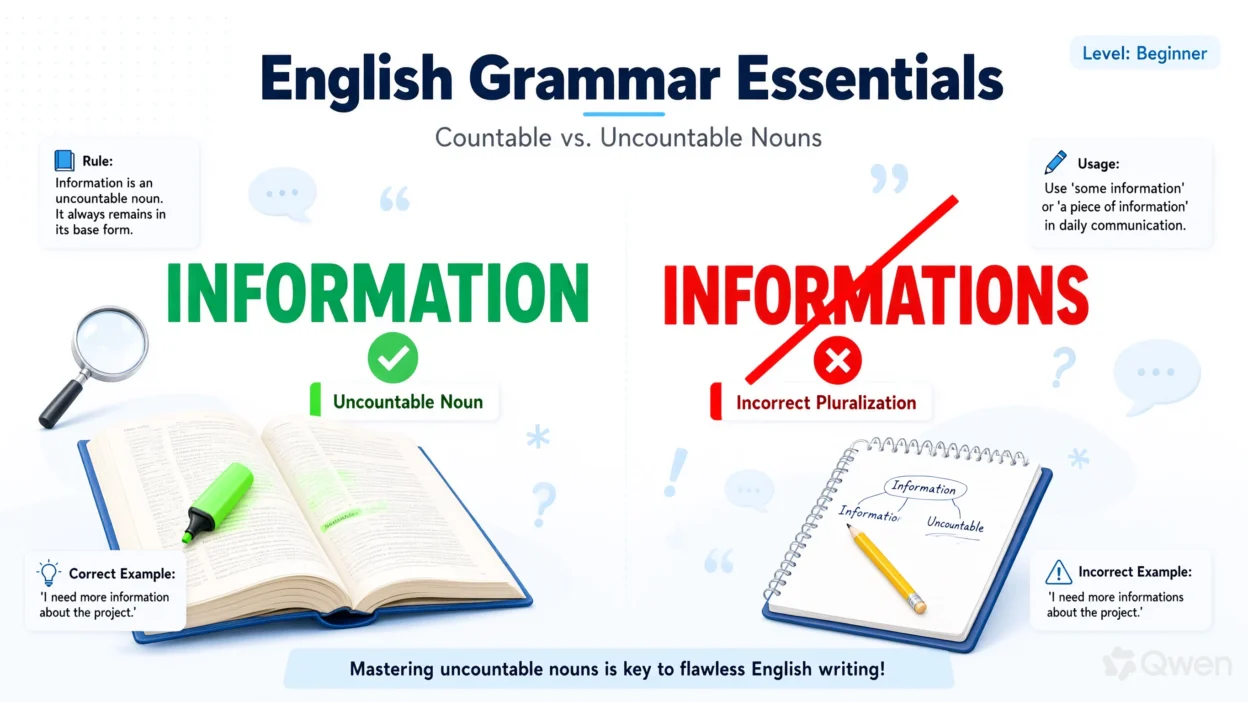
Information is the correct word in standard English. It is an uncountable noun used for facts, details, knowledge, or data. The word informations is generally incorrect in everyday English. Instead of saying “informations,” use “information,” “pieces of information,” or “details” when referring to multiple facts.
Why Do People Confuse Informations and Information?
People often confuse these words because most English countable nouns form their plurals by adding -s or -es.
For example:
- One book → Two books
- One question → Three questions
- One idea → Several ideas
- One document → Many documents
Following this pattern, some people naturally assume that information should become informations when referring to several facts.
However, English also has uncountable nouns. These nouns do not normally have plural forms.
Examples include:
- Advice
- Furniture
- Knowledge
- Equipment
- Luggage
- Information
Therefore, the correct expression is always information when referring to facts or details in ordinary English.
First Word: Information
Information is a noun that refers to facts, knowledge, details, or data about a particular person, subject, event, or situation.
It is an uncountable noun, so it does not normally take a plural ending.
Meaning of Information
Information means knowledge or facts that help someone understand something or learn about a particular subject.
Examples:
- I need more information about this course.
- The website provides useful information.
- She shared important information with her teacher.
- We collected information about the project.
Is Information Singular or Plural?
Information is an uncountable noun. It is grammatically singular when used as the subject of a sentence.
For example:
- The information is correct.
- This information helps students.
- The information was useful.
Notice that we use is, helps, and was, not are, help, or were.
Is Information Countable or Uncountable?
Information is uncountable in standard everyday English.
You cannot normally say:
- One information
- Two informations
- Many informations
Instead, use these expressions:
- A piece of information
- Two pieces of information
- Several pieces of information
- A lot of information
- Some information
Example: She gave me three pieces of information about the examination.
Second Word: Informations
Informations is generally considered incorrect in standard modern English when referring to facts, knowledge, or details.
Although adding -s is a common way to make English nouns plural, this rule does not apply to uncountable nouns such as information.
Meaning of Informations
In ordinary English, informations does not have a standard plural meaning.
You should use information instead.
Incorrect: I received many informations from my teacher.
Correct: I received a lot of information from my teacher.
Correct: I received several pieces of information from my teacher.
Is Informations Ever Correct?
The word informations can occasionally appear in specialized historical or legal contexts, particularly in older legal usage, where an information may refer to a formal accusation or legal proceeding.
However, this is a specialized exception. For normal conversations, academic writing, business communication, and everyday English, use information, not informations.
Information vs. Informations: Comparison Table
| Feature | Information | Informations |
| Correct in everyday English | Yes | No |
| Word type | Noun | Noun form |
| Countable? | Uncountable | Not normally used |
| Plural form | No regular plural | Generally incorrect |
| Meaning | Facts or knowledge | Not used for ordinary facts |
| Example | Useful information | Incorrect usage |
| Best choice | Always use it | Avoid it |
When Should You Use Information or Informations?
Knowing when to use the correct expression makes your English clearer and more natural.
When to Use Information
Use information when talking about facts, knowledge, data, or details.
Examples:
- I found useful information online.
- The teacher provided information about the test.
- We need more information before making a decision.
- This information is important for our research.
When to Use Pieces of Information
Use pieces of information when you want to count individual facts or details.
Examples:
- I have two pieces of information for you.
- She shared five pieces of information.
- We collected several pieces of information during the interview.
When to Use Details
Use details when referring to specific facts or particular parts of something.
Examples:
- Please send me the details.
- The manager explained all the details.
- I need a few more details about the meeting.
15 Examples of Information vs. Informations in Sentences
Here are practical examples to help you understand the correct usage.
| Incorrect Sentence | Correct Sentence |
| I need some informations. | I need some information. |
| She gave me two informations. | She gave me two pieces of information. |
| These informations are useful. | This information is useful. |
| He shared many informations. | He shared a lot of information. |
| The informations were helpful. | The information was helpful. |
| I collected several informations. | I collected several pieces of information. |
| We need more informations. | We need more information. |
| All informations are correct. | All the information is correct. |
| Please provide an information. | Please provide some information. |
| These are important informations. | These are important details. |
| I received three informations. | I received three pieces of information. |
| The informations helped us. | The information helped us. |
| Can you send me informations? | Can you send me information? |
| There are many informations online. | There is a lot of information online. |
| This informations is useful. | This information is useful. |
More Correct Examples
- The information in this book is helpful.
- I would like some information about the university.
- The internet contains a huge amount of information.
- Please share the information with your classmates.
- We received important information yesterday.
- This information can help you make a better decision.
- The company provides information to its customers.
- I found several interesting facts about history.
- She gave me a piece of information about the event.
- The information was collected from different sources.
Common Mistakes When Using Information
Even experienced English learners sometimes make mistakes with uncountable nouns. Here are some common errors to avoid.
1. Adding an S to Information
Incorrect: I need more informations.
Correct: I need more information.
Information does not need an s to refer to multiple facts.
2. Using A Before Information
Incorrect: I need an information.
Correct: I need some information.
You can also say:
- I need a piece of information.
- I need one important detail.
3. Using Are Instead of Is
Incorrect: The information are useful.
Correct: The information is useful.
Because information is uncountable, it generally takes a singular verb.
4. Using Many Instead of Much
Incorrect: We have many information.
Correct: We have much information.
More naturally, you can say:
- We have a lot of information.
- We have plenty of information.
5. Confusing Information with Details
Although these words have similar meanings, they are not always interchangeable.
Information refers to knowledge or facts generally, while details usually refers to specific pieces of information.
Example:
- I need more information about the company.
- I need the details of the company’s address.
Memory Trick: How to Remember the Correct Word
Here is an easy trick to remember the difference:
Information has no S, even when you have lots of it!
Remember this simple pattern:
- One piece of information
- Two pieces of information
- Ten pieces of information
- A lot of information
Think of information like advice and furniture. You do not normally add an s to these uncountable nouns.
This simple trick can help you avoid the mistake in both speaking and writing.
American vs. British English: Information or Informations
There is no difference between American and British English when it comes to the ordinary use of information.
Both varieties treat information as an uncountable noun.
| Usage | American English | British English |
| Correct word | Information | Information |
| Incorrect ordinary plural | Informations | Informations |
| Singular verb | The information is useful. | The information is useful. |
| Countable expression | Two pieces of information | Two pieces of information |
| Alternative | Details | Details |
Whether you are writing for an American or British audience, use information rather than informations.
Similar Words to Information
Several English words have meanings similar to information. However, their usage and grammar may differ.
| Word | Simple Meaning | Example |
| Facts | Things known to be true | The facts are clear. |
| Details | Specific pieces of information | Send me the details. |
| Data | Collected facts or figures | The data is useful. |
| Knowledge | Understanding gained through learning | Knowledge is valuable. |
| Evidence | Facts that support a claim | We need more evidence. |
| Advice | Suggestions about what to do | She gave me good advice. |
| Intelligence | Important collected information | The report contained intelligence. |
| Records | Stored information | The school keeps student records. |
| Findings | Results of research | The findings were interesting. |
| Insights | A deeper understanding | Her insights were helpful. |
These alternatives can make your writing more precise and prevent unnecessary repetition.
Final Verdict: Which One Is Correct?
Information is the correct choice in standard everyday English. It is an uncountable noun that refers to facts, details, knowledge, or data.
Informations is generally incorrect when referring to multiple facts or details. If you want to count individual items, use expressions such as two pieces of information, several details, or three facts.
The easiest rule to remember is that information does not normally take an s, regardless of how many facts you are discussing.
FAQs:
1. Is it informations or information?
Information is correct in standard English. It is an uncountable noun, so you should not normally add s to make it plural.
Correct: I need more information.
Incorrect: I need more informations.
2. Is information singular or plural?
Information is an uncountable noun that takes a singular verb.
For example:
- The information is correct.
- The information was helpful.
It can refer to one fact or many facts without changing its form.
3. Can I say two informations?
No, you should not say two informations in ordinary English.
The correct expression is two pieces of information.
Example: The teacher gave us two pieces of information about the examination.
4. Why is information uncountable?
Information is uncountable because English treats it as a general collection of facts or knowledge rather than separate countable objects.
To count individual items, use words such as pieces, items, or details.
5. What is the plural of information?
Information has no regular plural form in standard everyday English.
When referring to multiple facts, you can say:
- Pieces of information
- Several details
- Different facts
- Various data points
6. Is informations ever grammatically correct?
The word can appear in specialized historical or legal contexts, but it is not the normal plural of information. In everyday communication, use information or pieces of information.
7. What is the difference between information and details?
Information refers to facts or knowledge about a subject generally. Details refer to specific facts or individual parts of that information.
Example:
- I need information about the course.
- I need details about the course schedule.
Remember This
- Information is correct in everyday English.
- Informations is generally incorrect.
- Information is an uncountable noun.
- Use is instead of are with information.
- Say a piece of information, not an information.
- Say two pieces of information, not two informations.
Conclusion
Understanding the difference between informations and information is simple once you learn the rule for uncountable nouns. In standard English, information is the correct word because it can describe one fact or many facts without changing its form. You should avoid adding an s to it when discussing general knowledge, details, or data.
Whenever you need to count individual facts, use expressions such as a piece of information, several pieces of information, or important details. Remembering this small grammar rule will help you write more naturally, avoid common mistakes, and communicate more confidently in English.

I’m Nathan Collins, a language enthusiast passionate about exploring synonyms and improving everyday writing. I create clear, accurate, and helpful content that helps readers expand vocabulary and communicate with confidence.