
English has many words and phrases that look different but express almost the same idea. “Despite” and “in spite of” are two common examples. Both are used to show contrast between two situations. They explain that something happens even when another fact, condition, or situation might prevent it from happening. However, understanding how to use them correctly can sometimes be confusing, especially for students and English learners.
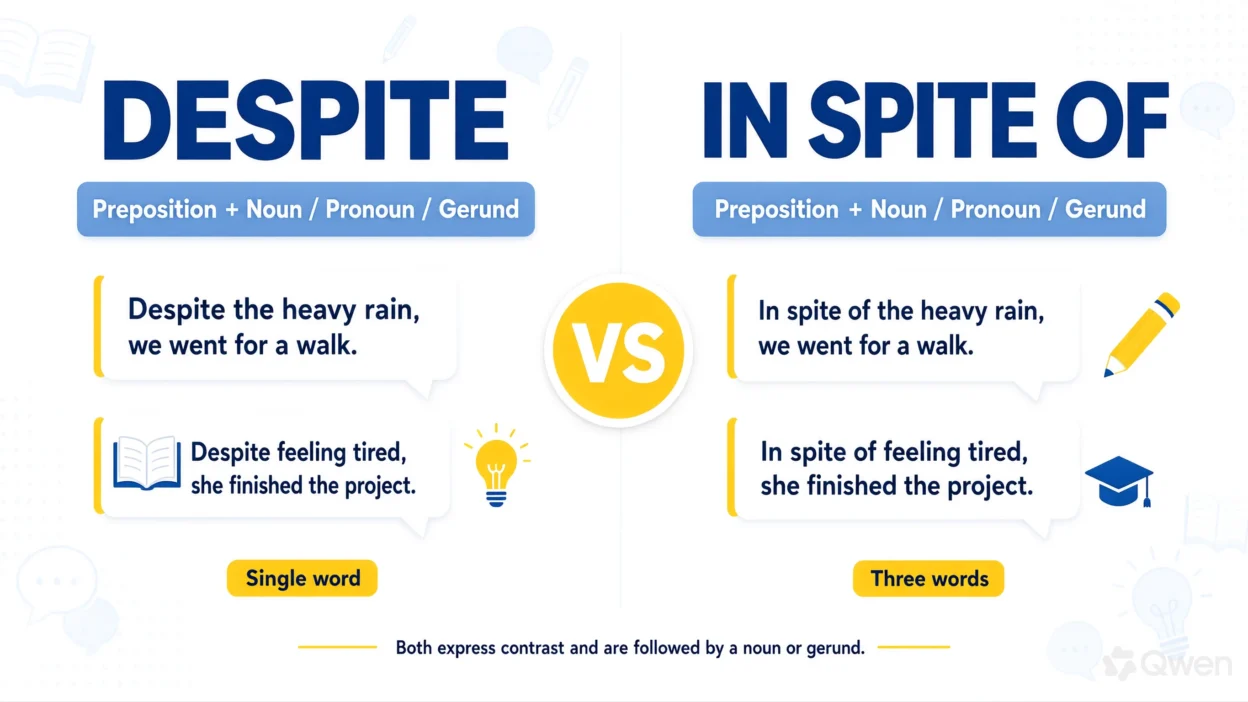
The main difference between despite and in spite of is their grammatical structure. Despite is a single preposition, while in spite of is a three-word prepositional phrase. Both have the same meaning and can usually replace each other without changing the overall message.
The important rule is that both are followed by a noun, pronoun, or gerund (an -ing verb). Learning this simple rule will help you use these expressions confidently in everyday conversations, academic writing, and professional communication.
Quick Answer
Despite and in spite of have the same meaning: without being prevented by something; even though something happens. Despite is one word, while in spite of is a three-word phrase. Both are followed by a noun, pronoun, or gerund, not a complete clause directly.
Why Do People Confuse Despite and In Spite Of?
People often confuse these expressions because they communicate almost exactly the same meaning.
For example:
- Despite the rain, we went outside.
- In spite of the rain, we went outside.
Both sentences explain that the rain did not stop us from going outside.
There are three main reasons people find them confusing:
- Similar meanings: Both expressions show contrast between two ideas.
- Different structures: Despite is one word, whereas in spite of contains three words.
- Common grammatical mistakes: Some learners incorrectly use “of” after despite or forget “of” after in spite.
The good news is that once you understand their grammatical patterns, choosing the correct expression becomes much easier.
First Word: Despite
What Does Despite Mean?
Despite means that something happens even though there is a particular difficulty, problem, condition, or situation.
It introduces information that might normally prevent something from happening, but does not.
Simple definition: Despite means “without being affected or stopped by something.
How to Use Despite in a Sentence
Despite is a preposition. It is followed by a noun, pronoun, or gerund.
Structure:
Despite + noun/pronoun/gerund + main clause
Examples:
- Despite the rain, we played football.
- Despite his age, he runs very fast.
- Despite feeling tired, she completed her homework.
- Despite the difficulties, they continued working.
- Despite everything, he remained positive.
More Examples of Despite
- Despite the cold weather, we went hiking.
- Despite her busy schedule, she visits her parents.
- Despite being nervous, he gave a wonderful speech.
- Despite the traffic, I arrived on time.
- Despite his mistakes, everyone supported him.
Important Grammar Rule for Despite
Never add “of” directly after despite.
Correct
Despite the heavy rain, we continued playing.
Incorrect
Despite of the heavy rain, we continued playing.
Remember that despite already expresses the meaning of “in spite of.” It does not need an additional “of.
Second Word: In Spite Of
What Does In Spite Of Mean?
In spite of means that something happens even when there is a difficulty, obstacle, or situation that could prevent it.
It has the same basic meaning as despite.
Simple definition: In spite of means “even though something exists or happens.”
How to Use In Spite Of in a Sentence
In spite of is a prepositional phrase. It is followed by a noun, pronoun, or gerund.
Structure:
In spite of + noun/pronoun/gerund + main clause
Examples:
- In spite of the rain, we played football.
- In spite of his age, he runs very fast.
- In spite of feeling tired, she completed her homework.
- In spite of the difficulties, they continued working.
- In spite of everything, he remained positive.
More Examples of In Spite Of
- In spite of the cold weather, we went hiking.
- In spite of her busy schedule, she visits her parents.
- In spite of being nervous, he gave a wonderful speech.
- In spite of the traffic, I arrived on time.
- In spite of his mistakes, everyone supported him.
Important Grammar Rule for In Spite Of
Always include “of” when using this expression.
Correct
In spite of the bad weather, the match continued.
Incorrect
In spite the bad weather, the match continued.
The word “of” is an essential part of this expression.
Despite vs. In Spite: Comparison Table
Although despite and in spite of have the same meaning, their grammatical structures are different.
| Feature | Despite | In Spite Of |
| Meaning | Even though | Even though |
| Word type | Preposition | Prepositional phrase |
| Structure | One word | Three words |
| “Of” required? | No | Yes |
| Followed by a noun | Yes | Yes |
| Followed by a gerund | Yes | Yes |
| Followed by a pronoun | Yes | Yes |
| Formality | Neutral | Neutral |
| Sentence position | Beginning or middle | Beginning or middle |
Main takeaway: Both expressions are grammatically correct and interchangeable in most situations. The biggest difference is their structure, not their meaning.
When Should You Use Despite or In Spite Of?
Choosing between these expressions depends mainly on your writing style and sentence structure.
1. Use Despite for Shorter Sentences
Despite is shorter and often makes sentences more concise.
Examples:
- Despite the noise, I studied.
- Despite his failure, he tried again.
- Despite the delay, we arrived safely.
It is particularly useful when you want to keep your writing direct and simple.
2. Use In Spite Of for Natural Expression
In spite of is equally correct and can sound natural in both speaking and writing.
Examples:
- In spite of the noise, I studied.
- In spite of his failure, he tried again.
- In spite of the delay, we arrived safely.
3. Use Either Expression in Formal Writing
Both expressions are acceptable in academic, professional, and everyday English.
For example:
- Despite the challenges, the research was successful.
- In spite of the challenges, the research was successful.
Neither expression is automatically more formal than the other.
4. Use Both with Gerunds
When you want to describe an action, you can use an -ing verb after either expression.
Examples:
- Despite working hard, he failed the exam.
- In spite of working hard, he failed the exam.
12+ Examples of Despite vs. In Spite Of
Here are practical examples showing how both expressions work in everyday English.
| Despite | In Spite Of |
| Despite the rain, we went out. | In spite of the rain, we went out. |
| Despite his illness, he worked. | In spite of his illness, he worked. |
| Despite being tired, she smiled. | In spite of being tired, she smiled. |
| Despite the traffic, we arrived early. | In spite of the traffic, we arrived early. |
| Despite her fear, she spoke. | In spite of her fear, she spoke. |
| Despite the difficulties, they succeeded. | In spite of the difficulties, they succeeded. |
| Despite losing, he remained happy. | In spite of losing, he remained happy. |
| Despite the warning, they continued. | In spite of the warning, they continued. |
| Despite his limited experience, he performed well. | In spite of his limited experience, he performed well. |
| Despite studying all night, she felt unprepared. | In spite of studying all night, she felt unprepared. |
| Despite the high price, I bought it. | In spite of the high price, I bought it. |
| Despite everything, they stayed together. | In spite of everything, they stayed together. |
These examples demonstrate that both expressions can communicate the same message without changing the meaning.
Common Mistakes When Using Despite and In Spite Of
Even experienced English learners sometimes make mistakes with these expressions. Here are some common errors to avoid.
1. Adding “Of” After Despite
Incorrect: Despite of the rain, we played.
Correct: Despite the rain, we played.
Why? Despite does not require “of.”
2. Forgetting “Of” in In Spite Of
Incorrect: In spite the difficulties, she succeeded.
Correct: In spite of the difficulties, she succeeded.
Why? The complete expression must include “of.”
3. Using a Complete Clause Directly After Despite
Incorrect: Despite he was tired, he continued working.
Correct: Despite being tired, he continued working.
Another correct option:
Although he was tired, he continued working.
Why? Despite normally takes a noun phrase, pronoun, or gerund rather than a complete clause.
4. Confusing Despite With Although
Incorrect: Despite she was sick, she attended school.
Correct: Although she was sick, she attended school.
Also correct:
Despite being sick, she attended school.
Why? Although is a conjunction and can introduce a complete clause. Despite is a preposition.
5. Using the Wrong Verb Form
Incorrect: Despite to work hard, he failed.
Correct: Despite working hard, he failed.
Why? When an action follows despite or in spite of, use the gerund form (-ing).
Memory Trick: How to Remember Despite vs. In Spite Of
Remembering the difference is simple when you focus on one small grammatical detail.
- Despite = No “Of”: Use despite directly before a noun, pronoun, or gerund.
- In Spite = Add “Of”: Always include “of” to complete the expression.
Try remembering these examples:
- Despite the rain, we played.
- In spite of the rain, we played.
Both sentences mean exactly the same thing.
Easy trick: If you write “despite of,” remove “of.” If you write “in spite,” add “of.”
American vs. British English: Despite and In Spite Of
There is no significant difference between American and British English when using despite and in spite of.
Both expressions are widely understood and grammatically correct in both varieties of English.
| Feature | American English | British English |
| Despite | Correct | Correct |
| In spite of | Correct | Correct |
| Meaning | Same | Same |
| Grammar | Same | Same |
| Usage | Common | Common |
Examples in American English:
- Despite the weather, we went shopping.
- In spite of the traffic, she arrived early.
Examples in British English:
- Despite the weather, we went shopping.
- In spite of the traffic, she arrived early.
Remember: Your choice should depend on sentence structure and personal writing preference, not whether you are using American or British English.
Similar Words and Expressions
Several other English words and phrases can express a similar idea to despite and in spite of.
However, their grammatical structures are not always identical.
| Word or Phrase | Simple Meaning | Example |
| Although | Even though | Although it rained, we played. |
| Though | Despite the fact that | Though he was tired, he worked. |
| Even though | Despite the fact that | Even though she was busy, she helped. |
| Regardless of | Without considering | Regardless of the cost, he bought it. |
| Notwithstanding | Despite | Notwithstanding the difficulties, they succeeded. |
| Nevertheless | Despite that | It was difficult; nevertheless, we continued. |
| However | Despite this | The weather was bad. However, we went out. |
| Even with | Despite having | Even with limited time, she finished. |
Important: Although, though, and even though are followed by a subject and verb. Despite and in spite of normally take a noun, pronoun, or gerund.
Final Verdict: Despite or In Spite Of?
Despite and in spite of have the same meaning and are both correct expressions in English. They show that something happens even when a difficulty, obstacle, or unexpected situation exists.
The main difference is grammatical structure:
- Despite: A single word that does not require “of.”
- In spite of: A three-word expression that always requires “of.”
You can use either expression in everyday conversations, academic assignments, professional emails, and general writing. Just make sure to follow the correct grammatical structure.
FAQs:
1. What is the difference between despite and in spite of?
There is no major difference in meaning. Both expressions mean “even though” or “without being prevented by something.” The only important difference is their grammatical structure. Despite is one word, while in spite of is a three-word phrase.
2. Are despite and in spite of interchangeable?
Yes, they are interchangeable in most situations because they express the same meaning.
For example:
- Despite the rain, we went outside.
- In spite of the rain, we went outside.
Both sentences are correct.
3. Is it correct to say despite of?
No, “despite of” is grammatically incorrect in standard English.
The correct expression is “despite.”
Correct: Despite the difficulties, she succeeded.
Incorrect: Despite of the difficulties, she succeeded.
4. Should I use “of” after in spite?
Yes. The word “of” is an essential part of the expression “in spite of.”
Correct: In spite of the bad weather, we traveled.
Incorrect: In spite the bad weather, we traveled.
5. Can despite and in spite of be followed by an -ing verb?
Yes. Both expressions can be followed by a gerund (an -ing verb).
Examples:
- Despite feeling sick, she attended the meeting.
- In spite of feeling sick, she attended the meeting.
Both sentences are grammatically correct.
6. Can I use despite and in spite of at the beginning of a sentence?
Yes. Both expressions can appear at the beginning or in the middle of a sentence.
Examples:
- Despite the rain, we continued playing.
- We continued playing despite the rain.
- In spite of the rain, we continued playing.
- We continued playing in spite of the rain.
7. Which is more formal: despite or in spite of?
Both expressions are acceptable in formal and informal English. Despite is shorter and often preferred when writing concise sentences, but in spite of is equally correct and natural.
Remember This
- Despite and in spite of have the same meaning.
- Despite is written as one word.
- In spite of always includes “of.”
- Both can be followed by nouns, pronouns, and gerunds.
- Never write “despite of.”
- Use although or even though when introducing a complete clause.
The easiest rule: Despite = No “Of”; In Spite = Always “Of.”
Conclusion
Understanding the difference between despite and in spite of is easy once you learn their grammatical structures. Both expressions communicate contrast and explain that something happens even when a particular difficulty or situation exists. They have the same meaning and can replace each other in most sentences without changing the message.
The most important thing is to remember when to use “of.” Write despite without “of,” and always include “of” when using in spite of. Practice these expressions with everyday examples, and you will become more confident using them in conversations, school assignments, and professional writing.

I am Andrew Foster, a passionate language writer who enjoys helping readers discover the right synonyms and improve their vocabulary. I create clear, accurate, and engaging content that makes learning English simple, practical, and enjoyable.