Have you ever wondered if to use relieving or reliving in a sentence? These two words look and sound similar, but they have completely different meanings. Choosing the wrong one can change the meaning of your sentence and confuse your readers. Although both words are formed by adding -ing to another word, they describe different actions and experiences.
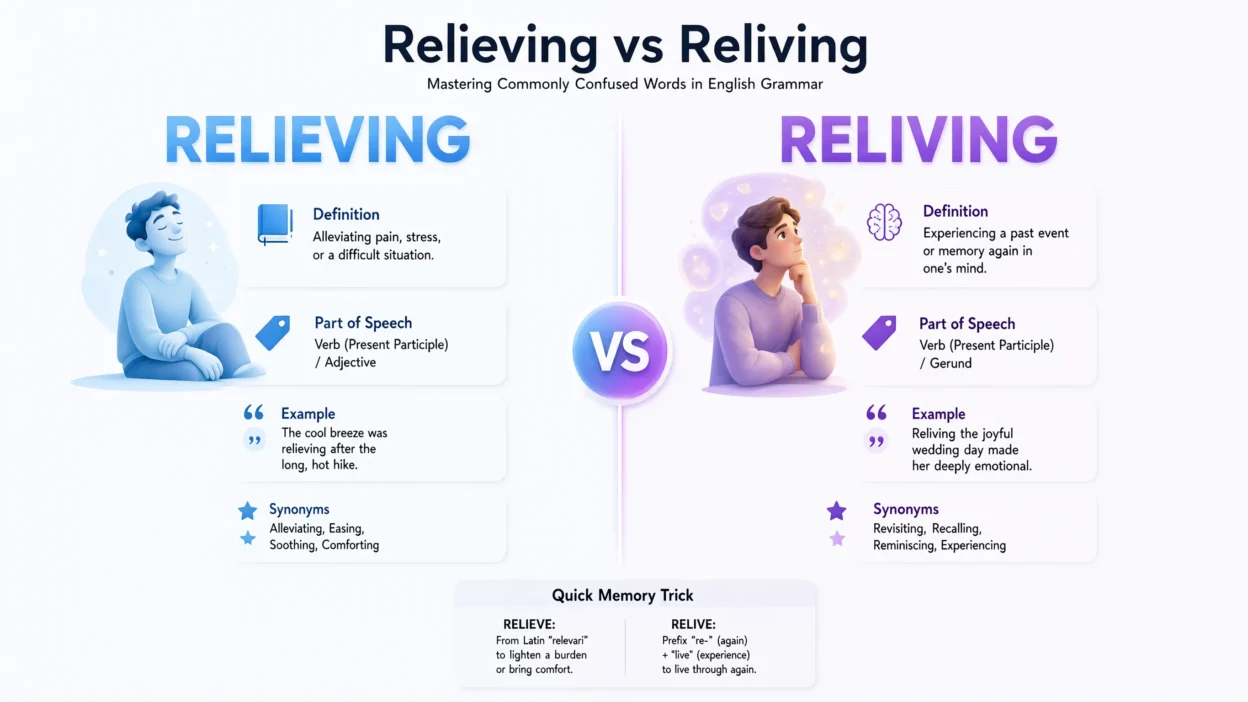
The main difference between relieving and reliving is that relieving means reducing pain, stress, worry, or discomfort, while reliving means experiencing or remembering something from the past as if it were happening again. For example, taking medicine can be relieving because it reduces pain. However, remembering a childhood memory in great detail means reliving that experience. Understanding their meanings, grammatical forms, and everyday uses will help you choose the correct word in writing and conversation.
Quick Answer: Relieving vs Reliving
Relieving means making pain, stress, pressure, or discomfort less severe. Reliving means experiencing or remembering a past event or feeling as though it is happening again. Use relieving when something provides comfort or reduces a problem. Use reliving when someone mentally revisits a previous experience.
Why Do People Confuse Relieving and Reliving?
People often confuse relieving and reliving because their spelling is almost identical. Both words contain seven letters and end in -ing. They also have similar pronunciations, which makes them easy to mix up in everyday communication.
However, their root words are different:
- Relieving comes from the verb relieve, which means to reduce pain, stress, difficulty, or discomfort.
- Reliving comes from the verb relive, which means to experience something again, usually through memory or imagination.
Another reason for confusion is that both words can describe emotional experiences.
For example:
- The conversation was relieving because it reduced my worries.
- She was reliving the emotional conversation in her mind.
The first sentence describes a reduction in worry, while the second describes remembering a previous experience.
What Does Relieving Mean?
Relieving is the present participle or gerund form of the verb relieve. It means reducing pain, stress, anxiety, pressure, difficulty, or another unpleasant condition.
When something is relieving, it makes a difficult or uncomfortable situation easier to handle.
Simple Meaning of Relieving
Relieving means providing comfort, removing pressure, or making something less unpleasant.
Examples:
- Drinking cold water was relieving after a long walk.
- Talking to my best friend was relieving during a stressful time.
- The medicine had a relieving effect on my headache.
- Getting help with my work felt relieving.
Synonyms of Relieving
Here are some common words related to relieving:
- Comforting
- Soothing
- Reassuring
- Easing
- Alleviating
- Relaxing
- Calming
- Releasing
- Mitigating
- Reducing
Important: These synonyms are not interchangeable in every sentence. Choose one according to the type of discomfort or difficulty being reduced.
When Is Relieving Used?
Use relieving when discussing something that reduces an unpleasant feeling or situation.
Common contexts include:
- Physical pain: A warm bath can be relieving after exercise.
- Emotional stress: Sharing your worries can be relieving.
- Mental pressure: Finishing an important assignment feels relieving.
- Difficult situations: Receiving financial support can be relieving.
- Medical treatment: The treatment provides relief from discomfort.
What Does Reliving Mean?
Reliving is the present participle or gerund form of the verb relive. It means experiencing, remembering, or mentally revisiting something that happened in the past.
People commonly use this word when talking about memories, emotions, important events, and personal experiences.
Simple Meaning of Reliving
Reliving means experiencing a past event or feeling again through memory, imagination, or recollection.
Examples:
- I am reliving my childhood memories through old photographs.
- He kept reliving the exciting moments of the match.
- She was reliving her wedding day in her imagination.
- Watching the video helped us relive our vacation.
Synonyms of Reliving
Here are some words and expressions related to reliving:
- Remembering
- Recalling
- Reexperiencing
- Revisiting
- Recollecting
- Replaying
- Reflecting on
- Recalling vividly
- Reminiscing
- Recalling emotionally
Important: Some of these words have slightly different meanings. For example, reminiscing usually involves remembering pleasant past experiences, while reliving can involve happy, sad, or difficult experiences.
When Is Reliving Used?
Use reliving when someone mentally experiences or remembers something from the past.
Common situations include:
- Childhood memories: She enjoys reliving her childhood through family stories.
- Special occasions: They were reliving the excitement of their graduation.
- Past experiences: I keep reliving my first day at school.
- Emotional memories: He was reliving a painful moment from his past.
- Historical events: The documentary helps viewers relive important moments in history.
Relieving vs Reliving: Key Differences
The following comparison table explains the main differences between these two words.
| Feature | Relieving | Reliving |
| Root word | Relieve | Relive |
| Meaning | Reducing discomfort | Experiencing something again |
| Main purpose | Providing relief | Revisiting memories |
| Common context | Pain, stress, pressure | Memories, events, experiences |
| Related noun | Relief | Life (in the root word) |
| Synonyms | Easing, soothing | Remembering, recalling |
| Example | The treatment was relieving. | She was reliving her memories. |
The easiest distinction: Relieving is about making something unpleasant less severe, while reliving is about experiencing something from the past again.
When Should You Use Relieving or Reliving?
Choosing between these words becomes easier when you understand what you want to communicate.
Use Relieving When Something Reduces Discomfort
Choose relieving when you are describing something that makes pain, worry, stress, or pressure less intense.
Examples:
- It was relieving to hear that everyone was safe.
- The new treatment has a relieving effect.
- Taking a break from work felt relieving.
In each sentence, the word communicates comfort or a reduction in discomfort.
Use Reliving When Remembering a Past Experience
Choose reliving when someone is mentally returning to an event or experience that happened before.
Examples:
- I am reliving my happiest childhood memories.
- She keeps reliving her graduation day.
- He was reliving the final moments of the competition.
In these examples, the word describes remembering or experiencing something again.
15 Examples of Relieving vs Reliving in Sentences
Examples make the difference between these words easier to understand. Here are 15 practical sentences showing how to use each word correctly.
Examples of Relieving
- Getting positive news about my health was relieving.
- The relaxing music had a relieving effect on my stress.
- Drinking enough water was relieving after hours in the sun.
- It was relieving to know that my family had arrived safely.
- The doctor recommended a treatment for relieving muscle pain.
- Sharing my problems with a friend felt relieving.
- Completing the difficult project was a relieving experience.
- A short break from studying can be relieving.
- The cool breeze was relieving on a hot afternoon.
- Knowing that the exam was postponed was relieving.
Examples of Reliving
- Looking at old photographs makes me feel like I am reliving my childhood.
- She spent the evening reliving her favorite vacation memories.
- Watching the final match again felt like reliving an exciting moment.
- He was reliving his school days through conversations with old friends.
- The documentary allowed viewers to relive an important historical event.
Common Mistakes When Using Relieving and Reliving
Even experienced English speakers sometimes mix up similar-looking words. Here are some common mistakes to avoid.
Mistake 1: Using Reliving Instead of Relieving
Incorrect: Drinking water was reliving after the workout.
Correct: Drinking water was relieving after the workout.
Why? The sentence describes something that provides comfort, not a memory from the past.
Mistake 2: Using Relieving Instead of Reliving
Incorrect: I enjoy relieving my childhood memories.
Correct: I enjoy reliving my childhood memories.
Why? The sentence describes remembering and experiencing childhood memories again.
Mistake 3: Confusing Their Root Words
Remember that:
- Relieve = Reduce discomfort.
- Relive = Experience something again.
Adding -ing does not change their basic meanings.
Mistake 4: Assuming Both Words Describe Feelings
Although both words can appear in emotional sentences, their meanings are different.
- Hearing the good news was relieving.
- Hearing the old song made me feel like I was reliving my childhood.
The first describes emotional comfort, while the second describes revisiting a memory.
Memory Trick: How to Remember Relieving vs Reliving
A simple memory trick can help you remember the difference permanently.
Relieving = Relief
Both words begin with the same letters, relie. Think of relief from pain, stress, or worry.
Example: The news was relieving.
Reliving = Living Again
The word reliving contains the word living. Think of experiencing something again, as if you were living through it.
Example: I am reliving my school memories.
Relieving
RELIEF = LESS PAIN OR STRESS
Think: Making something unpleasant easier.
Reliving
LIVING AGAIN = EXPERIENCING THE PAST
Think: Remembering an experience as if it is happening again.
Relieving vs Reliving in American and British English
There is no meaningful difference between American and British English when it comes to the meanings of relieving and reliving.
Both spellings are standard in American English and British English.
| Word | American English | British English |
| Relieving | Correct | Correct |
| Reliving | Correct | Correct |
The meanings and grammatical uses remain the same in both varieties.
For example:
- American English: It was relieving to hear the good news.
- British English: It was relieving to hear the good news.
- American English: She enjoys reliving her childhood memories.
- British English: She enjoys reliving her childhood memories.
Therefore, you do not need to change either spelling depending on your audience.
Similar Words That People Often Confuse
English contains many words that look or sound similar but have different meanings. Learning these pairs can improve your vocabulary and writing skills.
Here are some examples:
| Word Pair | Difference |
| Affect vs Effect | Affect is usually a verb; effect is usually a noun. |
| Advice vs Advise | Advice is a noun; advise is a verb. |
| Loose vs Lose | Loose means not tight; lose means to misplace or fail to keep. |
| Breath vs Breathe | Breath is a noun; breathe is a verb. |
| Accept vs Except | Accept means to receive; except means excluding. |
| Personal vs Personnel | Personal relates to an individual; personnel means employees. |
| Remind vs Remember | Remind means to help someone recall; remember means to keep something in mind. |
| Relief vs Relive | Relief means comfort from discomfort; relive means to experience again. |
Understanding these differences helps you avoid spelling mistakes and communicate more clearly.
Final Verdict: Relieving or Reliving?
The choice between relieving and reliving depends entirely on your intended meaning.
- Choose relieving when talking about reducing pain, stress, worry, pressure, or discomfort.
- Choose reliving when talking about remembering or experiencing a past event again.
For example, saying “The good news was relieving” means the news reduced your worry. Saying “I was reliving the good news” means you were mentally experiencing that previous moment again.
Both words are correct, but they cannot replace each other because they describe different actions.
FAQs:
1. What is the main difference between relieving and reliving?
Relieving means reducing pain, stress, worry, or discomfort. Reliving means experiencing or remembering something from the past as if it were happening again. One describes providing relief, while the other describes revisiting an experience.
2. Is relieving a real word?
Yes, relieving is a correct English word. It is the present participle or gerund form of relieve. It describes reducing discomfort, pressure, pain, or worry.
Example: Taking a relaxing bath was relieving after a stressful day.
3. Is reliving a real word?
Yes, reliving is a standard English word. It is the present participle or gerund form of relive. It describes mentally experiencing or remembering a past event.
Example: She enjoys reliving her childhood memories.
4. Is it relieving or reliving memories?
The correct phrase is reliving memories. It means remembering or mentally experiencing past events again.
Example: Looking through my old school photographs makes me feel like I am reliving those wonderful days.
5. Is it relieving or reliving stress?
The correct choice depends on the sentence.
- Relieving stress means reducing or managing stress.
- Reliving stress means mentally experiencing a stressful situation again.
Example: Exercise is helpful for relieving stress.
6. Can relieving and reliving be used interchangeably?
No, relieving and reliving cannot be used interchangeably because they have different meanings. Relieving is connected to providing relief, while reliving is connected to remembering or experiencing the past again.
7. What is an easy way to remember relieving and reliving?
Connect relieving with relief and reliving with living again. Relieving makes an unpleasant situation easier, while reliving means mentally experiencing something that happened before.
Remember This
- Relieving = Reducing pain, stress, or discomfort.
- Reliving = Experiencing or remembering something again.
- Relieving comes from the verb relieve.
- Reliving comes from the verb relive.
- Both words are correctly spelled in American and British English.
The simplest rule is to remember that relieving provides relief, while reliving brings back memories.
Conclusion
Understanding the difference between relieving and reliving is important for clear and accurate English communication. Although these words look similar, they serve different purposes. Relieving describes reducing discomfort, stress, or pain, whereas reliving describes remembering or experiencing something from the past again. Knowing their meanings and correct usage will help you avoid common vocabulary mistakes.
Whenever you are unsure which word to use, think about the message you want to express. If you are talking about comfort or reducing a problem, choose relieving. If you are talking about memories or past experiences, choose reliving. With regular practice and these simple examples, you can use both words confidently in everyday conversations and writing.

I am Andrew Foster, a passionate language writer who enjoys helping readers discover the right synonyms and improve their vocabulary. I create clear, accurate, and engaging content that makes learning English simple, practical, and enjoyable.