Have you ever wondered if to write plural or possessive? These two grammar concepts look similar because both can involve the letter s, but they serve very different purposes. Knowing when to use a plural noun and when to use a possessive noun can make your writing clearer and help you avoid common punctuation mistakes.
The main difference is simple: plural means more than one person, place, thing, or idea, while possessive shows ownership or a relationship between two things. For example, cats refers to more than one cat, whereas cat’s toy means a toy belonging to one cat.
The apostrophe makes an important difference. In this guide, you will learn the rules, explore practical examples, compare plural and possessive forms, and discover easy tricks to remember when an apostrophe is necessary.
Quick Answer: Is It Plural or Possessive?
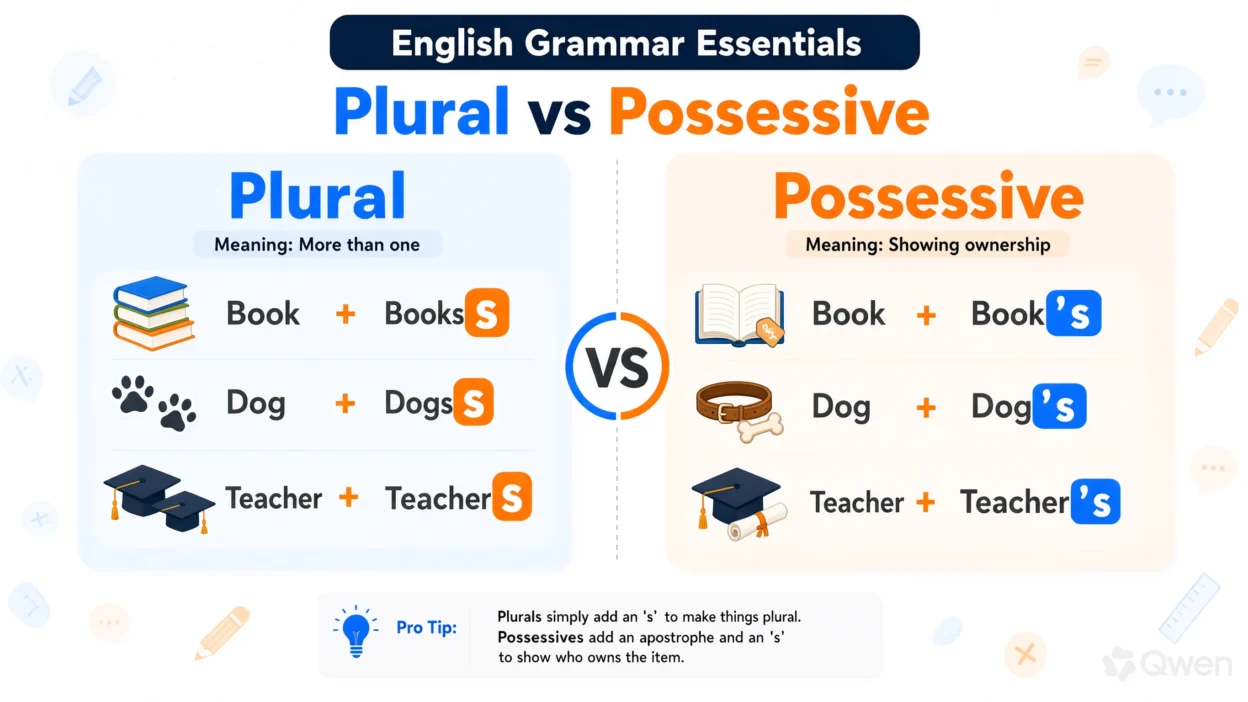
Plural means more than one person, place, animal, or thing. Most plural nouns end in -s or -es, such as books and boxes. Possessive shows ownership or a relationship and usually uses an apostrophe, such as John’s book or the students’ classroom. Remember: plural tells how many, while possessive tells whose.
Why Do People Confuse Plural and Possessive?
People often confuse plural and possessive forms because both commonly contain the letter s. However, the apostrophe changes the meaning of a word.
Consider these three examples:
- Dog: One dog.
- Dogs: More than one dog.
- Dog’s: Something belonging to one dog.
The difference becomes even more important when writing about multiple owners.
- Student’s books: Books belonging to one student.
- Students’ books: Books belonging to multiple students.
Another reason for confusion is that possessive nouns do not always follow the same apostrophe pattern. Singular nouns generally take apostrophe + s, while regular plural nouns ending in s usually take only an apostrophe.
Understanding these small differences can help you write more accurately.
What Does Plural Mean?
A plural noun refers to two or more people, animals, places, objects, or ideas. It is the opposite of a singular noun, which refers to just one.
Most English nouns become plural by adding -s or -es.
Rules for Making Nouns Plural
1. Add -s to most nouns
This is the most common plural formation rule.
- Book → Books
- Chair → Chairs
- Apple → Apples
- Student → Students
- Car → Cars
2. Add -es to certain nouns
Nouns ending in -s, -ss, -sh, -ch, -x, or -z commonly take -es.
- Box → Boxes
- Bus → Buses
- Dish → Dishes
- Watch → Watches
- Quiz → Quizzes
3. Change -y to -ies
When a noun ends in a consonant + y, change the y to ies.
- Baby → Babies
- City → Cities
- Story → Stories
- Country → Countries
However, when a vowel comes before y, simply add -s.
- Boy → Boys
- Toy → Toys
- Key → Keys
4. Some nouns have irregular plural forms
These nouns do not follow the usual rules.
- Child → Children
- Man → Men
- Woman → Women
- Foot → Feet
- Tooth → Teeth
- Mouse → Mice
5. Some nouns have the same singular and plural forms
Certain English nouns do not change when they become plural.
- Sheep → Sheep
- Deer → Deer
- Fish → Fish (in many contexts)
What Does Possessive Mean?
A possessive noun shows ownership, belonging, or a relationship between people, animals, places, and things.
In English, possessive nouns usually use an apostrophe (‘) with the letter s or an apostrophe after an existing plural s.
Rules for Making Nouns Possessive
1. Add ‘s to singular nouns
Use apostrophe + s to show that something belongs to one person, animal, or thing.
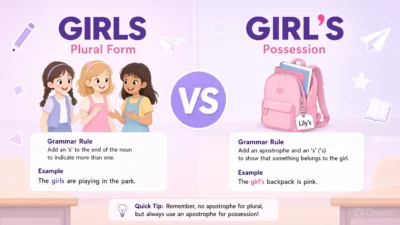
- Girl → Girl’s dress
- Boy → Boy’s bicycle
- Teacher → Teacher’s desk
- Cat → Cat’s food
- John → John’s phone
2. Add only an apostrophe to regular plural nouns ending in s
When a plural noun already ends in s, place the apostrophe after the s.
- Girls → Girls’ dresses
- Teachers → Teachers’ room
- Students → Students’ books
- Dogs → Dogs’ toys
- Parents → Parents’ house
3. Add ‘s to irregular plural nouns
Irregular plural nouns that do not end in s usually take ‘s.
- Children → Children’s toys
- Men → Men’s clothing
- Women → Women’s rights
- People → People’s opinions
4. Use apostrophes with names ending in s
For singular names ending in s, both James’s and James’ are accepted in different style conventions. Many modern style guides prefer James’s.
- James’s car
- Charles’s house
- Chris’s notebook
Consistency is important when choosing a style.
Plural vs Possessive: Comparison Table
| Feature | Plural | Possessive |
| Meaning | More than one | Ownership or relationship |
| Apostrophe | Usually no | Usually yes |
| Main purpose | Shows quantity | Shows whose something is |
| Example | Cats | Cat’s |
| Another example | Students | Student’s |
| Multiple owners | Teachers | Teachers’ |
The easiest way to understand the difference is to remember that plural nouns answer How many?, while possessive nouns answer Whose?
When Should You Use Plural or Possessive?
Choosing the correct form depends on what you want to communicate.
When to Use Plural
Use plural nouns when talking about more than one person, animal, place, or object.
Examples:
- I have three books.
- The students are studying.
- The dogs are playing outside.
- We visited several cities.
None of these examples requires an apostrophe because they simply describe quantity.
When to Use Possessive
Use possessive nouns when showing ownership, belonging, or a relationship.
Examples:
- Sarah’s laptop is new.
- The teacher’s explanation was helpful.
- The children’s playground is nearby.
- My parents’ house is beautiful.
The apostrophe helps readers understand who owns or is associated with something.
When to Use Both in One Sentence
Sometimes you need both plural and possessive forms.
Examples:
- The students’ notebooks are on the table.
- The girls’ shoes are beautiful.
- The dogs’ owners are waiting outside.
- The teachers’ meetings start at noon.
These examples describe multiple people or animals and show ownership.
15+ Examples of Plural and Possessive in Sentences
Here are practical examples that show how these forms work in everyday English.
Plural Examples
- The books are arranged on the shelf.
- My friends are coming to dinner.
- The children are playing in the garden.
- Several cars are parked outside.
- The teachers are preparing their lessons.
- We visited two beautiful cities.
- The dogs are running around the park.
Possessive Examples
- Emma’s phone is on the desk.
- The boy’s bicycle is red.
- My mother’s birthday is tomorrow.
- The cat’s bowl is empty.
- The children’s toys are everywhere.
- The teacher’s office is upstairs.
- The women’s team won the competition.
Examples Using Both Forms
- The students’ assignments are ready.
- The girls’ uniforms look beautiful.
- The players’ lockers are clean.
- The parents’ meeting begins at 5 p.m.
- The dogs’ food is in the kitchen.
Common Mistakes When Using Plural and Possessive
Even experienced English writers sometimes make apostrophe mistakes. Here are some common errors and their correct forms.
1. Adding an Apostrophe to Every Plural
Incorrect: I bought three apple’s.
Correct: I bought three apples.
Why? The word apples is simply plural. It does not show ownership.
2. Forgetting the Apostrophe in Possessive Nouns
Incorrect: My sisters room is clean.
Correct: My sister’s room is clean.
Why? The room belongs to one sister, so the apostrophe is necessary.
3. Confusing Singular and Plural Possessives
Incorrect: The students’s books are missing.
Correct: The students’ books are missing.
Why? Students is already plural and ends in s. Add only an apostrophe.
4. Using an Apostrophe With Ordinary Plural Names
Incorrect: The cat’s are sleeping.
Correct: The cats are sleeping.
Why? Cats simply refers to multiple cats.
5. Confusing Its and It’s
Incorrect: The dog wagged it’s tail.
Correct: The dog wagged its tail.
Why? Its is the possessive form of it, while it’s is a contraction meaning it is or it has.
6. Confusing Your and You’re
Incorrect: Your going to enjoy this book.
Correct: You’re going to enjoy this book.
Why? Your shows possession, while you’re means you are. Neither follows the ordinary plural-versus-possessive noun pattern.
Easy Memory Trick: How to Remember Plural or Possessive
A simple trick can help you remember the difference without memorizing complicated grammar rules.
Remember:
- Plural = More than one
- Possessive = Belongs to someone or something
- Apostrophe = Shows possession in most noun forms
Try this simple comparison:
- One dog = Dog
- Two or more dogs = Dogs
- Something belonging to one dog = Dog’s toy
- Something belonging to multiple dogs = Dogs’ toys
Ask yourself two questions whenever you are unsure:
- Am I talking about more than one thing? Use a plural noun.
- Am I showing who owns something? Use a possessive form.
This simple method makes choosing the correct form much easier.
American vs British English: Is There a Difference?
The basic rules for plural and possessive nouns are the same in American and British English. Both varieties use plural endings and apostrophes to show possession.
However, some style conventions differ when forming the possessive of singular names ending in s.
| Grammar Point | American English | British English |
| Regular plural | Books | Books |
| Singular possessive | John’s book | John’s book |
| Plural possessive | Students’ books | Students’ books |
| Name ending in s | James’s or James’ | James’s or James’ |
For example, James’s car and James’ car can both be found in English writing. The preferred form depends on the style guide or publication.
The important point is that the fundamental difference between plural and possessive does not change between American and British English.
Similar Words and Related Grammar Concepts
Understanding related grammar terms can make plural and possessive forms even easier to recognize.
Singular
A singular noun refers to one person, animal, place, or thing.
Examples: Book, student, apple, and teacher.
Plural
A plural noun refers to more than one person, animal, place, or thing.
Examples: Books, students, apples, and teachers.
Possessive Noun
A possessive noun shows ownership or a relationship.
Examples: Book’s cover, student’s bag, and teacher’s desk.
Possessive Pronoun
A possessive pronoun shows ownership without placing an apostrophe in the word.
Examples: Mine, yours, his, hers, ours, and theirs.
Contraction
A contraction combines two words into a shorter form, often using an apostrophe.
Examples: Don’t, can’t, it’s, and you’re.
Apostrophe
An apostrophe is a punctuation mark used in contractions and possessive forms.
Examples: Sarah’s bag, students’ books, and don’t.
Final Verdict: Plural or Possessive?
Plural and possessive are different grammatical forms, even though they often look similar.
Use plural when you want to talk about more than one person or thing. For example, dogs means multiple dogs, and books means multiple books.
Use possessive when you want to show ownership or a relationship. For example, dog’s collar means a collar belonging to one dog, while dogs’ collars means collars belonging to multiple dogs.
The apostrophe is the key difference in many written examples. Once you understand what each form communicates, choosing the correct one becomes much easier.
FAQs:
1. What is the difference between plural and possessive?
Plural refers to more than one person or thing, while possessive shows ownership or a relationship. For example, cats is plural, whereas cat’s means something belongs to one cat. The apostrophe changes the meaning.
2. Does plural always need an apostrophe?
No. Regular plural nouns do not need apostrophes. For example, books, cars, and students are correct plural forms. Apostrophes are generally used when showing possession, not simply when making a word plural.
3. Is it students or student’s?
Both forms are correct, but they have different meanings. Students refers to more than one student, while student’s shows that something belongs to one student.
4. Is it students’ or student’s?
Use students’ when something belongs to multiple students. Use student’s when something belongs to one student.
For example:
- The student’s desk is clean.
- The students’ desks are clean.
5. How do you make a plural noun possessive?
For regular plural nouns ending in s, add an apostrophe after the final s. For example, girls becomes girls’, and teachers becomes teachers’. For irregular plurals such as children, add ‘s to make children’s.
6. What are three examples of plural and possessive?
Here are three easy comparisons:
- Dogs = More than one dog; dog’s = Belonging to one dog.
- Girls = More than one girl; girl’s = Belonging to one girl.
- Teachers = More than one teacher; teacher’s = Belonging to one teacher.
7. What is the easiest way to identify a possessive noun?
Look for an apostrophe and ask whether the word shows ownership or a relationship. For example, John’s car means the car belongs to John. Remember that some possessive pronouns, such as hers and theirs, do not use apostrophes.
Remember This
- Plural means more than one.
- Possessive means ownership or belonging.
- Most plural nouns end in -s or -es.
- Singular possessive nouns generally use ‘s.
- Regular plural possessives ending in s generally use only an apostrophe.
- Irregular plural possessives generally use ‘s.
- Never add an apostrophe just to make an ordinary noun plural.
Conclusion
Understanding the difference between plural and possessive is an important part of improving your English grammar. Although both forms can contain the letter s, they communicate different meanings. Plural nouns tell readers that there is more than one person or thing, while possessive nouns explain who owns something or how two things are related.
The next time you are unsure whether to use plural or possessive, think about the meaning of your sentence. Ask yourself if you are describing quantity or ownership. With regular practice and these simple examples, you can avoid common apostrophe mistakes and make your writing clearer and more confident.

I’m James Parker, Administrator at SynonymsHive. I oversee content quality, improve user experience, and ensure reliable synonym resources. My passion is making language learning simple, accurate, and accessible for everyone.