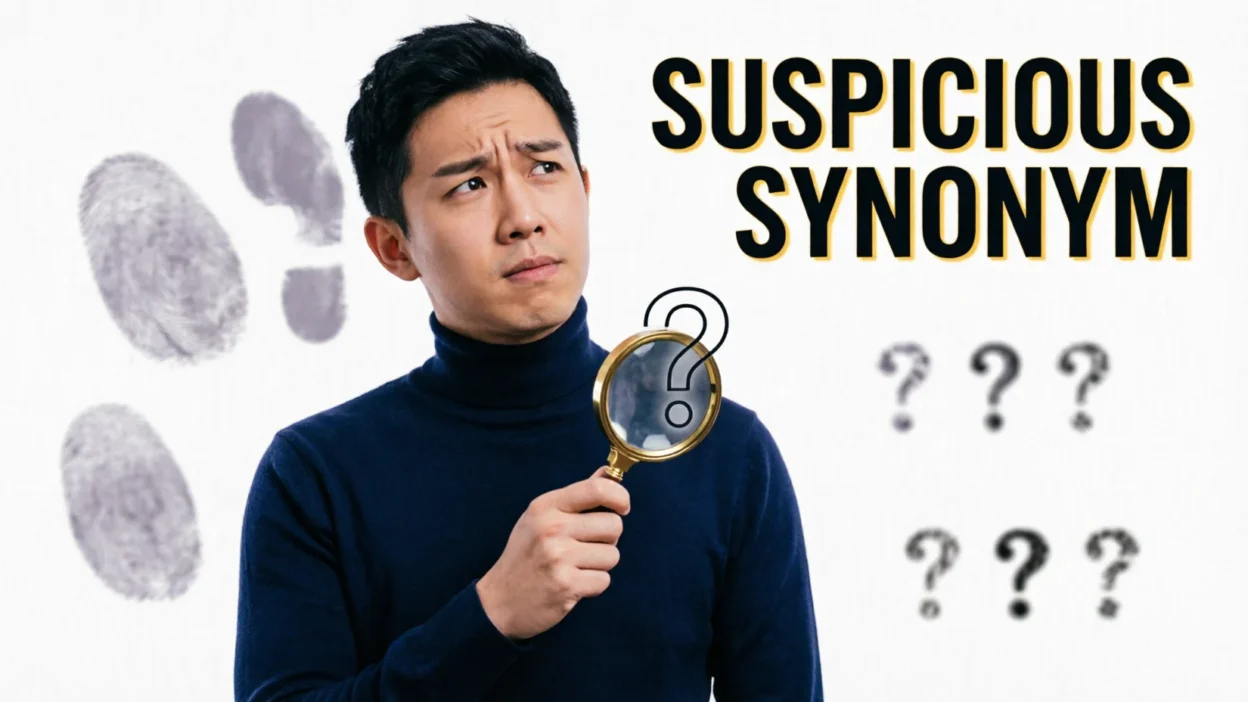
The word suspicious describes someone or something that seems dishonest, unusual, doubtful, or difficult to trust. Common suspicious synonyms include dubious, questionable, doubtful, skeptical, mistrustful, shady, and untrustworthy. The best synonym depends on whether you are describing a person’s behavior, questioning information, or expressing concern about something unusual.
Understanding these alternatives helps students, ESL learners, writers, and content creators communicate doubt more clearly. Some words suggest dishonesty, while others express uncertainty or a lack of trust.
Quick Answer: What Is a Synonym for Suspicious?
The best synonyms for suspicious include dubious, questionable, doubtful, skeptical, mistrustful, distrustful, shady, fishy, suspect, and untrustworthy.
- For a suspicious person: Mistrustful, distrustful, wary
- For suspicious behavior: Shady, fishy, questionable
- For doubtful information: Dubious, uncertain, questionable
- For possible dishonesty: Deceitful, dishonest, untrustworthy
- For expressing doubt: Skeptical, doubtful, unconvinced
What Does Suspicious Mean?
Suspicious is an adjective used when something seems wrong, dishonest, unusual, or unlikely to be true. It can describe a person’s attitude, an action, a situation, or information that raises concerns.
For example, if someone gives conflicting explanations about where they were, their behavior might seem suspicious. Similarly, an email requesting your password through an unfamiliar link may look suspicious.
The word does not always mean that someone has done something wrong. It often means there is a reason to question something or investigate it further.
Different Meanings of Suspicious
1. Showing a lack of trust
A suspicious person may believe that someone is hiding information or acting dishonestly.
Example: Maria was suspicious of the stranger who kept asking personal questions.
2. Seeming dishonest or unsafe
An action, object, or situation may appear unusual or potentially harmful.
Example: The security guard reported a suspicious package near the entrance.
3. Expressing doubt
Suspicious can describe a person’s uncertainty about a statement, explanation, or claim.
Example: The journalist was suspicious of the politician’s explanation.
30 Synonyms for Suspicious With Meanings and Examples
The following words offer different ways to express doubt, distrust, concern, or possible dishonesty. Choose the word that best matches your intended meaning.
1. Dubious
Simple meaning: Uncertain, doubtful, or not likely to be trustworthy.
Example: The customer was dubious about the seller’s unusually low prices.
Best usage/context: Use dubious when you question the truth, quality, or reliability of something.
2. Questionable
Simple meaning: Something that may be wrong, dishonest, or unreliable.
Example: The manager noticed several questionable expenses in the report.
Best usage/context: Suitable for formal writing, professional discussions, decisions, and actions that raise concerns.
3. Doubtful
Simple meaning: Not certain that something is true or likely to happen.
Example: I am doubtful about his promise to finish the project today.
Best usage/context: Use this word when expressing uncertainty about a claim, promise, result, or possibility.
4. Skeptical
Simple meaning: Unwilling to believe something without sufficient evidence.
Example: The scientist remained skeptical of the results until further tests were completed.
Best usage/context: Ideal for academic writing, research, debates, and situations requiring evidence.
5. Mistrustful
Simple meaning: Having little trust in someone.
Example: She became mistrustful after discovering that her colleague had hidden important details.
Best usage/context: Use it when a person’s attitude reflects doubt or a lack of confidence in another person.
6. Distrustful
Simple meaning: Not trusting someone or something.
Example: The residents were distrustful of the company’s sudden promises.
Best usage/context: Useful when discussing relationships, organizations, public confidence, or broken trust.
7. Wary
Simple meaning: Careful because something may be dangerous or dishonest.
Example: He was wary of sharing his personal information online.
Best usage/context: Choose wary when someone is cautious and alert to possible risks.
8. Suspicious-minded
Simple meaning: Likely to suspect that others have dishonest intentions.
Example: His suspicious-minded nature made him question even harmless suggestions.
Best usage/context: Use this expression to describe someone’s general tendency to suspect others.
9. Untrusting
Simple meaning: Not willing or ready to trust others.
Example: After several disappointing experiences, she became untrusting of strangers.
Best usage/context: Appropriate for personal relationships and descriptions of someone’s attitude toward trust.
10. Uncertain
Simple meaning: Not sure about something.
Example: The buyer was uncertain whether the online advertisement was genuine.
Best usage/context: Use uncertain when the main idea is a lack of confidence rather than suspected dishonesty.
11. Unconvinced
Simple meaning: Not persuaded that something is true.
Example: The committee remained unconvinced by the company’s explanation.
Best usage/context: Best for discussions, arguments, explanations, and claims that have not provided enough evidence.
12. Doubting
Simple meaning: Questioning whether something is true or reliable.
Example: She was doubting his account of what happened.
Best usage/context: Use it to describe the act of questioning a statement, explanation, or person’s honesty.
13. Leery
Simple meaning: Cautious or suspicious about a person or situation.
Example: I am leery of websites that ask for payment before showing their terms.
Best usage/context: Common in conversational English, especially when discussing potentially risky situations.
14. Guarded
Simple meaning: Careful about what you say, reveal, or trust.
Example: He gave a guarded response when asked about the missing documents.
Best usage/context: Suitable when someone appears cautious, reserved, or unwilling to share information freely.
15. Cagey
Simple meaning: Unwilling to provide clear information, often to avoid revealing something.
Example: The spokesperson was cagey about the reasons for the sudden resignation.
Best usage/context: Use it in informal or journalistic writing when someone avoids direct answers.
16. Shady
Simple meaning: Seeming dishonest, suspicious, or unreliable.
Example: The customer refused to deal with a shady online seller.
Best usage/context: Best for casual conversation about questionable businesses, people, or activities.
17. Fishy
Simple meaning: Strange in a way that makes you suspect something is wrong.
Example: Something seemed fishy about the message asking for his bank details.
Best usage/context: Use this informal word when a situation feels suspicious but the evidence is not conclusive.
18. Suspect
Simple meaning: Seeming unreliable, dishonest, or possibly connected with wrongdoing.
Example: Investigators examined a suspect transaction.
Best usage/context: Often used in formal reports, investigations, and discussions about questionable activities. As a noun, suspect can also refer to a person believed to be involved in a crime.
19. Untrustworthy
Simple meaning: Not deserving of trust.
Example: The company lost customers after its untrustworthy practices became public.
Best usage/context: Use it when there are reasons to believe a person, organization, or source cannot be relied upon.
20. Dishonest
Simple meaning: Not truthful or fair; willing to deceive others.
Example: The employee was dishonest about the amount of money spent.
Best usage/context: Choose this word when you want to describe actual dishonesty rather than merely express a suspicion.
21. Deceitful
Simple meaning: Intentionally misleading or tricking others.
Example: The investigation revealed a deceitful scheme designed to fool customers.
Best usage/context: Appropriate for deliberate deception, misleading statements, and manipulative behavior.
22. Dubitable
Simple meaning: Open to doubt or question.
Example: The report relied on several dubitable assumptions.
Best usage/context: A relatively uncommon, formal word suitable for specialized or academic writing. Doubtful or questionable is usually more natural in everyday English.
23. Problematic
Simple meaning: Likely to cause problems or raise concerns.
Example: The reviewer considered the lack of supporting evidence problematic.
Best usage/context: Use it in professional or academic contexts when a situation presents difficulties or concerns.
24. Irregular
Simple meaning: Not following what is normal, expected, or proper.
Example: The auditor found irregular payments in the financial records.
Best usage/context: Best for unusual patterns, procedures, transactions, or behavior that may need further examination.
25. Peculiar
Simple meaning: Unusual or different from what is expected.
Example: The detective noticed a peculiar detail in the witness’s story.
Best usage/context: Use it when something seems strange. It does not necessarily suggest dishonesty or wrongdoing.
26. Questioning
Simple meaning: Expressing doubt or examining whether something is true.
Example: The questioning look on her face suggested that she did not believe his explanation.
Best usage/context: Useful for describing expressions, attitudes, or behavior that indicate uncertainty or doubt.
27. Incredulous
Simple meaning: Unwilling or unable to believe something because it seems surprising or unlikely.
Example: He gave an incredulous laugh when he heard the unbelievable excuse.
Best usage/context: Choose it when someone reacts with disbelief rather than simply distrusting another person.
28. Apprehensive
Simple meaning: Worried or uneasy about something that may happen.
Example: She felt apprehensive about meeting the unfamiliar business partner.
Best usage/context: Best for expressing nervousness or concern about a possible future event.
29. Treacherous
Simple meaning: Dangerous or likely to betray someone’s trust.
Example: The travelers avoided the treacherous path during the storm.
Best usage/context: Use it for dangerous situations or people who may betray others. It is stronger than suspicious and is not a direct replacement in every sentence.
30. Furtive
Simple meaning: Secretive because someone wants to avoid being noticed.
Example: The guard noticed the visitor’s furtive movements near the restricted area.
Best usage/context: Ideal for describing secretive glances, movements, or actions that suggest someone may be hiding something.
Comparison Table: Suspicious Synonyms and Their Differences
| Synonym | Main meaning | Tone | Best use |
| Dubious | Doubtful or unreliable | Neutral to formal | Claims and offers |
| Questionable | Open to criticism or doubt | Neutral to formal | Decisions and conduct |
| Skeptical | Not easily convinced | Neutral | Evidence and arguments |
| Mistrustful | Lacking trust in others | Neutral | Personal relationships |
| Wary | Cautious about possible risks | Neutral | Safety and decisions |
| Shady | Seemingly dishonest | Informal | People and businesses |
| Fishy | Strange or suspicious | Informal | Unusual situations |
| Suspect | Possibly unreliable or improper | Formal | Transactions and investigations |
| Untrustworthy | Not deserving of trust | Strong | People and organizations |
| Dishonest | Not truthful | Strong | Proven or directly described dishonesty |
| Cagey | Avoiding clear answers | Informal | Secretive communication |
| Incredulous | Unable to believe something | Neutral to formal | Reactions to surprising claims |
| Apprehensive | Worried about what may happen | Neutral | Future events |
| Furtive | Secretive and avoiding notice | Descriptive | Hidden movements or actions |
| Peculiar | Unusual or strange | Neutral | Odd details or behavior |
How to Choose the Right Suspicious Synonym
The best alternative depends on what you want to communicate. Consider the meaning, tone, and purpose of your sentence before choosing a replacement.
1. Choose by Meaning
When you mean a lack of trust
Use mistrustful, distrustful, untrusting, or wary.
Example: The customer was wary of sharing financial details with an unfamiliar website.
When you mean something may be dishonest
Use shady, fishy, suspect, or questionable.
Example: The accountant investigated a questionable payment.
When you mean something may not be true
Use dubious, doubtful, skeptical, or unconvinced.
Example: The researcher was skeptical of the unsupported claim.
When you mean someone is hiding something
Use cagey, furtive, or guarded.
Example: The witness gave a guarded answer during the interview.
2. Choose by Tone
Formal tone: Dubious, questionable, suspect, problematic, irregular.
These words work well in reports, essays, business writing, and academic discussions.
Informal tone: Shady, fishy, leery, cagey.
These alternatives sound natural in everyday conversation and informal writing.
Strong negative tone: Dishonest, deceitful, untrustworthy, treacherous.
Use these words when you intend to communicate a stronger judgment. Some imply actual wrongdoing rather than a mere suspicion.
Neutral tone: Doubtful, uncertain, wary, peculiar.
These words can express concern or uncertainty without directly accusing someone of dishonesty.
3. Choose by Intent
If you want to describe a suspicious person, consider mistrustful, wary, untrusting, or suspicious-minded.
If you want to describe suspicious behavior, consider furtive, shady, questionable, or peculiar.
If you want to question a statement, consider dubious, doubtful, skeptical, or unconvinced.
If you want to warn someone about a possible risk, consider wary, leery, or apprehensive.
If you want to describe established dishonesty, consider dishonest, deceitful, or untrustworthy, provided the evidence supports that description.
Common Usage Mistakes When Using Suspicious Synonyms
Choosing a synonym without considering its exact meaning can change your sentence or make it sound unnatural. Here are several mistakes to avoid.
1. Using Skeptical and Suspicious Interchangeably
Skeptical usually means questioning whether something is true. Suspicious more often suggests concern that something is wrong or someone may be dishonest.
- Skeptical: She was skeptical of the scientific claim.
- Suspicious: She was suspicious of the stranger who followed her.
2. Confusing Wary With Dishonest
Wary describes someone who is cautious. It does not mean that the person is dishonest.
- Correct: He was wary of the unfamiliar offer.
- Incorrect meaning: He was wary, so he must have been dishonest.
3. Using Fishy in Formal Academic Writing
Fishy is an informal word. In a research paper or professional report, questionable, dubious, or suspicious may be more appropriate.
- Informal: The deal looks fishy.
- Formal: The terms of the deal appear questionable.
4. Treating Suspicious as Proof of Wrongdoing
Something suspicious may deserve attention, but suspicion alone does not establish guilt.
- Better: The transaction appeared suspicious and required further investigation.
- Avoid: The suspicious transaction proved that the company committed fraud.
5. Replacing Suspicious With Uncertain in Every Sentence
Uncertain expresses a lack of confidence or knowledge, whereas suspicious can imply concern about possible dishonesty.
- Uncertain: I am uncertain about the meeting time.
- Suspicious: I am suspicious of the unexplained changes to the schedule.
6. Using Strong Words Without Enough Evidence
Words such as deceitful, dishonest, and untrustworthy communicate stronger judgments than questionable or dubious. Use them carefully when facts are unclear.
FAQs:
1. What is the closest synonym for suspicious?
Questionable and dubious are close alternatives when something seems unreliable or potentially wrong. For a person who does not trust others, mistrustful or wary may be more accurate.
2. What is another word for suspicious person?
Depending on the intended meaning, you can use mistrustful, distrustful, wary, or suspicious-minded. If you mean someone who appears to be hiding something, secretive or cagey may fit.
3. What is a formal synonym for suspicious?
Formal alternatives include dubious, questionable, suspect, problematic, and irregular. Choose the word according to whether you are describing doubt, unusual conduct, or a possible problem.
4. What is an informal word for suspicious?
Fishy, shady, and leery are common informal alternatives. For example, “That offer sounds fishy” means the offer seems unusual or potentially dishonest.
5. What is the difference between suspicious and skeptical?
Suspicious often suggests that someone or something may be dishonest or involved in wrongdoing. Skeptical means that you question a claim or remain unconvinced until there is enough evidence.
6. What is a synonym for suspicious behavior?
Words such as shady, furtive, questionable, irregular, and peculiar can describe suspicious behavior. The best option depends on whether the behavior seems dishonest, secretive, or simply unusual.
7. Is suspicious a positive or negative word?
Suspicious usually has a negative or cautious meaning because it suggests doubt, possible dishonesty, or concern. However, being suspicious can sometimes be sensible when a person is protecting themselves from fraud or danger.
8. Can suspicious mean doubtful?
Yes. Suspicious can express doubt, particularly when something seems unreliable or unlikely to be honest. However, doubtful is often more suitable when you simply mean that something may not be true or may not happen.
Conclusion
Learning synonyms for suspicious helps you describe doubt, distrust, unusual behavior, and possible dishonesty more precisely. Words such as dubious, questionable, and skeptical are useful when discussing claims or information. Alternatives such as wary, mistrustful, and distrustful focus on a person’s attitude, while shady, fishy, and furtive describe behavior that raises concerns.
Remember that these words are related but not identical. Choose a synonym based on your sentence’s meaning, tone, and context. Most importantly, distinguish between something that merely seems suspicious and something that has been proven dishonest. This approach makes your writing clearer, more accurate, and more effective.

I am Andrew Foster, a passionate language writer who enjoys helping readers discover the right synonyms and improve their vocabulary. I create clear, accurate, and engaging content that makes learning English simple, practical, and enjoyable.