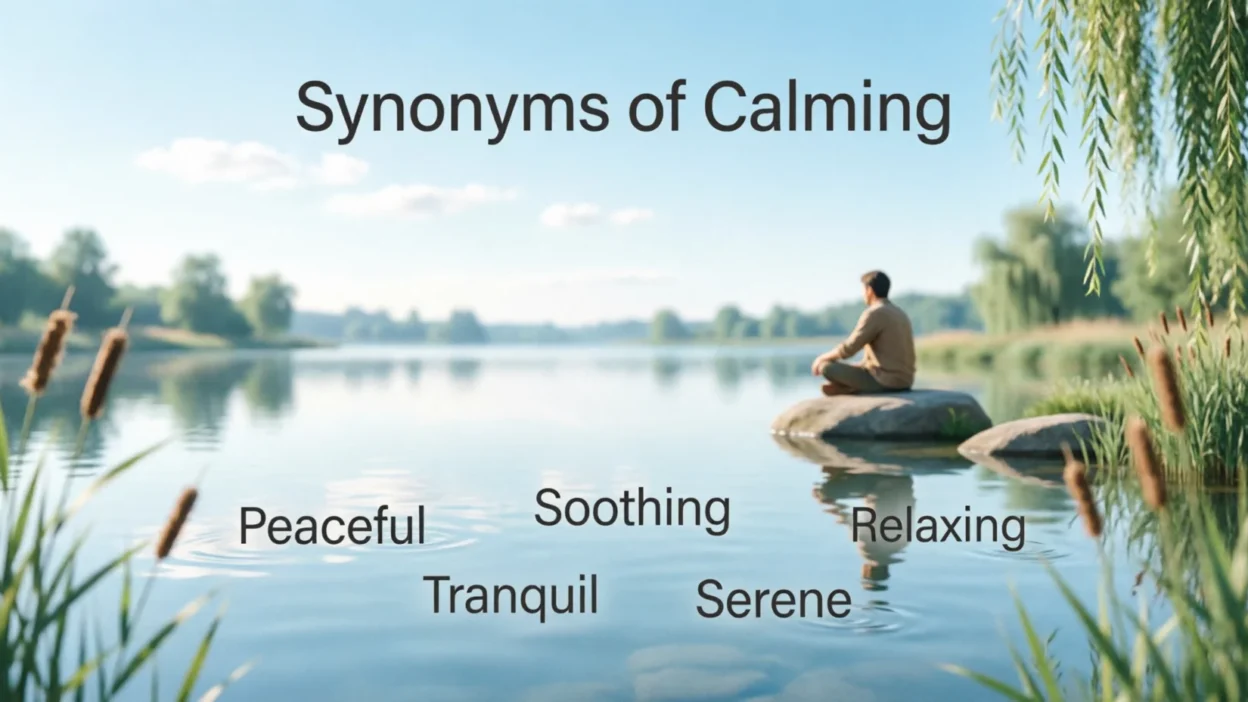
Finding the right synonyms of calming can help you describe peaceful feelings, quiet environments, soothing actions, and situations that reduce stress. Common alternatives include soothing, relaxing, tranquil, peaceful, reassuring, comforting, pacifying, and sedating.
The best synonym depends on what you mean. For example, soothing often describes something that reduces discomfort, while reassuring describes something that makes a person feel less worried. Learning these differences can make your speaking and writing more natural and precise.
Quick Answer: What Are the Best Synonyms of Calming?
Some of the most useful synonyms of calming are:
- Soothing – making someone feel relaxed or comfortable
- Relaxing – helping the body or mind rest
- Peaceful – free from disturbance or stress
- Tranquil – very quiet and peaceful
- Reassuring – reducing fear or worry
- Comforting – providing emotional support
- Pacifying – making someone less angry or upset
- Serene – calm, still, and undisturbed
- Restful – helping someone relax or recover
- Mellow – pleasantly relaxed and gentle
The right choice depends on whether you are describing a person, feeling, place, sound, activity, atmosphere, or action.
What Does Calming Mean?
Calming means making someone or something less anxious, angry, excited, stressed, or disturbed.
For example:
The sound of rain was calming after a stressful day.
Here, calming describes something that creates a more relaxed state of mind.
The word can describe both actions and qualities:
- A calming voice can reduce nervousness.
- A calming environment can help someone relax.
- A calming activity can reduce tension.
- A calming presence can make people feel safe.
The exact synonym should match the situation and the feeling you want to express.
30 Synonyms of Calming
1. Soothing
Simple meaning: Making someone feel relaxed, comfortable, or less upset.
Example: The soothing sound of the ocean helped her relax.
Best usage/context: Use soothing for voices, music, sounds, words, treatments, or experiences that reduce discomfort or emotional tension.
2. Relaxing
Simple meaning: Helping the body or mind rest.
Example: Reading before bed is a relaxing activity.
Best usage/context: Use relaxing for activities, environments, holidays, music, or experiences that encourage rest.
3. Peaceful
Simple meaning: Quiet, calm, and free from conflict or disturbance.
Example: We spent the afternoon in a peaceful garden.
Best usage/context: Use peaceful for places, situations, relationships, moments, and states of mind.
4. Tranquil
Simple meaning: Very calm, quiet, and undisturbed.
Example: The lake looked tranquil in the early morning.
Best usage/context: Use tranquil for natural surroundings, quiet places, and peaceful atmospheres. It is slightly more formal than calm.
5. Serene
Simple meaning: Calm, peaceful, and free from worry.
Example: Her serene expression showed that she was no longer worried.
Best usage/context: Use serene for people, faces, landscapes, settings, and peaceful emotional states.
6. Reassuring
Simple meaning: Making someone feel less worried or afraid.
Example: His reassuring words helped the children feel safe.
Best usage/context: Use reassuring when calming comes from confidence, support, information, or encouragement.
7. Comforting
Simple meaning: Making someone feel better when they are sad, worried, or upset.
Example: Her mother’s comforting words gave her strength.
Best usage/context: Use comforting for words, people, gestures, memories, or actions that provide emotional support.
8. Pacifying
Simple meaning: Making someone less angry, aggressive, or upset.
Example: The manager used a patient tone to pacify the frustrated customer.
Best usage/context: Use pacifying when someone actively tries to reduce anger, conflict, or agitation.
9. Restful
Simple meaning: Helping someone rest and regain energy.
Example: The quiet countryside provided a restful escape from the city.
Best usage/context: Use restful for sleep, places, vacations, environments, and activities.
10. Mellow
Simple meaning: Pleasantly relaxed, gentle, or unhurried.
Example: Soft lighting created a mellow atmosphere.
Best usage/context: Use mellow for moods, music, personalities, environments, or relaxed situations.
11. Composed
Simple meaning: Calm and in control of your emotions.
Example: Despite the pressure, she remained composed.
Best usage/context: Use composed mainly for people who remain calm during difficult or stressful situations.
12. Untroubled
Simple meaning: Free from worry, problems, or disturbance.
Example: The children enjoyed an untroubled afternoon in the park.
Best usage/context: Use untroubled to describe people, periods, lives, or situations without significant stress or difficulty.
13. Sedate
Simple meaning: Quiet, calm, and not very active.
Example: The neighborhood has a quiet and sedate atmosphere.
Best usage/context: Use sedate for calm lifestyles, environments, or behavior. In medical contexts, sedate can have a more specific meaning related to reducing consciousness or activity.
14. Unruffled
Simple meaning: Calm and not easily upset.
Example: She remained unruffled when the meeting became tense.
Best usage/context: Use unruffled for people who stay calm despite pressure, criticism, or unexpected problems.
15. Restorative
Simple meaning: Helping someone recover energy or well-being.
Example: A walk through the forest can be a restorative experience.
Best usage/context: Use restorative for activities, experiences, sleep, environments, or practices that help someone recover.
16. Reposeful
Simple meaning: Peaceful and restful.
Example: The quiet room had a reposeful atmosphere.
Best usage/context: Use reposeful for literary, descriptive, or formal writing about peaceful settings and moods.
17. Pacifying
Simple meaning: Reducing anger, hostility, or agitation.
Example: The teacher’s patient approach had a pacifying effect on the students.
Best usage/context: Particularly useful when describing an action intended to settle an argument or conflict.
18. Quieting
Simple meaning: Making something or someone quieter or less active.
Example: The gentle music had a quieting effect on the noisy room.
Best usage/context: Use quieting when the focus is on reducing noise, activity, excitement, or emotional intensity.
19. Settling
Simple meaning: Making someone or something calmer and more stable.
Example: A warm cup of tea had a settling effect after the stressful journey.
Best usage/context: Use settling for emotions, nerves, stomach discomfort, or situations that gradually become calmer.
20. Alleviating
Simple meaning: Making something unpleasant less severe.
Example: The treatment was effective in alleviating her discomfort.
Best usage/context: Use alleviating for pain, stress, discomfort, anxiety, pressure, or other problems when their intensity is reduced.
21. Paced
Simple meaning: Controlled in speed or movement.
Example: The speaker used a slow, paced delivery to create a calming atmosphere.
Best usage/context: Paced is not a direct synonym for calming in every context, but controlled pacing can create a calmer experience.
22. Gentle
Simple meaning: Soft, kind, mild, or not forceful.
Example: Her gentle voice helped the frightened child relax.
Best usage/context: Use gentle for voices, movements, behavior, touch, words, or approaches that feel soft and non-threatening.
23. Mild
Simple meaning: Not strong, severe, or intense.
Example: The mild music created a comfortable atmosphere.
Best usage/context: Use mild when something has low intensity. It can describe weather, reactions, flavors, symptoms, or experiences, but it is not always a direct synonym for calming.
24. Comforting
Simple meaning: Giving emotional relief or a sense of safety.
Example: The familiar song was comforting during a difficult evening.
Best usage/context: Best for emotional situations where something reduces sadness, loneliness, fear, or worry.
25. Unwinding
Simple meaning: Relaxing after tension or activity.
Example: She spent the evening unwinding with a good book.
Best usage/context: Use unwinding for informal descriptions of relaxing after work, study, travel, or stress.
26. Soothingly
Simple meaning: In a gentle way that makes someone calmer.
Example: He spoke soothingly to the nervous child.
Best usage/context: Use soothingly when you need an adverb to describe how someone speaks, behaves, or acts.
27. Pacified
Simple meaning: Made calmer, less angry, or less upset.
Example: The crying baby was finally pacified by a familiar lullaby.
Best usage/context: Use pacified when a person or situation has already been brought into a calmer state.
28. Calmingly
Simple meaning: In a way that creates calm.
Example: The instructor spoke calmly and calmingly throughout the exercise.
Best usage/context: This is understandable but less natural than alternatives such as soothingly or reassuringly. Use it carefully.
29. Reassuringly
Simple meaning: In a way that reduces worry or fear.
Example: The doctor spoke reassuringly to the concerned patient.
Best usage/context: Use reassuringly when words, behavior, or tone provide confidence and reduce uncertainty.
30. Relaxed
Simple meaning: Free from tension, worry, or pressure.
Example: Everyone felt relaxed after the long weekend.
Best usage/context: Use relaxed to describe people, moods, environments, conversations, or situations that are free from tension.
Comparison Table: Synonyms of Calming at a Glance
| Synonym | Main idea | Common context | Tone |
| Soothing | Reduces discomfort or upset | Sounds, voices, experiences | Gentle |
| Relaxing | Helps the mind or body rest | Activities, places | Everyday |
| Peaceful | Free from disturbance | Places, situations | Neutral |
| Tranquil | Deeply quiet and peaceful | Nature, settings | Formal |
| Serene | Calm and untroubled | People, places, moods | Elegant |
| Reassuring | Reduces worry | Words, actions, people | Supportive |
| Comforting | Provides emotional relief | People, words, memories | Warm |
| Pacifying | Reduces anger or conflict | Arguments, people | Practical |
| Restful | Helps recovery | Sleep, places, breaks | Positive |
| Mellow | Pleasantly relaxed | Music, moods, settings | Informal |
| Composed | Emotionally controlled | People under pressure | Formal |
| Unruffled | Not easily disturbed | People, behavior | Formal |
| Restorative | Helps recovery | Activities, experiences | Formal |
| Gentle | Soft and non-forceful | Voices, actions, behavior | Warm |
| Relaxed | Free from tension | People, situations | Everyday |
Calming vs. Soothing: What’s the Difference?
Although calming and soothing are closely related, they are not always interchangeable.
Calming generally means reducing excitement, anxiety, anger, or emotional intensity.
Soothing often emphasizes relief from discomfort, distress, irritation, or emotional pain.
For example:
- The teacher’s words were calming during the emergency.
- The gentle music was soothing after a stressful day.
Both words suggest relief, but soothing often feels softer and more comforting.
Calming vs. Relaxing
Relaxing usually describes something that helps you rest.
For example:
A relaxing bath helped me forget about work.
Calming has a broader meaning and can involve reducing anxiety, anger, excitement, or nervousness.
For example:
Her calming voice helped everyone remain focused.
Something can be both calming and relaxing, but the emphasis may be different.
Calming vs. Reassuring
Reassuring is especially useful when someone is worried because they do not know what will happen.
For example:
The teacher gave the student a reassuring smile.
The smile does not necessarily make the environment quiet. Instead, it reduces uncertainty or fear.
Use reassuring when the main idea is confidence and reduced worry.
Calming vs. Peaceful
Peaceful usually describes a state or environment that is free from disturbance or conflict.
For example:
The village was peaceful at sunrise.
Calming focuses more on the effect something has on a person or emotional state.
For example:
The sunrise had a calming effect on her.
How to Choose the Right Synonym for Calming
The best synonym depends on your meaning, tone, audience, and context.
For Emotional Relief
Choose:
- Soothing
- Comforting
- Reassuring
- Relaxing
Example:
Her comforting words helped him through a difficult moment.
These words work well when someone is experiencing sadness, worry, fear, or emotional pressure.
For Quiet Places and Environments
Choose:
- Peaceful
- Tranquil
- Serene
- Restful
- Reposeful
Example:
The tranquil garden was perfect for reading.
These words are particularly useful for descriptive writing.
For People Who Stay Calm
Choose:
- Composed
- Unruffled
- Serene
- Relaxed
- Untroubled
Example:
Even during the difficult interview, she remained composed.
These choices emphasize emotional control rather than an action that actively calms others.
For Reducing Anger or Conflict
Choose:
- Pacifying
- Quieting
- Settling
- Reassuring
- Soothing
Example:
His diplomatic response helped settle the disagreement.
These words work when the situation involves tension, anger, disagreement, or agitation.
For Formal or Academic Writing
Choose:
- Tranquil
- Serene
- Restorative
- Alleviating
- Composed
- Reassuring
Example:
The restorative effects of time spent in nature are frequently discussed in wellness contexts.
Formal vocabulary can make writing more precise, but it should still sound natural.
For Casual Everyday Writing
Choose:
- Relaxing
- Peaceful
- Mellow
- Gentle
- Unwinding
- Comfortable
Example:
We had a relaxing evening at home.
These words sound natural in conversations, blogs, social posts, and everyday writing.
Common Usage Mistakes
1. Treating Every Synonym as Exactly the Same
Words can have similar meanings without being interchangeable in every sentence.
For example, reassuring focuses on reducing worry, while tranquil focuses on peace and quiet.
2. Using “Tranquil” for Every Person
Tranquil is often more natural for places, environments, scenes, and states of mind.
Instead of:
He was a tranquil person during the argument.
You may prefer:
He remained composed during the argument.
3. Confusing “Relaxing” With “Reassuring”
A relaxing activity helps you rest, while a reassuring statement helps reduce uncertainty or fear.
For example:
- A warm bath can be relaxing.
- A doctor’s explanation can be reassuring.
4. Using “Pacifying” in Positive Situations
Pacifying often suggests that someone is trying to reduce anger, conflict, or resistance.
For a peaceful vacation, relaxing or restful is usually more natural.
5. Choosing a Formal Word When a Simple Word Works Better
Words such as reposeful and tranquil can be useful, but they may sound unnecessarily formal in everyday conversation.
Sometimes calm, peaceful, or relaxing is the clearest choice.
6. Assuming “Calming” Always Means Quiet
Something can be calming without being silent.
A reassuring conversation, supportive friend, gentle exercise, or familiar song can all have a calming effect.
Examples of Calming Synonyms in Sentences
Here are several examples showing how the words work naturally:
- The soothing music helped me concentrate.
- We found a peaceful place to sit.
- The beach was incredibly tranquil in the morning.
- Her reassuring message reduced my anxiety.
- The soft blanket was comforting.
- He remained composed during the difficult conversation.
- The weekend was quiet and restful.
- The restaurant had a mellow atmosphere.
- A walk in the woods can be restorative.
- She spent the evening unwinding with a book.
- His gentle voice helped the child settle down.
- The manager’s response was pacifying rather than confrontational.
FAQs:
What is the closest synonym for calming?
Soothing is one of the closest general synonyms for calming. Depending on context, relaxing, peaceful, reassuring, or comforting may be more precise.
What is a synonym for calming someone down?
Useful choices include soothing, pacifying, reassuring, settling, comforting, and quieting.
For example:
She used a soothing voice to calm the child down.
What is a synonym for a calming environment?
Good choices include peaceful, tranquil, serene, restful, and relaxing.
For example:
The hotel created a tranquil environment for its guests.
What is a synonym for calming music?
Common choices include soothing, relaxing, gentle, peaceful, and mellow.
For example:
She listened to soothing music before going to sleep.
What is a synonym for calming someone who is angry?
Pacifying, soothing, reassuring, and settling can work depending on the situation.
Pacifying is especially appropriate when the person is angry or hostile.
What is a synonym for calming anxiety?
Depending on the sentence, you can use soothing, relieving, reassuring, relaxing, or alleviating.
For example:
The counselor’s reassuring words helped ease her anxiety.
What is a formal synonym for calming?
Formal alternatives include tranquil, serene, restorative, alleviating, composed, and reassuring, depending on the intended meaning.
What is an opposite of calming?
Possible opposites include agitating, disturbing, upsetting, alarming, exciting, and provoking. The best antonym depends on whether you mean emotional stress, physical activity, conflict, or increased excitement.
Conclusion
The best synonyms of calming depend on the exact situation you want to describe. Soothing works well for reducing discomfort or emotional distress, relaxing emphasizes rest, peaceful describes freedom from disturbance, and tranquil suggests deep quiet and serenity.
For people, words such as composed, unruffled, serene, and reassuring can provide greater precision. When describing conflict or anger, pacifying, settling, and quieting may be more appropriate.
Understanding these subtle differences helps you choose vocabulary that sounds natural and communicates exactly what you mean. Instead of replacing calming with any similar word, consider the emotion, situation, tone, and audience first.

I’m James Parker, Administrator at SynonymsHive. I oversee content quality, improve user experience, and ensure reliable synonym resources. My passion is making language learning simple, accurate, and accessible for everyone.