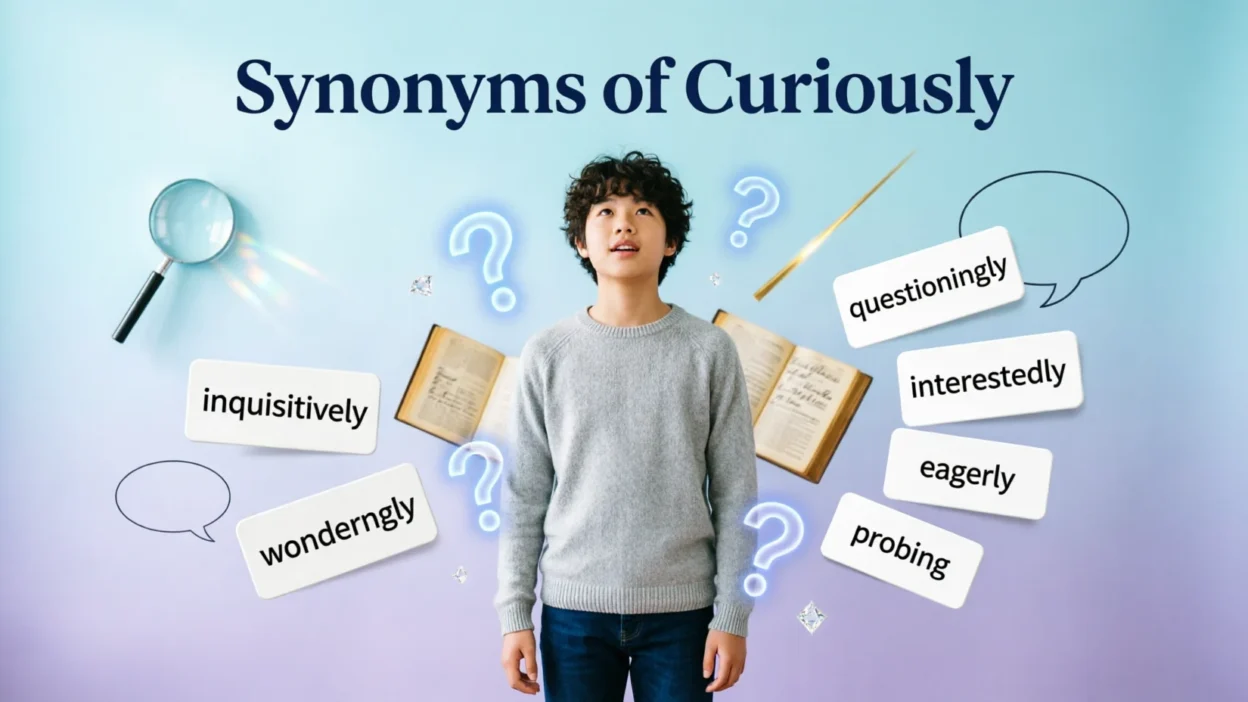
When you want to describe someone who is curiously interested, eager to discover something, or behaving in a way that makes others wonder, you have many alternatives. Useful synonyms of curiously include inquisitively, interestedly, questioningly, attentively, eagerly, wonderingly, and intriguingly. The best choice depends on whether you mean wanting to know more, showing wonder, or in an unusual way.
Quick Answer
The most useful synonyms of curiously are:
- Inquisitively
- Interestedly
- Questioningly
- Wonderingly
- Eagerly
- Attentively
- Intriguedly
- Investigatively
- Probingly
- Searchingly
Curiously usually describes an action done with a desire to learn, discover, understand, or investigate something. It can also mean strangely or unusually, depending on the sentence.
What Does “Curiously” Mean?
Curiously is an adverb that describes doing something with curiosity, interest, or a desire to know more.
For example:
She curiously examined the old photograph.
This means she looked at the photograph because she wanted to understand or discover something about it.
The word can also describe something unusual or unexpected:
Curiously, nobody mentioned the missing file.
Here, curiously means strangely or surprisingly.
Two Main Meanings of Curiously
1. With interest or a desire to know
- He curiously opened the box.
- The children watched curiously.
- She curiously asked about the unusual sound.
2. In a strange or unusual way
- Curiously, the door was already unlocked.
- Curiously, both answers were identical.
Because the word has these two meanings, you should choose a synonym according to the context.
30 Synonyms of Curiously
1. Inquisitively
Simple meaning: In a way that shows a strong desire to learn or ask questions.
Example:
The student looked inquisitively at the unfamiliar machine.
Best usage/context: Use it when someone actively wants information or understanding.
2. Interestedly
Simple meaning: With interest or attention.
Example:
She listened interestedly as the guide explained the history of the building.
Best usage/context: Suitable when someone pays attention because something interests them.
3. Questioningly
Simple meaning: In a way that suggests a question or uncertainty.
Example:
He looked questioningly at his colleague.
Best usage/context: Useful for describing facial expressions, looks, or behavior that silently asks for an explanation.
4. Wonderingly
Simple meaning: With a feeling of wonder or amazement.
Example:
The child stared wonderingly at the bright stars.
Best usage/context: Best when curiosity is mixed with amazement or admiration.
5. Eagerly
Simple meaning: With strong interest or excitement.
Example:
The students eagerly waited for the experiment to begin.
Best usage/context: Use it when curiosity is accompanied by enthusiasm.
6. Attentively
Simple meaning: With careful attention.
Example:
She listened attentively to the scientist’s explanation.
Best usage/context: Appropriate when curiosity leads someone to concentrate carefully.
7. Intriguedly
Simple meaning: In a way that shows strong interest because something is unusual or mysterious.
Example:
He studied the strange symbol intriguedly.
Best usage/context: Useful when something captures someone’s interest through mystery or unusual qualities. In natural English, with intrigue or with interest is often more idiomatic.
8. Investigatively
Simple meaning: In a way that involves examining something to discover facts.
Example:
The reporter approached the story investigatively.
Best usage/context: Good for journalism, research, science, and systematic examination.
9. Probingly
Simple meaning: In a way that tries to discover deeper information.
Example:
The interviewer asked probingly about the company’s decision.
Best usage/context: Best for detailed questions and attempts to uncover hidden information.
10. Searchingly
Simple meaning: In a way that carefully looks for an answer or meaning.
Example:
She looked searchingly at his face.
Best usage/context: Useful when someone is trying to find an answer, clue, or emotional meaning.
11. Inquiringly
Simple meaning: In a way that shows a desire for information.
Example:
“Are you coming with us?” she asked inquiringly.
Best usage/context: Particularly useful for questions, expressions, and conversations.
12. Observantly
Simple meaning: With careful attention to what is happening.
Example:
The researcher watched the animals observantly.
Best usage/context: Use it when curiosity involves carefully noticing details.
13. Exploratively
Simple meaning: In a way that involves exploring or discovering something.
Example:
The children moved exploratively through the unfamiliar garden.
Best usage/context: Appropriate for exploration, experimentation, and discovery.
14. Analytically
Simple meaning: By carefully examining information.
Example:
She examined the results analytically.
Best usage/context: Best when curiosity involves reasoning, evidence, and detailed examination.
15. Delvingly
Simple meaning: In a way that involves going deeply into a subject.
Example:
The historian researched the subject deeply and delvingly.
Best usage/context: Less common as an adverb. By delving into is usually more natural.
16. Scrutinizingly
Simple meaning: With very careful examination.
Example:
The manager looked scrutinizingly at the documents.
Best usage/context: Use it when someone examines something closely to identify details or problems.
17. Observingly
Simple meaning: In a way that involves watching or noticing.
Example:
He stood observingly near the entrance.
Best usage/context: Uncommon in everyday English. Observantly or while observing is usually more natural.
18. Experimentally
Simple meaning: In a way that involves trying something to see what happens.
Example:
She experimentally changed the settings of the device.
Best usage/context: Suitable for science, testing, research, and trying new approaches.
19. Adventurously
Simple meaning: With excitement about experiencing something new.
Example:
The travelers adventurously explored the remote village.
Best usage/context: Best when curiosity is connected with exploration and adventure.
20. Expectantly
Simple meaning: With the belief or hope that something will happen.
Example:
The audience looked expectantly toward the stage.
Best usage/context: Use it when curiosity involves waiting to discover what happens next.
21. Surprisedly
Simple meaning: In a way that shows surprise.
Example:
She looked surprisedly at the unexpected result.
Best usage/context: This can describe a reaction, although in surprise or with surprise is often more natural.
22. Amazedly
Simple meaning: With strong surprise or admiration.
Example:
The visitors looked amazedly at the enormous structure.
Best usage/context: Appropriate when curiosity develops into amazement.
23. Wonderingly
Simple meaning: With wonder or a desire to understand something remarkable.
Example:
He gazed wonderingly at the night sky.
Best usage/context: Particularly effective for literary and descriptive writing.
24. Thoughtfully
Simple meaning: With careful consideration.
Example:
She thoughtfully examined the unusual proposal.
Best usage/context: Useful when curiosity involves reflection rather than simply asking questions.
25. Deliberately
Simple meaning: Intentionally and with purpose.
Example:
He deliberately examined every part of the device.
Best usage/context: This is only an occasional substitute for curiously when the sentence emphasizes purposeful examination rather than curiosity itself.
26. Carefully
Simple meaning: With attention and caution.
Example:
She carefully examined the mysterious package.
Best usage/context: Useful when curiosity involves close attention, although it does not necessarily imply interest.
27. Closely
Simple meaning: With detailed attention.
Example:
The detective looked closely at the photograph.
Best usage/context: Good for investigation and detailed observation.
28. Eagerly
Simple meaning: With excitement and strong interest.
Example:
The children eagerly explored the new science lab.
Best usage/context: Particularly useful when curiosity is energetic and enthusiastic.
29. Intriguingly
Simple meaning: In a way that is interesting, mysterious, or unusual.
Example:
Intriguingly, the two reports reached the same conclusion.
Best usage/context: Usually used to describe something interesting or unusual rather than the manner in which a person acts.
30. Strangely
Simple meaning: In an unusual or unexpected way.
Example:
Strangely, the lights turned on by themselves.
Best usage/context: Use this when curiously means “strangely” rather than “with curiosity.”
Comparison Table: Synonyms of Curiously
| Synonym | Main idea | Tone | Best context |
| Inquisitively | Desire to learn | Neutral | Questions and learning |
| Interestedly | Showing interest | Neutral | Listening or watching |
| Questioningly | Asking silently | Neutral | Looks and expressions |
| Wonderingly | Wonder or amazement | Positive | Beautiful or surprising things |
| Eagerly | Strong interest | Positive | Excited curiosity |
| Attentively | Careful attention | Neutral | Listening and observing |
| Inquiringly | Seeking information | Neutral | Questions and conversations |
| Probingly | Seeking deeper answers | Serious | Interviews and investigations |
| Searchingly | Looking for meaning | Serious | Expressions and investigation |
| Scrutinizingly | Examining closely | Formal | Documents and evidence |
| Investigatively | Investigating | Formal | Research and journalism |
| Exploratively | Discovering | Neutral | Exploration |
| Analytically | Examining logically | Formal | Research and analysis |
| Adventurously | Exploring with excitement | Positive | Travel and discovery |
| Expectantly | Waiting to discover | Neutral | Anticipation |
| Intriguingly | Interesting or mysterious | Neutral | Unusual situations |
| Strangely | Unusual or unexpected | Neutral | Unexpected events |
| Carefully | With attention | Neutral | Close examination |
| Closely | In detail | Neutral | Observation |
| Thoughtfully | With reflection | Positive | Careful consideration |
How to Choose the Right Synonym for Curiously
The best synonym depends on what kind of curiosity you want to express.
For Asking Questions
Choose:
- Inquisitively
- Inquiringly
- Questioningly
- Probingly
Example:
The journalist asked probingly about the company’s decision.
This suggests deeper and more challenging questions than simply asking out of interest.
For Wonder and Amazement
Choose:
- Wonderingly
- Amazedly
- Intriguingly
Example:
The children gazed wonderingly at the fireworks.
Here, the feeling is more than simple curiosity. There is a sense of amazement.
For Careful Observation
Choose:
- Attentively
- Observantly
- Carefully
- Closely
- Scrutinizingly
Example:
The scientist examined the sample carefully.
These words emphasize attention rather than the emotional feeling of curiosity.
For Investigation
Choose:
- Investigatively
- Probingly
- Analytically
- Searchingly
- Scrutinizingly
Example:
The detective examined the evidence scrutinizingly.
These choices work well in formal, academic, professional, and investigative writing.
For Excitement and Enthusiasm
Choose:
- Eagerly
- Adventurously
- Expectantly
Example:
The students eagerly opened their new textbooks.
These words suggest positive energy and anticipation.
When Curiously Means “Strangely”
Sometimes curiously does not describe a person’s desire to know something. It means something is unusual.
For example:
Curiously, the store was empty at noon.
Here, possible replacements include:
- Strangely
- Oddly
- Unusually
- Surprisingly
- Interestingly
The correct synonym depends on the exact meaning you want.
Curiously vs. Common Alternatives
Curiously vs. Inquisitively
Curiously is broad and can simply show interest.
Inquisitively strongly suggests a desire to ask questions or gain information.
She looked curiously at the painting.
She looked inquisitively at the painting.
The second sentence gives a stronger impression that she wants to understand or investigate it.
Curiously vs. Wonderingly
Wonderingly emphasizes amazement or wonder.
He looked curiously at the machine.
This suggests interest.
He looked wonderingly at the machine.
This suggests that the machine impressed or amazed him.
Curiously vs. Strangely
These words can have completely different meanings.
She curiously opened the box.
Here, she opened it because she wanted to know what was inside.
Strangely, she opened the box.
Here, the action itself seems unusual.
Curiously vs. Eagerly
Eagerly emphasizes enthusiasm.
He curiously examined the map.
The focus is on wanting to discover something.
He eagerly examined the map.
The focus is on excitement and enthusiasm.
Common Mistakes When Using Synonyms of Curiously
1. Using “strangely” when you mean “with interest”
These words are not always interchangeable.
Incorrect meaning:
She strangely examined the painting because she wanted to learn more.
If you mean she was interested, curiously or inquisitively is better.
2. Using “inquisitively” for simple attention
Inquisitively implies a desire for information.
If someone is simply listening carefully, attentively may be more accurate.
3. Forgetting the unusual meaning of “curiously”
Consider:
Curiously, the results were identical.
Here, the meaning is closer to strangely, interestingly, or surprisingly.
4. Choosing a word that is too formal
Words such as scrutinizingly and probingly can sound formal.
For everyday writing, simpler choices such as curiously, carefully, closely, or inquisitively may sound more natural.
5. Assuming every synonym has exactly the same meaning
Synonyms often overlap without being identical.
For example:
- Eagerly = strong enthusiasm
- Wonderingly = wonder or amazement
- Inquisitively = desire for information
- Attentively = careful attention
- Strangely = unusual behavior or circumstances
Choosing the precise word makes your writing clearer.
FAQs:
What is the best synonym for curiously?
Inquisitively is one of the closest choices when curiously means showing a strong desire to learn or discover something. Other useful options include inquiringly, questioningly, interestedly, and wonderingly, depending on context.
What is another word for curiously in a sentence?
Depending on the sentence, you can use inquisitively, eagerly, attentively, questioningly, wonderingly, closely, or strangely. Always choose the word that matches the intended meaning.
What is a synonym for curiously in formal writing?
For formal writing, useful alternatives include inquisitively, investigatively, analytically, probingly, and scrutinizingly. However, the best choice depends on whether you mean curiosity, investigation, or careful examination.
What is the opposite of curiously?
Possible opposites include indifferently, uninterestedly, apathetically, and unconcernedly. The appropriate opposite depends on whether you are describing a lack of interest, attention, or curiosity.
Is “inquisitively” the same as “curiously”?
They are closely related but not identical. Inquisitively usually emphasizes asking questions or seeking information, while curiously has a broader meaning and can describe general interest, investigation, wonder, or unusual circumstances.
Can “strangely” replace “curiously”?
Sometimes. When curiously means in an unusual or unexpected way, strangely can work well. It cannot replace curiously when the intended meaning is “with a desire to learn.”
What is a positive synonym for curiously?
Eagerly, wonderingly, inquisitively, and attentively can have positive or neutral associations. Wonderingly is especially useful when curiosity is connected with admiration or amazement.
What is a synonym for “curiously looking”?
Depending on the situation, you could say looking inquisitively, looking questioningly, looking attentively, looking closely, or looking wonderingly. Each expression gives the action a slightly different meaning.
Conclusion
There are many useful synonyms of curiously, but they are not all interchangeable. Inquisitively works well when someone wants information, wonderingly emphasizes amazement, eagerly highlights enthusiasm, and attentively focuses on careful attention. When curiously means “strangely,” words such as strangely, oddly, or unusually may be more appropriate.
For clear writing, always consider the exact feeling or intention behind the original word. Choosing a precise synonym can make your sentences more natural, expressive, and meaningful.

I’m Nathan Collins, a language enthusiast passionate about exploring synonyms and improving everyday writing. I create clear, accurate, and helpful content that helps readers expand vocabulary and communicate with confidence.