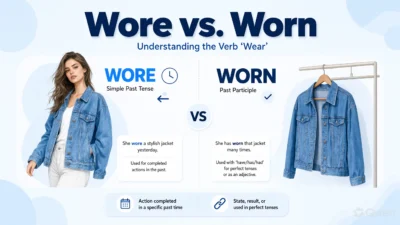

English has many verbs that look and sound similar but follow different grammatical rules. Wore and worn are two commonly confused forms of the verb wear. Both describe putting on or having something on your body, such as clothes, shoes, glasses, or accessories. However, they are not interchangeable.
The main difference is that wore is the simple past tense of wear, while worn is the past participle. You use wore when talking about something that happened in the past. You generally use worn with helping verbs such as have, has, and had, or in passive constructions.
For example, you would say, “She wore a beautiful dress yesterday,” but “She has worn that dress before.” Understanding this difference will help you speak and write more naturally. This guide explains their meanings, grammatical uses, common mistakes, and practical examples.
Quick Answer: Wore or Worn?
Wore is the simple past tense of the verb wear, while worn is its past participle. Use wore for completed past actions, such as “He wore a jacket yesterday.” Use worn with helping verbs, such as “He has worn that jacket before.” Both are correct, but their grammatical uses differ.
Why Do People Confuse Wore and Worn?
People often confuse wore and worn because both come from the same irregular verb, wear. They describe the same basic action but serve different grammatical purposes.
Unlike regular verbs that form their past tense and past participle by adding “-ed,” the verb wear changes its form:
- Present tense: Wear
- Simple past tense: Wore
- Past participle: Worn
The confusion usually happens when someone forgets that worn needs an appropriate helping verb in perfect-tense sentences.
For example:
- Incorrect: She worn a red shirt yesterday.
- Correct: She wore a red shirt yesterday.
- Correct: She has worn a red shirt before.
Remembering their grammatical roles makes choosing the correct word much easier.
1. What Does Wore Mean?
Wore is the simple past tense of the verb wear. It describes an action that happened and finished in the past.
You use wore when talking about clothing, footwear, jewelry, accessories, or anything someone had on their body at a particular time.
Simple Definition: Wore means had something on your body in the past.
Examples of Wore in Sentences
- She wore a beautiful dress to the wedding.
- He wore black shoes to work yesterday.
- I wore my favorite jacket last winter.
- They wore matching uniforms at school.
- My brother wore sunglasses at the beach.
- She wore a gold necklace to the party.
- We wore warm clothes during the trip.
- He wore his new watch to the meeting.
When Is Wore Used?
Use wore in these situations:
- Past actions: She wore a blue dress yesterday.
- Completed events: He wore a suit to the interview.
- Past habits or repeated actions: My grandfather wore a hat every day.
- Past descriptions: The actor wore a black costume in the movie.
Important: Wore usually appears without a helping verb when it functions as the main verb in the simple past tense.
2. What Does Worn Mean?
Worn is the past participle of the verb wear. It is commonly used with helping verbs such as have, has, and had to form perfect tenses.
It can also appear in passive constructions and as an adjective describing something damaged or old because of regular use.
Simple Definition: Worn means something that has been worn or used, often referring to clothing, shoes, or other items.
Examples of Worn in Sentences
- She has worn that dress several times.
- He has worn his new shoes to work.
- I had worn my jacket before leaving home.
- They have worn matching outfits at previous events.
- The shoes were worn after years of use.
- My favorite jeans are worn but comfortable.
- She has never worn those earrings.
- The carpet looks worn from daily use.
When Is Worn Used?
Use worn in these situations:
- Present perfect tense: She has worn this dress before.
- Past perfect tense: He had worn the jacket earlier.
- Passive voice: The uniform was worn by the students.
- Adjective: These are my old, worn shoes.
Important: Worn is not normally used alone as the simple past tense of wear. It needs a helping verb when functioning as a past participle.
Wore vs Worn: Comparison Table
The following table highlights the main differences between these two forms.
| Feature | Wore | Worn |
| Base verb | Wear | Wear |
| Grammar form | Simple past | Past participle |
| Main use | Completed past action | Perfect tenses and passive voice |
| Helping verb | Usually not needed | Usually needed as a verb form |
| Example | She wore a coat. | She has worn a coat. |
| Correct question | What did you wear? | Have you worn it? |
The easiest way to remember the difference is that wore tells you what happened in the past, while worn usually works with a helping verb to show a completed action or describe something.
When Should You Use Wore or Worn?
Choosing between these words becomes easier when you understand the sentence structure.
Use Wore for Simple Past Actions
Choose wore when describing something that happened at a specific time in the past.
Examples:
- I wore a blue shirt yesterday.
- She wore a beautiful dress last night.
- He wore his school uniform on Monday.
- We wore jackets during the winter.
Use Worn With Have, Has, or Had
Choose worn when forming perfect tenses.
Examples:
- I have worn these shoes before.
- She has worn that dress many times.
- They had worn their costumes before the show started.
Use Worn in Passive Sentences
Use worn when the sentence focuses on the clothing or item rather than the person wearing it.
Examples:
- The uniform was worn by every student.
- The traditional costume has been worn for generations.
- These shoes were worn during the competition.
Use Worn as an Adjective
Sometimes worn describes something that looks old, damaged, or used.
Examples:
- His shoes look worn.
- She carried a worn leather bag.
- The old carpet was badly worn.
15 Examples of Wore and Worn in Sentences
Here are practical examples to help you understand how both words work in everyday English.
| No. | Wore Example | Worn Example |
| 1 | She wore a red dress. | She has worn a red dress. |
| 2 | He wore black shoes. | He has worn black shoes. |
| 3 | I wore a warm coat. | I have worn a warm coat. |
| 4 | They wore uniforms. | They have worn uniforms. |
| 5 | She wore sunglasses. | She has worn sunglasses. |
| 6 | He wore a gold watch. | He has worn a gold watch. |
| 7 | We wore matching shirts. | We have worn matching shirts. |
| 8 | My mother wore a scarf. | My mother has worn that scarf. |
| 9 | I wore my old jeans. | I have worn these jeans. |
| 10 | She wore a beautiful hat. | She had worn a beautiful hat. |
11. Wore: The children wore costumes at the school event.
12. Worn: The children have worn those costumes before.
13. Wore: He wore his favorite sneakers yesterday.
14. Worn: His sneakers are worn from regular use.
15. Wore: She wore a traditional outfit at the celebration.
These examples show that the correct form depends on the tense and structure of the sentence.
Common Mistakes When Using Wore and Worn
Even fluent English speakers sometimes make mistakes with irregular verbs. Here are some common errors and their corrections.
Mistake 1: Using Worn Without a Helping Verb
Incorrect: She worn a beautiful dress yesterday.
Correct: She wore a beautiful dress yesterday.
Why? The sentence describes a completed past action, so the simple past form wore is needed.
Mistake 2: Using Wore After Has
Incorrect: He has wore those shoes before.
Correct: He has worn those shoes before.
Why? The present perfect tense requires the past participle worn after has.
Mistake 3: Using Wore After Had
Incorrect: I had wore that jacket last winter.
Correct: I had worn that jacket last winter.
Why? The past perfect tense uses had + past participle.
Mistake 4: Confusing Wore With Wear
Incorrect: Yesterday, she wear a black dress.
Correct: Yesterday, she wore a black dress.
Why? A completed past action requires the simple past tense.
Mistake 5: Using Worn Instead of Wore in Simple Past Questions
Incorrect: Did you worn your new shoes?
Correct: Did you wear your new shoes?
Why? After did, always use the base form of the verb.
What Is an Easy Memory Trick for Wore and Worn?
A simple memory trick can help you remember which word to use.
- Wore = Past action: She wore a dress yesterday.
- Worn = Helping verb: She has worn a dress before.
Think of this pattern:
Wear → Wore → Worn
- Wear = Present
- Wore = Past
- Worn = Past participle
You can also remember this simple rule:
If you see yesterday, last week, or last year, you will often need wore.
If you see has, have, or had, you will often need worn.
Remember that worn can also appear in passive sentences and as an adjective.
Wore vs Worn in American and British English
There is no grammatical difference between American and British English when using wore and worn.
Both varieties follow the same irregular verb pattern:
- Present: Wear
- Past: Wore
- Past participle: Worn
Examples in American English:
- She wore sneakers to school.
- He has worn that jacket before.
Examples in British English:
- She wore trainers to school.
- He has worn that jacket before.
The main difference is vocabulary. Americans commonly say sneakers, while British speakers commonly use trainers. However, the words wore and worn follow the same grammar rules in both varieties.
Similar Words Related to Wore and Worn
Understanding other forms of the verb wear can improve your grammar and vocabulary.
| Word | Grammatical Form | Example |
| Wear | Base form | I wear glasses. |
| Wears | Third-person singular | She wears glasses. |
| Wearing | Present participle | He is wearing glasses. |
| Wore | Simple past | She wore glasses yesterday. |
| Worn | Past participle | She has worn glasses before. |
These five forms belong to the same verb but are used in different sentence structures.
Final Verdict: Wore or Worn?
Both wore and worn are correct English words, but they have different grammatical functions.
- Use wore as the simple past tense of wear.
- Use worn as the past participle with helping verbs such as have, has, and had.
- Use worn in passive constructions and as an adjective when describing something old or damaged.
For example:
- Correct: She wore a beautiful dress yesterday.
- Correct: She has worn that beautiful dress before.
The key is to identify the tense and sentence structure before choosing your word.
FAQs:
1. Is it wore or worn?
Both words are correct, but their uses are different. Wore is the simple past tense of wear, while worn is the past participle. Use wore for completed past actions and worn with helping verbs such as has, have, and had.
2. Is worn the past tense of wear?
No. Worn is the past participle of wear. The simple past tense is wore. For example, “I wore a jacket yesterday” is correct, while “I have worn this jacket before” uses the past participle correctly.
3. Should I say I wore it or I have worn it?
Both are grammatically correct, but they express different things. Say “I wore it” when referring to a completed past action. Say “I have worn it” when connecting the past action to the present or describing past experience without specifying a finished past time.
4. Is it has wore or has worn?
The correct phrase is has worn. The present perfect tense follows the structure has + past participle. For example, “She has worn that dress before” is correct, while “She has wore that dress before” is incorrect.
5. Is it had wore or had worn?
The correct phrase is had worn. The past perfect tense uses had + past participle. For example, “He had worn his uniform before the ceremony” is grammatically correct.
6. Can worn be used without a helping verb?
Yes. Worn can be used without a helping verb when it functions as an adjective. For example, “His shoes look worn” describes shoes that have become old or damaged through use.
7. What is the third form of wear?
The third form of wear is worn. The three main forms are:
- First form: Wear
- Second form: Wore
- Third form: Worn
Remember This
- Wear = Present tense.
- Wore = Simple past tense.
- Worn = Past participle.
- Has/Have/Had + Worn = Perfect tense.
- Was/Were + Worn = Passive voice in appropriate contexts.
Always use wore for simple past actions and worn when the sentence requires a past participle.
Conclusion
Understanding the difference between wore and worn is important for speaking and writing correct English. Although both words come from the verb wear, they serve different grammatical purposes. Wore describes an action completed in the past, while worn is the past participle used in perfect tenses, passive constructions, and adjective phrases.
The easiest way to remember their difference is to practice the pattern wear, wore, worn. Use sentences such as “I wore my favorite shoes yesterday” and “I have worn these shoes before” to build confidence. With regular practice, you will find it much easier to choose the correct word in everyday conversations and writing.

I’m James Parker, Administrator at SynonymsHive. I oversee content quality, improve user experience, and ensure reliable synonym resources. My passion is making language learning simple, accurate, and accessible for everyone.