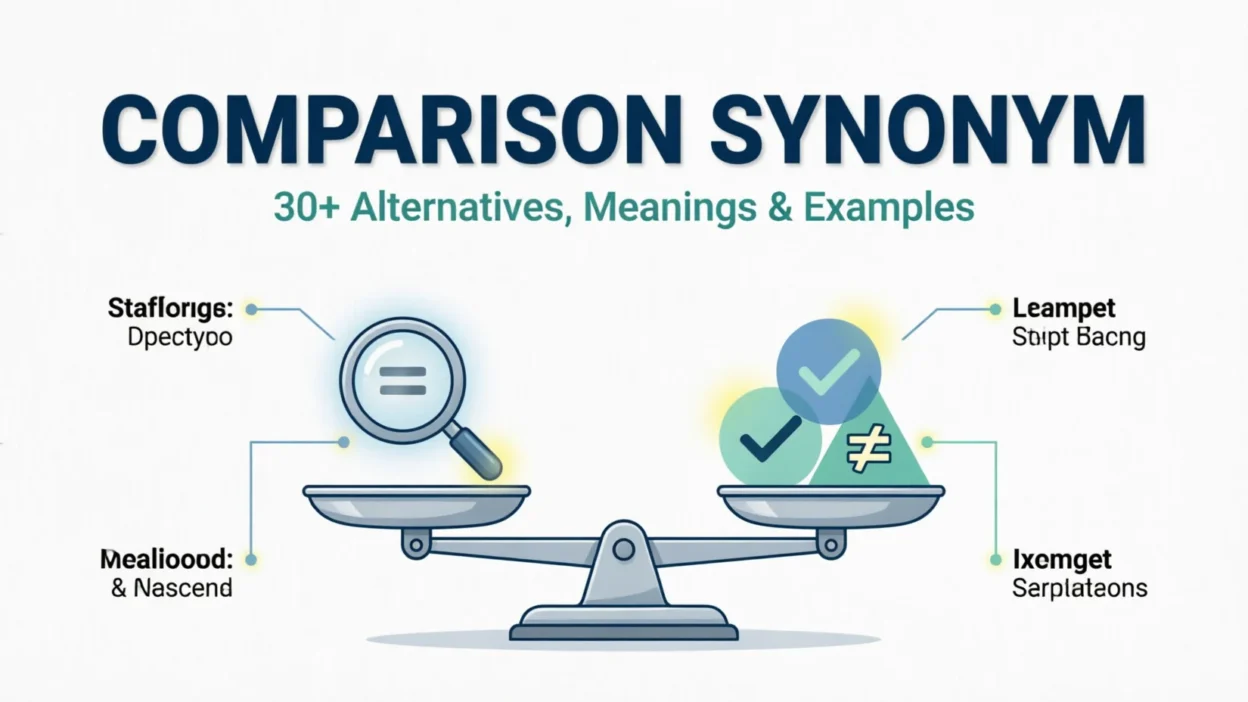
When you need another word for comparison, several useful alternatives can help you express similarities, differences, relationships, and evaluations more clearly. Common comparison synonyms include contrast, analysis, evaluation, assessment, juxtaposition, and examination. The best word depends on your purpose, whether you are writing an essay, describing two products, discussing ideas, or explaining how things are alike or different.
Quick Answer: What Is a Synonym for Comparison?
A comparison synonym is a word or phrase that expresses the idea of examining two or more things to identify their similarities, differences, or relative qualities. Some alternatives are close in meaning, while others are suitable only in specific contexts.
The best synonyms for comparison include:
- Contrast: Highlights differences.
- Analysis: Examines details carefully.
- Evaluation: Judges quality or value.
- Assessment: Measures or considers characteristics.
- Examination: Studies something closely.
- Juxtaposition: Places things side by side to highlight their relationship.
- Correspondence: Indicates similarity or agreement.
- Parallel: Shows a similarity between two things.
What Does Comparison Mean?
Comparison is the act of examining two or more people, objects, ideas, situations, or experiences to understand how they are similar or different.
For example, comparing two smartphones may involve looking at their prices, cameras, battery life, and performance. Comparing two characters in a novel may involve examining their personalities, decisions, and motivations.
Comparison is a noun. Its verb form is compare, which means to examine things in relation to one another.
When Is Comparison Used?
The word comparison is common in many situations:
- Education: Comparing two historical events or literary characters.
- Business: Comparing prices, products, and company performance.
- Everyday conversation: Discussing the differences between two restaurants.
- Science: Comparing research findings or experimental results.
- Writing: Showing similarities and differences between ideas.
- Personal decisions: Weighing the advantages and disadvantages of different choices.
Choosing an appropriate synonym makes your writing more precise and helps readers understand exactly what kind of comparison you mean.
30 Synonyms for Comparison With Meanings and Examples
The following words offer different ways to express comparison. Some emphasize similarities, others focus on differences, and several describe the process of examining or judging things.
1. Contrast
Simple meaning: A noticeable difference between two or more things.
Example sentence: The contrast between the old building and the modern office was striking.
Best usage/context: Use contrast when your main purpose is to highlight differences in appearance, behavior, ideas, or qualities.
2. Analysis
Simple meaning: A detailed examination of something to understand its parts or meaning.
Example sentence: Her analysis of the two novels revealed important differences in their themes.
Best usage/context: Suitable for academic essays, research, reports, and detailed discussions.
3. Evaluation
Simple meaning: The process of judging the quality, value, or effectiveness of something.
Example sentence: The evaluation of both proposals helped the manager choose the better option.
Best usage/context: Use evaluation when comparison involves making a judgment or deciding which option performs better.
4. Assessment
Simple meaning: An examination or judgment of the qualities, value, or condition of something.
Example sentence: The teacher completed an assessment of the students’ writing skills.
Best usage/context: Appropriate for education, professional reports, performance reviews, and decision-making.
5. Examination
Simple meaning: A careful study of something.
Example sentence: An examination of both plans showed that they had similar goals.
Best usage/context: Use examination when you want to emphasize the process of looking closely at information or evidence.
6. Juxtaposition
Simple meaning: Placing two or more things close together to highlight their similarities or differences.
Example sentence: The author’s juxtaposition of wealth and poverty makes the story more powerful.
Best usage/context: Useful in literary analysis, visual arts, journalism, and discussions of contrasting ideas.
7. Comparison and Contrast
Simple meaning: The process of identifying both similarities and differences.
Example sentence: The assignment requires a comparison and contrast of two political systems.
Best usage/context: Particularly useful for school assignments, essays, research papers, and structured discussions.
8. Correlation
Simple meaning: A relationship in which two things change or vary together.
Example sentence: The study found a correlation between regular exercise and improved fitness.
Best usage/context: Use correlation in scientific, statistical, and research contexts. Remember that correlation does not necessarily mean one thing causes the other.
9. Parallel
Simple meaning: A similarity or corresponding feature between two things.
Example sentence: The researcher noticed a parallel between the two historical movements.
Best usage/context: Suitable for identifying similar patterns, experiences, events, or developments.
10. Correspondence
Simple meaning: A similarity, connection, or agreement between things.
Example sentence: There is a close correspondence between the two sets of results.
Best usage/context: Use correspondence when two sets of facts, ideas, or results match or align in some way.
11. Analogy
Simple meaning: A comparison that explains something by showing how it resembles something else.
Example sentence: The teacher used an analogy between the human heart and a pump to explain circulation.
Best usage/context: Ideal for teaching, explanations, persuasive writing, and making unfamiliar ideas easier to understand.
12. Similarity
Simple meaning: A quality or feature that two or more things share.
Example sentence: The similarity between the two paintings is easy to notice.
Best usage/context: Use similarity when you want to emphasize what things have in common rather than their differences.
13. Resemblance
Simple meaning: The quality of looking, sounding, or being like something else.
Example sentence: There is a strong resemblance between the two sisters.
Best usage/context: Especially appropriate for appearance, behavior, characteristics, and recognizable likenesses.
14. Difference
Simple meaning: A way in which two or more things are not the same.
Example sentence: The main difference between the products is their battery life.
Best usage/context: Use difference when identifying a particular feature that separates one thing from another.
15. Distinction
Simple meaning: A clear difference between two things that may seem similar.
Example sentence: The article explains the distinction between confidence and arrogance.
Best usage/context: Useful in academic writing, definitions, technical explanations, and discussions that require precision.
16. Differentiation
Simple meaning: The process of identifying or creating differences between things.
Example sentence: The company uses product differentiation to make its brand stand out.
Best usage/context: Common in business, education, marketing, and technical discussions.
17. Benchmarking
Simple meaning: Measuring performance against a standard or another example.
Example sentence: The hospital uses benchmarking to compare its services with industry standards.
Best usage/context: Best for business performance, quality control, education, and organizational improvement.
18. Appraisal
Simple meaning: A judgment about the value, quality, or importance of something.
Example sentence: The appraisal of both properties helped the buyers understand their market value.
Best usage/context: Suitable for property valuation, professional reviews, and judgments about worth or quality.
19. Review
Simple meaning: A careful look at something to understand or judge it.
Example sentence: The review of the two proposals highlighted their strengths and weaknesses.
Best usage/context: Use review for documents, products, plans, services, and work that needs to be examined.
20. Scrutiny
Simple meaning: Very careful and detailed examination.
Example sentence: The financial records underwent close scrutiny before the final decision.
Best usage/context: Appropriate when a comparison requires close attention to details, accuracy, or possible problems.
21. Investigation
Simple meaning: A systematic effort to discover facts or understand a situation.
Example sentence: The investigation compared the evidence collected from both locations.
Best usage/context: Use investigation for research, inquiries, problem-solving, and fact-finding.
22. Survey
Simple meaning: A general examination or collection of information about a subject.
Example sentence: The survey of competing products revealed several differences in price.
Best usage/context: Suitable for market research, broad reviews, questionnaires, and overviews of a subject.
23. Matching
Simple meaning: The process of finding things that are similar or correspond to one another.
Example sentence: Matching the two lists helped us identify the missing entries.
Best usage/context: Best for practical tasks involving records, patterns, items, or characteristics that need to be paired.
24. Ranking
Simple meaning: Arranging people or things in order according to performance, quality, or another standard.
Example sentence: The ranking of the five laptops was based on price and performance.
Best usage/context: Use ranking when comparison leads to an ordered list from highest to lowest or best to worst.
25. Measurement
Simple meaning: The process of determining the size, amount, level, or degree of something.
Example sentence: The measurement of both rooms showed that one was larger.
Best usage/context: Suitable for scientific, mathematical, technical, and quantitative comparisons.
26. Weighing
Simple meaning: Considering different factors, advantages, or disadvantages before making a decision.
Example sentence: After weighing the benefits and costs of both options, she chose the cheaper plan.
Best usage/context: Use weighing when comparing choices before reaching a decision.
27. Inspection
Simple meaning: A close examination to check condition, quality, or correctness.
Example sentence: The inspection of both machines revealed that one needed repairs.
Best usage/context: Appropriate for quality control, equipment checks, property reviews, and practical assessments.
28. Verification
Simple meaning: The process of checking whether something is accurate or true.
Example sentence: The verification of both reports uncovered an incorrect figure.
Best usage/context: Use verification when the purpose is to confirm accuracy or check information against a reliable source.
29. Relative Assessment
Simple meaning: Judging something in relation to another thing or a shared standard.
Example sentence: A relative assessment of the two courses showed that both offered different benefits.
Best usage/context: Useful in formal writing when the value or quality of one option depends on how it compares with another.
30. Side-by-Side Analysis
Simple meaning: Examining two or more things next to each other to identify similarities and differences.
Example sentence: The side-by-side analysis of the phones made their camera differences easy to see.
Best usage/context: Suitable for product reviews, reports, educational materials, and practical decision-making.
Comparison Synonyms: A Quick Comparison Table
The most suitable synonym depends on what you want to communicate. This table makes it easier to choose the right word.
| Synonym | Main focus | Best context |
| Contrast | Differences | Essays and descriptions |
| Analysis | Detailed examination | Research and academics |
| Evaluation | Quality or effectiveness | Decisions and reviews |
| Assessment | Overall judgment | Education and work |
| Juxtaposition | Side-by-side relationships | Literature and art |
| Correlation | Relationship between variables | Science and statistics |
| Analogy | Explanatory similarity | Teaching and writing |
| Similarity | Shared qualities | General conversation |
| Distinction | Important difference | Formal explanations |
| Benchmarking | Performance against a standard | Business and quality control |
| Appraisal | Value or worth | Property and professional reviews |
| Scrutiny | Close examination | Audits and investigations |
| Ranking | Order of performance | Lists and comparisons |
| Measurement | Quantifiable differences | Science and mathematics |
| Verification | Accuracy or truth | Fact-checking and reports |
How to Choose the Right Synonym for Comparison
Not every synonym for comparison works in every sentence. Consider the meaning, tone, and purpose of your writing before choosing an alternative.
1. Choose According to Tone
For everyday English: Use similarity, difference, review, or contrast. These words are easy to understand and fit most casual conversations.
For academic writing: Choose analysis, assessment, distinction, or juxtaposition when the context supports their specific meanings.
For professional writing: Use evaluation, benchmarking, appraisal, or measurement when discussing performance, value, or standards.
For literary writing: Choose analogy, resemblance, parallel, or juxtaposition to explain relationships between characters, themes, images, and ideas.
2. Choose According to Meaning
- To show similarities: Use similarity, resemblance, parallel, or correspondence.
- To highlight differences: Use contrast, difference, distinction, or differentiation.
- To examine details: Use analysis, examination, scrutiny, or investigation.
- To judge quality: Use evaluation, assessment, appraisal, or review.
- To explain relationships: Use correlation or analogy, depending on whether you mean a statistical relationship or an explanatory comparison.
- To compare performance: Use benchmarking, ranking, or measurement.
3. Choose According to Intent
Your purpose is often the easiest way to find the right word.
If you are writing an essay about two books, comparison and contrast may describe the overall task. If you are judging which book is more effective, evaluation is more suitable. If you are explaining a shared theme, parallel may work better. If you are examining each book’s structure and language in detail, analysis is likely the best choice.
Always consider the sentence as a whole rather than replacing comparison with a synonym simply to avoid repetition.
Comparison vs. Contrast vs. Analysis
These three words are closely related, but they do not mean exactly the same thing.
| Word | Meaning | Example |
| Comparison | Examining similarities or differences | The comparison covered both phones. |
| Contrast | Emphasizing differences | The contrast between their prices was significant. |
| Analysis | Examining details to understand something | The analysis explained why one phone performed better. |
Comparison is the broadest term of the three. Contrast focuses on differences, while analysis involves a deeper examination of details, causes, or relationships.
Common Mistakes When Using Comparison Synonyms
1. Treating Every Synonym as an Exact Replacement
Words such as analysis, evaluation, and correlation have distinct meanings. Analysis examines details, evaluation judges quality, and correlation describes a relationship between variables.
Better approach: Choose a word that matches the actual purpose of your sentence.
2. Using Contrast When You Mean Similarity
Contrast usually emphasizes differences, even though comparing things can involve both similarities and differences.
Incorrect: The contrast between the twins was their shared interest in music.
Better: The similarity between the twins was their shared interest in music.
3. Confusing Correlation With Causation
A correlation between two variables does not prove that one causes the other.
Better approach: Use correlation when describing an observed relationship. Use causal language only when the evidence supports a cause-and-effect conclusion.
4. Using Formal Words in Simple Conversations
Words such as juxtaposition, differentiation, and relative assessment can sound unnecessarily complicated in everyday communication.
Better approach: Prefer simple words such as similarity, difference, or review when they express your meaning accurately.
5. Repeating Comparison Too Often
Using the same word several times can make a paragraph feel repetitive, but replacing every instance with a different synonym may create confusion.
Better approach: Use comparison for the general process, contrast for differences, similarity for shared features, and evaluation for judgments.
6. Ignoring Grammar
Comparison, contrast, and analysis are nouns, while compare, contrast, and analyze can function as verbs depending on the sentence.
Incorrect: We comparison the two products.
Correct: We compare the two products.
Correct: Our comparison of the two products revealed several differences.
FAQs:
1. What is the closest synonym for comparison?
Comparison has several close alternatives, including contrast, examination, analysis, and juxtaposition. However, the best choice depends on context. Similarity focuses on shared qualities, while contrast emphasizes differences.
2. What is a more formal word for comparison?
Analysis, assessment, evaluation, and juxtaposition can sound more formal than comparison. Choose analysis for detailed study, assessment for an overall judgment, evaluation for quality or effectiveness, and juxtaposition for things placed side by side to highlight their relationship.
3. What is another word for comparison in academic writing?
Academic writing often uses analysis, comparison and contrast, evaluation, examination, and juxtaposition. The right choice depends on whether the assignment asks you to identify similarities, explain differences, or judge the significance of evidence.
4. What is the difference between comparison and contrast?
Comparison examines two or more things to identify similarities and differences. Contrast focuses specifically on differences. For example, comparing two cars may involve their prices and features, while contrasting them emphasizes what makes them different.
5. What is a synonym for comparison in business?
Useful business alternatives include benchmarking, evaluation, assessment, appraisal, and side-by-side analysis. Benchmarking compares performance against a standard, while evaluation helps judge the effectiveness or value of different options.
6. What is another word for comparing two things?
Depending on the sentence, you can use examining, analyzing, contrasting, assessing, or evaluating. For example, “We are evaluating two proposals” suggests that you are judging their relative merits.
7. What is the opposite of comparison?
There is no single universal opposite of comparison. Depending on the intended meaning, separation, isolation, or treating things independently may express the opposite idea. In some contexts, ignoring similarities and differences is more accurate than using a single antonym.
Conclusion
Choosing the right comparison synonym helps make your writing clearer, more precise, and more engaging. Words such as contrast, analysis, evaluation, similarity, distinction, and juxtaposition each express a different aspect of examining things in relation to one another.
For everyday writing, simple words such as similarity and difference are often enough. For academic or professional work, analysis, assessment, evaluation, and benchmarking may be more appropriate. The key is to consider your meaning, audience, and purpose before selecting an alternative.
By understanding these 30 comparison synonyms and their practical uses, you can express relationships between ideas more naturally, avoid repetitive wording, and communicate your thoughts with greater confidence.

I am Olivia Brooks, a language enthusiast and writer at SynonymsHive. I enjoy creating clear, engaging content about synonyms, vocabulary, and word meanings, helping readers improve their writing and communicate with confidence every day.