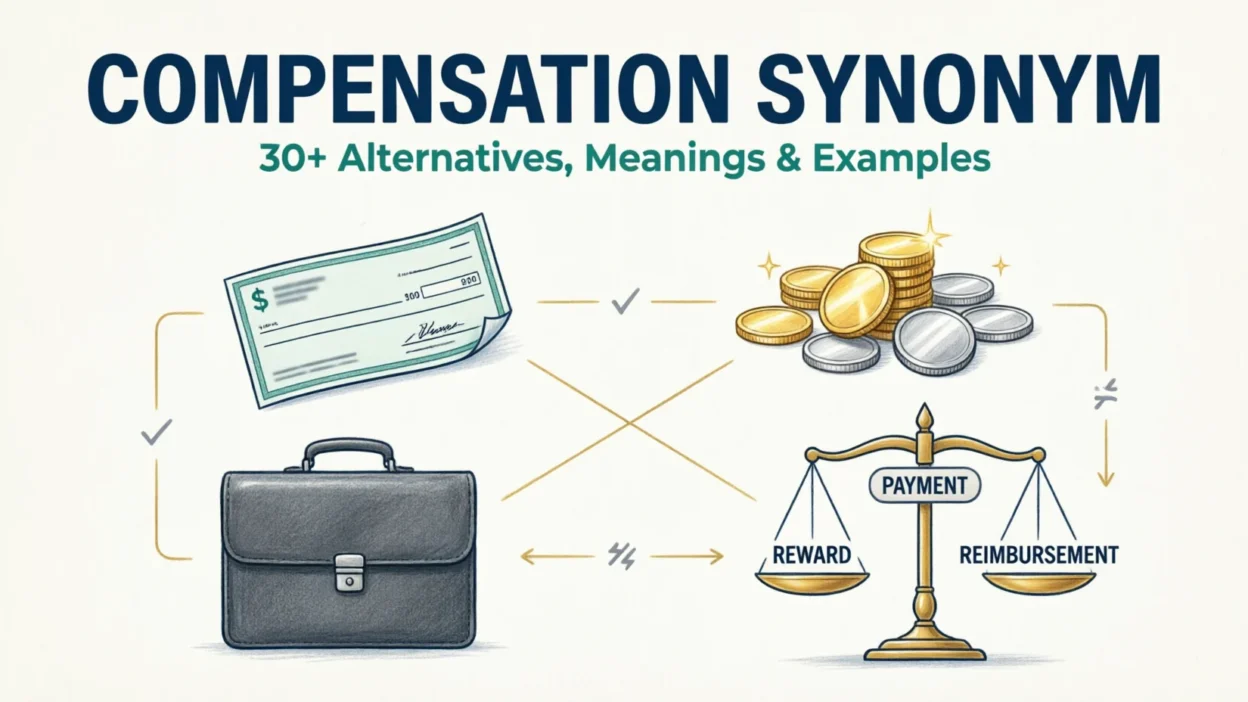
Finding the right compensation synonym can help you express payment, rewards, reimbursement, or something given to make up for a loss. Common synonyms for compensation include payment, remuneration, reimbursement, reward, salary, wages, restitution, indemnity, and recompense. However, each word has a slightly different meaning, so choosing the right one depends on the situation.
If you are writing an email, preparing an academic assignment, discussing workplace benefits, or improving your vocabulary, understanding these alternatives will help you communicate more clearly.
Quick Answer: What Is a Synonym for Compensation?
The best synonym for compensation depends on the context. Payment is a general alternative, remuneration refers to payment for work, reimbursement means repaying someone for expenses, and recompense means giving something in return for a loss, effort, or inconvenience.
Here are some common alternatives:
- Payment
- Remuneration
- Reimbursement
- Reward
- Salary
- Wages
- Compensation package
- Recompense
- Restitution
- Indemnity
What Does Compensation Mean?
Compensation is something given to a person in exchange for work, services, effort, or a loss they have experienced. It often refers to money, but it can also include benefits, goods, services, or other forms of value.
For example, an employee may receive compensation through a monthly salary, health benefits, and a performance bonus. Similarly, a customer may receive compensation for a damaged product or poor service.
The word has several common uses.
1. Compensation for Work
In employment, compensation refers to the money and benefits an employee receives for working.
Example: The company offers competitive compensation to attract experienced employees.
Related words include salary, wages, remuneration, and earnings.
2. Compensation for Expenses
Compensation can refer to money paid back to someone who has spent money on behalf of another person or organization. In this context, reimbursement is often the more precise term.
Example: Employees can request compensation for approved travel expenses.
Related words include reimbursement, repayment, and expense allowance.
3. Compensation for Loss or Injury
Compensation may also refer to money or another form of value given because someone has suffered a loss, injury, or inconvenience.
Example: The customer received compensation for the damaged equipment.
Related words include damages, restitution, indemnity, and recompense. The appropriate term may depend on the legal or financial circumstances.
30 Synonyms for Compensation With Meanings and Examples
The following words can replace compensation in suitable contexts. Some are close synonyms, while others are appropriate only in particular situations.
1. Payment
Simple meaning: Money given in exchange for goods, work, or services.
Example: The contractor received payment after completing the project.
Best usage/context: Use payment when referring to a general transfer of money. It is one of the simplest alternatives to compensation.
2. Remuneration
Simple meaning: Money or other rewards received for work or services.
Example: The position offers attractive remuneration and professional development opportunities.
Best usage/context: Use remuneration in formal workplace documents, employment discussions, and professional writing.
3. Reimbursement
Simple meaning: Money returned to someone for expenses they have paid.
Example: The company provided reimbursement for her business travel expenses.
Best usage/context: Use reimbursement when someone gets money back for an approved expense. It does not normally describe a salary.
4. Reward
Simple meaning: Something given in recognition of an achievement, effort, or good action.
Example: The employee received a reward for exceeding the annual sales target.
Best usage/context: Use reward when the payment or benefit recognizes performance, success, or a particular action.
5. Salary
Simple meaning: A fixed amount of money an employee earns regularly, usually monthly or annually.
Example: She negotiated a higher salary before accepting the position.
Best usage/context: Use salary when discussing regular employment income rather than compensation in its broader sense.
6. Wages
Simple meaning: Money paid to workers, often based on hours worked, days worked, or completed tasks.
Example: The workers received higher wages after the agreement was approved.
Best usage/context: Use wages when discussing hourly, daily, or task-based earnings, although the term can also be used more broadly.
7. Recompense
Simple meaning: Something given in return for effort, suffering, loss, or inconvenience.
Example: The organization offered recompense for the inconvenience caused by the cancellation.
Best usage/context: Use recompense in formal writing when emphasizing something given in return for a burden or loss.
8. Restitution
Simple meaning: The act of returning something or providing a remedy for a wrong or loss.
Example: The court ordered restitution to the victims.
Best usage/context: Use restitution in legal, ethical, or financial contexts involving the correction of a wrong. It is not a general replacement for employee pay.
9. Indemnity
Simple meaning: Protection against a loss or an obligation to cover certain losses.
Example: The agreement included an indemnity clause covering specified claims.
Best usage/context: Use indemnity in insurance, contracts, and legal discussions. It can refer to protection or an obligation to compensate, rather than simply a payment.
10. Damages
Simple meaning: Money awarded or claimed for harm, injury, or loss, particularly in legal cases.
Example: The court awarded damages for the financial harm caused by the breach of contract.
Best usage/context: Use damages when discussing legal claims or financial remedies for harm. The word does not generally mean wages or salary.
11. Allowance
Simple meaning: A sum of money provided for a particular purpose.
Example: The company gives employees a monthly travel allowance.
Best usage/context: Use allowance for specific payments, such as travel, meals, housing, or other approved expenses.
12. Benefits
Simple meaning: Additional advantages or services provided alongside regular pay.
Example: The compensation package includes health insurance and retirement benefits.
Best usage/context: Use benefits when referring to non-salary rewards offered by an employer. Benefits are often part of total compensation.
13. Earnings
Simple meaning: Money received through work, business, or other income-producing activities.
Example: Her annual earnings increased after she changed jobs.
Best usage/context: Use earnings when discussing the money someone makes over a particular period.
14. Income
Simple meaning: Money received from work, investments, business, or other sources.
Example: His total income includes his salary and rental earnings.
Best usage/context: Use income when discussing a person’s overall financial receipts rather than a specific payment for work or loss.
15. Honorarium
Simple meaning: A payment given for a professional service that is often voluntary or not covered by a standard fee.
Example: The guest speaker received an honorarium for delivering the lecture.
Best usage/context: Use honorarium for certain speaking engagements, guest lectures, and similar services.
16. Stipend
Simple meaning: A fixed amount of money provided to support someone during training, study, research, or an internship.
Example: The research intern received a monthly stipend.
Best usage/context: Use stipend for students, trainees, interns, researchers, and similar recipients.
17. Fee
Simple meaning: Money paid for a professional service or a particular activity.
Example: The consultant charged a reasonable fee for the project.
Best usage/context: Use fee when referring to the price of a service, such as legal advice, consulting, or tuition.
18. Commission
Simple meaning: Money earned based on sales, transactions, or completed business.
Example: The salesperson earned a commission on every successful sale.
Best usage/context: Use commission when compensation depends on sales or another agreed performance measure.
19. Bonus
Simple meaning: Extra money or a benefit given in addition to regular pay.
Example: The team received a bonus for completing the project ahead of schedule.
Best usage/context: Use bonus for additional rewards beyond ordinary salary or wages.
20. Perk
Simple meaning: An extra advantage or benefit associated with a job or position.
Example: One perk of the job is the option to work remotely.
Best usage/context: Use perk in conversational or informal workplace writing when describing extra benefits.
21. Consideration
Simple meaning: Something of value exchanged between parties as part of an agreement.
Example: Both parties agreed on the financial consideration before signing the contract.
Best usage/context: Use consideration in contract law and formal business agreements. It is not usually a direct synonym for ordinary employee compensation.
22. Settlement
Simple meaning: An agreement or payment that resolves a dispute or claim.
Example: The company reached a settlement with the customer after negotiations.
Best usage/context: Use settlement when compensation forms part of resolving a legal, financial, or contractual dispute.
23. Pay
Simple meaning: Money received for working.
Example: The employee requested a review of her pay.
Best usage/context: Use pay in everyday conversations, workplace messages, and straightforward writing.
24. Repayment
Simple meaning: Money returned to someone to pay back an amount previously owed or received.
Example: The employer arranged repayment of the amount deducted in error.
Best usage/context: Use repayment when money is returned to settle a debt or correct a previous payment issue.
25. Payback
Simple meaning: A return for something previously done or a repayment of money; it can also suggest revenge.
Example: The agreement included payback of the approved expenses.
Best usage/context: Use payback mainly in informal conversations. In professional writing, repayment or reimbursement is usually clearer.
26. Redress
Simple meaning: Action taken to correct a wrong or address an unfair situation.
Example: The customers sought redress for the company’s misleading claims.
Best usage/context: Use redress when emphasizing the correction of an injustice or grievance. It may involve compensation, but it does not always mean money.
27. Reparation
Simple meaning: Something provided to repair or make amends for harm or wrongdoing.
Example: The agreement included reparations for the damage caused.
Best usage/context: Use reparation in formal, legal, historical, or political discussions about harm and making amends.
28. Award
Simple meaning: A prize, payment, or other benefit formally granted to someone.
Example: The employee received a performance award for exceptional service.
Best usage/context: Use award when a payment or benefit is formally granted by an employer, organization, court, or institution.
29. Payoff
Simple meaning: A payment or financial return resulting from an action, effort, or investment.
Example: Years of careful planning finally produced a financial payoff.
Best usage/context: Use payoff in informal discussions of results or returns. In some contexts, it can imply a questionable or improper payment, so choose it carefully.
30. Remunerative Return
Simple meaning: A financial return or reward received for work, effort, or an investment.
Example: The consultant hoped the demanding project would provide a remunerative return.
Best usage/context: Use this phrase when emphasizing a financial return. It is less common and less natural as a direct substitute for compensation than payment or remuneration.
Comparison Table: Which Compensation Synonym Should You Use?
| Synonym | Main meaning | Best context | Tone |
| Payment | Money given | General transactions | Neutral |
| Remuneration | Payment for work or services | Employment and formal writing | Formal |
| Reimbursement | Money returned for expenses | Business expenses | Professional |
| Salary | Regular fixed employment pay | Jobs and contracts | Neutral |
| Wages | Earnings for work | Hourly or task-based work | Neutral |
| Reward | Recognition for effort or success | Performance and achievement | Positive |
| Recompense | Return for effort, loss, or inconvenience | Formal writing | Formal |
| Restitution | Remedy for a wrong or loss | Legal matters | Formal |
| Indemnity | Protection against specified losses | Insurance and contracts | Technical |
| Damages | Money for harm or loss | Legal claims | Legal |
| Allowance | Money for a specific purpose | Workplace expenses | Neutral |
| Benefits | Extra employment advantages | Employee packages | Professional |
| Stipend | Fixed support payment | Internships and research | Formal |
| Commission | Earnings linked to sales | Sales roles | Professional |
| Settlement | Resolution of a dispute | Legal and financial claims | Formal |
How to Choose the Right Compensation Synonym
The best word depends on what the compensation is for, who receives it, and how formal the situation is.
1. Choose According to Tone
For everyday conversations: Use pay, payment, or reward.
Example: “The company increased my pay.”
For professional writing: Use remuneration, salary, earnings, or benefits.
Example: “The position offers competitive remuneration.”
For formal or legal writing: Use restitution, indemnity, damages, or reparation when the circumstances support those terms.
Example: “The court awarded damages for the loss.”
2. Choose According to Meaning
When discussing work: Choose salary, wages, remuneration, or pay.
When discussing expenses: Choose reimbursement or repayment, depending on whether you are recovering an expense or settling an amount owed.
When discussing performance: Choose bonus, reward, commission, or award.
When discussing harm or loss: Choose recompense, damages, restitution, or reparation according to the situation.
When discussing employee packages: Choose benefits, allowance, or compensation package.
3. Choose According to Intent
Ask yourself what you want the sentence to communicate.
- To describe regular income: Use salary, wages, or earnings.
- To emphasize professional payment: Use remuneration.
- To describe money returned for expenses: Use reimbursement.
- To recognize excellent work: Use reward or bonus.
- To resolve a legal claim: Use settlement or damages where appropriate.
- To correct a wrong: Use redress, restitution, or reparation when suitable.
Choosing a precise word makes your writing more natural and reduces confusion.
Common Mistakes When Using Compensation Synonyms
Even though many words are related to compensation, they are not always interchangeable.
Mistake 1: Using Salary for Every Type of Compensation
Incorrect: “The customer received a salary for the damaged product.”
Correct: “The customer received compensation for the damaged product.”
Salary normally refers to regular employment pay, not a payment for damage.
Mistake 2: Confusing Reimbursement With Reward
Incorrect: “The company rewarded the employee for paying the approved travel expenses.”
Better: “The company reimbursed the employee for the approved travel expenses.”
Reimbursement returns money spent, while a reward recognizes an achievement or action.
Mistake 3: Treating Benefits and Salary as Identical
Salary is a form of employment pay. Benefits may include insurance, paid leave, retirement contributions, and other advantages.
A compensation package can include both salary and benefits.
Mistake 4: Using Damages in Ordinary Workplace Conversations
Damages is commonly used for money awarded or claimed because of harm or loss, particularly in legal settings.
For ordinary workplace discussions, payment, reimbursement, or compensation may be more appropriate.
Mistake 5: Using Formal Words in Casual Conversations
Words such as remuneration, indemnity, and reparation can sound overly technical in everyday communication.
Instead of saying, “I received remuneration for my work,” you can simply say, “I got paid for my work.”
Mistake 6: Assuming Every Synonym Has the Same Legal Meaning
Words such as restitution, indemnity, damages, and settlement can have distinct legal meanings. Their precise use depends on the applicable law, agreement, and circumstances.
When writing a legal document, do not replace one of these terms with another merely because they seem similar.
FAQs:
1. What is the most common synonym for compensation?
Payment is one of the most common general synonyms for compensation. However, remuneration is often more appropriate when discussing payment for professional work, while reimbursement is better for money returned for expenses.
2. What is another word for compensation at work?
Common alternatives include salary, wages, remuneration, pay, earnings, and benefits. The best choice depends on whether you mean regular income, total employment rewards, or additional workplace advantages.
3. What is a formal word for compensation?
Remuneration is a common formal term for payment received for work or services. Recompense is useful when referring to something given in return for loss, effort, or inconvenience.
4. What is a synonym for compensation for damages?
Depending on the circumstances, possible terms include damages, restitution, reparation, and recompense. These words have different meanings, particularly in legal contexts, so they should not be treated as exact equivalents.
5. Is reimbursement the same as compensation?
Not exactly. Reimbursement means returning money someone has spent, usually on approved expenses. Compensation is broader and can include payment for work, benefits, or money given because of a loss or injury.
6. What is the difference between compensation and remuneration?
Compensation can refer to payment for work as well as benefits or payments for losses. Remuneration specifically focuses on the payment or reward received for work or services.
7. What is a simple word for compensation?
Pay or payment is usually the simplest alternative. For example, “The company offered fair compensation” can become “The company offered fair pay” when discussing an employee’s earnings.
8. Can compensation mean something other than money?
Yes. Compensation can include non-cash benefits, goods, services, or other forms of value. For example, an employee may receive health insurance and paid leave as part of a compensation package.
Conclusion
Understanding compensation synonyms helps you choose words that express your meaning clearly. Although payment, remuneration, reimbursement, salary, wages, reward, recompense, and restitution are related, each serves a different purpose.
Use payment for general transactions, remuneration for work-related rewards, reimbursement for expenses, and damages or restitution when discussing certain forms of legal relief. For employment discussions, salary, wages, and benefits can describe different parts of a compensation package.
The key is to consider the context before choosing a synonym. A precise word makes your writing easier to understand, more natural, and more effective for your readers.

I’m James Parker, Administrator at SynonymsHive. I oversee content quality, improve user experience, and ensure reliable synonym resources. My passion is making language learning simple, accurate, and accessible for everyone.