
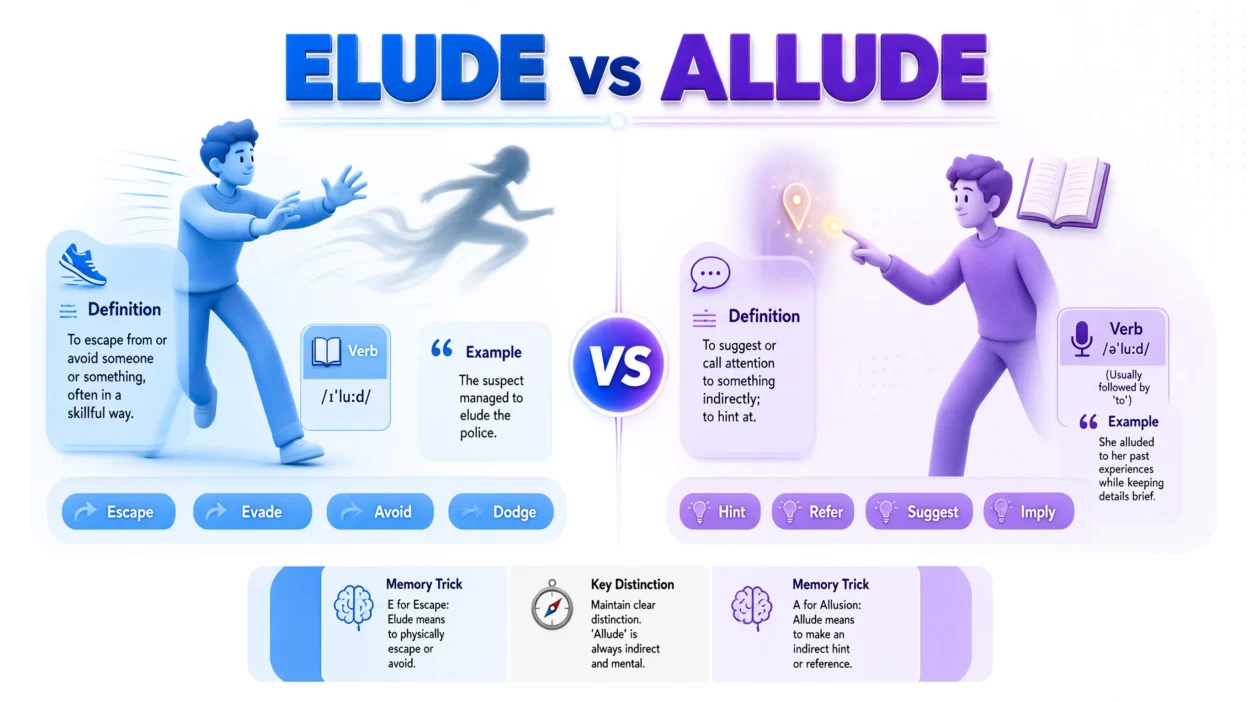
The English words elude and allude sound similar and have almost identical spelling, but they have completely different meanings. Because of their pronunciation and appearance, many students, ESL learners, and even experienced writers sometimes confuse these two words. However, understanding their meanings and uses makes it much easier to choose the correct word in everyday writing and conversation.
The main difference between elude and allude is that elude means to escape, avoid, or remain difficult to catch or understand, while allude means to refer to something indirectly without mentioning it directly.
For example, a criminal might elude the police, while a writer might allude to a famous historical event. Both words are useful in English, but they belong in different contexts. This guide explains their definitions, grammatical uses, differences, and practical examples to help you use them confidently.
Quick Answer: What Is the Difference Between Elude and Allude?
Elude means to escape from someone or something, avoid capture, or remain difficult to understand. Allude means to mention or refer to something indirectly. For example, a suspect may elude the police, while a speaker may allude to an earlier conversation without explaining it directly.
Why Do People Confuse Elude and Allude?
People often confuse elude and allude because they:
- Have similar spellings.
- Sound almost identical in everyday speech.
- Contain the same number of letters.
- Are commonly used in formal writing.
- Can both appear in academic, professional, and literary contexts.
Their pronunciation is slightly different. Elude begins with an unstressed vowel sound, while allude begins with a short or open vowel sound, depending on the speaker’s accent.
The easiest way to avoid confusion is to remember that elude is about escaping or avoiding, whereas allude is about indirectly referring to something.
1. What Does Elude Mean?
Elude is a verb that means to escape from someone or something, avoid being caught, or remain difficult to find, achieve, or understand.
It describes situations where something cannot easily be captured, reached, remembered, or understood.
Different Meanings of Elude
Elude can be used in several ways:
1. To escape or avoid capture
When someone successfully avoids being caught, they elude the person chasing them.
- The thief managed to elude the police.
- The suspect eluded security officers.
2. To avoid or escape something
It can describe avoiding a problem, responsibility, or difficult situation.
- She tried to elude responsibility for her mistake.
- He could not elude the consequences of his actions.
3. To remain difficult to understand
Elude can also describe something that is hard to understand, remember, or achieve.
- The meaning of the poem eluded me.
- Success continued to elude the young athlete.
Synonyms of Elude
Some common synonyms include:
- Escape
- Evade
- Avoid
- Dodge
- Outsmart
- Slip away
- Bypass
- Eliminate (in certain contexts, but not as a direct synonym)
- Avoid capture
- Remain beyond reach
Example Sentences with Elude
- The clever fox managed to elude the hunters.
- The answer to this difficult question continues to elude me.
- The criminal attempted to elude the police.
- She could not elude her responsibilities.
- His true intentions eluded everyone in the room.
2. What Does Allude Mean?
Allude is a verb that means to refer to, mention, or suggest something indirectly without discussing it openly or explaining it completely.
When someone alludes to something, they expect the listener or reader to understand the reference through context.
Different Uses of Allude
1. To refer to something indirectly
This is the most common meaning of allude.
- The teacher alluded to an important historical event.
- She alluded to her previous experience during the interview.
2. To make an indirect reference
Writers and speakers often use allude when they want to mention something without naming it directly.
- The author alluded to a famous novel.
- His speech alluded to the country’s difficult past.
3. To hint at something
Allude can also describe giving someone a clue or hint about a subject.
- She alluded to a surprise but did not reveal the details.
- He alluded to a possible career change.
Synonyms of Allude
Common synonyms include:
- Refer to
- Hint at
- Mention indirectly
- Suggest
- Imply
- Touch on
- Make a reference to
- Indicate
- Point toward
- Suggest indirectly
Example Sentences with Allude
- The speaker alluded to the company’s recent problems.
- She alluded to her childhood memories during the interview.
- The author alludes to Shakespeare in the opening chapter.
- He alluded to an earlier disagreement without explaining it.
- The politician alluded to future changes in the education system.
Elude vs Allude: Comparison Table
The following table highlights the main differences between these two commonly confused words.
| Feature | Elude | Allude |
| Part of speech | Verb | Verb |
| Main meaning | To escape or avoid | To refer indirectly |
| Main idea | Avoidance or escape | Indirect reference |
| Common usage | Escape capture or understanding | Hinting or referring |
| Common phrase | Elude the police | Allude to something |
| Synonyms | Evade, escape, avoid | Hint at, refer to, imply |
| Example | The suspect eluded the guards. | She alluded to the incident. |
| Grammar | Elude someone/something | Allude to someone/something |
Important grammar tip: Elude usually takes a direct object, while allude is commonly followed by the preposition to.
- Correct: He eluded the guards.
- Correct: He alluded to the guards’ warning.
- Incorrect: He alluded the guards’ warning.
When Should You Use Elude or Allude?
Choosing between these words becomes easier when you understand the situation you are describing.
When to Use Elude
Use elude when discussing:
- Escaping from someone chasing you.
- Avoiding capture or detection.
- Avoiding responsibility or consequences.
- Something that is difficult to understand.
- A goal that remains difficult to achieve.
Examples:
- The criminal eluded the police for several days.
- The solution to the problem eluded the researchers.
- Happiness seemed to elude him despite his success.
When to Use Allude
Use allude when discussing:
- Indirect references to people or events.
- Hints about something without explaining it.
- References to books, movies, or historical events.
- Mentioning a subject without naming it directly.
- Suggesting something through context.
Examples:
- The teacher alluded to an upcoming examination.
- The novel alludes to ancient mythology.
- She alluded to their disagreement during the meeting.
10+ Examples of Elude vs Allude in Sentences
Here are practical examples showing how each word works in everyday English.
Examples Using Elude
- The escaping prisoner managed to elude the guards.
- The answer to the puzzle continued to elude him.
- The suspect eluded police officers during the chase.
- She tried to elude questions about her personal life.
- The athlete’s dream of winning a championship seemed to elude him.
- The meaning of the complicated passage eluded the students.
- No matter how hard he tried, sleep continued to elude him.
Examples Using Allude
- The professor alluded to an important scientific discovery.
- She alluded to her past experiences without sharing details.
- The writer alluded to Greek mythology in the story.
- During his speech, he alluded to the company’s financial difficulties.
- My friend alluded to a surprise birthday celebration.
- The article alludes to several historical events.
- He alluded to their previous conversation but did not explain it.
Examples Using Both Words
15. The detective could not catch the suspect, who continued to elude him, but he alluded to the case during his interview.
16. The speaker alluded to a mysterious person whose identity continued to elude the audience.
These examples demonstrate that the two words can appear in the same sentence while maintaining completely different meanings.
Common Mistakes When Using Elude and Allude
Even though these words have different meanings, their similar spelling can lead to grammatical and vocabulary mistakes.
Here are some common errors to avoid.
Mistake 1: Using Allude When You Mean Escape
Incorrect: The criminal alluded the police.
Correct: The criminal eluded the police.
Why? Elude means to escape or avoid capture. Allude does not mean to escape.
Mistake 2: Using Elude When You Mean Refer Indirectly
Incorrect: The author eluded to an important event.
Correct: The author alluded to an important event.
Why? Allude to means to make an indirect reference.
Mistake 3: Forgetting the Word “To”
Incorrect: She alluded the previous discussion.
Correct: She alluded to the previous discussion.
Why? The verb allude is normally followed by the preposition to when introducing a reference.
Mistake 4: Confusing Their Synonyms
Remember:
- Elude = evade, escape, avoid.
- Allude = hint at, refer to, imply.
Although some words may overlap in broader contexts, these are the most useful distinctions.
Easy Memory Trick to Remember Elude vs Allude
A simple memory trick can help you remember these words without checking a dictionary every time.
Remember E in Elude = Escape.
Both words begin with E, and elude describes escaping, avoiding, or remaining beyond someone’s reach.
Remember A in Allude = Allusion.
Allude is related to allusion, which means an indirect reference to something.
Think of these examples:
- Elude: The rabbit escapes the dog.
- Allude: The writer hints at an earlier event.
Easy way to remember
Elude = Escape. Allude = Indirect reference.
Elude vs Allude in American and British English
There is no major difference in the meanings of elude and allude between American and British English.
Both varieties use these words with the same basic definitions and grammatical patterns.
| Word | American English | British English |
| Elude | To escape or avoid | To escape or avoid |
| Allude | To refer indirectly | To refer indirectly |
The spelling is also the same in both varieties.
For example:
- American English: The suspect eluded the police.
- British English: The suspect eluded the police.
- American English: She alluded to the problem.
- British English: She alluded to the problem.
Therefore, you do not need to learn separate meanings or spellings for these words when switching between American and British English.
Similar Words Related to Elude and Allude
Several other English words have meanings connected to escaping, avoiding, hinting, or referring indirectly.
Understanding these related words can improve your vocabulary.
| Word | Meaning | Example |
| Evade | Avoid something or someone | He tried to evade the question. |
| Escape | Get away from danger or control | The prisoner escaped. |
| Avoid | Stay away from something | She avoids unnecessary arguments. |
| Dodge | Move quickly to avoid something | He dodged the question. |
| Allusion | An indirect reference | The poem contains a biblical allusion. |
| Imply | Suggest something without saying it directly | Her words implied disappointment. |
| Hint | Give an indirect suggestion | He gave me a hint. |
| Refer | Mention or direct attention to something | She referred to the report. |
| Suggest | Present an idea indirectly | His expression suggested concern. |
| Elusive | Difficult to find, catch, or understand | The answer remained elusive. |
Elude vs Elusive
Elusive is an adjective related to elude. It describes something that is difficult to find, catch, or understand.
Example: The elusive solution finally became clear.
Allude vs Allusion
Allusion is the noun form related to allude. It means an indirect reference to a person, event, idea, or piece of literature.
Example: The author’s allusion to Greek mythology makes the story more interesting.
Final Verdict: Elude vs Allude
The difference between elude and allude is simple once you understand their meanings.
- Elude means to escape, avoid, or remain difficult to understand or achieve.
- Allude means to refer to something indirectly or make a subtle reference.
Use elude when someone escapes the police, avoids responsibility, or struggles to understand something. Use allude when someone hints at an event, mentions a subject indirectly, or refers to something without explaining it directly.
Remember that elude is connected to escape, while allude is connected to indirect references. This small distinction will help you use both words correctly.
FAQs:
1. What is the main difference between elude and allude?
Elude means to escape, avoid, or remain difficult to understand. Allude means to refer to something indirectly. For example, a criminal can elude the police, while a speaker can allude to a previous conversation.
2. Is it elude or allude to something?
The correct expression is allude to something when you mean to refer to it indirectly. Elude does not normally take to in this meaning. For example, “She alluded to the problem” is correct.
3. Can elude and allude be used interchangeably?
No. Elude and allude have different meanings and cannot normally replace each other. Elude describes escaping or avoiding something, whereas allude describes making an indirect reference.
4. What is an example of elude in a sentence?
“The suspect managed to elude the police during the chase.” In this sentence, elude means that the suspect successfully escaped or avoided being caught.
5. What is an example of allude in a sentence?
“The author alluded to a famous historical event in her novel.” Here, alluded means that the author indirectly referred to the event without explaining it completely.
6. What is the noun form of allude?
The noun form associated with allude is allusion. It means an indirect reference to a person, event, place, or idea. For example, “The poem contains an allusion to Greek mythology.”
7. What is the adjective form of elude?
The related adjective is elusive. It describes something that is difficult to find, catch, achieve, or understand. For example, “The answer remained elusive despite several attempts.”
8. How can I remember the difference between elude and allude?
Remember that elude means escape, while allude means indirectly refer. You can also connect allude with allusion, which means an indirect reference. These simple associations make the distinction easier to remember.
Remember This
- Elude = Escape or avoid.
- Allude = Refer indirectly or hint at.
- Elude someone: The thief eluded the police.
- Allude to something: She alluded to the incident.
- Allusion: An indirect reference.
Conclusion
Understanding the difference between elude and allude can help you become a more confident English speaker and writer. Although these words look and sound similar, their meanings are completely different. Elude describes escaping, avoiding, or remaining difficult to understand, while allude means referring to something indirectly.
The best way to remember them is to associate elude with escape and allude with allusion. Practice using both words in your own sentences, pay attention to their grammatical patterns, and you will find it much easier to choose the correct word in conversations, academic writing, and everyday communication.

I’m James Parker, Administrator at SynonymsHive. I oversee content quality, improve user experience, and ensure reliable synonym resources. My passion is making language learning simple, accurate, and accessible for everyone.