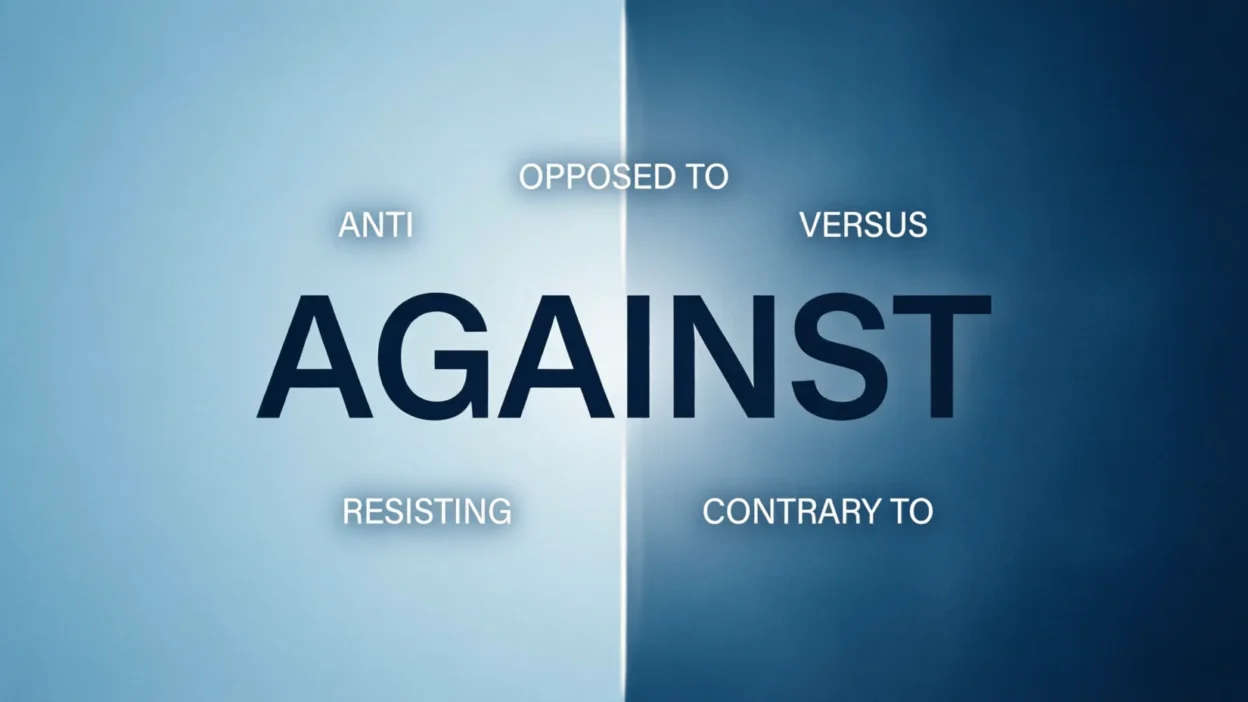
The best synonyms for against include opposed to, contrary to, versus, opposing, conflicting with, resisting, anti, in opposition to, incompatible with, and adverse to. The right word depends on the context: you might use opposed to to express disagreement, versus to describe competition, or contrary to to show that something goes against a rule, belief, or expectation.
If you are writing an essay, improving your vocabulary, or looking for a more precise word, understanding these alternatives will help you communicate your meaning clearly.
Quick Answer: What Are the Best Synonyms for Against?
The most useful synonyms for against are:
- Opposed to — expressing disagreement or resistance.
- Contrary to — going against a rule, statement, or expectation.
- Versus — showing competition or comparison.
- Opposing — working in disagreement with something.
- Resisting — trying to prevent or fight something.
- In opposition to — formally expressing disagreement.
- Conflicting with — being inconsistent with something.
- Anti — expressing opposition to a person, idea, or policy.
- Adverse to — unfavorable or harmful to something.
- Incompatible with — unable to exist or work well together.
What Does Against Mean?
The word against is a preposition with several meanings. It can express opposition, disagreement, physical contact, competition, protection, or comparison.
The exact meaning depends on how the word is used in a sentence.
For example:
- Opposition: They voted against the proposal.
- Physical contact: He leaned against the wall.
- Competition: Our team played against its strongest rival.
- Protection: The vaccine protects against certain diseases.
- Comparison: The benefits must be weighed against the costs.
Because against has several meanings, no single synonym works in every situation. Choosing an alternative requires understanding the intended message.
30 Synonyms for Against With Meanings and Examples
The following 30 words and phrases offer alternatives for different situations, from everyday disagreement to formal writing, competition, and physical contact.
1. Opposed to
Simple meaning: Disagreeing with or not supporting something.
Example: Many residents are opposed to the new construction project.
Best usage/context: Use it when someone disagrees with a policy, decision, proposal, or idea.
2. Contrary to
Simple meaning: Opposite to a rule, belief, statement, or expectation.
Example: His actions were contrary to the company’s values.
Best usage/context: Suitable for formal writing, academic work, and discussions about rules or principles.
3. Versus
Simple meaning: In competition or comparison with someone or something.
Example: The final match was between City United versus the defending champions.
Best usage/context: Common in sports, legal cases, debates, and comparisons. In standard prose, write either “between City United and the champions” or “City United versus the champions.”
4. Opposing
Simple meaning: Disagreeing with or working against something.
Example: The opposing group rejected the proposed changes.
Best usage/context: Useful when describing rival groups, competing opinions, or conflicting positions.
5. Resisting
Simple meaning: Trying to stop, fight, or avoid something.
Example: The community is resisting the proposed land development.
Best usage/context: Use it when someone actively pushes back against pressure, change, authority, or an unwanted action.
6. Anti
Simple meaning: Against or opposed to a particular person, idea, or activity.
Example: The organization launched an anti-bullying campaign.
Best usage/context: Often used as a prefix in terms such as anti-war, anti-corruption, and anti-smoking.
7. In opposition to
Simple meaning: Expressing disagreement or resistance.
Example: Several members spoke in opposition to the new regulations.
Best usage/context: Appropriate for formal discussions, political writing, reports, and public statements.
8. Conflicting with
Simple meaning: Being inconsistent with or contradicting something.
Example: His explanation was conflicting with the evidence presented earlier.
Best usage/context: Use conflicting with to describe disagreements between facts, statements, plans, or interests. A more natural version of the example is “His explanation conflicted with the evidence presented earlier.”
9. Adverse to
Simple meaning: Unfavorable to or working against something.
Example: The decision could have an adverse effect on small businesses.
Best usage/context: Suitable for formal writing about negative effects, risks, conditions, or outcomes. Often, adverse to is less natural than harmful to or unfavorable to.
10. Incompatible with
Simple meaning: Unable to work or exist well together.
Example: His proposed schedule is incompatible with our current working hours.
Best usage/context: Use it for conflicting requirements, beliefs, systems, plans, or characteristics.
11. Resisting
Simple meaning: Refusing to accept or give in to something.
Example: The workers are resisting unfair treatment.
Best usage/context: Useful when describing an active effort to oppose pressure, unfairness, or unwanted change.
12. Fighting
Simple meaning: Taking action to oppose or defeat something.
Example: Local volunteers are fighting against poverty.
Best usage/context: Appropriate for direct, energetic language about struggles, campaigns, injustice, and serious challenges.
13. Challenging
Simple meaning: Questioning or refusing to accept something as correct.
Example: The researcher is challenging the traditional explanation.
Best usage/context: Use it when questioning an established idea, decision, belief, or authority rather than simply disagreeing.
14. Contesting
Simple meaning: Disputing or formally challenging something.
Example: The candidate is contesting the election results.
Best usage/context: Common in legal, political, academic, and official settings.
15. Disagreeing with
Simple meaning: Having a different opinion from someone or something.
Example: I am disagreeing with the proposal because it lacks sufficient evidence.
Best usage/context: Suitable for everyday conversations, meetings, discussions, and opinion-based writing. For a general statement, “I disagree with the proposal” is more natural.
16. Contradicting
Simple meaning: Saying or showing the opposite of something.
Example: The latest findings contradict the earlier report.
Best usage/context: Use it when facts, statements, or evidence directly conflict.
17. Counter to
Simple meaning: Opposite to or inconsistent with something.
Example: The decision was counter to the advice of the medical team.
Best usage/context: Useful in formal writing when explaining why an action or conclusion goes against advice, evidence, or expectations.
18. Contrary
Simple meaning: Opposite in nature, direction, or meaning.
Example: Contrary to popular belief, the task was relatively simple.
Best usage/context: Often used in expressions such as contrary to expectations and on the contrary.
19. Hostile to
Simple meaning: Unfriendly or strongly opposed to something.
Example: The committee was hostile to the proposed changes.
Best usage/context: Use it when opposition is intense, unfriendly, or openly antagonistic.
20. Resistant to
Simple meaning: Not easily affected by or unwilling to accept something.
Example: The material is resistant to heat.
Best usage/context: Appropriate for scientific, technical, medical, and everyday descriptions of resistance. It does not always imply disagreement; it can describe physical properties.
21. Fighting against
Simple meaning: Actively trying to defeat or prevent something.
Example: The organization is fighting against discrimination.
Best usage/context: Useful for social campaigns, personal struggles, and efforts to stop harmful behavior.
22. Objecting to
Simple meaning: Expressing disagreement or disapproval.
Example: Several employees are objecting to the proposed changes.
Best usage/context: Suitable for meetings, discussions, formal complaints, and situations where someone voices an objection.
23. At odds with
Simple meaning: In disagreement or conflict with someone or something.
Example: His actions are at odds with his public promises.
Best usage/context: A natural expression for describing conflicting opinions, behavior, values, or interests.
24. Antagonistic toward
Simple meaning: Showing active opposition or hostility.
Example: The manager became antagonistic toward employees who questioned the decision.
Best usage/context: Use it when the opposition involves an unfriendly or confrontational attitude.
25. In defiance of
Simple meaning: Refusing to obey or respect a rule, order, or authority.
Example: The protesters continued their march in defiance of the ban.
Best usage/context: Best for strong opposition to authority, restrictions, instructions, or established rules.
26. In conflict with
Simple meaning: Being in disagreement or opposition.
Example: The new policy is in conflict with existing regulations.
Best usage/context: Suitable for professional reports, legal discussions, workplace issues, and competing interests.
27. Unsupportive of
Simple meaning: Not giving approval, encouragement, or help.
Example: The board was unsupportive of the proposed expansion.
Best usage/context: Use it when a person or group does not approve of or encourage a plan.
28. Contrary to the interests of
Simple meaning: Going against what would benefit someone.
Example: The decision was contrary to the interests of local residents.
Best usage/context: Helpful in business, policy, legal, and social discussions involving benefits or priorities.
29. In resistance to
Simple meaning: As an act of resisting something.
Example: The workers organized a demonstration in resistance to the proposed cuts.
Best usage/context: Can appear in formal writing, although in protest against or in resistance to may sound less natural than simply resisting in many sentences.
30. Leaning against
Simple meaning: Resting or pressing against a physical surface.
Example: She was leaning against the door while waiting for her friend.
Best usage/context: Use it when against describes physical contact rather than disagreement or opposition.
Comparison Table: Which Synonym for Against Should You Use?
| Synonym | Main meaning | Best context | Tone |
| Opposed to | Disagreeing | Opinions and proposals | Neutral |
| Contrary to | Inconsistent with | Rules and expectations | Formal |
| Versus | Competition or comparison | Sports and debates | Neutral |
| Resisting | Pushing back | Change and pressure | Active |
| Anti | Against an idea or practice | Campaigns and labels | Direct |
| Conflicting with | Being inconsistent | Facts and plans | Neutral |
| Hostile to | Strongly unfriendly | Relationships and attitudes | Strong |
| Contesting | Formally disputing | Legal and political matters | Formal |
| Objecting to | Expressing disapproval | Meetings and complaints | Neutral |
| At odds with | Being in disagreement | Values and behavior | Conversational |
| In defiance of | Refusing to obey | Authority and restrictions | Strong |
| Leaning against | Physical contact | Describing position | Neutral |
How to Choose the Right Synonym for Against
The best alternative depends on your meaning, the strength of your disagreement, and the tone of your writing.
1. For everyday disagreement
Choose opposed to, disagreeing with, or objecting to.
- “I am opposed to the plan.”
- “I disagree with that opinion.”
- “She objected to the decision.”
These phrases communicate disagreement without necessarily suggesting hostility.
2. For formal and academic writing
Choose contrary to, counter to, in conflict with, or in opposition to.
- “The findings are contrary to the original hypothesis.”
- “The proposal is in conflict with existing regulations.”
- “The evidence runs counter to the initial assumption.”
These expressions work well in essays, reports, and analytical discussions.
3. For strong resistance
Choose fighting against, resisting, hostile to, or in defiance of.
- “They are fighting against discrimination.”
- “The residents are resisting the changes.”
- “The group acted in defiance of the order.”
These choices communicate a more active or forceful form of opposition.
4. For competition and comparison
Choose versus or opposing.
- “The match is Team A versus Team B.”
- “The opposing candidates presented different policies.”
Use versus for direct comparisons and competitions, and opposing when describing people, sides, or positions.
5. For rules, evidence, and expectations
Choose contrary to, contradicting, or counter to.
- “The action was contrary to company policy.”
- “The results contradict the earlier findings.”
- “The decision was counter to expert advice.”
These expressions help show that something does not agree with an established standard or piece of information.
6. For physical contact
Choose leaning against, resting against, or pressed against, depending on the action.
- “He leaned against the wall.”
- “The ladder rested against the building.”
- “She pressed the cloth against the wound.”
In these sentences, against does not mean disagreement, so an opposition-related synonym would be incorrect.
Common Mistakes When Using Synonyms for Against
Mistake 1: Treating every synonym as interchangeable
Incorrect: “The ladder was opposed to the wall.”
Correct: “The ladder was leaning against the wall.”
Opposed to expresses disagreement, while against can describe physical contact.
Mistake 2: Confusing disagreement with hostility
Opposed to generally indicates disagreement. Hostile to suggests a much stronger, unfriendly attitude.
Choose the word that matches the actual intensity of the situation.
Mistake 3: Using versus in ordinary disagreement
Incorrect: “I versus your opinion.”
Correct: “I disagree with your opinion.”
Versus normally introduces competing sides, alternatives, or opponents.
Mistake 4: Confusing adverse with opposed
Adverse generally means harmful or unfavorable, while opposed means disagreeing or resisting.
For example, “adverse weather conditions” means unfavorable weather conditions, not weather that expresses disagreement.
Mistake 5: Using formal expressions in casual conversations
Phrases such as in defiance of and contrary to can sound overly formal in everyday speech.
Instead of “I am in opposition to that idea,” you could simply say, “I disagree with that idea.”
Mistake 6: Forgetting the correct preposition
Some expressions normally take specific prepositions:
- Opposed to a proposal
- Resistant to change
- Objecting to a decision
- Hostile toward a person or idea
- In conflict with a rule
Learning these patterns makes your writing more natural and grammatically accurate.
FAQs:
1. What is the most common synonym for against?
Opposed to is one of the most useful alternatives when against means disagreeing with or not supporting something. For example, “They are opposed to the proposal.”
2. What is a formal synonym for against?
Formal alternatives include contrary to, counter to, in opposition to, and in conflict with. The best choice depends on whether you mean disagreement, inconsistency, or direct conflict.
3. What is another word for against in an argument?
Use opposed to, objecting to, disagreeing with, challenging, or contesting. Use contesting when someone formally disputes a claim or decision.
4. What is a strong word for against?
Hostile to, antagonistic toward, and in defiance of can express strong opposition. Resisting and fighting against emphasize active efforts to prevent or defeat something.
5. What is the opposite of against?
Depending on the context, opposites include for, in favor of, supporting, alongside, and with. For example, “She voted against the proposal” becomes “She voted in favor of the proposal.”
6. Can against mean touching something?
Yes. Against can describe physical contact or pressure. For example, “The picture is against the wall.” Depending on the situation, you could use leaning on, resting against, or pressed against.
7. What is a synonym for against in academic writing?
Contrary to, inconsistent with, counter to, and in conflict with are useful in academic writing. For example, “The results are inconsistent with the original hypothesis.”
8. How do I choose the best synonym for against?
First, identify what against means in your sentence. If it expresses disagreement, use opposed to. If it describes inconsistency, use contrary to. If it describes competition, use versus. If it describes physical contact, use a phrase such as leaning against.
Conclusion
Learning synonyms for against helps you express disagreement, resistance, competition, and physical contact more precisely. Words such as opposed to, contrary to, resisting, objecting to, and in conflict with are useful alternatives, but each carries a slightly different meaning.
For everyday conversations, choose simple expressions such as opposed to or disagreeing with. For formal writing, consider contrary to or inconsistent with. For strong resistance, use fighting against or in defiance of. When describing physical contact, keep the literal meaning of against in mind.
The key is to select the word that fits your sentence, intended meaning, and tone. This will make your English clearer, more natural, and more effective.

I’m James Parker, Administrator at SynonymsHive. I oversee content quality, improve user experience, and ensure reliable synonym resources. My passion is making language learning simple, accurate, and accessible for everyone.