Understanding the difference between past vs passed can make your English writing clearer and help you avoid common grammar mistakes. Although these two words sound exactly alike, they have different meanings, spellings, and grammatical functions. One refers to time, position, or something that has already happened, while the other is the past tense and past participle of the verb pass.
The confusion usually happens because both words are pronounced the same way. However, you cannot use them interchangeably. Choosing the correct word depends on what you want to express and how it functions in a sentence.
If you are writing an email, completing a school assignment, or improving your everyday English, learning this simple distinction will help you use both words confidently.
Quick Answer: Past vs Passed
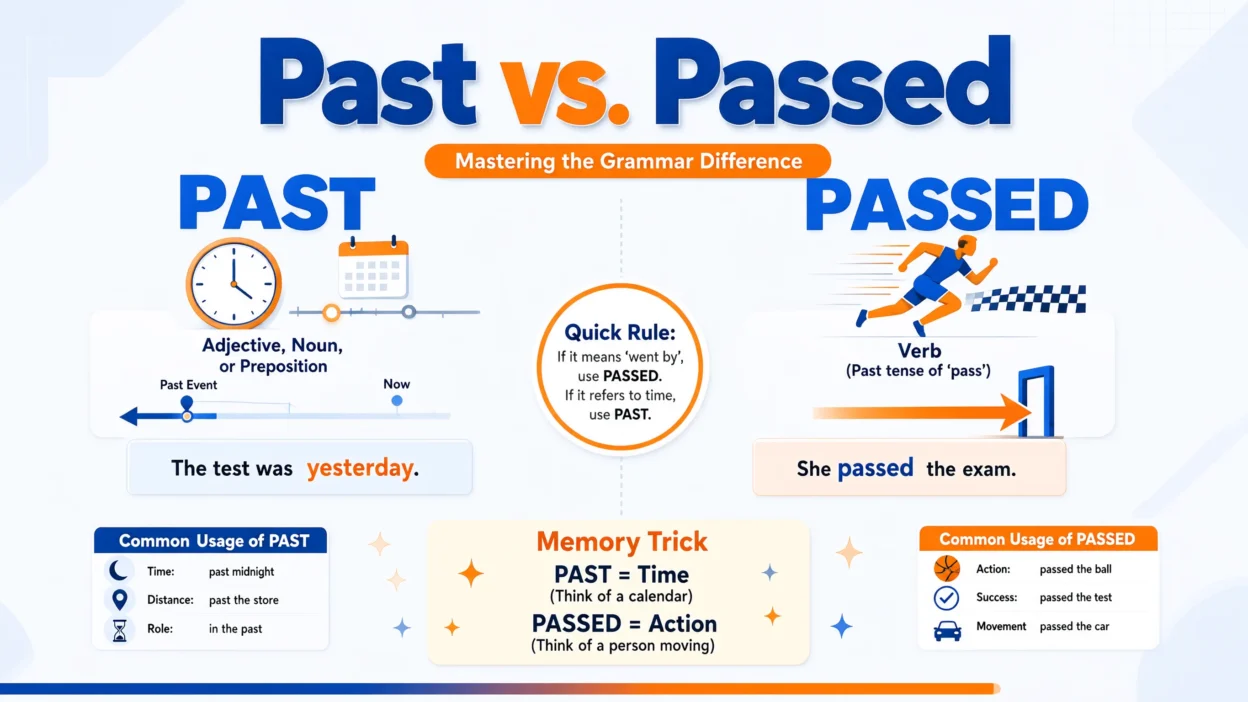
Past refers to a time that has already happened, a position beyond something, or something earlier than the present. It can function as a noun, adjective, or preposition. Passed is the past tense and past participle of the verb pass. It describes an action that has already happened, such as passing an exam, moving by something, or giving something to another person.
Why Do People Confuse Past and Passed?
People often confuse these words because past and passed are homophones. Homophones are words that have the same pronunciation but different spellings and meanings.
When spoken, there is no noticeable difference between the two words. This makes it difficult for learners to identify which spelling belongs in a sentence without considering its meaning.
Here are the main reasons for the confusion:
- Similar pronunciation: Both words sound identical in everyday speech.
- Related meanings: Both can describe something that has already happened or movement beyond a point.
- Different grammatical roles: One can describe time or position, while the other expresses an action.
- Writing habits: People sometimes choose a spelling based on sound rather than sentence structure.
The easiest way to avoid mistakes is to understand what each word does in a sentence.
First Word: Past – Meaning, Definition, and Examples
Past refers to a period of time before the present, a previous event, or a position beyond a particular point. It can also describe something that is no longer current.
It commonly functions as a noun, adjective, or preposition.
Different Uses of Past
1. Past as a noun
When used as a noun, past refers to an earlier time or previous experiences.
Examples:
- I often think about my past.
- We cannot change the past.
- Her past was full of interesting experiences.
2. Past as an adjective
As an adjective, past describes something that happened or existed before the present.
Examples:
- We discussed our past experiences.
- The past president visited our school.
- I learned from my past mistakes.
3. Past as a preposition
As a preposition, past describes movement beyond a particular person, place, or point.
Examples:
- She walked past the library.
- The bus drove past our house.
- We ran past the finish line.
4. Past as an adverb
Past can also function as an adverb to describe movement beyond a point.
Examples:
- The car drove past.
- Time went quickly as the years passed by.
When Should You Use Past?
Use past when talking about:
- Previous events or experiences.
- A time before the present.
- Something that is no longer current.
- Movement beyond a particular location.
- A time or point that has already been reached.
Second Word: Passed – Meaning, Definition, and Examples
Passed is the past tense and past participle of the verb pass. It describes an action that has already taken place.
The verb pass has several meanings, including moving beyond something, succeeding in an examination, transferring an object, or spending time.
Different Uses of Passed
1. Passed as an action of movement
Use passed when someone or something moved beyond another person or object.
Examples:
- The train passed our station.
- She passed the building without stopping.
- A cyclist passed me on the road.
2. Passed as an action of success
Use passed when someone successfully completes an examination, test, or assessment.
Examples:
- He passed his driving test.
- I passed my English examination.
- She passed all her final exams.
3. Passed as an action of transferring something
Use passed when someone gives or transfers something to another person.
Examples:
- He passed me the salt.
- The teacher passed the papers to the students.
- She passed the message to her manager.
4. Passed as an action of time
Use passed when describing time moving forward.
Examples:
- Three hours passed before the meeting started.
- Several weeks passed without any news.
- A long time has passed since we last met.
5. Passed as an action of approval
Use passed when a law, proposal, or decision receives official approval.
Examples:
- Parliament passed a new law.
- The committee passed the proposal.
- The council passed the budget.
Past vs Passed: Comparison Table
The following table highlights the important differences between these two commonly confused words.
| Feature | Past | Passed |
| Meaning | Earlier time or beyond a point | An action that has happened |
| Part of speech | Noun, adjective, preposition, adverb | Verb form |
| Base word | Past | Pass |
| Verb form | Not a verb | Past tense and past participle |
| Pronunciation | Same | Same |
| Example | Think about the past. | She passed the test. |
| Usage | Time, position, history | Movement, success, transfer, approval |
Simple rule: If you are describing an action performed by someone or something, passed is often correct. If you are referring to an earlier time or a position beyond something, use past.
When to Use Past vs Passed
Choosing the correct word becomes easier when you look at the meaning and grammatical structure of your sentence.
Use Past When Referring to Time
When discussing something that happened before the present, use past.
Examples:
- I enjoyed my past holidays.
- We talked about the past.
- The past year was challenging.
Use Past When Describing Movement Beyond Something
When someone or something moves beyond a specific location, past can function as a preposition.
Examples:
- Walk past the hospital.
- Drive past the supermarket.
- She ran past the school.
Use Passed When Describing an Action
When someone performs the action of passing, use passed.
Examples:
- He passed the ball.
- She passed the entrance exam.
- The train passed our house.
Use Passed When Talking About Time Moving Forward
When time itself moves forward, use passed.
Examples:
- Five minutes passed quickly.
- Several years have passed.
- The afternoon passed peacefully.
15 Examples of Past vs Passed in Sentences
Looking at both words in practical sentences is one of the easiest ways to understand their differences.
| Past | Passed |
| I learned a lot from my past. | I passed my mathematics test. |
| She walked past the store. | She passed the store yesterday. |
| We discussed past events. | Time passed very quickly. |
| He lives in the past. | He passed the ball to me. |
| The past few days were busy. | A few days passed without rain. |
| They talked about their past experiences. | They passed the final examination. |
| The restaurant is just past the bank. | The bus passed the bank. |
| I want to forget my past mistakes. | She passed the message to her friend. |
| We cannot return to the past. | The law was passed last year. |
| The past decade brought many changes. | The teacher passed out the worksheets. |
| He walked past the entrance. | He passed through the entrance. |
| My past decisions taught me valuable lessons. | Several hours passed before he arrived. |
| She prefers not to discuss her past. | The car passed us on the highway. |
| The past month was productive. | The days passed slowly. |
| We moved past our disagreements. | The proposal passed without objections. |
More Examples in Everyday Conversations
Here are some natural examples you might hear in daily English:
- Past: Is there a pharmacy just past the traffic lights?
- Passed: I passed the pharmacy on my way home.
- Past: My past experiences helped me grow.
- Passed: I passed my interview successfully.
- Past: We should leave our problems in the past.
- Passed: She passed me a glass of water.
Common Mistakes When Using Past and Passed
Even experienced English speakers sometimes make mistakes with homophones. Understanding these common errors will help you write more accurately.
Mistake 1: Using Passed to Describe Earlier Time
Incorrect: I enjoyed my passed holidays.
Correct: I enjoyed my past holidays.
Why? The sentence refers to previous holidays, not an action of passing.
Mistake 2: Using Past Instead of Passed for an Action
Incorrect: She past her driving test.
Correct: She passed her driving test.
Why? Passing a driving test is an action, so the past tense of pass is required.
Mistake 3: Confusing Movement With Time
Incorrect: He walked passed the school.
Correct: He walked past the school.
Why? Here, past is a preposition describing movement beyond the school.
Mistake 4: Using Past When Describing Time Passing
Incorrect: Two hours past before he arrived.
Correct: Two hours passed before he arrived.
Why? The sentence describes an action: two hours went by.
Mistake 5: Using Passed as an Adjective for Previous Events
Incorrect: We discussed our passed experiences.
Correct: We discussed our past experiences.
Why? The sentence describes experiences from an earlier period.
Easy Memory Trick to Remember Past vs Passed
A simple memory trick can help you choose the correct spelling without thinking too hard.
Remember:
- Past = Time or position.
- Passed = Action or something that happened.
You can also connect passed with its original verb, pass.
For example:
- Pass → Passed
- Pass an exam → Passed an exam
- Pass the ball → Passed the ball
Try this simple test:
- Are you talking about an earlier time? Use past.
- Are you describing a position beyond something? Use past.
- Are you describing an action of passing? Use passed.
Quick tip: If you can replace the word with went by, succeeded, or transferred, you probably need passed. If you can replace it with previous or beyond, you probably need past.
Past vs Passed in American and British English
The distinction between past and passed is the same in both American and British English.
Both varieties use:
- Past for earlier time, previous experiences, and movement beyond something.
- Passed as the past tense and past participle of pass.
Examples in American English:
- I passed my driving test.
- We walked past the restaurant.
Examples in British English:
- I passed my driving test.
- We walked past the restaurant.
There is no spelling difference between the two varieties. Both words are also pronounced the same way in standard American and British English, although individual accents may vary.
Similar Words That People Often Confuse
Past and passed are not the only English words that cause confusion. Several other word pairs have similar pronunciations or spellings but different meanings.
Here are some useful examples:
| Word Pair | Difference |
| Affect vs Effect | Affect is usually a verb; effect is usually a noun. |
| Their vs There | Their shows possession; there refers to a place or introduces a statement. |
| Your vs You’re | Your shows possession; you’re means you are. |
| To vs Too | To expresses direction or purpose; too means also or excessively. |
| Then vs Than | Then relates to time or sequence; than makes comparisons. |
| Lose vs Loose | Lose means to misplace or fail to keep; loose means not tight. |
| Were vs Where | Were is a verb; where asks about a place. |
| Its vs It’s | Its shows possession; it’s means it is or it has. |
| Principal vs Principle | Principal refers to a person or something important; principle means a rule or belief. |
| Brake vs Break | Brake slows a vehicle; break means to damage or separate something. |
Learning these confusing word pairs can improve your spelling, grammar, and everyday communication.
Final Verdict: Past or Passed?
The difference between past and passed is simple once you understand their grammatical roles.
Use past when talking about an earlier time, previous experiences, or a position beyond something. Use passed when describing an action performed by someone or something, such as passing an examination, transferring an object, or time moving forward.
Remember that both words sound alike, but they cannot be used interchangeably. Always consider the meaning of your sentence before choosing the spelling.
FAQs:
1. What is the main difference between past and passed?
The main difference is their meaning and grammatical function. Past refers to an earlier time or position beyond something, while passed is the past tense and past participle of the verb pass.
2. Is it passed or past my bedtime?
The correct phrase is past my bedtime.
Example: It is already past my bedtime, so I should go to sleep.
Here, past means beyond or later than a particular time.
3. Is it walked past or walked passed?
The correct expression is walked past.
Example: She walked past my house.
In this sentence, past is a preposition that describes movement beyond a location.
4. Is it time passed or time past?
Both expressions can be correct, but they have different grammatical uses.
- Time passed: Describes time moving forward. Example: Time passed quickly.
- Time past: Can appear in expressions referring to an earlier time. Example: Think about the time past.
For most sentences describing time moving forward, use time passed.
5. Is passed the past tense of pass?
Yes. Passed is both the simple past tense and the past participle of the verb pass.
Examples:
- Present: I pass the building every morning.
- Past: I passed the building yesterday.
- Present perfect: I have passed the examination.
6. How do you remember whether to use past or passed?
Remember that past relates to time or position, while passed describes an action. If you mean something happened or someone performed an action, passed is usually the right choice.
7. Are past and passed pronounced the same?
Yes. Past and passed are homophones, meaning they have the same pronunciation but different spellings and meanings.
Remember This
- Past = Earlier time, previous events, or beyond a point.
- Passed = Past tense and past participle of the verb pass.
- Past can be a noun, adjective, preposition, or adverb.
- Passed is a verb form.
- Both words sound the same but have different grammatical uses.
The easiest way to remember the difference is to think of past as time or position and passed as an action.
Conclusion
Understanding past vs passed is an important part of improving your English grammar and writing skills. Although these words sound identical, they have different meanings and grammatical functions. Past describes an earlier time, previous experiences, or movement beyond a particular point.
On the other hand, passed describes an action that has already happened, such as passing a test, giving someone an object, or time moving forward.
The next time you are unsure which word to use, consider the meaning of your sentence. If you are referring to time or position, choose past. If you are describing an action of passing, choose passed. With regular reading and practice, you will find it much easier to use both words correctly.

I am Olivia Brooks, a language enthusiast and writer at SynonymsHive. I enjoy creating clear, engaging content about synonyms, vocabulary, and word meanings, helping readers improve their writing and communicate with confidence every day.