Have you ever wondered if to write laying or lying? These two words look and sound similar, so it is easy to mix them up. However, they have different meanings and follow different grammar rules. Choosing the correct one depends on whether someone is placing something down or resting in a particular position.
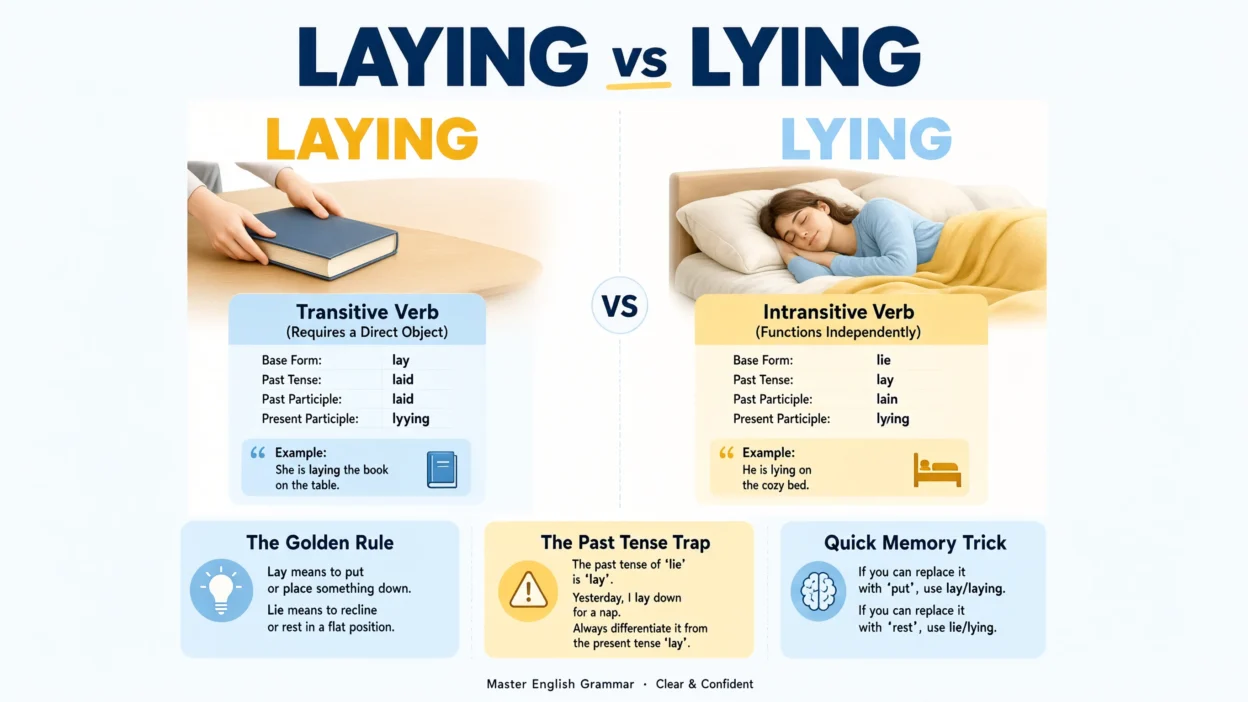
The main difference between laying and lying is that laying means putting or placing something somewhere, while lying means resting or being in a horizontal position. Laying usually requires a direct object, such as laying a book on a table.
Lying does not require an object, such as lying on a bed. Both words are forms of the verbs lay and lie, but their meanings and uses are different. Understanding these differences will help you avoid common grammar mistakes and write more clearly in everyday conversations, school assignments, emails, and professional writing.
Quick Answer: Laying vs Lying
Laying means placing something down or putting it in a particular position. It is the present participle of lay. Lying means resting or being in a horizontal position. It is the present participle of lie. For example, “She is laying the baby in the crib” and “The baby is lying in the crib.”
Why Do People Confuse Laying and Lying?
People often confuse laying and lying because both words describe actions or positions involving something being down. They also have similar spellings and pronunciations.
Another reason is that their base verbs have different grammatical patterns:
- Lay: Requires a direct object. Someone lays something down.
- Lie: Does not require a direct object. Someone or something lies down.
The confusion becomes even greater because the past tense of lie (meaning to rest) is lay. This makes the relationship between these words slightly tricky.
For example:
- Present: I lie on the sofa.
- Past: I lay on the sofa.
- Present continuous: I am lying on the sofa.
- Present continuous: I am laying a blanket on the sofa.
Understanding the base verbs makes the difference much easier to remember.
What Does Laying Mean?
Laying is the present participle of the verb lay, which means to put, place, or position something somewhere.
It describes an action in which a person or thing places something down. Because lay is a transitive verb, it normally needs a direct object.
Simple meaning: Putting something down or placing something in a particular position.
Examples of Laying in Sentences
- She is laying the clothes on the bed.
- He is laying bricks to build a wall.
- The teacher is laying books on the desk.
- I am laying the baby gently in the crib.
- They are laying a new carpet in the living room.
When Is Laying Used?
Use laying when someone is actively placing something somewhere.
Common situations include:
- Placing objects: She is laying her phone on the table.
- Preparing something: They are laying the foundation for a new building.
- Putting someone down: He is laying the child in bed.
- Arranging items: She is laying the plates on the dining table.
- Producing eggs: The hen is laying eggs.
Remember that laying always relates to the action of putting or producing something, depending on the context.
What Does Lying Mean?
Lying is the present participle of the verb lie. When lie means to rest, it describes someone or something being in a horizontal position or remaining in a particular place.
Unlike laying, lying does not require a direct object.
Simple meaning: Resting, reclining, or being in a horizontal position.
Examples of Lying in Sentences
- She is lying on the sofa.
- The dog is lying under the table.
- I am lying in bed because I feel tired.
- He is lying on the grass and watching the clouds.
- The keys are lying on the kitchen counter.
When Is Lying Used?
Use lying when someone or something is resting or positioned somewhere without actively placing another object.
Common situations include:
- Resting: I am lying on the bed.
- Relaxing: She is lying on the beach.
- Describing position: The book is lying on the floor.
- Describing location: The village is lying near the river.
- Describing an object: Your phone is lying beside the laptop.
Lying can also mean telling something untrue, but that is a different meaning of the same verb.
For example: “He is lying about his age.”
Laying vs Lying: Comparison Table
The following table highlights the main differences between laying and lying.
| Feature | Laying | Lying |
| Base verb | Lay | Lie |
| Meaning | Putting something down | Resting or reclining |
| Grammar | Transitive verb | Intransitive verb |
| Direct object | Usually required | Not required |
| Present participle | Laying | Lying |
| Past tense | Laid | Lay |
| Past participle | Laid | Lain |
| Example | She is laying a blanket down. | She is lying on the blanket. |
Important: The past tense of lie (to rest) is lay, while the past tense of lay (to place something) is laid.
When Should You Use Laying or Lying?
Choosing between laying and lying becomes easier when you identify the action in your sentence.
Use Laying When Something Is Being Placed
Choose laying when a person is putting something somewhere.
Examples:
- I am laying my jacket on the chair.
- She is laying the baby in the crib.
- They are laying tiles in the kitchen.
- He is laying the documents on the desk.
Ask yourself: Is someone placing something down?
If the answer is yes, laying is probably correct.
Use Lying When Someone or Something Is Resting
Choose lying when a person or object is already resting or positioned somewhere.
Examples:
- I am lying on the couch.
- The cat is lying near the window.
- She is lying on the beach.
- The papers are lying on the floor.
Ask yourself: Is someone or something resting or remaining in a position?
If the answer is yes, lying is probably correct.
15 Examples of Laying vs Lying in Sentences
Here are practical examples to help you understand how both words work in everyday English.
Examples of Laying
- She is laying her phone on the kitchen counter.
- The workers are laying bricks for the new house.
- I am laying my clothes out for tomorrow.
- He is laying the baby carefully in the crib.
- The gardener is laying fresh grass in the backyard.
- My mother is laying the dinner plates on the table.
- The hen is laying eggs every morning.
- They are laying the foundation for a new school.
Examples of Lying
- The child is lying on the bedroom floor.
- I am lying in bed and reading a book.
- The dog is lying beside its owner.
- She is lying on the grass under a tree.
- Your notebook is lying on the desk.
- He is lying on the sofa after a long day.
- The cat is lying in the sunshine.
Compare Both Words in Similar Situations
These paired examples show how changing one word changes the meaning.
- Laying: She is laying the blanket on the bed.
- Lying: She is lying on the blanket.
- Laying: He is laying the baby in the crib.
- Lying: The baby is lying in the crib.
- Laying: I am laying my books on the desk.
- Lying: My books are lying on the desk.
Common Mistakes When Using Laying and Lying
Even fluent English speakers sometimes confuse these words. Here are some common mistakes and their corrections.
1. Using Laying Without an Object
Incorrect: I am laying on the sofa.
Correct: I am lying on the sofa.
Why? The sentence describes resting, not placing something down.
2. Using Lying When Placing Something
Incorrect: She is lying the baby in bed.
Correct: She is laying the baby in bed.
Why? She is actively putting the baby in a particular position.
3. Confusing Lay and Lie in the Past Tense
Incorrect: Yesterday, I laid on the couch.
Correct: Yesterday, I lay on the couch.
Why? The past tense of lie (to rest) is lay.
4. Using Layed Instead of Laid
Incorrect: He is laying the books where he layed yesterday.
Correct: He is laying the books where he laid them yesterday.
Why? The correct past tense and past participle of lay are laid, not layed.
5. Confusing Lying With Telling a Lie
Incorrect: He is lying the truth.
Correct: He is lying about the truth.
Why? When lying means telling something untrue, it does not mean physically resting or placing something.
Easy Memory Trick: How to Remember Laying vs Lying
A simple memory trick can help you choose the correct word without memorizing complicated grammar rules.
Remember:
- Laying = Placing something.
- Lying = Resting yourself.
Think of these two sentences:
- I am laying my phone on the table.
- I am lying on the sofa.
Here is another useful trick:
If you can ask “What am I laying?” and give an answer, you are probably using laying correctly.
For example:
“What am I laying?” → My book.
However, if you are describing where you are resting, use lying.
“What am I lying?” is not the right question. Instead, ask “Where am I lying?”
This simple distinction will help you remember the difference.
Laying vs Lying in American and British English
There is no major difference between American and British English when it comes to the basic meanings and grammatical rules of laying and lying.
Both varieties use:
- Laying for placing something down.
- Lying for resting or being in a horizontal position.
Examples in both varieties:
- American English: She is lying on the couch.
- British English: She is lying on the sofa.
- American English: He is laying the books on the table.
- British English: He is laying the books on the table.
The main differences may involve vocabulary choices, such as couch and sofa, rather than the spelling or grammar of these verbs.
Similar Words Related to Laying and Lying
Understanding related words can make the difference even clearer.
| Word | Meaning | Example |
| Lay | To put something down | Lay the book here. |
| Lie | To rest or recline | Lie on the bed. |
| Laid | Past tense of lay | She laid the keys down. |
| Lain | Past participle of lie | He has lain there for hours. |
| Lying | Resting or telling something untrue | She is lying on the floor. |
| Laying | Placing or producing something | He is laying the tiles. |
| Reclining | Leaning or resting backward | He is reclining on the sofa. |
| Placing | Putting something somewhere | She is placing the cup on the table. |
These related words help you understand how different forms of lay and lie work in English sentences.
FAQs:
1. Is It Laying or Lying on the Bed?
The correct phrase is lying on the bed when someone is resting on it. For example, “I am lying on the bed.” Use laying when someone is putting something on the bed, such as “I am laying my clothes on the bed.”
2. What Is the Main Difference Between Laying and Lying?
Laying means putting or placing something down, while lying means resting or being in a horizontal position. Laying normally requires a direct object, but lying does not need one.
3. Is Laying Down Correct Grammar?
Yes, laying down is grammatically correct when someone is placing something down. For example, “She is laying down the books.” However, when describing your own resting position, say “I am lying down.”
4. Is It Laying in Bed or Lying in Bed?
The correct phrase is lying in bed when you are resting or sleeping. For example, “He is lying in bed because he is tired.” Laying in bed would only make sense if you were placing something or someone in the bed.
5. What Is the Past Tense of Lying?
The past tense of lie (meaning to rest) is lay. For example, “Yesterday, I lay on the sofa for two hours.” Its past participle is lain, as in “I have lain here all morning.”
6. Is It Laying or Lying on the Floor?
Use lying on the floor when someone is resting on the floor. For example, “The dog is lying on the floor.” Use laying when someone is putting something on the floor, such as “She is laying a carpet on the floor.”
7. Is Laying Eggs Correct?
Yes, laying eggs is correct. The verb lay also means to produce or deposit eggs. For example, “The hen is laying eggs in the nesting box.” In this context, laying does not mean resting.
Remember This: Laying vs Lying
Keep these simple rules in mind whenever you are unsure which word to use:
- Laying: Putting or placing something somewhere.
- Lying: Resting or being in a horizontal position.
- Lay: Present-tense verb that requires an object.
- Lie: Present-tense verb that describes resting without a direct object.
- Laid: Past tense of lay.
- Lay: Past tense of lie.
- Lain: Past participle of lie.
The easiest way to remember the difference is that you lay something, but you lie down yourself.
Conclusion
Understanding the difference between laying and lying is important for writing grammatically correct English. Although these words look similar, they describe different actions. Laying means placing something down, while lying means resting or remaining in a horizontal position. Remember that laying usually needs a direct object, whereas lying does not.
With a little practice, you can use both words confidently in everyday conversations and written communication. Whenever you feel confused, ask yourself if someone is placing something or simply resting. This small grammar trick will help you choose the correct word and avoid common mistakes.

I’m James Parker, Administrator at SynonymsHive. I oversee content quality, improve user experience, and ensure reliable synonym resources. My passion is making language learning simple, accurate, and accessible for everyone.