Have you ever wondered if the correct expression is per se or per say? These two phrases sound almost identical when spoken, so it is easy to mix them up in writing. However, only one is the standard expression. If you have searched for per se vs per say, you are probably trying to understand their meanings, differences, and correct usage.
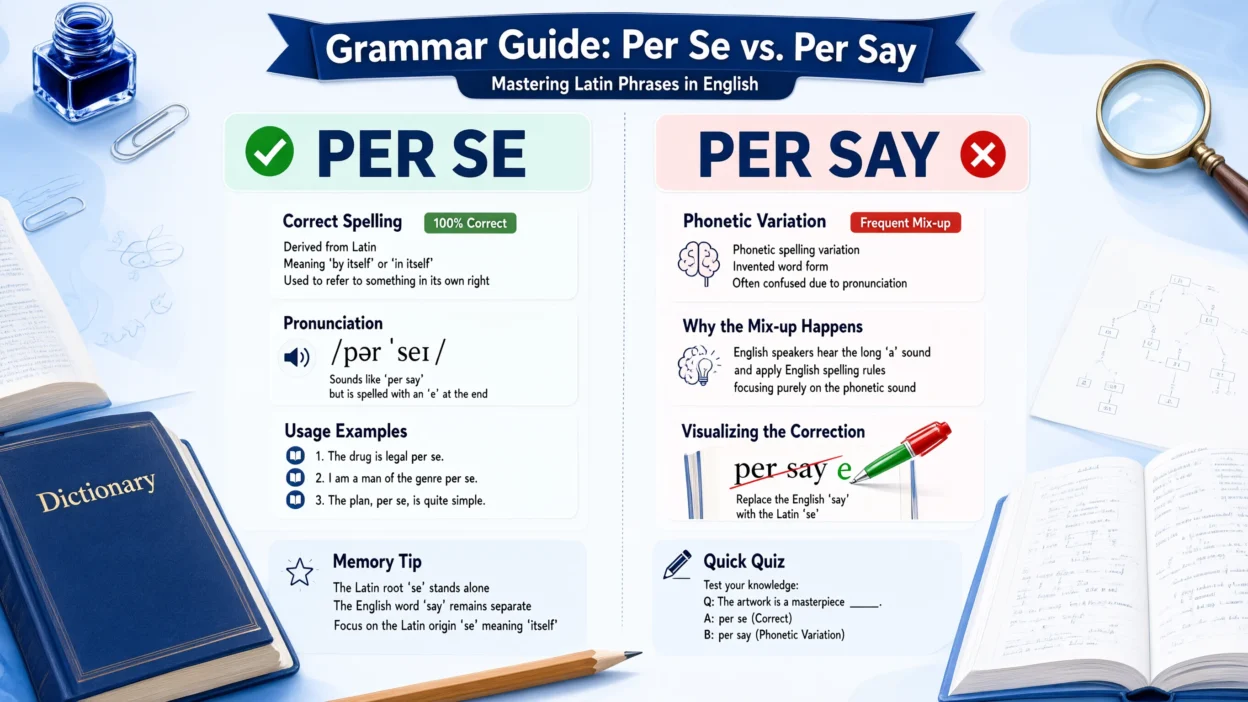
The correct expression is per se, not per say. Per se is a Latin phrase that means by itself, in itself, or intrinsically. It is commonly used to explain that something is being considered independently rather than in relation to something else.
For example, “The idea is not bad per se, but it needs improvement.” Although per say is a common spelling mistake, it is not the correct alternative when you want to use this expression. Understanding the difference will help you avoid spelling errors and communicate more clearly in everyday conversations, academic writing, and professional communication.
Quick Answer: Per Se vs Per Say
Per se is the correct expression. It is a Latin phrase meaning “by itself” or “in itself.” Per say is an incorrect spelling that results from hearing the phrase rather than recognizing its Latin origin. Use per se when discussing something independently or in its own nature. For example: “The rule is not unfair per se.”
Why Do People Confuse Per Se and Per Say?
People often confuse per se and per say because both expressions have almost identical pronunciations.
When spoken aloud, per se sounds like “per say.” This makes it difficult for beginners, students, and even experienced writers to recognize the correct spelling.
There are three main reasons behind this confusion:
- Similar pronunciation: Both sound like “per say” when spoken in English.
- Unfamiliar Latin origin: Many people do not realize that per se comes from Latin.
- Incorrect spelling habits: Writers sometimes spell words according to how they hear them instead of checking their original spelling.
The important thing to remember is that pronunciation does not always tell you how a word or expression should be written.
What Does Per Se Mean?
Per se is a Latin expression meaning “by itself,” “in itself,” or “intrinsically.”
It is used when someone wants to discuss something in isolation, without considering other factors or circumstances.
The expression is especially common in academic writing, legal discussions, business communication, and everyday English.
Examples of Per Se in Sentences
- The movie was not bad per se, but the ending was disappointing.
- Money is not a problem per se; managing it is the real challenge.
- The decision was not wrong per se, but it could have been better.
- There is nothing wrong with working from home per se.
- The idea is interesting per se, although it needs more research.
In each example, per se helps explain that something is being considered on its own rather than as part of a larger situation.
Is Per Se Formal or Informal?
Per se is generally considered a slightly formal or educated expression, but it is also used in everyday conversations.
You can use it in:
- Academic essays and assignments.
- Professional emails and reports.
- Legal and philosophical discussions.
- Everyday conversations.
- Articles and opinion pieces.
However, simpler alternatives such as “by itself” and “in itself” may sound more natural in beginner-friendly writing.
What Does Per Say Mean?
Per say is not the standard spelling of the expression per se. It is a common misspelling caused by the way the Latin phrase sounds when spoken.
People sometimes write per say because they hear the final sound of se as “say.”
For example:
Incorrect
“The restaurant is not expensive per say.”
Correct
“The restaurant is not expensive per se.”
The correct spelling is always per se when you mean “by itself” or “in itself.
Can Per Say Ever Be Correct?
Per say is not a recognized standard alternative to per se.
However, the individual words “per” and “say” can appear next to each other in an ordinary sentence when they have separate grammatical functions.
For example:
- The instructions say to pay $10 per day.
- You can say whatever you want per the agreement.
These examples do not use the expression per se. They simply contain the separate words per and say.
Per Se vs Per Say: Comparison Table
| Feature | Per Se | Per Say |
| Correct spelling | Yes | No, as the expression |
| Origin | Latin | Incorrect spelling |
| Meaning | By itself; in itself | No established meaning |
| Pronunciation | Per say | Usually pronounced the same |
| Usage | Formal and everyday English | Common spelling mistake |
| Example | It is not harmful per se. | Incorrect usage |
The main difference is simple: per se is the correct expression, while per say is a spelling mistake when used with the same intended meaning.
When Should You Use Per Se or Per Say?
Choosing between these expressions is easy once you understand their meanings.
Use Per Se When You Mean “By Itself”
Use per se when you want to describe something independently or without considering other circumstances.
Examples:
- The plan is not complicated per se.
- Social media is not harmful per se.
- The job is not difficult per se, but it requires patience.
Do Not Use Per Say as a Replacement
Avoid writing per say when you mean “in itself.”
Examples:
- Incorrect: The problem is not serious per say.
- Correct: The problem is not serious per se.
- Incorrect: I do not dislike the idea per say.
- Correct: I do not dislike the idea per se.
If you are unsure, replace the expression with “by itself.” If the sentence still makes sense, per se is probably the expression you need.
15 Examples of Per Se vs Per Say in Sentences
Here are practical examples to help you understand the correct spelling and usage.
| Incorrect Sentence | Correct Sentence |
| The idea is not bad per say. | The idea is not bad per se. |
| Money is not everything per say. | Money is not everything per se. |
| The job is not difficult per say. | The job is not difficult per se. |
| The movie was not boring per say. | The movie was not boring per se. |
| Technology is not harmful per say. | Technology is not harmful per se. |
| The problem is not serious per say. | The problem is not serious per se. |
| The decision was not wrong per say. | The decision was not wrong per se. |
| Exercise is not painful per say. | Exercise is not painful per se. |
| The subject is not complicated per say. | The subject is not complicated per se. |
| The rule is not unfair per say. | The rule is not unfair per se. |
| The book is not expensive per say. | The book is not expensive per se. |
| The situation is not unusual per say. | The situation is not unusual per se. |
| The suggestion is not unreasonable per say. | The suggestion is not unreasonable per se. |
| The change is not negative per say. | The change is not negative per se. |
| The experience was not unpleasant per say. | The experience was not unpleasant per se. |
More Examples of Per Se in Everyday English
Here are five additional examples showing how per se works naturally in different situations.
- Education: Mathematics is not difficult per se; it just requires regular practice.
- Business: Competition is not harmful per se because it can encourage innovation.
- Entertainment: The show was not disappointing per se, but I expected more.
- Technology: Artificial intelligence is not dangerous per se; its effects depend on how people use it.
- Relationships: Being alone is not a problem per se, but loneliness can sometimes be difficult.
Common Mistakes When Using Per Se and Per Say
Even though the difference is straightforward, people make several mistakes when writing this expression.
1. Writing Per Say Instead of Per Se
This is the most common mistake.
Incorrect: The idea is not wrong per say.
Correct: The idea is not wrong per se.
2. Thinking Per Se Is an English Phrase
Per se comes from Latin. It has become part of modern English vocabulary, but its spelling remains based on its Latin origin.
3. Using Per Se When It Is Unnecessary
Sometimes writers use per se when simpler wording would make their sentences easier to understand.
For example:
- Wordy: The task is not difficult per se.
- Simpler: The task is not difficult by itself.
Both sentences can communicate the same idea.
4. Assuming Per Se and Per Say Have Different Meanings
They are not two interchangeable expressions with separate meanings. Per say is generally just a misspelling of per se.
What Is an Easy Memory Trick for Per Se vs Per Say?
The easiest way to remember the correct spelling is to think about its Latin origin.
Memory trick: Per Se = By Itself.
Remember these three points:
- Per se has two words.
- The second word is spelled S-E, not S-A-Y.
- It means “in itself” or “by itself.”
You can also remember this simple sentence:
“Something can be good per se, meaning good in itself.”
Whenever you feel tempted to write per say, remind yourself that the correct expression ends with the letters S-E.
Per Se vs Per Say in American and British English
There is no spelling difference between American and British English when it comes to per se.
Both varieties use the same Latin expression with the same spelling and meaning.
| English Variety | Correct Expression | Incorrect Expression |
| American English | Per se | Per say |
| British English | Per se | Per say |
| Australian English | Per se | Per say |
| Canadian English | Per se | Per say |
The pronunciation may vary slightly depending on a speaker’s accent, but the written form remains unchanged.
Whether you are writing an American school assignment, a British academic essay, or an international business email, always use per se.
Similar Words and Expressions to Per Se
If you want to avoid repeating per se in your writing, you can use several alternatives depending on the context.
| Alternative | Simple Meaning | Example |
| In itself | Considered alone | The idea is not bad in itself. |
| By itself | Without anything else | The tool works by itself. |
| Intrinsically | By its essential nature | The activity is not intrinsically harmful. |
| Essentially | Basically or fundamentally | The problem is essentially the same. |
| Independently | Separately or on its own | Each case is considered independently. |
| Inherently | Naturally or as an essential quality | The subject is not inherently difficult. |
| As such | In that particular capacity | The rule is not unfair as such. |
Remember that these expressions are not perfect replacements in every sentence. Choose the one that best communicates your intended meaning.
Final Verdict: Per Se or Per Say?
The correct expression is per se.
It is a Latin phrase meaning “by itself,” “in itself,” or “intrinsically.” It is used in modern English to discuss something independently of other factors.
Per say is an incorrect spelling when used as a substitute for per se. Although both sound almost identical, only per se is the accepted spelling of the expression.
For clear and accurate writing, always choose per se.
FAQs:
1. Is It Per Se or Per Say?
The correct expression is per se. It is a Latin phrase meaning “by itself” or “in itself.” Per say is a common misspelling caused by the similar pronunciation of the two expressions.
2. What Does Per Se Mean in Simple English?
Per se means “by itself,” “in itself,” or “considered alone.” It is used when discussing something independently of other factors. For example, “The plan is not bad per se.”
3. Is Per Say Ever Correct?
Per say is not correct when you intend to use the Latin expression per se. However, the words per and say can appear next to each other in ordinary sentences with separate meanings.
4. Why Do People Spell Per Se as Per Say?
People often spell per se as per say because the expression sounds like “per say” when spoken. Since many people are unfamiliar with its Latin origin, they write it according to its pronunciation.
5. Is Per Se Formal English?
Yes, per se is generally considered a slightly formal expression, but it is also common in everyday English. It is appropriate for academic writing, professional communication, and casual conversations.
6. How Do You Pronounce Per Se?
Per se is commonly pronounced “per SAY.” The second word sounds like the English word “say,” but its correct spelling is S-E.
7. Can I Use Per Se in an Academic Essay?
Yes. Per se is appropriate in academic essays when you want to explain that something is being considered independently. However, avoid overusing it, and consider alternatives such as “in itself” when they make your writing clearer.
Remember This
- Per se: Correct spelling.
- Per say: Incorrect spelling when used as the same expression.
- Meaning: By itself, in itself, or intrinsically.
- Origin: Latin.
- Pronunciation: Per SAY.
- Usage: Academic, professional, and everyday English.
The easiest rule is to remember that per se is always the correct choice when you mean “by itself.
Conclusion
Understanding the difference between per se and per say is simple once you know that the correct expression comes from Latin. Although both sound almost identical, their written forms are not interchangeable. Per se means “by itself” or “in itself,” while per say is a common spelling mistake.
The next time you use this expression in an email, essay, article, or everyday conversation, remember to write per se. A small spelling detail can make your writing clearer, more accurate, and more professional.

I’m James Parker, Administrator at SynonymsHive. I oversee content quality, improve user experience, and ensure reliable synonym resources. My passion is making language learning simple, accurate, and accessible for everyone.