The English words whos and whose look almost identical, but they do not have the same meaning or grammatical purpose. Knowing the difference can help you write clearer sentences, avoid common grammar mistakes, and communicate more confidently. Although both words are connected to the word who, only one is correct in standard English.
The correct spelling depends on what you want to say. Whose is a possessive word used to ask who owns something or to show that something belongs to a person. On the other hand, whos is not a standard English word.
It is usually an incorrect spelling of who’s, which is a contraction of who is or who has. Understanding these small differences will make it easier to choose the right word in questions, conversations, emails, and academic writing.
Quick Answer: Whos vs Whose
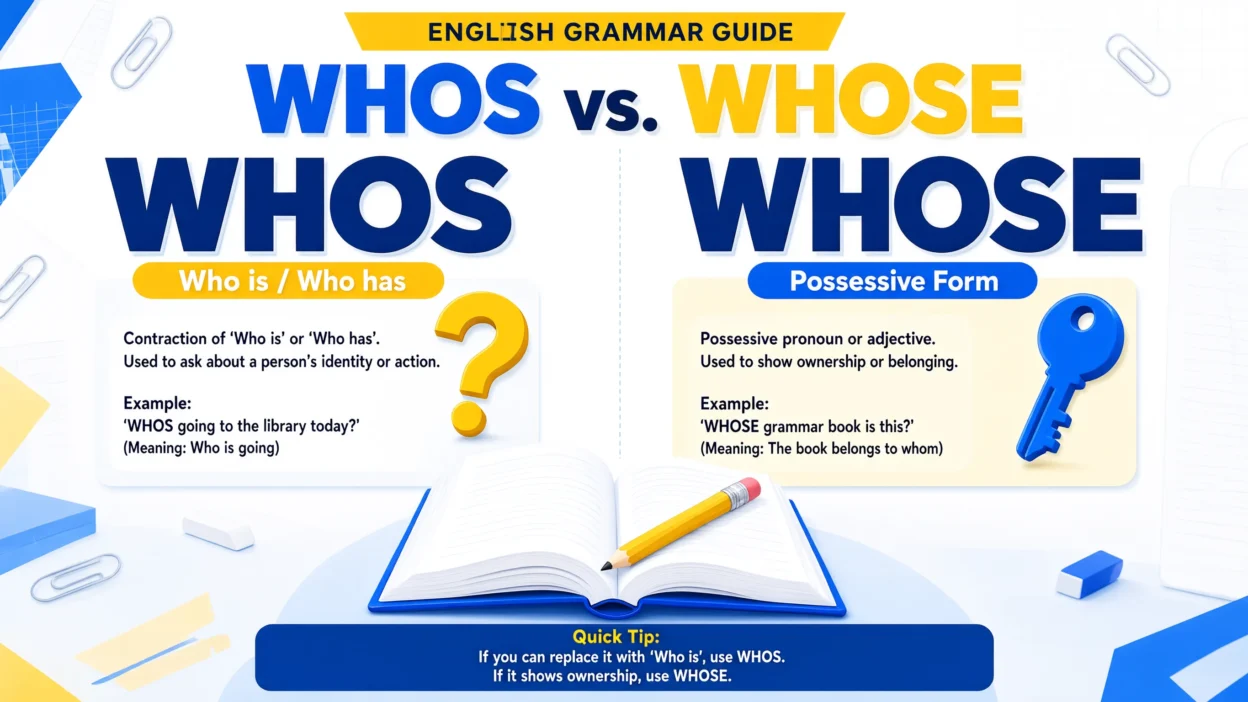
Whose is the correct possessive word used to ask who owns something or to indicate possession. Whos is not a standard English spelling. People often confuse it with who’s, which means who is or who has. Remember: whose shows ownership, who’s is a contraction, and whos is incorrect in standard writing.
Why Do People Confuse Whos and Whose?
People commonly confuse these words because they sound very similar when spoken. The apostrophe in who’s also makes the difference easy to overlook when writing quickly.
Another reason is that English uses apostrophes differently depending on the word.
For example:
- Whose: Shows ownership or possession.
- Who’s: Short for who is or who has.
- Whos: An incorrect spelling in standard English.
The confusion becomes easier to understand when you remember that an apostrophe does not always indicate ownership. In this case, who’s is a contraction, while whose is possessive.
First Word: Whos
Whos is not a standard English word. It is generally considered a spelling mistake when someone intends to write whose or who’s.
People sometimes leave out the apostrophe in who’s or mistakenly replace whose with whos. However, neither use is correct in standard formal writing.
Meaning of Whos
The word whos has no accepted independent meaning in standard English grammar.
It is usually a mistaken version of one of these two words:
- Who’s: A contraction of who is or who has.
- Whose: A possessive word that indicates ownership or association.
Incorrect Examples of Whos
Here are some examples showing how whos is incorrectly used:
1. Whos coming to the party? (Incorrect)
- Correct: Who’s coming to the party?
2. Whos bag is this? (Incorrect)
- Correct: Whose bag is this?
3. Whos been using my laptop? (Incorrect)
- Correct: Who’s been using my laptop?
4. Whos responsible for this project? (Incorrect)
- Correct: Who’s responsible for this project?
5. Whos car is parked outside? (Incorrect)
- Correct: Whose car is parked outside?
Remember: Avoid using whos in standard English writing. Choose who’s or whose according to your intended meaning.
Second Word: Whose
Whose is a possessive form of who. It is used to ask which person owns something or to show a relationship between a person and something associated with them.
It can appear in direct questions, indirect questions, and relative clauses.
Meaning of Whose
Whose means belonging to whom or associated with which person.
It helps identify the owner of an object, a person, or something connected to someone.
For example:
- Whose phone is ringing?
- Whose shoes are these?
- I know a student whose father is a teacher.
- She is the writer whose book won an award.
In each example, whose indicates ownership or a relationship.
How to Use Whose in a Sentence
Use whose when you want to ask about ownership or describe something belonging to a person.
1. To ask about ownership
- Whose jacket is lying on the chair?
- Whose keys are these?
- Whose house are we visiting?
2. To show possession in a sentence
- The boy whose bicycle was stolen reported it.
- I met a woman whose daughter studies medicine.
- She is the artist whose paintings are famous.
3. To describe a relationship
- He is the teacher whose lessons I enjoy.
- We visited a family whose home was beautiful.
- I know someone whose brother works abroad.
Whos vs Whose: Comparison Table
| Feature | Whos | Whose |
| Correct spelling | No | Yes |
| Grammatical role | None in standard English | Possessive determiner or pronoun |
| Meaning | No standard meaning | Belonging to whom |
| Shows ownership | No | Yes |
| Used in questions | Incorrect | Yes |
| Used in formal writing | No | Yes |
| Example | Whos bag? | Whose bag? |
Important: Do not confuse whos with who’s. Who’s is a valid contraction, while whose is the possessive form.
When Should You Use Each Word?
Choosing between whos and whose is simple once you understand the intended meaning.
When to Use Whos
You should not use whos in standard English writing. If you are trying to write a question or sentence, check whether you actually mean who’s or whose.
For example:
- Incorrect: Whos your best friend?
- Correct: Who’s your best friend?
Here, who’s means who is.
When to Use Whose
Use whose when asking about ownership or showing that something belongs to someone.
Examples:
- Whose notebook is this?
- Whose idea was it?
- The girl whose mother is a doctor won the competition.
A useful way to check is to ask yourself whether the sentence is about ownership or association. If it is, whose is usually the right choice.
15 Examples of Whos vs Whose in Sentences
The following examples show how to recognize the correct spelling in everyday English.
| Incorrect or intended form | Correct sentence |
| Whos your teacher? | Who’s your teacher? |
| Whos bag is this? | Whose bag is this? |
| Whos at the door? | Who’s at the door? |
| Whos shoes are these? | Whose shoes are these? |
| Whos coming tomorrow? | Who’s coming tomorrow? |
| Whos phone is ringing? | Whose phone is ringing? |
| Whos been here? | Who’s been here? |
| Whos book did you borrow? | Whose book did you borrow? |
| Whos ready for lunch? | Who’s ready for lunch? |
| Whos car is that? | Whose car is that? |
More Examples Using Whose
- Whose responsibility is it to clean the classroom?
- Do you know whose birthday is today?
- The woman whose son won the race was very happy.
- Whose handwriting is on this paper?
- We met a writer whose stories inspire young readers.
These examples demonstrate that whose can be used in both questions and statements.
Common Mistakes When Using Whos and Whose
Even experienced English writers sometimes make mistakes with these words. Here are some common errors and how to correct them.
1. Using Whos Instead of Whose
Incorrect: Whos laptop is this?
Correct: Whose laptop is this?
Use whose because the sentence asks who owns the laptop.
2. Using Whose Instead of Who’s
Incorrect: Whose coming to dinner?
Correct: Who’s coming to dinner?
The sentence means who is coming, so the contraction who’s is needed.
3. Thinking an Apostrophe Always Shows Ownership
Incorrect: Who’s jacket is this?
Correct: Whose jacket is this?
An apostrophe in who’s indicates missing letters, not possession.
4. Forgetting the Apostrophe in Who’s
Incorrect: Whos your favorite singer?
Correct: Who’s your favorite singer?
When you mean who is, include the apostrophe.
5. Confusing Possessive Words
Some writers understand that whose shows ownership but mistakenly use who’s when describing possession.
Incorrect: The student who’s notebook was missing looked worried.
Correct: The student whose notebook was missing looked worried.
Easy Memory Trick to Remember Whos vs Whose
Here is a simple trick to remember the difference:
Whose = Ownership
Think of the question: “Whose book is this?” You are asking who owns the book.
Who’s = Who is or Who has
Try replacing who’s with who is or who has. If the sentence still makes sense, who’s is correct.
Whos = Incorrect
Remember that whos without an apostrophe is not the standard spelling of either word.
Quick Memory Examples
- Whose pen is this? (Ownership)
- Who’s your friend? (Who is)
- Who’s finished the assignment? (Who has)
- Whos your friend? (Incorrect)
American vs British English: Whos vs Whose
There is no spelling difference between American and British English when it comes to whose and who’s.
Both varieties follow the same standard grammar rules:
- American English: Whose bag is this?
- British English: Whose bag is this?
- American English: Who’s coming to the meeting?
- British English: Who’s coming to the meeting?
In both forms of English, whos is not an accepted standard spelling.
Therefore, you do not need to learn separate American and British rules for these words.
Similar Words: Whos, Whose, and Who’s
Understanding the relationship between these three spellings will help you avoid confusion.
| Word | Meaning | Example |
| Whos | Incorrect spelling | Whos calling? |
| Whose | Possessive form | Whose phone is this? |
| Who’s | Who is or who has | Who’s calling? |
Whose vs Who’s
- Whose asks about ownership.
- Who’s means who is or who has.
Examples:
- Whose shoes are these?
- Who’s wearing those shoes?
Who’s vs Whos
- Who’s is grammatically correct when used as a contraction.
- Whos is an incorrect standard spelling.
Examples:
- Who’s your favorite author?
- Whos your favorite author? (Incorrect)
Whose vs Whom
These words also have different grammatical purposes.
- Whose asks about ownership.
- Whom refers to the person receiving an action or following a preposition.
Examples:
- Whose bag did you find?
- Whom did you invite?
Final Verdict: Whos vs Whose
The main difference between whos and whose is that whose is a correct English word used to indicate possession, while whos is an incorrect spelling in standard English.
However, there is another important word to remember: who’s. It is a contraction of who is or who has.
Use whose when asking who owns something, who’s when you mean who is or who has, and avoid whos in standard writing.
FAQs:
1. Is whos or whose correct?
Whose is correct when asking about ownership or showing possession. Whos is not a standard English word. If you mean who is or who has, use who’s with an apostrophe.
2. What is the difference between whos and whose?
Whos is an incorrect spelling, while whose is a possessive word. Whose is used to ask who owns something or to describe a relationship with a person.
Example: Whose phone is ringing?
3. Is whos a real word?
No, whos is not recognized as a standard English word. It is generally a spelling mistake for who’s or whose. Always use the correct form according to the meaning of your sentence.
4. Is whose the same as who’s?
No, these words have different grammatical functions. Whose shows possession, while who’s is a contraction of who is or who has.
Examples:
- Whose book is this?
- Who’s reading the book?
5. How do you remember when to use whose?
Remember that whose is connected to ownership. If you are asking who something belongs to, use whose.
Example: Whose jacket is hanging by the door?
6. Can whose be used for people and things?
Yes. Whose can refer to people and, in certain contexts, things or organizations.
Examples:
- The girl whose father is a doctor is my friend.
- The company whose products we use has expanded.
7. Why does who’s have an apostrophe?
The apostrophe in who’s shows that letters have been omitted. It combines who with is or has.
Examples:
- Who’s there? (Who is there?)
- Who’s finished? (Who has finished?)
Remember This
Keep these three simple rules in mind:
- Whose: Use it to show ownership or association.
- Who’s: Use it as a short form of who is or who has.
- Whos: Avoid it because it is not a standard English spelling.
If you remember these differences, you can easily choose the correct word in everyday conversations, school assignments, professional emails, and other forms of writing.
Conclusion
Understanding the difference between whos and whose is important for writing accurate and grammatically correct English. Although these spellings look similar, they have different purposes. Whose is the correct possessive word, while whos is generally an incorrect spelling. The word who’s is also correct, but it works as a contraction of who is or who has.
The easiest way to avoid mistakes is to check the meaning of your sentence before choosing a spelling. If you are asking about ownership, use whose. If you mean who is or who has, use who’s. With a little practice, you will be able to use these words correctly and confidently in your everyday writing.

I’m Nathan Collins, a language enthusiast passionate about exploring synonyms and improving everyday writing. I create clear, accurate, and helpful content that helps readers expand vocabulary and communicate with confidence.